Category: Lifestyle

  • Govt to send one million Pakistanis abroad for employment

    Govt to send one million Pakistanis abroad for employment

    The Government of Pakistan will send 1 million citizens abroad for employment, Tikka Sani has reported for Samaa. Federal Minister for Overseas Pakistanis and Human Resource Development, Sajid Hussain Turi, while talking to Samaa said that the ministry is working on signing work visa agreements with fifty countries including Germany.

    He continued by adding that Saudi authorities are coming to Pakistan soon to issue visas and citizens who pass technical training tests will be able to get the visa.

    The minister further said that Japan has also opened visas for Pakistani workers while South Korea has a demand for 10,000 skilled workers from Pakistan.

    The Federal Minister for Overseas Pakistanis said that 27,000 blocked passports of overseas Pakistanis have also been restored.

  • Historian gets mistaken for actor Tom Holland, gets swamped by messages from Bollywood fans

    Ever thought getting mistaken for a celebrity would be a life changing adventure? Turns out reality is far more bizarre than fiction.

    At the launch of the Nita Mukesh Ambani Cultural Center, or as we call it ‘Ambani Gala’, celebrities from all over the world showed up dressed to the nines and had the time of their life. Present among them were Hollywood model Gigi Hadid, and actors Zendaya and Tom Holland rubbing shoulders with the who’s who of Bollywood.

    Holland, renowned for playing Spiderman, only has one social media account on Instagram. However, as photos of the actor posing with Indian celebrities showed up online, Bollywood fans didn’t realise that the Marvel superstar is not on Twitter.

    They tagged another Tom Holland in their tweets, a historian from London.

    The case of mistaken identity later kickstarted a hilarious sequence of Bollywood fans spamming Holland with pictures of an event he definitely did not attend.

    Twitter users found this mistake extremely funny.

    I mean who wouldn’t want to be mistaken for a Marvel star?

  • Karachi teenage girl allegedly marries her kidnapper

    Karachi teenage girl allegedly marries her kidnapper

    A teenage girl who had been reported missing from Karachi has allegedly married her kidnapper in Lahore, according to police, Dawn has reported.

    The girl’s family had filed a First Information Report (FIR) under Section 365-B of PPC while the police had conducted raids in Peshawar and Lahore to find her.


    The police have claimed that the girl married the kidnapper with her consent. The family had named Abdullah in the FIR, and according to Korangi-SSP Sajid Amir Sadozai, the girl’s marriage documents are being verified.


    The girl had gone missing on February 13. The case is currently under investigation, and further details are yet to be revealed.

  • The high cost of not automating healthcare records can be death

    The high cost of not automating healthcare records can be death

    Shafiq* is a middle-aged Pakistani man, working as a driver for a household in Lahore. His son has just been diagnosed with early-stage lung cancer. He finally manages to take time off to take his son to an oncologist in a government hospital. The oncologist asks for all the lab reports of the patient. Shafiq hands over a heavy file. It turns out, one of the reports has been misplaced. The doctor tells Shafiq to come back after getting his son’s lab work done again. Shafiq now has to find the money to pay for more testing and also has to plead with his boss to give him another day off. Meanwhile, his son’s condition is only getting worse.

    When a healthcare system has no proper infrastructure for medical record keeping, the result is waste and medical errors. For example, the cost of repeat lab work will either be borne by Shafiq if he goes to a private lab or by the taxpayer if he opts for a government one. Repetition of tests will also use up limited laboratory resources and delay the test results of other patients. Shafiq’s story also points out another avenue of concern: medical misdiagnoses. Generally, a primary care physician, or family doctor, ensures an individual’s health through keeping family histories, doing annual health screenings and ensuring immunisations. These doctors maintain all this information is the form of electronic medical records. Shafiq’s son had no such family doctor to track his smoking habits or note the prevalence of cancer in his family history. In fact, the first doctor he saw gave him antibiotics for what he diagnosed as a bacterial infection of the lungs.

    In a country with less than 125,000 government hospital beds for more than 200 million people, there is little room for such errors. According to the World Health Organisation (WHO), Pakistan has one of the lowest per capita current health expenditures among Eastern Mediterranean countries, second only to Afghanistan. Because of our chronic debt issues, our healthcare spending will likely remain dismal. In such an environment, technology is a relatively inexpensive tool that can be used to improve efficiencies and better population health.

    Pakistan’s larger cities are home to a select few secondary and tertiary care hospitals, which are meant to provide inpatient care, ambulatory services and specialist care. The major swathe of the country, however, does not have access to these hospitals. In rural areas, the major public health facilities are small establishments called Basic Health Units (BHUs). In the more than 5,500 BHUs across Pakistan, outpatient facilities are provided to ordinary citizens. Contrastingly, the private sector is dominated by specialist care with doctors running their own independent clinics. Here, primary care is seen as neither lucrative nor prestigious. Patients do their own guesswork at diagnosing their problems and then decide which specialist they should see.

    But be it private or public, most doctors in Pakistan are reliant on pen and paper for record keeping. Patients like Shafiq* are meant to keep these physical records safe in a folder and bring them to each appointment. According to one doctor practicing in a government-run tertiary hospital in Lahore, the only records their hospital keeps is the patient’s admission date, discharge date and what kind of operation was performed. Any blood tests, imaging or other notes go into a black hole of patient data. 

    This is all set to change in the province of Punjab. The government is in the process of completing its transition from physical registers to electronic medical records in BHUs across the province.

    Khalid Sharif is Manager MIS in the government’s Health Information and Service Delivery Unit (HISDU). His unit aids the primary and secondary health department in developing and running health dashboards, inventory management systems and mobile applications.

    “Electronic Medical Records (EMR) came about because we wanted to be able to assess our performance as a department,” he said. “Before this, we had no credible way of knowing any metrics like doctor-patient ratios or the number of daily births.”

    The process began in around 2017, when they began testing out earlier versions of EMR in select BHUs. Now, they are running the multi-module application across more than 2,500 BHUs.

    “We expect to be fully paperless in about one and a half month’s time,” he said.

    Each employee at a BHU logs in using their computerised national identity card (CNIC) number and has access to a different module of the system. When a patient comes in, they are registered using their CNIC number. The receptionist takes the patient’s vitals and adds them to their profile. Then, when the patient goes to the doctor’s office, the doctor select a diagnosis and prescribes medicine. Finally, the medicine dispenser checks off the prescription he/she is filling, which automatically updates inventory records.

    “If someone doesn’t have a CNIC we have created another option,” Sharif said. “They can use a relative’s CNIC and we can select their relationship to the CNIC holder.”

    Dr. Faiza Ahmed* has been practicing as a health officer at a BHU near Faisalabad for the last couple of years. When I visited her, they were partially using the EMR system. Out of the 150 patients that had been to the BHU that day, they had electronically registered around 90 of them.

    Most of her patients, especially women, don’t bring along CNICs. But she has made it a point to especially encourage expectant mothers to bring along their own or a relative’s CNIC so that she can track the health of mothers and babies. “This way, I can see a patient’s data even if she had her baby six months ago,” she said. “I can see if she was hypertensive or diabetic back then and how her child was doing back then.”

    Dr. Ahmed has not received instructions to go paperless and she is skeptical of the idea.

    “It’s practically impossible to register all 200 patients because of resource limitations,” she told me. “Internet speed in this area is also very slow.”

    When I asked Khalid Sharif about this, he said that they had already address this issue by creating an offline version of the software which automatically uploads the data when the internet reconnects. However, Dr Ahmed said that the offline version is not functional yet.

    Another reason why the system might feel tedious to Dr Ahmed is because they are currently running two parallel systems. The EMR system has been designed with the idea of print receipts. When the midwife sends the patient off to the doctor, they are supposed to bring their registration slip along. Similarly, the doctor is supposed to print out a prescription slip and hand it to the patient. However, Dr. Ahmed contended that the BHU cannot afford to thermally print slips for every patient. So currently they are both logging data online and writing all the information manually on pieces of paper to give to the patients.

    “I think there’s always resistance to change — everyone gets used to a certain system and doesn’t want to get out of it,” Zara Ansari, a consultant for the government, said. “As with any new data system, it takes time, but this is definitely the future.”

    Zara Ansari is a senior consultant at ACASUS, a management consultancy firm that is assisting the health department with the rollout of electronic medical records. Ansari and her team have been giving trainings to doctors to make them comfortable with the new system. They have also been analysing data for the government to monitor the level of compliance that each BHU is showing.  

    “We started off by assigning lax targets so people can be onboard with actually doing this and then progressively over time making it more strict,” she said. “As of recently, we will be monitoring to see which facilities are doing completely paperless entry.”

    There are of course caveats to this new age technology. There is not a lot of clarity around the privacy of the date being collected and how it will be kept safe. There seem to be no conversations happening around data privacy or patient confidentiality in government halls. 

    Caveats and all, Punjab is making a step forward into modern healthcare. How successful they will be is something only time can tell.

    (*Names have been changed to protect privacy)

  • Proposed French bill will require influencers to disclose filters used on their pictures

    A new law proposed by the French Finance Minister Bruno Le Maire will soon ban social media influencers from uploading photos without mentioning re-touches or filters they have added to them.

    The new law seeks to curtail cosmetic surgery, keeping in mind its ill effect on the mental health of teenagers. The law states that any new picture or video uploaded will also include the filters added to it in the caption or description, while all promotions of cosmetic surgery will be banned.

    Penalty for revoking this law could include up to two years in prison and $32,525 in fines, while the influencer responsible for breaking the law would also be banned from using social media or profiting from being an influencer.

    Speaking to a French website, Le Maire said that the law was not an attempt to restrict influencers. It was to create a system that protects them as well as consumers.

    This is not the first time France has taken strict measures to tackle the rise of inaccessible beauty standards. In 2017, the country passed a law requiring any commercial photo that has been re-touched to change the model’s body to be labeled as ‘photographie retouchĂŠe’ (retouched photograph).

  • ‘More mouths to feed than we can cope with’: Street Kitchen ‘Khana Ghar’ feeds millions of Pakistanis amid inflation

    Due the ongoing inflation crisis in Pakistan, food and petrol prices have risen astronomically, leading to many families finding it difficult to afford basic necessities like rice or flour. Writing for The Guardian, Zofeen T Ebrahim has covered the story of the street kitchen ‘Khana Ghar’ set up in Karachi’s poorest district by Parveen Saeed, who has been serving food to families for the past 22 years.

    Opening up to The Guardian, Saeed said that the kitchen has become even more busy since Ramzan began, as more families have arrived to receive one-month food rations:

    “But we can only give one bag to one family, and we need their ID cards to check that,” she said. “There are more and more mouths to feed than we can cope with.”

    Saeed, who had received the Pride of Performance award in 2021, sells salan and roti to families for only Rs 3. Before the Covid-19 lockdown, the kitchen provided meals for 6,000 people, but afterwards it rose to 7000, and now currently stands at 8,200.

    Saeed revealed that people stand in line for long hours in order to eat, because the ongoing political and economic instability has made it difficult for people to make a living:

    “These people are not beggars, they have become destitute..where are the jobs?”

    “Food prices have hit the sky. It is heartbreaking as they have waited for a couple of hours, only to leave empty-handed.”

    The newspaper also spoke to some of the regulars who visit Khana Ghar. Former construction worker Mohammad Shakeel, a father of six, suffered a head injury and broken wrists after which finding work became incredibly hard. He said the food was a ‘Godsend’ because “with a kilo of flour costing 150 rupees, we would not be able to survive the jump in food prices.”

    A widow who has been relying on Khana Ghar to feed her polio ridden daughter and toddler grandson said, “Had it not been for Parveen, we would have died from hunger.”

  • TRIGGER WARNING: Lodhran court sentences man to 25 years in prison for raping daughter

    A court in the Lodhran has sentenced a man to 25 years in prison and subjected to Rs 1,00,000 fine for torturing and raping his 15 year old daughter, as reported by Express Tribune.

    The rape case was filed by the survivor’s paternal aunt, Yasan, who revealed that she was suspicious when the father, Irshad, brought the girl to her house unconscious.

    The complainant told the police that after the girl woke up, she confessed to her aunt that her father had drugged and tortured her. When she and other witnesses approached Irshad, he confessed to the crime.

    The aunt urged the police to take strict action against the rapist.

  • Stampede for ration kills 11 in Karachi including three children

    Stampede for ration kills 11 in Karachi including three children

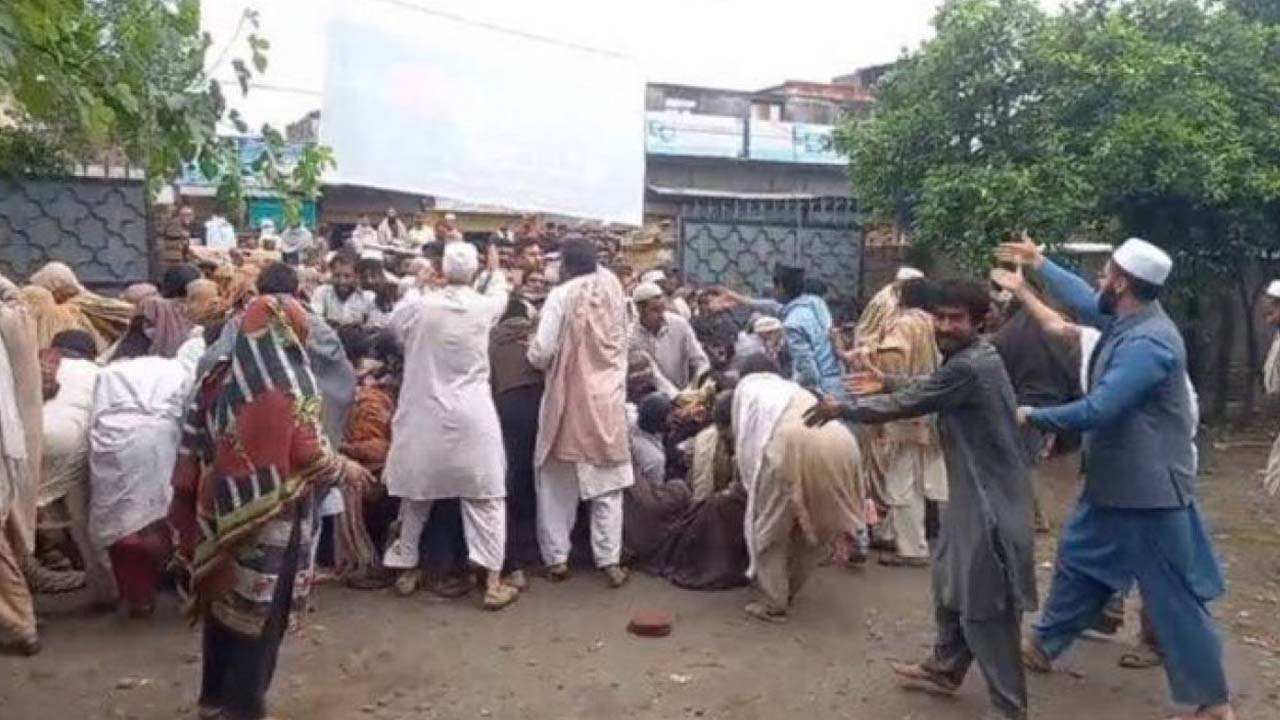
    A stampede at a private charity food ration distribution site in Karachi’s SITE industrial area on Friday left at least 11 people dead, including three children.

    Eyewitnesses and rescue workers reported that several people fell into a nullah at the location during the stampede. Reports suggest that some of the victims were electrocuted as an electricity power-line had fallen into the nullah.

    Several people, including women and children, also fell unconscious during the incident.

    The Abbasi Shaheed Hospital received nine bodies and six injured victims, while the Civil Hospital received two dead bodies, bringing the death toll to 11.

    The incident is one of several recent deadly stampedes at free food and flour distribution sites across the country as the population struggles with rising inflation.

    The government launched the flour distribution programme to reach millions of families in need during the holy month of Ramzan that began last week.

    Sindh Chief Minister Murad Ali Shah has ordered an inquiry into the incident and expressed sorrow over the loss of lives.

    Leader of the Opposition in the Sindh Assembly Khurram Sher Zaman demanded a transparent inquiry and action against those responsible for the incident, blaming the government for the people’s carelessness.

  • About 830,000 Pakistanis left the country in 2022 in search of better jobs

    About 830,000 Pakistanis left the country in 2022 in search of better jobs

    The Bureau of Immigration and Overseas Employment (BE&OE) has reported a historic surge in emigrants seeking overseas employment in 2022, with a staggering 829,549 individuals registering for job opportunities abroad. Syed Agha Rafiullah, Parliamentary Secretary for Overseas Pakistanis and Human Resource Development (OPHRD), presented this data to the National Assembly on Wednesday, shedding light on the nation’s growing interest in international job markets.

    Rafiullah went on to explain that although 12.45 million Pakistani workers had registered for overseas employment opportunities since 1971, the COVID-19 pandemic had significantly impacted emigration numbers in 2020 and 2021. Only 224,705 and 286,648 Pakistani emigrants had been recorded in those years, respectively.

    To combat this decline, the government is actively pursuing a diversification strategy, seeking new international employment markets for its workforce. In this regard, the government has already established statements of intent on migration and mobility with Greece and the United Kingdom, and is hopeful of signing a similar agreement with Germany soon.

    Moreover, the ministry is currently in talks with 12 nations, including Denmark, Belgium, Germany, Greece, Italy, Iran, Lebanon, Kuwait, Libya, Romania, Portugal, and Uzbekistan, to sign memorandums of understanding (MoUs) on personnel export. In addition, 24 social welfare attachĂŠs have been deployed to 16 countries to explore new opportunities for Pakistani labor.

    The government is committed to providing Pakistani emigrants with the necessary training in line with the host country’s labor market requirements, as determined by the host country’s Labour Market Analysis (LMA). These measures reflect the government’s proactive approach in promoting overseas employment and ensuring its workforce’s sustainable livelihood.

  • ‘Sexist’: NADRA slammed for declaring men head of family

    ‘Sexist’: NADRA slammed for declaring men head of family

    Twitter users have slammed a sexist policy authorized by The National Database and Registration Authority (NADRA) after a user shared a screenshot of the message she received from the government organization that informed her that the husband was designated as the head of the household.

    The user went on to criticize NADRA as she had not nominated her husband as the head of the household, per the message stated.

    https://twitter.com/yougoglencocco/status/1640997625821380608?s=20

    The user further went on to question how this policy would become a threat for women trying to escape abusive marriages, because their private information is being sent to their spouses without their consent.

    https://twitter.com/yougoglencocco/status/1640997629923344384?s=20

    Other women also slammed NADRA for refusing to recognize female agency, and pointed out how this policy alienates single parent households, especially with women who had escaped abusive relationships.

    Sharing their experiences of being turned away from offices while applying for their CNIC card, female tweeps blamed the policy that demands that a male guardian verify themselves as the head of their household.

    NADRA responded to the tweet by sharing that this policy was designed to guard family data from unauthorized access, because of which they had decided to inform the family head about procedures related to family data.

    “It is one of the security features to guard family data from unauthorised access. In order to maintain the integrity of family data, @NadraPak informs every family head about any processing through which someone becomes part of his family.”

    This tweet was bashed by Twitter users are regressive for refusing to recognize women as the head of their households, as activist and researcher Ammar Rashid tweeted that the government body should not have violated the privacy of women by leaking their data this way.

    “Maybe @NadraPak should try to institute measures to confirm identities that don’t openly violate the constitutional right to privacy of adult female citizens? Other countries seem to be managing data security just fine without such archaic rules.”

    Another user said: “A married woman is usually above the age of 18 and that makes her legally a citizen. She must have access to her OWN security features without having man govern her changes to the card.”

    https://twitter.com/dcfaiqalethal/status/1641077646548148227?s=20

    The Chairman of NADRA, Tariq Malik addressed the controversy in a tweet on Thursday, sharing that the policy did not discriminate against women from becoming the head of the household, and shared statistics that showed more women were nominated for this position than men.

    @NadraPak policy of declaring head of family is not gender specific. See thru lens of #realdata 28 million citizens declared their mother, 291,039 declared their sisters, 116,800 men declared their wife as head of family. And, 3.69 million females who are self head of family.”

    Malik further went on to reveal that the backlash to this policy has encouraged the department to reform it in order to prevent discrimination of any kind:

    “Declaring head of family is self reported event. I have directed our Public Engagement Department to sit down with social scientists and subject matter experts to bring reform in policies and SoPs. Suggestions welcomed. We have revamped quite a few since a year.”