Twitter announced on Wednesday that it is testing a new feature called ‘Notes’ that will allow users to create long-form content utilising rich formatting and uploaded media.
The new feature allows users to share ‘Notes’ up to 2,500 words long. Presently, posts on the social media platform are limited to 280 characters.
Once published, these notes can be tweeted and shared with followers. It will include embedded photos, GIFs, videos, tweets, etc.
According to Dr Laura Toogood, a social media specialist, the trial was an important step for Twitter. She stated that this feature would encourage users to stay on the platform rather than linking to other websites that could host long-format content.
“Adding this extra capability means that Twitter is now in a position to compete with some of the popular blogging platforms and potentially attract a new audience and a different type of user,” she added.
The two-month test will include a small group of authors from Canada, Ghana, the United Kingdom, and the United States.
Soon after the release of the Galaxy S22 series, a source claimed that Samsung had begun “Project Diamond” development on the Galaxy S23 series. More details regarding the company’s upcoming flagship devices are now becoming available months later.
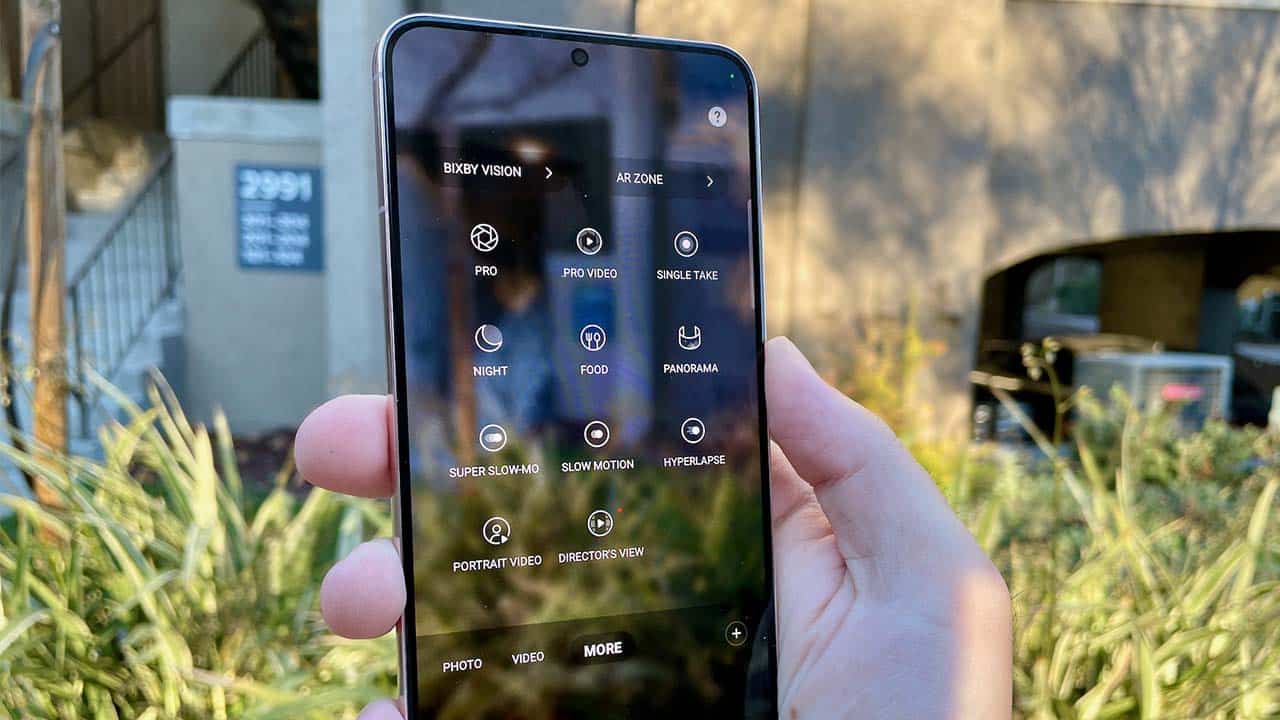
Samsung will reportedly update the selfie camera in the vanilla and larger editions of the forthcoming Galaxy S series phones, according to a claim by GalaxyClub. The business has been utilising the same front-facing camera since 2019 for those who are unaware.
The same 10MP selfie camera is included in every Galaxy S series phone (apart from Ultra variants), from the Galaxy S10 series to the Galaxy S22 series. Apparently, this will finally change with the coming generation.
According to the rumour, Samsung would equip the Galaxy S23 and Galaxy S23 Plus with a 12MP front-facing camera. The Galaxy S23 Ultra’s selfie camera is not mentioned in any way. A 40MP front-facing camera has been standard on Ultra variants up to this point.
The Galaxy S23 series’ 12MP selfie camera’s placement underneath the display or inside a punch-hole is unknown at this time. We anticipate learning more information about the devices in the upcoming months as their release is still over a year away.
Sony and Honda have formally signed a joint venture agreement to form an electric vehicle (EV) manufacturing company. The new business is named “Sony Honda Mobility Inc.,” with Sony taking precedence over the proven automaker.
Honda executive Yasuhide Mizuno has been named chairman and CEO, and Sony executive vice president Izumi Kawanishi has been named president and COO.
As previously stated, the partnership will make use of “Honda’s cutting-edge environmental and safety technologies, mobility development capabilities, vehicle body manufacturing technology, and after-sales service management experience,” as well as Sony will contribute “imaging, sensing, telecommunications, network, and entertainment technologies” in the meantime.
Honda is lagging behind competitors in EV progression, with the Honda E as its only electric vehicle, but it has recently accelerated its plans. It announced a partnership with GM earlier this year to co-develop a series of affordable electric vehicles based on a global architecture and GM’s Ultium battery technology. Honda and Acura SUVs are expected to be available in North America by 2024.
Honda also announced last year that by 2040, it will have converted its entire vehicle lineup to electric and fuel-cell vehicles. It will invest $40 billion and launch 30 new electric vehicles by 2030 as part of this plan.
Meanwhile, Sony has unveiled not one, but two self-designed electric vehicles, the Vision-S EV and Vision-S 02 electric SUV. It’s unclear how Sony Honda Mobility fits into all of these plans, but we should find out more information soon.
On Tuesday, several popular websites were unavailable due to a widespread outage reported by Cloudflare, an American content delivery network.
The DNS service, said in a statement that its team was aware of the issues and was working “to resolve as quickly as possible”.
The Cloudflare team is aware of the current service issues and is working to resolve as quickly as possible. Updates can be followed here. https://t.co/22Yiyu3lKJ
Cloudflare recently announced in an update that it had resolved a widespread outage that impacted a range of services earlier in the day, including FTX, Discord, Omegle, DoorDash, Crunchyroll, NordVPN, and Feedly.
Users began experiencing problems accessing popular sites along with Zerodha, Medium.com, news outlet Register, Groww, Buffer, iSpirt, Upstox, and Social Blade about an hour after the internet infrastructure firm resolved the issue.
According to the statement, a critical P0 incident – defined as an imperative, first-priority problem – was confirmed at 06:34AM UTC (11:57AM PST) and Cloudflare’s network connectivity was disrupted in major zones. “Customers attempting to reach Cloudflare sites in impacted regions will observe 500 errors. The incident impacts all data plane services in our network,” it added.
Multiple websites in Pakistan were unavailable due to the outage, along with DoorDash, Crunchyroll, Discord, Omegle, Feedly, Zerodha, Medium.com, Register, Upstox, and Social Blade.
The latest data from Pakistan Telecommunication Authority (PTA) reveals that the number of 3G and 4G users grew by 1.14 million from 112.75 million in April 2022 to 113.89 million in May 2022.
Pakistan’s cellular subscriber base grew by 0.25 million to 193 million by the end of May 2022, up from 192.75 million at the end of April, according to Brecorder.
By the end of May, cellular mobile teledensity had risen from 87.6 per cent to 87.67 per cent. By the end of May, the total teledensity had risen to 88.81 per cent, up from 88.74 per cent in April.
The monthly penetration of Next Generation Mobile Services (NGMS) at the end of April had risen to 51.73 per cent, up from 51.24 per cent.
Network providers
The total number of 3G users on Jazz fell from 6.222 million at the end of April to 6.068 million at the end of May, a reduction of 0.154 million. By the end of May, the number of Jazz 4G users had risen from 36.567 million to 37.168 million.
Zong 3G subscribers fell from 3.357 million at the end of April to 3.272 million at the end of May, while 4G users grew from 27.952 million at the end of April to 28.317 million at the end of May.
Telenor 3G subscribers fell from 3.696 million at the end of April to 3.613 million at the end of May, whereas Telenor 4G users enhanced from 21.216 million at the end of April to 21.494 million at the end of May.
By the end of May, there were 3.576 million Ufone 3G users, up from 3.673 million at the end of April. Ufone’s 4G users increased from 8.761 million at the end of April to 9.052 million at the end of May, a 0.291 million increase over the previous month.
Last year, the Meta-owned messaging platform WhatsApp began developing a new privacy setting that would allow users to hide their profile photos, last seen, and about information from specific people in their contact lists.
It was only available for beta version users, but the company has now announced that it will be accessible to all iPhone and Android users worldwide.
Users can now show their WhatsApp profile photo, last seen, and About information to anyone in their contacts list except those they choose to keep out.
Previously, users could choose between three privacy settings for their profile photo, last seen, and About information: Everyone, My Contacts, and Nobody. According to GSM Arena, these are met by a third alternative named ‘My contacts except…,’ which can also be used for Status privacy.
However, just like read receipts, if someone doesn’t share their last seen with others, they won’t be able to see others. The only difference is that the latter will always remain operational for group chats, even if they’ve turned it off.
To test this new privacy control, users can go to WhatsApp’s Settings > Account > Privacy menu on an iPhone or Android device.
WhatsApp also announced some group calling features, including the ability to mute others during a group call and send messages to particular users, in addition to new privacy control. When someone joins a group call off-screen, a banner appears.
The latest WhatsApp beta update also includes an admin approval feature, which allows group admins to accept or deny requests from people who want to join via hyperlink.
A survey conducted by Gallup Pakistan and Worldwide Independent Network of Market Research has revealed that only 51 per cent of Pakistanis are aware of the fact that their data can be missed by the applications downloaded on their phones.
Only 35 per cent Pakistani respondents said that they are aware of it. In addition, only 9 per cent of Pakistanis said they have reported misuse of their data. Fake e-mails, company spam e-mails, bank accounts, credit cards, and e-mail hacking were among the most common issues reported by Pakistanis.
66 per cent of Pakistanis said that technology is an important part of their lives.
The survey was conducted between October 15 and December 18, 2021. A total of 33,000 people from 39 countries participated in the survey, out of which 1,000 were from Pakistan.
Following a massive tax hike, telecom companies in Pakistan have warned the public of initiating ‘loadshedding’ of phone calls, similar to power cuts, across the country.
Telecommunication officials informed senators during a meeting of the Senate Standing Committee on Finance that, like electricity, load-shedding of phone calls would be observed in the coming days, according to ARY News.
During the meeting, telecom company representatives stated that the federal government has enhanced the advance tax on imported fibre optic cable by 15 per cent while boosting duty by 20 per cent.
The senators were informed that the companies are experiencing severe financial difficulties as a result of the enhanced financial strain of importing fiber-optic.
Telecom company representatives claimed that fibre optic cable is only used in 10 per cent of towers across the country, and that unless the government lowers fibre optic cable taxes, Pakistan will fall behind in the global connectivity race.
After hearing the telecom companies’ arguments, the Senate committee recommended that the federal government reduce relevant taxes on fibre optic imports.
Snapchat is reportedly working on a subscription plan that will allow users access to several features, including the ability to pin conversations. With the launch of Snapchat +, users may have to pay to access exclusive, experimental, and pre-release features on social media platforms. With a premium subscription, Snapchat users will get a special Snapchat icon and a special badge.
What is Snapchat Plus?
With Snapchat Plus, Liz Markman (Snapchat Spokesperson) reports, subscribers will have access to certain features of the app.
“You’ll be able to pin friends as best friends, get custom snap chat icons and subscriber profile badges, and see how many retweets you have on Snap Stories”. He also notes that “you will be able to see your friends’ location in the last 24 hours, but only if they share it with you”.
Why paid when they can offer free?
This is not the only social media platform to launch a paid subscription model. Other social media platforms are also running the same race. For example, Twitter launched its first subscription offer, Twitter Blue, in June, which is currently available in Australia, New Zealand, and Canada.
The transition to a subscription-based business model may be the result of app tracking transparency, a feature introduced by Apple in iOS 14 that requires apps to ask users before they can track their data. Companies such as Snap and Meta have publicly stated that Apple’s new guidelines have affected their revenue, which is largely based on advertising.
By introducing new subscription plans, these companies hope to offset the loss in advertising revenue by charging for access to special features that will not be available to free users.
How much does Snapchat Plus cost?
The service costs € 4.59 (Rs1,009) monthly or € 45.99 (Rs10,111) per year.
It is not clear when Snapchat Plus will launch as it is still in testing mode, but keep an eye out for it. Will you pay for it?
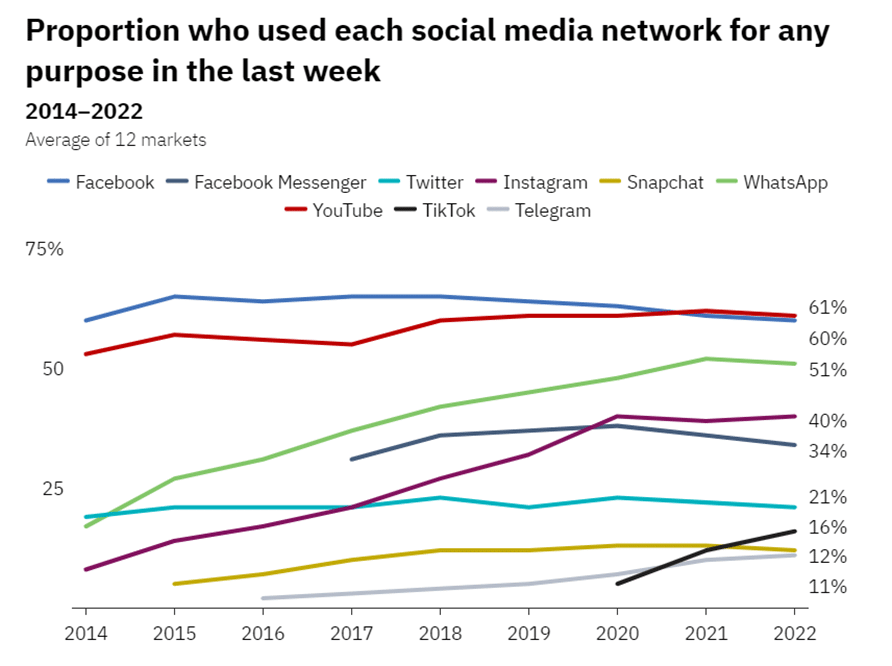
Data from the Reuters Digital Media Report 2022 shows that among users of social media platforms, TikTok took over Snapchat and Telegram in 2021 and 2022 respectively, across the world. It is the fastest growing platform among all social media channels. In 2021, only five per cent of the global audience was using TikTok and this number has grown to 16 per cent in 2022. Snapchat audience decreased by one per cent to 12 per cent while Telegram has seen an increase of five per cent with new global audience of 12 per cent.
The table shows change in audiences using Snapchat and TikTok
2020
2022
Change
TikTok
5 per cent
16 per cent
11 per cent
Snapchat
13 per cent
12 per cent
-1 per cent
Social media usage has also increased throughout the world.
Trust in BBC falls by 20%
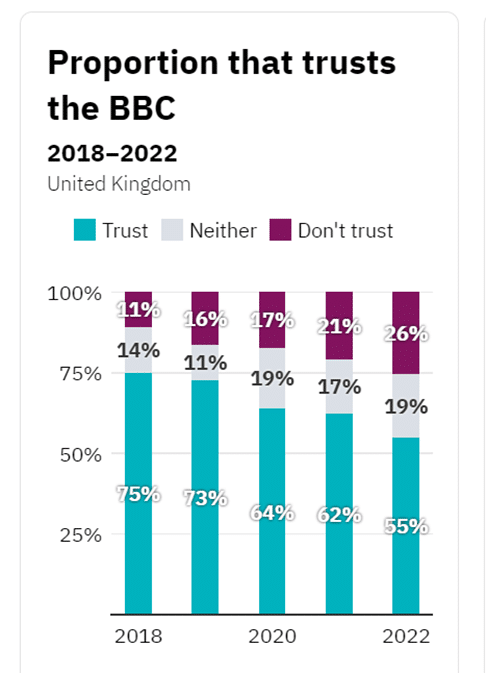
Datamentioned in the report also shows that the average level of trust in news networks globally has reduced by eight points from 50 per cent to 42 per cent in a year. Moreover, in the UK, the proportion of people not trusting BBC has increased from 11 per cent to 26 per cent while the proportion trusting BBC has fallen by 20 per cent.
The attached graph shows how the UK audience’s trust in the BBC has dwindled over time.
Another important thing to notice is that TikTok is not just being used for fun videos. It is also emerging as a new player in the news ecosystem. More and more people are turning to TikTok for their news. It has also taken over Snapchat for news as well.
2020
2022
Change
TikTok
1 per cent
7 per cent
6 per cent
Snapchat
3 per cent
2 per cent
-1 per cent
Audience is less interested in news
Globally, the interest of people in news is falling. The proportion that says they are extremely interested in the news has fallen sharply over time. On average, in 2015, 67 per cent of global audiences was interested in the news while this number declined to 47 per cent in 2022 with a change of -20 per cent.
Country
2017
2022
Change
Argentina
77 per cent
48 per cent
-29 per cent
Brazil
82 per cent
57 per cent
-25 per cent
Spain
82 per cent
55 per cent
-27 per cent
UK
65 per cent
43 per cent
-22 per cent
USA
68 percent
47 per cent
-21 per cent
Consumers are avoiding the news
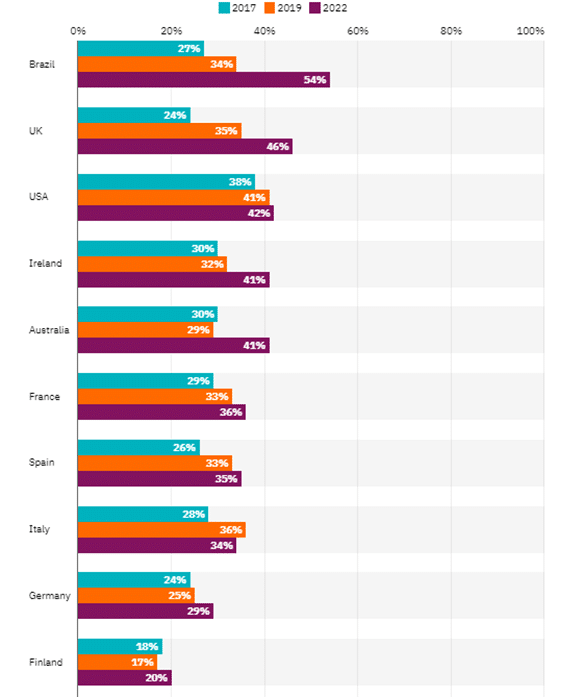
The report also says that 38 per cent of the audience actively avoided news in 2022. The audience becoming least interested in the news has been increasing from 2017 to 2022 in every country except for Italy. The attached graph shows the percentage of people staying away from news in different countries.
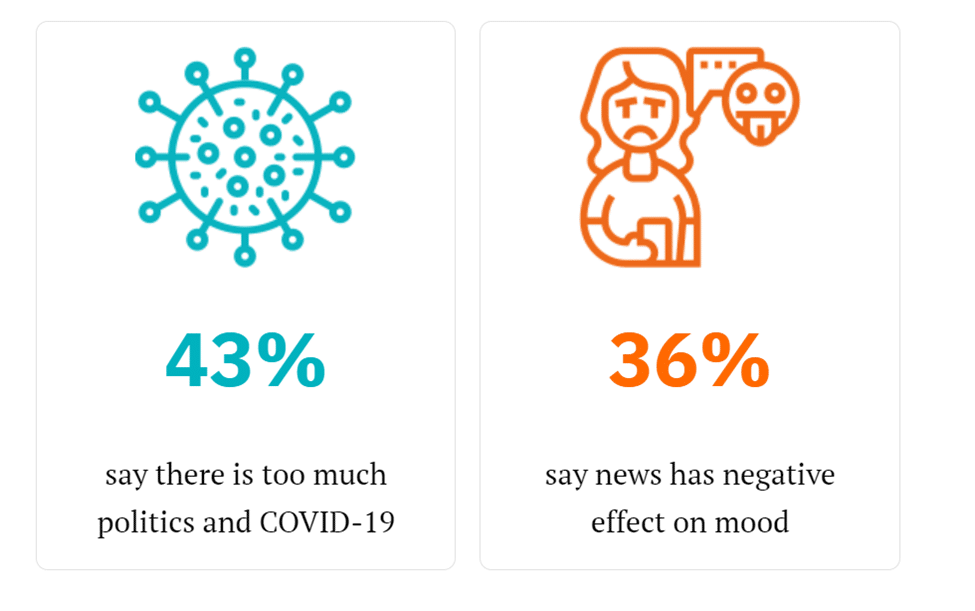
The most common reason for avoiding news is politics and Covid-19. Data shows that 43 per cent of users avoid the news because of excessive news regarding Covid-19 and politics. Moreover, 36 per cent of the audience thinks that the news has a negative impact on their mood.
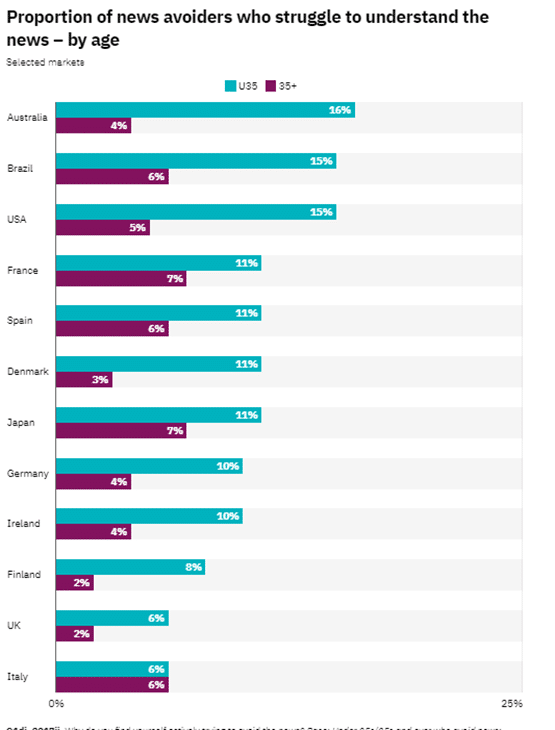
People under the age of 35 struggle to understand news
People under 35 are also finding it hard to understand the news and it is causing them to avoid the news.
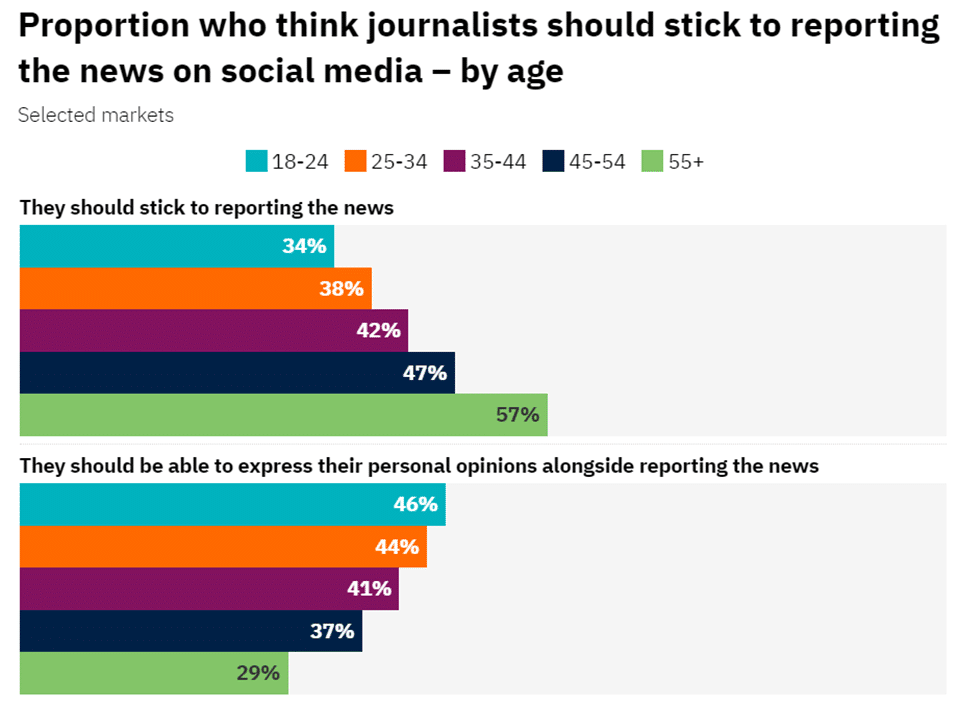
Younger audiences want journalists to express personal opinions
Data from the report shows that 46 per cent of the population between the ages of 18-24 do not want news channels to just report news on social media but want them to express their personal opinions alongside reporting news, while the opposite is true for people of age 55+. 57 per cent of older people want news channels to stick to reporting the news. The older the consumer, the more the proportion of them want journalists to stick to just posting news on social media.
Majority uses smart phones to access morning news
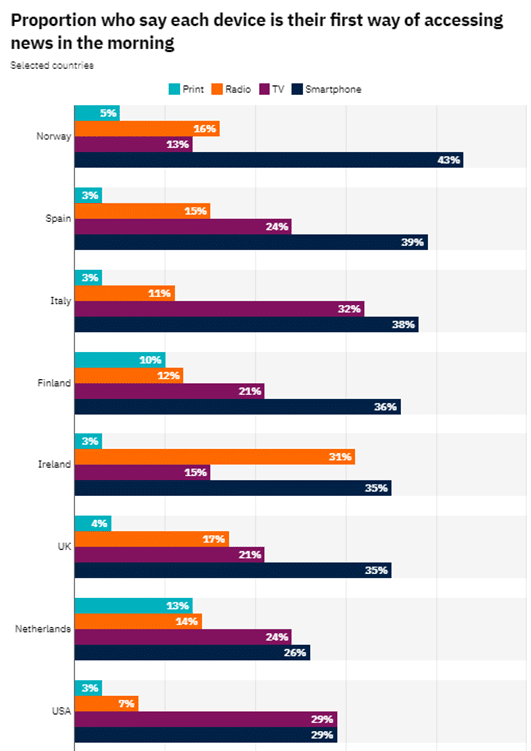
In most countries, the majority use mobile phones to access news in the morning with the highest percentage being 43 per cent in Norway. In most countries, the least used medium for news is print media. The 2021 report shows that the lockdown during Covid-19 proved to be a nail in the coffin for print media.
Younger audiences prefer watching the news rather than reading it
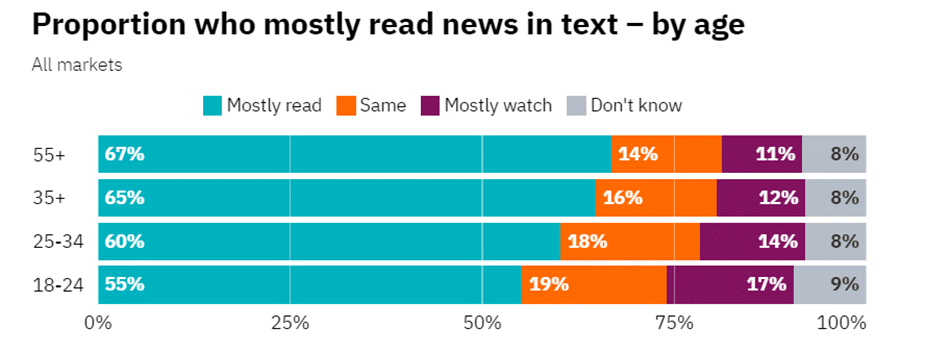
Although the significant majority still prefers reading news irrespective of age, data reveals that people aged 18-24 prefer watching the news (17 per cent) which is more when compared to older people (11 per cent for age above 55). The younger you are, the more you prefer watching the news rather than reading about it.
Key findings in Digital Media Report 2021
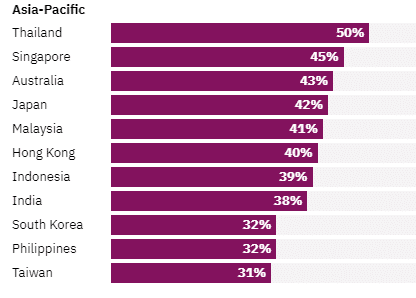
Data from the digital media report last year (2021)showed that the trust level for news reports in Asia-Pacific is no more than 50 per cent with the most being in Thailand. It is important to notice that the USA is reported to have a trust level of 29 per cent in the news, which is the lowest of all 46 countries selected for the report. The report says it is the aftermath of deep division over the US ‘stolen election reports’ and the killing of George Floyd.
To measure the trust level, people were asked to indicate if they trusted the news posted on social media,
Other key findings of last year’s report showed that Facebook, which was known for Covid-19 misinformation, was still used by 32 per cent for news and the most successful social media platform was YouTube.