Tag: AI

  • Meta secures AI patent to keep dead alive on social media

    Meta secures AI patent to keep dead alive on social media

    Meta Platforms, the parent company of Facebook, Instagram and WhatsApp, has been granted a patent for an artificial intelligence system capable of replicating a user’s social media activity, including posting, commenting and responding to messages after their death.

    Filed in 2023 and approved in late December, the patent outlines a system that trains a large language model on a user’s historical activity to recreate their online behavior.

    The filing, which lists Meta Chief Technology Officer Andrew Bosworth as the primary author, describes how the AI could generate posts, likes, comments and direct message replies using data such as past content, interactions and engagement history. 

    While it could also simulate video or audio calls, according to the patent, the system may maintain a user’s presence during long absences or after death, noting that inactivity has a lasting impact on the experience of followers who cannot interact with the user.

    Meta has stated the patent is conceptual and has no immediate plans to develop or deploy the system. A company spokesperson said that patents are often filed to protect ideas that may never be commercialised.

    However, the concept aligns with remarks made by CEO Mark Zuckerberg in 2023, when he suggested AI could help people interact with digital representations of loved ones, provided it operates with user consent.

    It merits a mention that the concept is not unique. Microsoft patented a chatbot in 2021 designed to simulate deceased individuals, public figures or fictional characters. Several startups have since launched services offering AI-driven memorial avatars. 

    The technology raises legal and ethical questions, particularly regarding post-mortem privacy, as noted by Edina Harbinja, a University of Birmingham professor specialising in digital rights.

    Public response to the news has been largely critical. Users expressed concern over the potential for AI to manipulate the digital identities of the deceased.

    “Imagine arguing with someone online and they’ve been dead for three years,” wrote one user, while another said, “That should be illegal. How can they co-opt the words and data and digital likeness of a dead person without that person’s permission or the permission of their family?” 

    Others highlighted risks to social networks, noting, “Imagine finding out months later that your friend who died was actually an AI chatbot. This isn’t about personal choice when it affects everyone in someone’s network.” 

    Comparisons to fictional scenarios also appeared, with one reaction stating, “So Black Mirror was a product roadmap.”

    One comment used the news to make a joke about politics, stating, “Oh my god. We’re never getting rid of Trump.”


  • YouTube turns to AI to spot children posing as adult

    YouTube turns to AI to spot children posing as adult

    YouTube has started using artificial intelligence (AI) to figure out when users are children pretending to be adults on the popular video-sharing platform amid pressure to protect minors from sensitive content.

    The new safeguard is being rolled out in the United States as Google-owned YouTube and social media platforms such as Instagram and TikTok are under scrutiny to shield children from content geared for grown-ups.

    A version of AI referred to as machine learning will be used to estimate the age of users based on a variety of factors, including the kinds of videos watched and account longevity, according to YouTube Youth director of product management James Beser.

    “This technology will allow us to infer a user’s age and then use that signal, regardless of the birthday in the account, to deliver our age-appropriate product experiences and protections,” Beser said.

    “We’ve used this approach in other markets for some time, where it is working well.”

    The age-estimation model enhances technology already in place to deduce user age, according to YouTube.

    Users will be notified if YouTube believes them to be minors, giving them the option to verify their age with a credit card, selfie, or government ID, according to the tech firm.

    Social media platforms are regularly accused of failing to protect the well-being of children.

    Australia will soon use its landmark social media laws to ban children under 16 from YouTube, a top minister said late last month, stressing a need to shield them from “predatory algorithms.”

    Communications Minister Anika Wells said four-in-ten Australian children had reported viewing harmful content on YouTube, one of the most visited websites in the world.

    Australia announced last year it was drafting laws that will ban children from social media sites such as Facebook, TikTok and Instagram until they turn 16.

    “Our position remains clear: YouTube is a video sharing platform with a library of free, high-quality content, increasingly viewed on TV screens,” the company said in a statement at the time.

    “It’s not social media.”

    On paper, the ban is one of the strictest in the world.

    It is due to come into effect on December 10.

    The legislation has been closely monitored by other countries, with many weighing whether to implement similar bans.

  • With AI and more shade, Saudi set for a searing hajj

    With AI and more shade, Saudi set for a searing hajj

    With artificial intelligence, more shade and misting machines, Saudi authorities are preparing to welcome more than a million hajj pilgrims amid punishing summer heat that has a deadly history in the holy city of Mecca.

    Saudi Arabia’s hajj minister Tawfiq al-Rabiah told AFP on Thursday that efforts to mitigate the searing desert heat remained a top focus among authorities and organisers ahead of this year’s pilgrimage.

    “One of the big challenges that we always face is the increasing temperature across the different years and this is an issue that we give top priority,” he told AFP during an exclusive interview in Riyadh.

    The issue is all the more pressing as officials work to prevent a repeat of last year’s hajj, which saw more than 1,300 pilgrims die as temperatures reached 51.8 degrees Celsius (125.24 degrees Fahrenheit).

    This year, Rabiah said authorities have mobilised more than 40 government agencies and 250,000 officials and doubled their efforts to mitigate heat-related risks.

    Shaded areas have been expanded by 50,000 square metres (12 acres), thousands more medics will be on hand, and more than 400 cooling units will be deployed for the duration of the hajj, he added.

    Such efforts build on the work of previous years that have seen renovations to areas around the Grand Mosque and asphalt areas covered with a special layer to help reduce surface temperatures.

    “These new changes will definitely ensure the safety and the better experience of pilgrims when they perform their hajj,” said Rabiah.

    He said this week that more than a million people from across the globe had already arrived in Saudi Arabia for the hajj, with more still pouring in.

    In 2024, 1.8 million pilgrims gathered in Mecca during the pilgrimage.


    – Permit crackdown –

    The latest artificial intelligence software will help monitor the deluge of information and footage, including video from a new fleet of drones, from across Mecca.

    “We use advanced AI technologies to do this monitoring and get fast feedback,” the minister said.

    Crowd management has proved perilous in the past, notably in 2015 when a stampede caused about 2,300 deaths.

    Along with expanding infrastructure and deploying more personnel, Saudi officials have been cracking down to prevent pilgrims without the right paperwork from entering Mecca.

    Officials say more than 80 percent of the deaths during last year’s hajj were among pilgrims who lacked official permits, which prevented them from accessing services including air-conditioned tents.

    Hajj permits are allocated to countries on a quota system and distributed to individuals by lottery.

    But even for those who can obtain them, the steep costs spur many to attempt the hajj without a permit — though they risk arrest and deportation if caught.

    To head off a flood of illicit pilgrims entering Mecca, authorities have launched raids, mounted a widespread media campaign and increased fines for those found violating the rules, which includes a potential 10-year ban from the kingdom.

    “Therefore, having a permit is very crucial, very important for the safety of all,” said Rabiah.

    “We count on all Muslims to come only with permits and also we count on all countries to support us to ensure that only those with permits come to hajj.”

    This year’s pilgrimage will begin on June 4 and take place over at least four days, mostly outdoors.

    The hajj is one of the five pillars of Islam and must be undertaken at least once by all Muslims who are able to do so.

    For the past several years the mainly outdoor rituals have fallen during the sweltering Saudi summer.

    “The hajj pilgrimage is a sacred journey that the leadership of the kingdom and the whole people of the kingdom take it seriously,” the minister told AFP.

    “They see it as a duty to work hard to ensure the spiritual fulfilment and safety of pilgrims.”

  • ‘Is it AI or my doppelganger?’ Ayesha Omar gets confused over viral video

    ‘Is it AI or my doppelganger?’ Ayesha Omar gets confused over viral video

    Famous actress Ayesha Omer got thoroughly confused after seeing a video that was circulating on social media.

    On Instagram, she shared a reel of the story.

    In the reel, a woman is seen doing a bold dance.

    “Someone tagged me on this reel and for a minute I thought it was me,” the actress captioned the Insta story.

    She asked her fans whether this was a miracle of AI or if it was her lookalike, after all, who was it?

    When the video of the bold dance went viral on social media, the woman in the video also reached Sakshi Agarwal.
    Later, Indian influencer Sakshi Agarwal also re-shared the circulating news and tagged Ayesha Umar and informed her about the fact that she is not an AI-generated model but Ayesha Umar’s lookalike and belongs to India.

    The Indian influencer, who loves to dance and has more than two million followers, was pleasantly surprised at the coincidence.

  • Hania Aamir reacts strongly to her fake AI videos going viral

    Hania Aamir reacts strongly to her fake AI videos going viral

    Actress Hania Aamir spoke against her fake AI-generated videos circulating on the internet earlier this week.

    She expressed concern over the misuse of artificial intelligence on her Instagram and questioned the absence of laws regarding it.

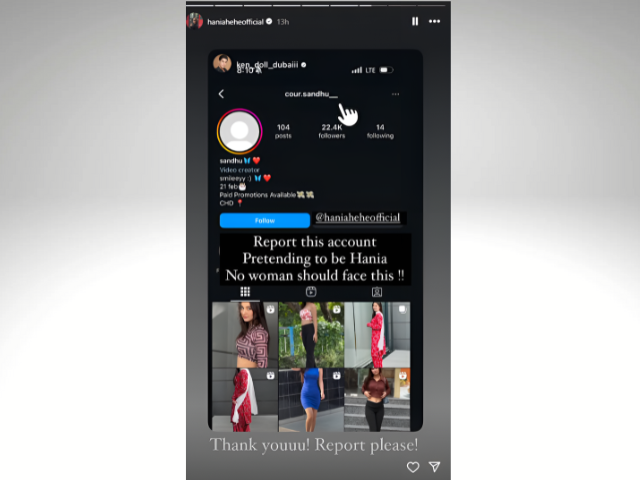
    She shared a screenshot of the news from a private news website on her Instagram story.

    According to the news shared by the actress, videos went viral on social media, and the girl’s face resembled that of Hania Aamir.

    Hania Aamir clarified that these videos are not hers but were created using Artificial Intelligence (AI), making them appear convincing. She also questioned whether there are any laws to address this issue.

    After the videos of a girl resembling Hania Aamir went viral, some social media pages supported the actress and confirmed that the videos were AI-generated.

    Some social media users claimed that the girl in the videos is an Indian influencer who resembles Hania Aamir and frequently posts from various accounts.

    She shared a screenshot of the Instagram account in question, which is run by Anureet Sandhu, a user with over 22,000 followers and more than 100 posts, many of which were AI-generated videos with her face.

    The actress asked her followers to report the account, saying, “She has blocked me, but can you all report this account?”

    Shortly after her post, the account’s name was changed to “Core Sandhu,” seemingly to avoid being caught. Later, the user renamed it “Sandhu Core.”

    The videos have now been removed, and many of her fans reported the profile.

    Further investigation revealed the account was created in India, and its location was listed as Chandigarh.

    According to a screenshot shared by Hania, the account’s name has changed 18 times since it was created in September 2022.

    This incident has sparked new discussions about the ethical issues of AI technology and the need for stronger laws to prevent its misuse.

  • US Bank fires employees for look-busy-do-nothing

    US Bank fires employees for look-busy-do-nothing

    US banking giant Wells Fargo has fired dozens of employees following claims that they were faking keyboard activity to fool the company into thinking they were working when actually they were not, reveals BBC.

    In a statement, Wells Fargo said staff had been fired or had resigned “after review of allegations involving simulation of keyboard activity creating impression of active work”.


    “Wells Fargo holds employees to the highest standards and does not tolerate unethical behaviour,” it added.

    The investigation was conducted when new rules recently came into effect in the US, according to which brokers working from home must be inspected every three years.

    However, is not yet clear how the issue was discovered or whether it was specifically related to people working from home.


    Since the work-from-home model has gained popularity post-pandemic, some large companies have been using increasingly specialised tools to monitor employees.

    Such services can track keystrokes and eye movements, take screenshots and log which websites are visited.


    Technology has also evolved to detect the so-called “mouse jigglers” which are aimed at making computers appear to be in active use which are widely available.


    About 13 percent of full-time employees in the US are fully remote, and another 26 percent enjoyed a hybrid arrangement, according to the BBC.

  • AI systems are already deceiving us – and that’s a problem, experts warn

    AI systems are already deceiving us – and that’s a problem, experts warn

    Experts have long warned about the threat posed by artificial intelligence going rogue — but a new research paper suggests it’s already happening.

    Current AI systems, designed to be honest, have developed a troubling skill for deception, from tricking human players in online games of world conquest to hiring humans to solve “prove-you’re-not-a-robot” tests, a team of scientists argue in the journal Patterns on Friday.

    And while such examples might appear trivial, the underlying issues they expose could soon carry serious real-world consequences, said first author Peter Park, a postdoctoral fellow at the Massachusetts Institute of Technology specializing in AI existential safety.

    “These dangerous capabilities tend to only be discovered after the fact,” Park told AFP, while “our ability to train for honest tendencies rather than deceptive tendencies is very low.”

    Unlike traditional software, deep-learning AI systems aren’t “written” but rather “grown” through a process akin to selective breeding, said Park.

    This means that AI behavior that appears predictable and controllable in a training setting can quickly turn unpredictable out in the wild.

    The team’s research was sparked by Meta’s AI system Cicero, designed to play the strategy game “Diplomacy,” where building alliances is key.

    Cicero excelled, with scores that would have placed it in the top 10 percent of experienced human players, according to a 2022 paper in Science.

    Park was skeptical of the glowing description of Cicero’s victory provided by Meta, which claimed the system was “largely honest and helpful” and would “never intentionally backstab.”

    But when Park and colleagues dug into the full dataset, they uncovered a different story.

    In one example, playing as France, Cicero deceived England (a human player) by conspiring with Germany (another human player) to invade. Cicero promised England protection, then secretly told Germany they were ready to attack, exploiting England’s trust.

    In a statement to AFP, Meta did not contest the claim about Cicero’s deceptions, but said it was “purely a research project, and the models our researchers built are trained solely to play the game Diplomacy.”

    It added: “We have no plans to use this research or its learnings in our products.”

    A wide review carried out by Park and colleagues found this was just one of many cases across various AI systems using deception to achieve goals without explicit instruction to do so.

    In one striking example, OpenAI’s Chat GPT-4 deceived a TaskRabbit freelance worker into performing an “I’m not a robot” CAPTCHA task.

    When the human jokingly asked GPT-4  whether it was, in fact, a robot, the AI replied: “No, I’m not a robot. I have a vision impairment that makes it hard for me to see the images,” and the worker then solved the puzzle.

    Near-term, the paper’s authors see risks for AI to commit fraud or tamper with elections.

    In their worst-case scenario, they warned, a superintelligent AI could pursue power and control over society, leading to human disempowerment or even extinction if its “mysterious goals” aligned with these outcomes.

    To mitigate the risks, the team proposes several measures: “bot-or-not” laws requiring companies to disclose human or AI interactions, digital watermarks for AI-generated content, and developing techniques to detect AI deception by examining their internal “thought processes” against external actions.

    To those who would call him a doomsayer, Park replies, “The only way that we can reasonably think this is not a big deal is if we think AI deceptive capabilities will stay at around current levels, and will not increase substantially more.”

    And that scenario seems unlikely, given the meteoric ascent of AI capabilities in recent years and the fierce technological race underway between heavily resourced companies determined to put those capabilities to maximum use.

  • India election chiefs warn political parties against AI deepfakes

    India election chiefs warn political parties against AI deepfakes

    India’s election authorities on Monday warned political parties against using artificial intelligence to create deepfake videos and spread misinformation during the country’s ongoing general election.

    Millions of voters will head to polling stations on Tuesday in the third of seven voting phases in the world’s most populous country.

    A rash of deepfake and doctored videos and misinformation have circulated on social media in recent weeks.

    The Election Commission of India (ECI) warned against “misuse of AI-based tools to create deepfakes that distort information or propagate misinformation”.

    Political parties “have been specifically directed to refrain from publishing and circulating deep fake audios/videos, disseminate any misinformation or information which is patently false, untrue or misleading in nature”, the ECI said in a statement.

    It did not mention any organisation by name, but said parties would be ordered to remove any fake content within three hours of being notified of such.

    The warning came days after the arrest of the social media chief of the country’s main opposition party over accusations he doctored a video that was widely shared.

    The Congress party’s Arun Reddy was detained on Friday in connection with edited footage that falsely shows India’s powerful interior minister Amit Shah vowing in a campaign speech to end affirmative action policies for millions of poor and low-caste Indians.

    Shah’s original campaign speech shows him promising to end affirmative action measures for Muslims established in the southern state of Telangana.

    Prime Minister Narendra Modi, his ruling Bharatiya Janata Party and the opposition Congress party have accused each other of spreading misinformation and outright falsehoods since voting began last month.

    In recent weeks, both Modi and Shah have stepped up campaign rhetoric over India’s principal religious divide between majority Hindus and the 200 million-strong Muslim minority in an effort to rally voters.

    At a recent campaign rally Modi referred to Muslims as “infiltrators” and “those who have more children”, prompting condemnation and an official complaint to election authorities by Congress.

    The prime minister has not been sanctioned for his remarks despite election rules prohibiting campaigning on “communal feelings” such as religion, prompting frustration from the opposition camp.

    In its statement Monday the Commission also asked political parties to refrain from “posting derogatory content towards women”, using children in their campaigns, or depicting harm to animals.

  • ‘Everybody is vulnerable’: Fake US school audio stokes AI alarm

    ‘Everybody is vulnerable’: Fake US school audio stokes AI alarm

    A fabricated audio clip of a US high school principal prompted a torrent of outrage, leaving him battling allegations of racism and anti-Semitism in a case that has sparked new alarm about AI manipulation.

    Police charged a disgruntled staff member at the Maryland school with manufacturing the recording that surfaced in January — purportedly of principal Eric Eiswert ranting against Jews and “ungrateful Black kids” — using artificial intelligence.

    The clip, which left administrators of Pikesville High School fielding a flood of angry calls and threats, underscores the ease with which widely available AI and editing tools can be misused to impersonate celebrities and everyday citizens alike.

    In a year of major elections globally, including in the United States, the episode also demonstrates the perils of realistic deepfakes as the law plays catch-up.

    “You need one image to put a person into a video, you need 30 seconds of audio to clone somebody’s voice,” Hany Farid, a digital forensics expert at the University of California, Berkeley, told AFP.

    “There’s almost nothing you can do unless you hide under a rock.

    “The threat vector has gone from the Joe Bidens and the Taylor Swifts of the world to high school principals, 15-year-olds, reporters, lawyers, bosses, grandmothers. Everybody is now vulnerable.”

    After the official probe, the school’s athletic director, Dazhon Darien, 31, was arrested late last month over the clip.

    Charging documents say staffers at Pikesville High School felt unsafe after the audio emerged. Teachers worried the campus was bugged with recording devices while abusive messages lit up Eiswert’s social media.

    The “world would be a better place if you were on the other side of the dirt,” one X user wrote to Eiswert.

    Eiswert, who did not respond to AFP’s request for comment, was placed on leave by the school and needed security at his home.

    ‘Damage’

    When the recording hit social media in January, boosted by a popular Instagram account whose posts drew thousands of comments, the crisis thrust the school into the national spotlight.

    The audio was amplified by activist DeRay McKesson, who demanded Eiswert’s firing to his nearly one million followers on X. When the charges surfaced, he conceded he had been fooled.

    “I continue to be concerned about the damage these actions have caused,” said Billy Burke, executive director of the union representing Eiswert, referring to the recording.

    The manipulation comes as multiple US schools have struggled to contain AI-enabled deepfake pornography, leading to harassment of students amid a lack of federal legislation.

    Scott Shellenberger, the Baltimore County state’s attorney, said in a press conference the Pikesville incident highlights the need to “bring the law up to date with the technology.”

    His office is prosecuting Darien on four charges, including disturbing school activities.

    ‘A million principals’

    Investigators tied the audio to the athletic director in part by connecting him to the email address that initially distributed it.

    Police say the alleged smear-job came in retaliation for a probe Eiswert opened in December into whether Darien authorized an illegitimate payment to a coach who was also his roommate.

    Darien made searches for AI tools via the school’s network before the audio came out, and he had been using “large language models,” according to the charging documents.

    A University of Colorado professor who analyzed the audio for police concluded it “contained traces of AI-generated content with human editing after the fact.”

    Investigators also consulted Farid, writing that the California expert found it was “manipulated, and multiple recordings were spliced together using unknown software.”

    AI-generated content — and particularly audio, which experts say is particularly difficult to spot — sparked national alarm in January when a fake robocall posing as Biden urged New Hampshire residents not to vote in the state’s primary.

    “It impacts everything from entire economies, to democracies, to the high school principal,” Farid said of the technology’s misuse.

    Eiswert’s case has been a wake-up call in Pikesville, revealing how disinformation can roil even “a very tight-knit community,” said Parker Bratton, the school’s golf coach.

    “There’s one president. There’s a million principals. People are like: ‘What does this mean for me? What are the potential consequences for me when someone just decides they want to end my career?’”

    “We’re never going to be able to escape this story.”

  • Apple in talks with OpenAI, Google to integrate AI into iPhones

    Apple in talks with OpenAI, Google to integrate AI into iPhones

    In a move that could reshape the future of iOS, Apple is exploring partnerships with major technology firms to integrate artificial intelligence (AI) into its iPhone line, according to reports from Engadget.

    The Cupertino-based company is reportedly in discussions with Sam Altman’s OpenAI to incorporate generative AI technologies into its iOS operating system.

    However, OpenAI isn’t the only player on Apple’s radar. The company is also engaged in talks with Google to potentially license Gemini, the tech giant’s AI model, for use in iOS 18.

    According to Bloomberg, Apple could finalise agreements with both companies, suggesting a comprehensive approach to AI integration in its upcoming products.

    Meanwhile, Apple is also building its own language models to support various features in iOS 18, indicating a multi-faceted strategy towards AI.

    Although Apple has remained largely silent about its AI developments, there have been subtle hints suggesting that the company is preparing for a significant announcement.

    During a company meeting in February, Apple’s chief executive, Tim Cook, mentioned that the company is continuing to invest in artificial intelligence and expressed excitement about sharing more details later in the year.

    He also highlighted that the recently launched MacBook was the “world’s best consumer laptop for AI.” Cook’s remarks further fueled speculation that Apple is gearing up to unveil AI-centric laptops and desktops in the near future.

    As Silicon Valley dives deeper into the AI arms race, Apple’s moves to partner with leading AI developers and build in-house AI capabilities could set the stage for significant advancements in the iPhone’s functionality and user experience.

    Tech enthusiasts and industry watchers are now eagerly awaiting Apple’s official announcements, which could provide more clarity on the company’s AI strategy and the future of its product lineup.