Tag: export

  • Samsung shipped 73.7 million cellphones in Q1 2022

    Samsung shipped 73.7 million cellphones in Q1 2022

    Samsung does not like surrendering its position as the world’s leading smartphone manufacturer. Even though Apple temporarily dethroned it, the firm has fought back and reclaimed what it considers to be its rightful position.

    1st quarter of 2022 According to data from market research organisations Canalys and Counterpoint, Samsung is the global leader in smartphone shipments. Apple did well as well, but it was only able to finish second to the Korean behemoth.

    Samsung’s Galaxy S22 series has contributed to the company’s strong performance in the first quarter of this year. Many Galaxy Note fans were enticed back to Samsung with the Galaxy S22 Ultra in particular.

    According to Canalys, worldwide smartphone shipments hit 311.2 million units in the first quarter of 2022, down 11 per cent year on year. While Samsung regained the lead, delivering 73.7 million units, the company saw a 43 per cent drop in sales.

    Read more: HP to launch its first 17-inch foldable OLED notebook

    Xiaomi came in third place in the ‘top 5 shipping’ list, with 39.2 million units shipped, a 20 per cent decrease. Oppo shipped 29 million units, a decrease of 27 per cent, and Vivo’s growth slowed by 30 per cent.


  • Global oil prices rise amid supply concerns

    Global oil prices rise amid supply concerns

    Oil prices increased on April 20, swamped by fears about tightening supply as the European Union (EU) considers a possible ban on Russian oil imports, which would further impede global oil commerce.

    After reaching a high of $109.80, Brent oil futures finished up $1.53 to close at $108.33 a barrel. After earlier reaching a high of $105.42, U.S. West Texas Intermediate (WTI) crude futures ended up $1.60, or 1.6 per cent, at $103.79.

    Consumers also reacted to continued disruptions in Libya, where blockades at major fields and export terminals have resulted in a loss of about 550,000 barrels per day of oil supply.

    Brent has climbed about 8 per cent in the last seven days of trading, but the advance has been calm and steady, unlike the frenzy that surrounded Russia’s invasion of Ukraine in late February and again in mid-March.

    Last week, US crude exports increased to more than 4 million barrels per day, slightly countering Russian crude losses caused by US and European bans.

    Read more: Pakistani rupee plunges by Rs1.05 against the US dollar

    The oil market is still constrained, with the Organization of Petroleum Exporting Countries and its affiliates, led by Russia, striving to achieve output commitments and US crude inventories plunging dramatically in the week ending April 15.

  • PTA records 1.73 million new 3G, 4G users in one month

    PTA records 1.73 million new 3G, 4G users in one month

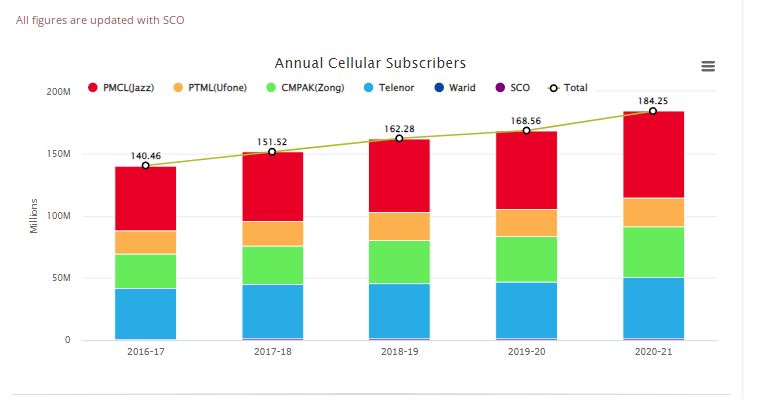
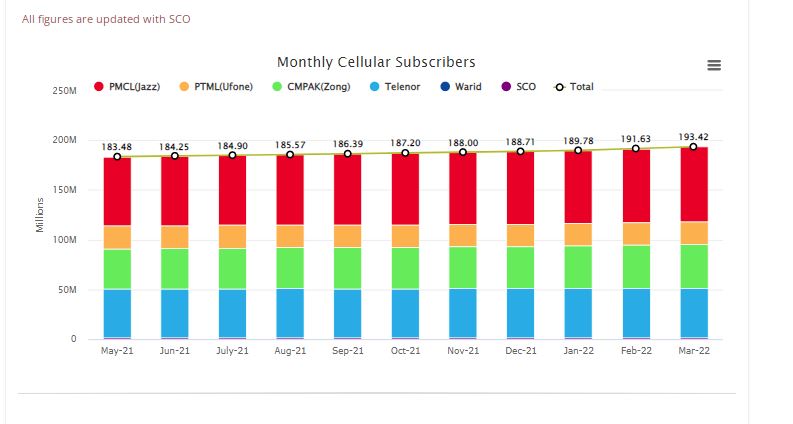
    The latest stats from Pakistan Telecommunication Authority (PTA) show that the number of 3G and 4G customers in Pakistan increased by 1.73 million to 113.11 million by the end of March 2022, up from 111.38 million at the end of February 2022.

    By the end of March 2022, the number of mobile users in Pakistan had risen by 1.79 million to 193.42 million, up from 191.63 million at the end of February 2022. The cellular population climbed from 87.17 per cent in February 2022 to 87.95 per cent in March 2022.

    The entire teledensity had risen to 89.09 per cent, up from 88.31 per cent in February.

    The overall number of Jazz 3G users was 6.489 million at the end of March, down from 6.607 million at the end of February 2022, a fall of 0.118 million. By the end of March, the number of Jazz 4G users had risen from 35.822 million to 36.518 million.

    The number of Zong 3G customers fell from 3.501 million in February to 3.447 million in March, while the amount of 4G users increased from 27.483 million in February to 28.033 million in March.

    Telenor’s 3G users totaled 3.911 million at the end of March, which was the same as at the end of February. The graph, however, shows a downward trend. Its 4G subscribers increased from 20.801 million at the end of February to 21 million by the end of March 2022.

    Read more: Textile exports soared 25pc to $14.3b: PBS

    By the end of March, there were 3.809 million Ufone 3G users, up from 3.873 million at the end of February. Ufone’s 4G user base expanded from 8.099 million in February to 8.6 million by the end of March 2022, a 0.501 million growth in the time period under consideration.

  • Global oil prices climb to highest in three weeks

    Oil prices increased on Monday as fears of limited global supply intensified, with the developing crisis in Ukraine raising the risk of more penalties from the West against Russia, the world’s leading exporter.

    Brent futures were up $1.50, or 1.3 per cent, at $113.20 a barrel, while US West Texas Intermediate futures were up 98 cents, or 0.9 per cent, at $107.93 per barrel. Both contracts surged more than 2.5 per cent on April 14, ahead of the Easter weekend holidays, on news that the European Union would phase in a ban on Russian oil imports.

    Last week, EU governments said that the bloc’s executive was working on ideas to ban Russian oil, but officials said Germany was not actively backing an immediate ban.

    Those remarks came before the Ukraine situation escalated over the weekend, with the Ukrainian military defying a Russian demand to lay down arms in the pulverised port of Mariupol on Sunday. Moscow, which refers to its efforts in Ukraine as a “special operation,” said its soldiers had nearly entirely captured the city, with no sign of a truce in sight.

    Read more: Oil prices jump following Russia’s biggest production decline

    Due to sanctions or importers voluntarily rejecting Russian shipments, the International Energy Agency has warned that around 3 million barrels per day (BPD) of Russian oil might be shut in from May onwards.

  • Pakistan’s cotton fabric trade climbed by 28.23 per cent

    Pakistan’s cotton fabric trade climbed by 28.23 per cent

    In the first eight months of the fiscal year 2021-22, Pakistan’s textile and garment exports grew to $1.65 billion. The Pakistan Bureau of Statistics (PBS) estimates that the textile and apparel sector brought in $12.607 billion this time, compared to $ 9.999 billion in exports from July to February 2020-21.

    Knitwear exports surged by 33.86 per cent to $3.302 billion on a year-over-year (YoY) basis, while non-knit readymade clothes trade increased by 25.11 per cent to $2.516 billion. Additionally, cotton yarn exports increased by 34.40 per cent to $815.375 million, up from $606.690 million the previous year.

    Cotton fabric trade climbed by 28.23 per cent in 2022, reaching $1.584 billion in value. Also, over the eight months of 2021-22, the distribution of bed clothing jumped by 20.34 per cent.

    The industry has engaged in synthetic fiber imports, which increased by 31.65 per cent from July to February 2021-22, and the cost of artificial silk yarn soared by $ 569.256 million.

    Consequently, the value of textile machinery in Pakistan has climbed dramatically over the last eight months, reaching $577.249 million.

    Read more: SBP determined to curb inflation, improve foreign exchange reserves

    For those unaware, Pakistan’s textile sector has the capacity to generate $30 billion in annual revenue. The country’s leaders and economic experts should assess the existing economic situation and devise an effective economic strategy to boost textile exports.

    To summarise, the industry has tremendous potential and can significantly contribute to the country’s economic success by providing job opportunities. Which could help the country’s GDP and GNP grow even more.

  • Pakistani rupee records impressive gains against US Dollar, highest single-day gain

    Pakistani rupee records impressive gains against US Dollar, highest single-day gain

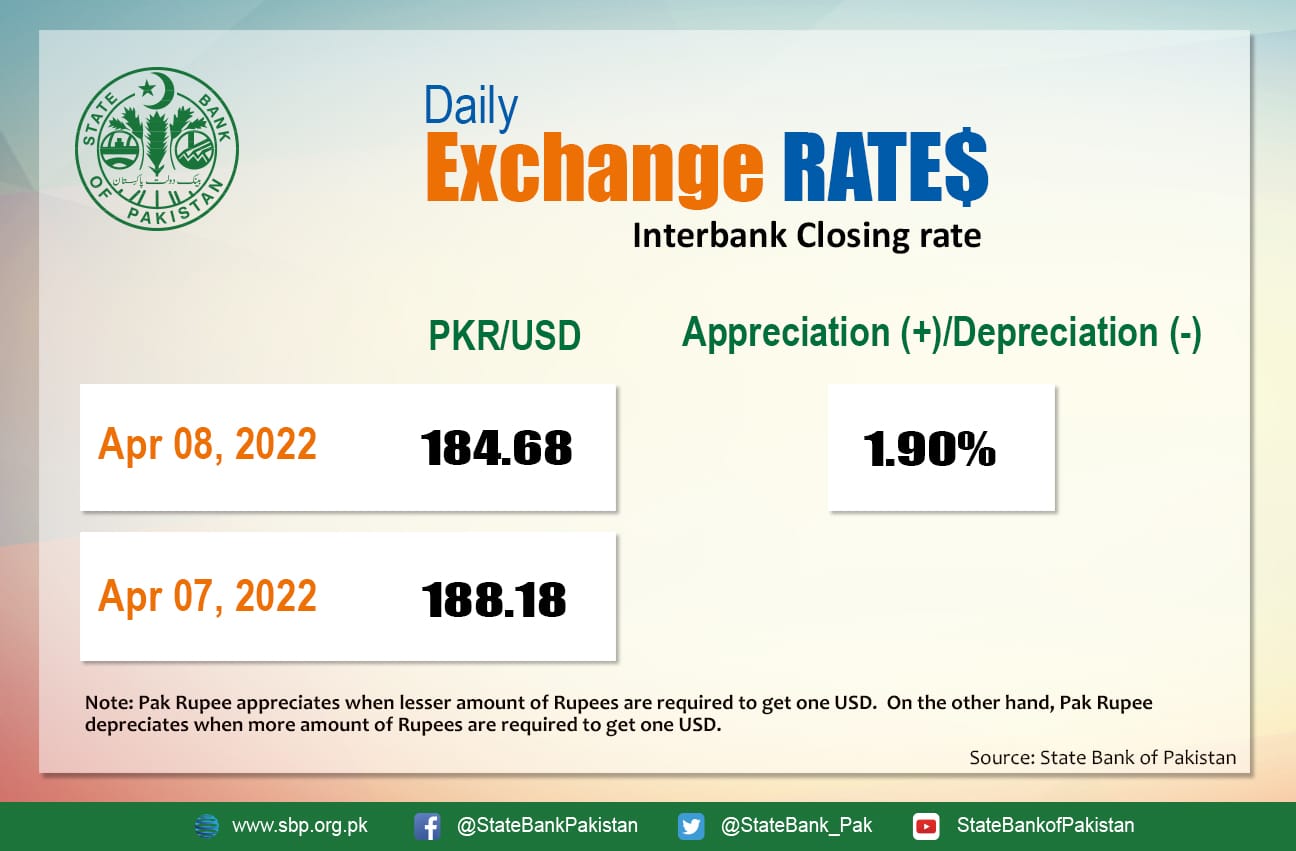
    In the intra-day trade on Friday, the Pakistani rupee (PKR) gained an impressive Rs3.5 against the US dollar, the highest single-day gain in two years after the Supreme Court (SC) pronounced the National Assembly (NA) deputy speaker order unconstitutional and restored the NA.

    The US dollar is currently trading at Rs185, as per foreign currency dealers, after weakening Rs3.5 versus the local currency in early trade. The USD is currently trading for above Rs186 on the open market.

    On Thursday, the rupee concluded at Rs188.18 against the USD in the interbank market.

    Consequently, the Pakistan Stock Exchange’s (PSX) benchmark KSE-100 index, reversed its downtrend shortly after starting on Friday and surpassed the 44,000 mark, a day after the Supreme Court of Pakistan annulled the deputy speaker’s decision against a no-confidence motion.

    Considering the trading which continued at 44, 198 on the Pakistan Stock Exchange, the KSE-100 benchmark index gained 411 points.

    The stock market has been under pressure since April 4, when it crumbled, losing over 900 points amid Pakistan’s ongoing political crisis, which arose after the National Assembly deputy speaker declared Prime Minister Imran Khan’s no-confidence resolution unconstitutional.

    SBP’s rate increase of 250 basis points and establishment of cash margins on 177 commodities is a marker that the economic system is in a slump and that prior initiatives were inadequate. This protective approach will aid in limiting the import of certain products, consequently bolstering the balance of payments.

  • Pakistan’s exports grew 25% in the last nine months

    Pakistan’s exports increased by 17.3 per cent in March 2021 to $2.773 billion, up from $2.365 billion in March 2021 and 25 per cent in the last nine months.

    The Prime Minister’s Adviser on Commerce and Investment, Abdul Razak Dawood, said that exports increased by 25 per cent to $23.332 billion in the July-March fiscal year 2021-2022, compared to $18.688 billion in the same period last year, implying a $4.644 billion upsurge.

    On the other hand, according to preliminary data from the Pakistan Bureau of Statistics (PBS), exports fell 2 per cent on a month-on-month (MoM) basis to $2.77 billion in March 2022, down from $2.82 billion in February 2022.

    Dawood said in a tweet, “We are glad to share that Pakistan’s exports for Mar-2022 grew by 17.3 per cent to $2.773 billion as compared to $2.365 billion Mar-2021. For Jul-Mar 2022, our exports grew by 25 per cent to $23.332 billion as compared to $18.688 billion in Jul-Mar 2021. This is an increase $4.644 billion”.

    While talking about the target for exports he added that “We expect to achieve our yearly target. The import figures would be shared when finalised by the PBS. We would like to congratulate our exporters for maintaining the momentum of exports under these testing times in the global market”.

    Pakistan’s current account deficit (CAD) decreased by 78.46 per cent to $545 million in February from $2.531 billion in January, owing primarily to a steep drop in imports.

    Read more: FBR records 29.1% growth during July 2021 to March 2022, despite providing ‘massive tax relief’

    Surprisingly, the CAD crossed the $12 billion level in the first eight months of FY22, showing no signs of improvement in the external account. The CAD was only $34 million in February 2021.

  • Pakistani rupee continues its record-breaking decline against the US Dollar

    Pakistani rupee continues its record-breaking decline against the US Dollar

    The Pakistani Rupee (PKR) continued its decline against the US Dollar (USD) today, reporting losses in the interbank market. At the close of the session today, the local currency lost 30 paisas against the US dollar.

    It fell 0.16 percent against the US dollar, closing at Rs182.64 after losing 30 paisas and closing at Rs182.34 in the interbank market on Tuesday, March 29.

    Pakistan’s ongoing political volatility and economic problems continue to weaken currency reserves as the country attempts to remove obstacles toward financial relief.

    After global oil prices surged on Monday, the PKR maintained its downward trend against the greenback.

    The rupee has lost about 17 per cent of its value since its last peak in May 2021. To date, the local currency has lost more than 13.6 per cent of its value.

    It is worth noting that the Pakistani currency depreciated 30.5 per cent against the US dollar in the last three years under the government of Prime Minister (PM) Imran Khan.

  • Pak-China trade to resume through Khunjerab pass after 2-year hiatus

    A lucrative trade route connecting Pakistan and China, the Khunjerab Pass will finally reopen for trade activities on April 1, 2022 after more than a 2-year hiatus. The pass was closed in November 2019 as a preventive measure against the spread of COVID-19.

    As per a credible resource, Chinese authorities sent Pakistan a letter requesting the reopening of the border, in reference to the agreement made in May 2013 between the neighboring countries.

    Port authorities on the Chinese side have been advised to take all preventive measures related to the COVID-19 outbreak.

    Likewise, the Pakistani border authorities have also been instructed to take all necessary precautions to prevent the spread of coronavirus spread.

    The Khunjerab Pass was temporarily opened for less than two weeks from July 29, 2020 to August 10, 2020 to allow the passage of stranded containers filled with goods. The prolonged closure of Khunjerab Pass had caused severe financial hardships to the local business community.

  • Pakistan set to export beef to China

    For the first time ever, Pakistan will be exporting beef to China in the near future.

    Organic Meat is a local public listed company that got approval and registration by Chinese customs authorities to export heat-treated beef to the People’s Republic of China.

    According to Pakistan Stock Exchange (PSX), the Organic Meat company has new heat machines that kill bacteria and root out the virus from the meat, which is a mandatory process for meat products.

    The export of meat and meat products by Pakistani companies is gradually increasing due to their adoption of new technologies.

    Due to the adoption of new technologies, several Pakistani companies have started exports to different regions, including Gulf countries (GCC) like the UAE, Saudi Arabia, Kuwait, and Bahrain.

    Last year, two Pakistani companies had received approval from the concerned Malaysian authorities to export meat and meat products to Malaysia.

    According to the Pakistan Bureau of Statistics (PBS), meat exports have maintained a growth of 12 per cent year-on-year. The exports surged to $216 million from July to February during the financial year 2020-21, in comparison to $210 million recorded in the previous financial year.

    The consistent growth of exports to both the traditional and new emerging markets will also attract new investments in the local companies and the area of livestock.

    Organic Meat won an export deal of supplying meat to markets in Saudi Arabia. The company also claims that their new system will enable them to export.

    The company was listed with the PSX last year for raising of funds, which resulted in the expansion of its operations and businesses.