Tag: India

  • In a first, Indian defence official admits loss of jets in Pakistan clashes

    In a first, Indian defence official admits loss of jets in Pakistan clashes

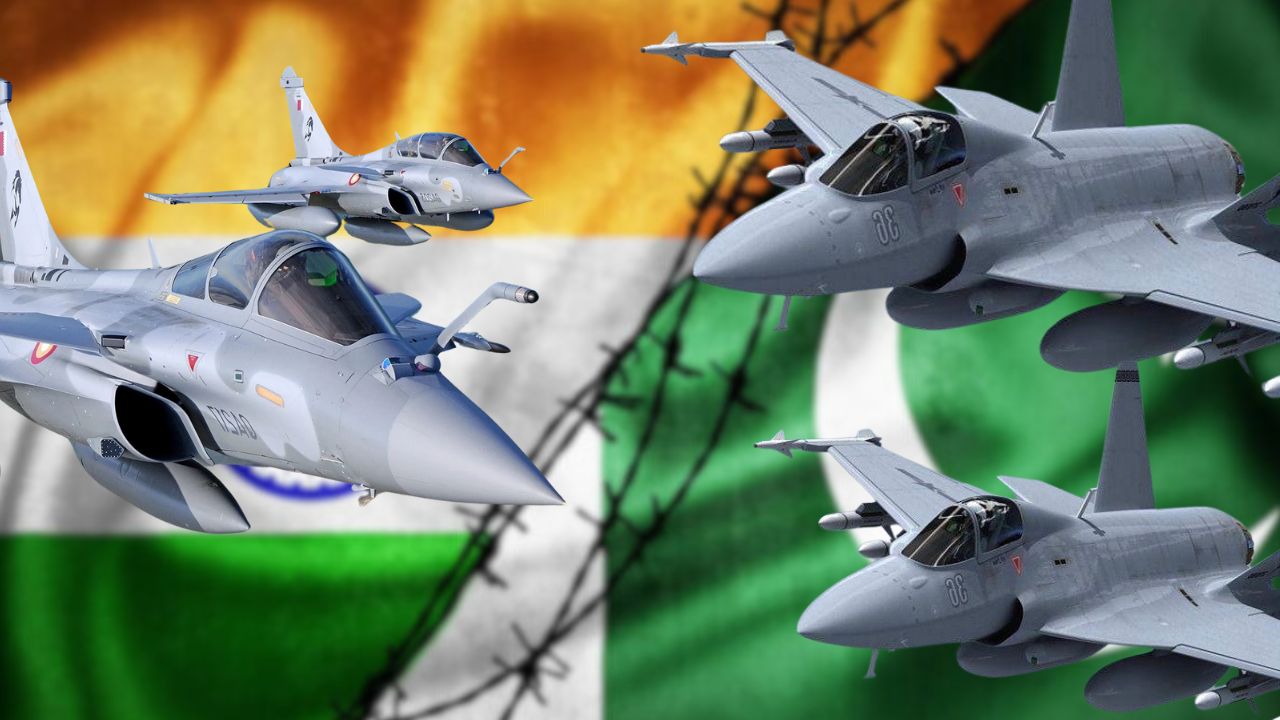
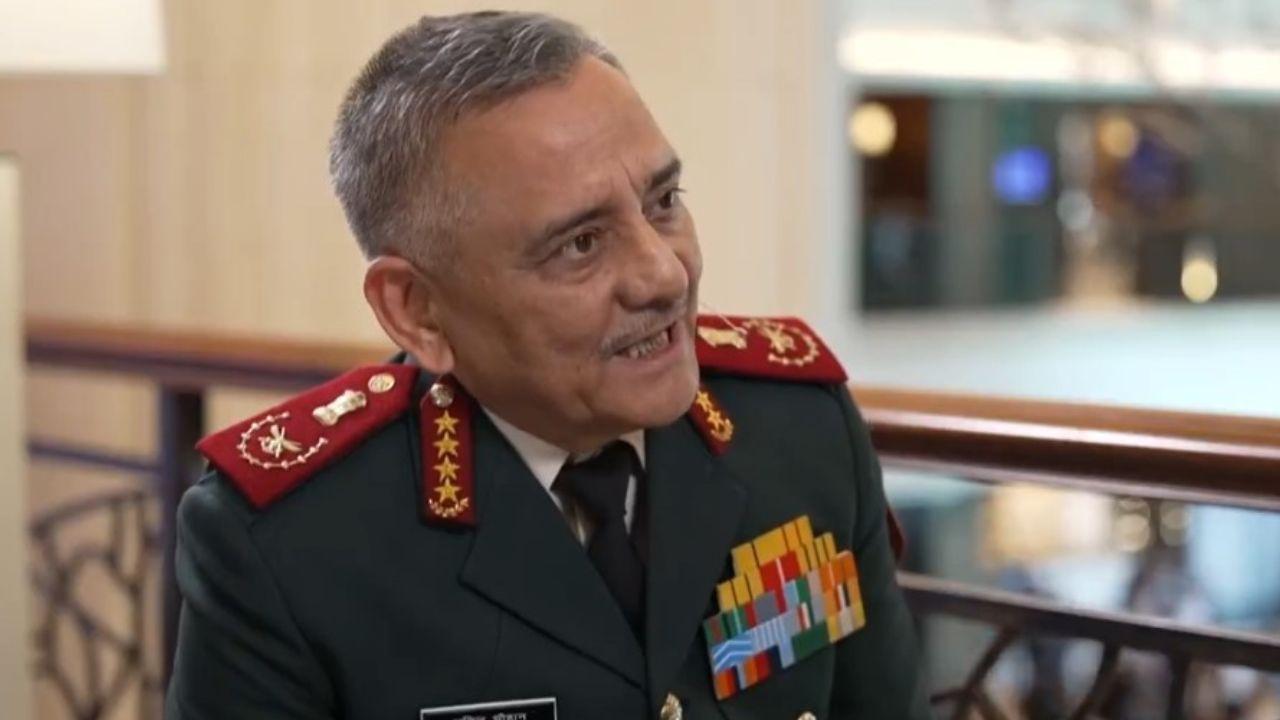
    Chief of Defence Staff of the Indian Armed Forces, General Anil Chauhan, has acknowledged the losses the Indian Air Force (IAF) suffered during recent clashes with Pakistan between May 6 and 10, though he declined to disclose the number of aircraft downed.

    Earlier, on May 15, while speaking at the Pakistan Air Force’s (PAF) Minhas Airbase in Kamra, Prime Minister Shehbaz Sharif claimed that Pakistan had shot down six Indian aircraft, including three Rafale jets, amid what he described as Indian aggression.

    “What is important is not the number of jets that were downed, but why they were downed and what we did after that; that’s more important,” General Chauhan said, in an interview with Bloomberg TV at the Shangri-La Dialogue in Singapore on Saturday.

    “Understanding the mistakes that led to the losses, correcting them, and ensuring they are not repeated—that is what matters,” he added.

    Chauhan said that the good part was that the IAF was able to “identify its mistake, rectify it, and implement it again after two days.” 

    “All our jets were flying again and engaging targets at long range,” he added. However, he refused to admit that six of the IAF fighter jets were downed.

    Chauhan’s acknowledgement followed when the interviewee asked, “Pakistan claims that six Indian jets were downed. Is it correct in that estimate?”

    After being asked about US President Donald Trump’s claim that American diplomacy helped avert a nuclear conflict between India and Pakistan, General Chauhan declined to comment directly, calling the suggestion “far-fetched.”

    “I personally feel there is significant space between conventional military operations and the nuclear threshold,” he said. 

    Chauhan asserted that communication channels with Pakistan were always open to de-escalate tensions, noting that there are “sub-ladders” on the escalation scale that both countries can use to resolve issues without resorting to nuclear options.

    While an official statement from the Indian government remains pending regarding the losses of aircraft during the 88-hour clash with Pakistan, a senior leader of India’s ruling Bharatiya Janata Party (BJP), Subramanian Swamy, admitted on Friday that Pakistan had shot down five IAF fighter jets.

    “Pakistan downed five of our planes,” Swamy, however, confirmed during a podcast with YouTube channel Press Talks.

    When asked if China had played a role in downing the jets, Swamy said that it was indeed the case as the jets used by PAF were “Chinese-made”. He, however, dismissed claims that China was directly involved in a clash with India.


  • UN expert reacts to Indian navy ‘throwing’ Rohingya refugees, including children, into sea

    UN expert reacts to Indian navy ‘throwing’ Rohingya refugees, including children, into sea

    A UN expert said on Thursday, May 15, he was investigating “credible reports” that Rohingya refugees were forced off an Indian navy vessel into the Andaman Sea, in what would be an “unconscionable” act.

    “The idea that Rohingya refugees have been cast into the sea from naval vessels is nothing short of outrageous,” said Tom Andrews, the United Nations special rapporteur on the rights situation in Myanmar.

    “I am seeking further information and testimony regarding these developments and implore the Indian government to provide a full accounting of what happened.”

    Andrews, who is an independent expert mandated by the UN Human Rights Council but who does not speak on behalf of the UN itself, said he was “deeply concerned by what appears to be a blatant disregard for the lives and safety of those who require international protection”.

    The mostly Muslim Rohingya have been heavily persecuted in Myanmar for decades.

    One million Rohingya live in a string of squalid camps in Bangladesh after escaping a 2017 military crackdown in Myanmar.

    Thousands of them risk their lives each year on long sea journeys to seek refuge elsewhere.

    Andrews’ statement pointed to reports that Indian authorities last week detained dozens of Rohingya refugees living in Delhi, “many or all of whom held refugee identification documents”.

    Around 40 members of the group were reportedly blindfolded and flown to the Andaman and Nicobar Islands and then transferred to an Indian naval ship, he said.

    “After the boat crossed the Andaman Sea, the refugees were reportedly given life jackets, forced into the sea and made to swim to an island in Myanmar territory,” he said.

    “Such cruel actions would be an affront to human decency and represent a serious violation of the principle of non-refoulment,” he said, pointing out that Rohingya “face the threat of violence, persecution and other grave human rights violations in Myanmar”.

    “The government of India must immediately and unequivocally repudiate unconscionable acts against Rohingya refugees, stop all deportations to Myanmar and ensure that those responsible for these blatant violations of India’s international obligations are held responsible,” Andrews said.

  • India’s much-hyped satellite launch fails after technical fault

    India’s much-hyped satellite launch fails after technical fault

    India’s space agency, known for its low-cost projects, experienced a technical issue during the launch of its PSLV-C61 vehicle, causing it to fail to place the EOS-09 surveillance satellite into its intended orbit.

    In Sriharikota, in the southern Indian state of Andhra Pradesh, the Satish Dhawan Space Centre launched the EOS-09 Earth observation satellite on Sunday morning using the PSLV-C61 launch vehicle.

    “During the third stage, there was a fall in the chamber pressure of the motor case, and the mission could not be accomplished,” said V. Narayanan, chief of the Indian Space Research Organisation (ISRO).

    In a statement to local media, he added, “We are studying the entire performance and we shall come back at the earliest.”

    India, the most populous country in the world, has a relatively low-budget aerospace programme that is rapidly approaching benchmarks set by major space powers.

    Since the 1960s, it has conducted space research, successfully launching both domestic and foreign satellites.

    In 2014, India placed one of its satellites into orbit around Mars.

    In August 2023, India became the fourth country, after China, Russia, and the United States, to land an unmanned spacecraft on the Moon. ISRO’s ambitions have continued to grow since then.

    Its first attempt to land on the Moon in 2019, however, was unsuccessful. Sunday’s PSLV mission marks the third documented setback in ISRO’s history, with the first dating back to 1993.

    Narayanan stated that ISRO would review the mission’s performance and provide further details on the issue.

    According to local media reports, a failure analysis committee will be formed to investigate the agency’s most recent setback.

  • Indian Supreme Court sets free rapist after he proposes marriage to survivor in court

    Indian Supreme Court sets free rapist after he proposes marriage to survivor in court

    The Supreme Court of India on May 15 suspended the 10-year prison sentence of a man convicted of rape, after he proposed marriage to the survivor during a court hearing. The case, which originated in Madhya Pradesh, involves allegations of repeated sexual assault over several years under the pretext of marriage.

    The man was convicted under Section 376(2)(n) of the Indian Penal Code for repeated rape, and Section 417 for deception. The survivor filed a First Information Report (FIR) in 2021, alleging that the accused had assaulted her multiple times since 2016, after the two connected on Facebook.

    She claimed he had repeatedly promised to marry her, only to withdraw later, citing family pressure.

    A trial court sentenced him to 10 years in prison in 2024, a decision subsequently upheld by the Madhya Pradesh High Court.

    During the Supreme Court session, the man proposed to the survivor in court. Justices BV Nagarathna and Satish Chandra Sharma, after private consultations with both parties and their families, supported the proposal.

    The two exchanged flowers in a symbolic gesture, after which the Court suspended the man’s sentence and granted him bail.

    His release was made conditional on terms set by the Sessions Court in Madhya Pradesh.

    The case has been adjourned until July 25, with the Court noting that both families would make arrangements for the marriage.


    Justice Nagarathna stated that both parties had expressed a mutual intention to marry.

    The decision has sparked widespread debate online, with many users expressing alarm over the legal and ethical implications.

    One Facebook comment read,  “Completely manipulative. You can’t establish strong matrimonial bonds on the foundation of abuse. He was an abuser and will continue to be one. What a tragedy.”

    Another user remarked, “What a disgrace. The system has just offered him a second chance without any accountability.”

  • No Apple in India: Kangana Ranaut deletes post against Trump, says was instructed by BJP president

    No Apple in India: Kangana Ranaut deletes post against Trump, says was instructed by BJP president

    Indian actor and politician Kangana Ranaut, widely revered by right-eing Hindutva trolls, has deleted a post on X (formerly Twitter) after she claimed she was instructed to do so by her party Bharatiya Janata Party (BJP) President J.P. Nadda. 

    The original tweet, now deleted, came in response to Trump’s recent remarks discouraging Apple CEO Tim Cook from expanding manufacturing operations in India. 

    Trump said during his visit to Qatar that he told Cook that Apple should “build in America” instead of investing further in India, citing high tariffs and market barriers. 

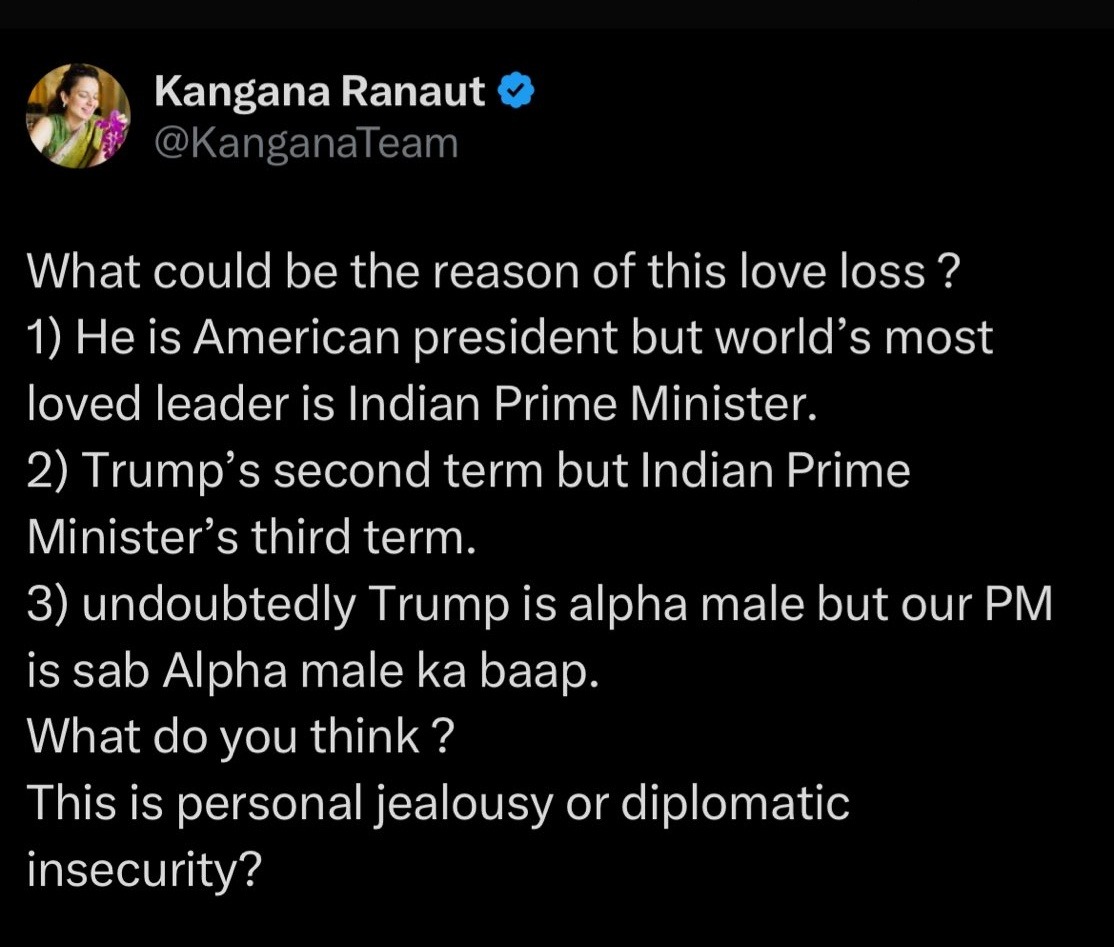
     In a now-deleted post, Ranaut had written:

    “What could be the reason of this love loss?

    1. He is American president but world’s most loved leader is Indian Prime Minister.

    2. Trump’s second term but Indian Prime Minister’s third term.

    3. Undoubtedly Trump is alpha male but our PM is sab Alpha male ka baap.

    What do you think? This is personal jealousy or diplomatic insecurity?”


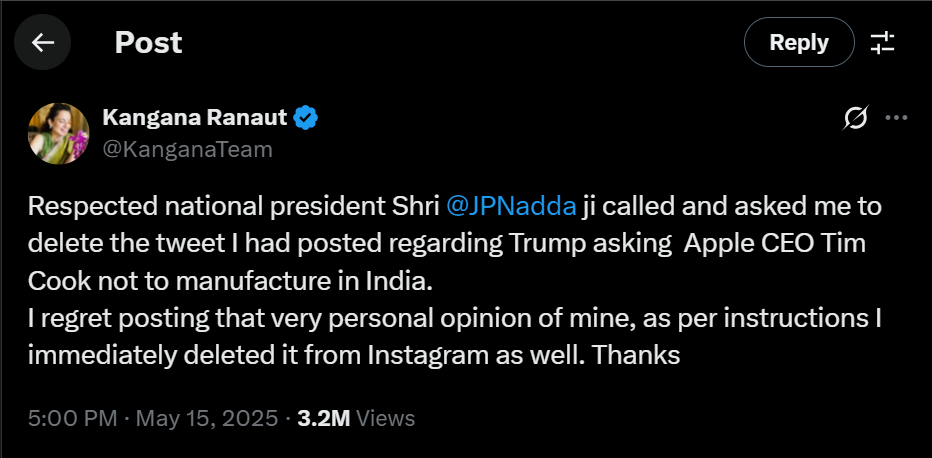
    Shortly after, she posted a clarification stating that BJP President J.P. Nadda had asked her to delete the post:

    “Respected national president Shri @JPNadda ji called and asked me to delete the tweet I had posted regarding Trump asking Apple CEO Tim Cook not to manufacture in India. I regret posting that very personal opinion of mine, as per instructions I immediately deleted it from Instagram as well. Thanks.”


    The sequence of events provoked an enormous amount of online criticism, with many users questioning Kangana’s judgment and the BJP’s response.

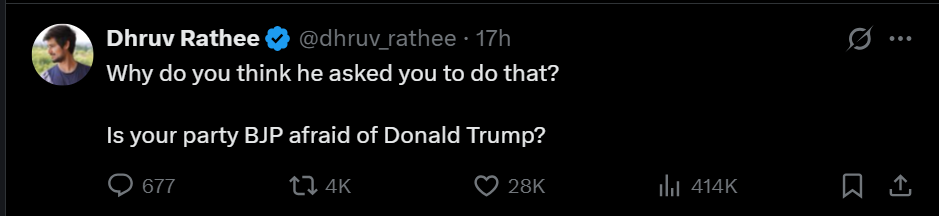
    Popular YouTuber and political commentator Dhruv Rathee reacted:

    “Why do you think he asked you to do that? Is your party BJP afraid of Donald Trump?”

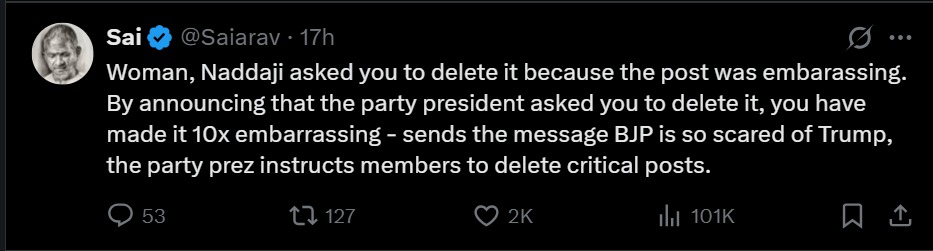
    Another user commented: 

    “Woman, Naddaji asked you to delete it because the post was embarrassing. By announcing that the party president asked you to delete it, you have made it 10x more embarrassing – sends the message BJP is so scared of Trump, the party prez instructs members to delete critical posts.” 


    She was also criticized by a number of other users for openly acknowledging that the party had told her to take down a personal opinion. People questioned Ranaut’s understanding of global affairs and referred to the party as “submissive” to Trump.


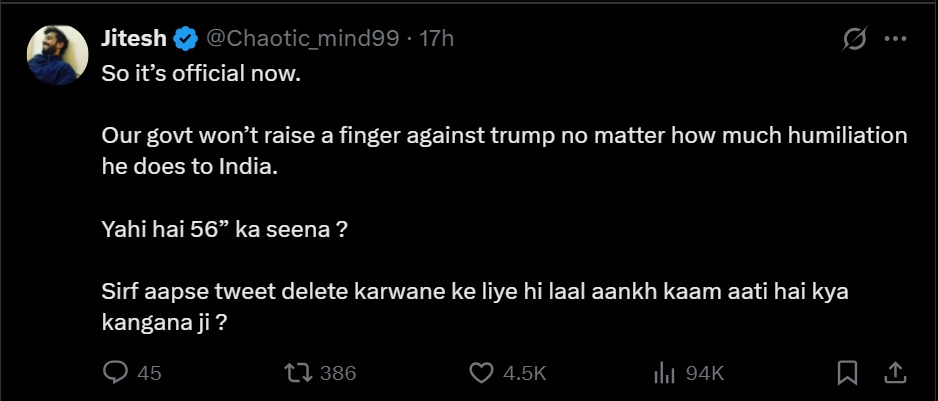
    Ranaut’s public acknowledgment that she removed the tweet at the BJP president’s request sparked a strong reaction from many users. Someone commented, “So it’s official now.” No matter how much humiliation Trump causes India, our administration will not take any action against him,” suggesting a lack of diplomatic assertiveness. 


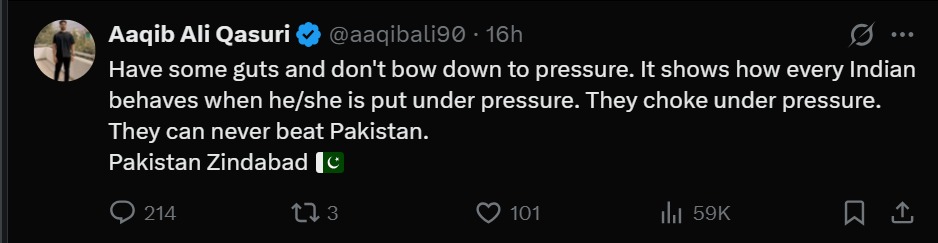
    “Have some guts and don’t bow down to pressure, said another commenter, who slammed the action as being weak. It demonstrates how all Indians act under duress. They suffocate. They will never be able to defeat Pakistan Zindabad.”


    Several others referred to BJP’s leadership in harsh terms. A user wrote, “Hence proved. Modi & BJP are slaves of the US president,” while another accused Ranaut of lacking independence: “So you are chamchi of JP Nadda and Modi, can’t even post your own views.” 


    Others commented on party loyalty, saying, “Gulaam hai saare BJP me. Kabhi Modi ki gulaami. Kabhi Trump ki gulaami. Aur ye dusro ko gulaam bolte hai.” The behavior was interpreted by several users as diplomatic caution; one suggested, 


     “Modi ji is a pure Gujarati guy. He doesn’t want to ruin his friendship with Trump,” and another adding, “So Trump is still being the boss you can’t mess with even in a tweet.”


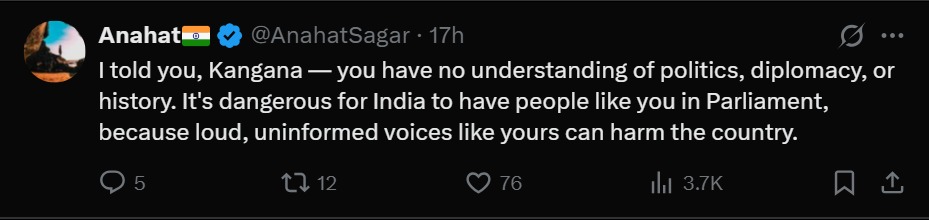
    A critical post also questioned Ranaut’s political capabilities: “I told you, Kangana,  you have no understanding of politics, diplomacy, or history. It’s dangerous for India to have people like you in Parliament.”


    Kangana Ranaut, who is contesting elections under the BJP banner, has not responded further to the backlash. This incident comes as the party navigates its diplomatic messaging in the wake of evolving U.S.-India trade relations and ongoing election campaigning.

  • ‘Find ways to de-escalate’, US calls Chief of Army Staff, Foreign Minister

    ‘Find ways to de-escalate’, US calls Chief of Army Staff, Foreign Minister

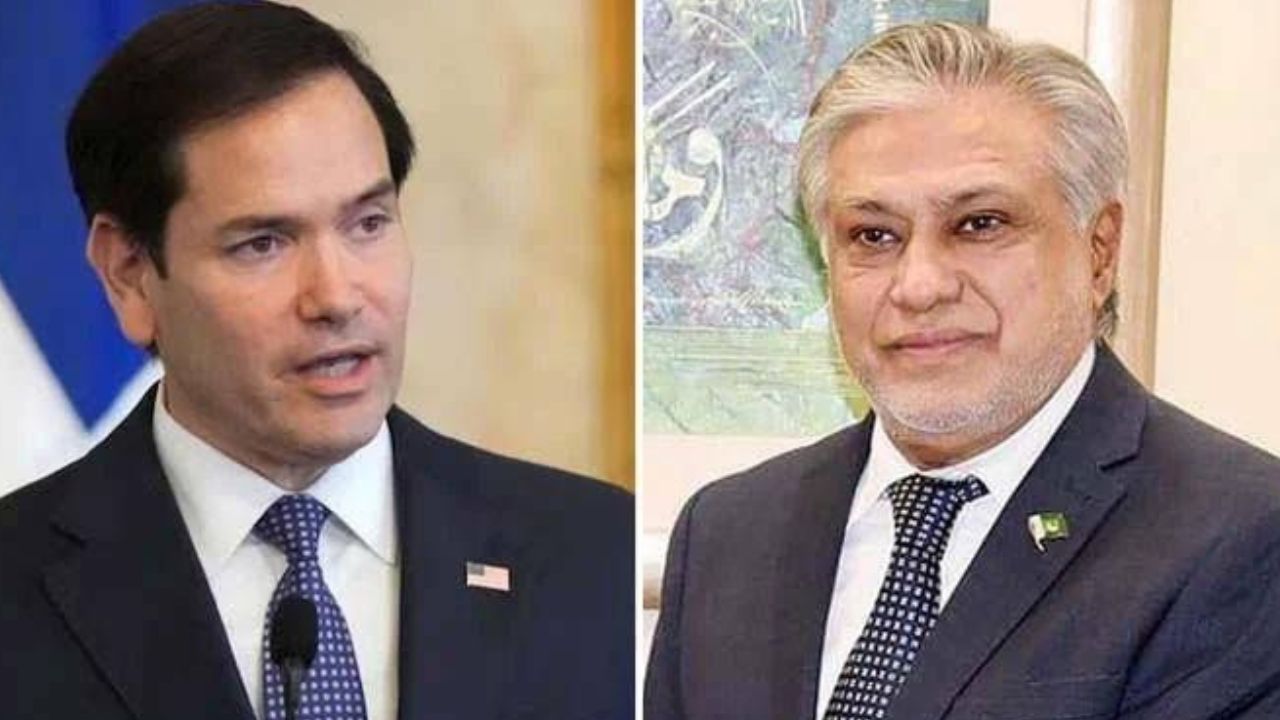
    US Secretary of State Marco Rubio spoke with Pakistani Army Chief Asim Munir on Saturday morning, urging both Pakistan and India to “find ways to de-escalate” and offering assistance in starting constructive talks in order to avoid future conflicts. The phone call comes after Pakistan has launched operation ‘Operation Bunyan ul Marsoos’ early on Saturday morning, successfully hitting multiple military targets in the heart of India. 

    Rubio has reportedly also spoken with Foreign Minister Ishaq Dar and according to GEO News, Dar has said that Pakistan is willing to de-escalate if India stops here. If India continues the aggression, Pakistan will respond further.


    In the early hours of May 10, around 1:45 am, DG ISPR chief Lt Gen Ahmed Sharif Chaudhry, in an emergency press conference, revealed that India fired six ballistic missiles on its own Sikh minority community from Adampur, one hit near Adampur itself, and five landed around Amritsar in Indian Punjab.

    India also fired air-to-surface missiles at PAF airbases in Nur Khan (Rawalpindi), Murid (Chakwal), and Rafiqui (Shorkot). DG ISPR called it continued aggression, but confirmed all air force assets are safe so far.

    DG ISPR told New Delhi to “now wait for the response” and soon launched Operation Bunyan-un-Marsoos.

    India also reportedly also launched missile strikes into Afghanistan and carried out drone attacks there, further destabilising and escalating tensions in the region.

    Most of the Indian missiles aimed at PAF airbases were shot down by Pakistan’s air defence systems. A few missiles did get through, but they didn’t cause any harm to PAF aircraft, according to early damage checks.

    The DG ISPR said India’s strikes didn’t meet their goals, thanks to effective defence.

    Pakistan also has the full electronic record of India’s missile launches, where they came from and what they were targeting.

    State-run PTV News reported that in response to India’s actions, Pakistan has hit back with a major cyberattack, hacking several Indian websites, including the BJP’s and Border Security Forces (BSF’s). Sites linked to defence, telecom, and ID systems were breached, with some data leaked. Over 2,500 surveillance cameras were also reportedly hacked in the ongoing digital retaliation.


    This phase of the tension follows Friday night’s press briefing, in which DG ISPR, along with officers of PAF and Pakistan Navy, said Pakistan has solid proof of India’s involvement in sponsoring terrorism within its borders. 

    DG ISPR criticised India for blaming Pakistan for the recent Pahalgam attack without evidence, calling it theatrics to distract from internal issues. He added that 77 Indian drones have been shot down inside Pakistani territory and none returned. He challenged India to show any real proof of Pakistan attacking Indian soil, saying the allegations are baseless. “If you want us to fire back,” he said, “we’ll do it on our own terms.”

  • India restricts water flow to Pakistan via Baglihar dam on river Chenab

    India restricts water flow to Pakistan via Baglihar dam on river Chenab

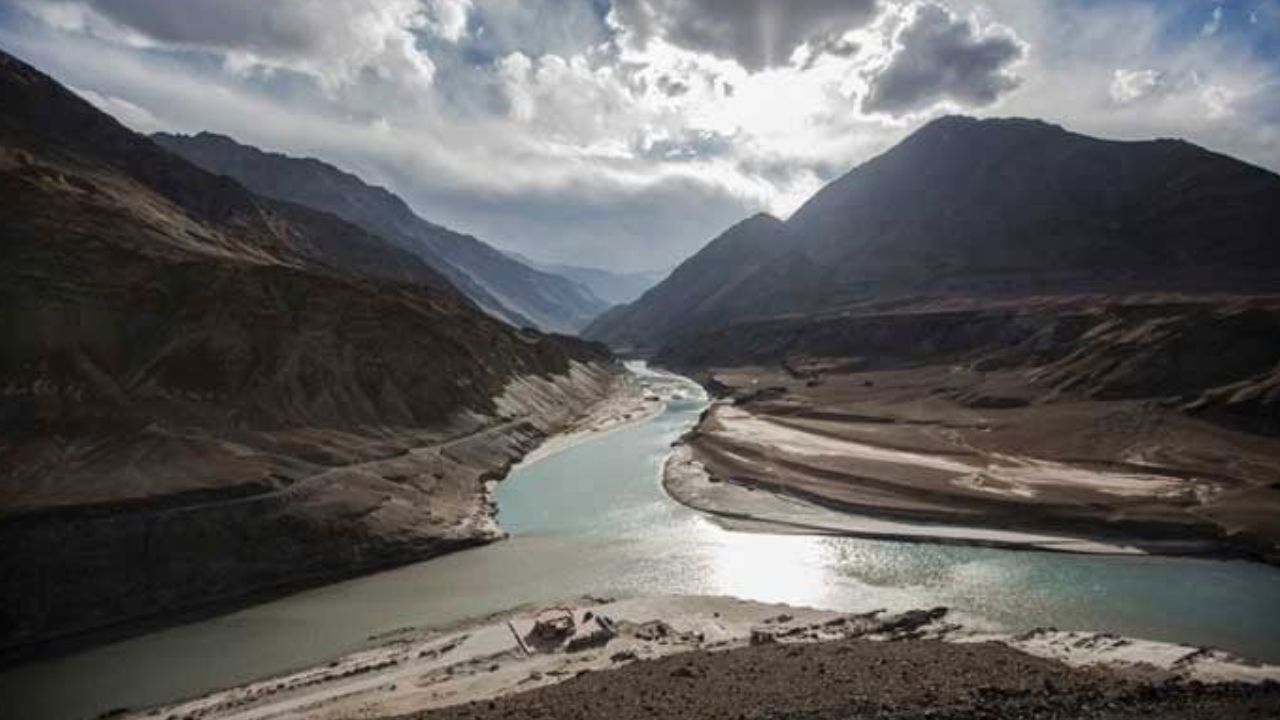
    India has restricted the water flow from the Baglihar Dam on the Chenab River to Pakistan, as ties between neighbouring India and Pakistan nosedived following a militant attack in Pahalgam, in Indian Illegally Occupied Jammu and Kashmir (IIOJK), Indian media reported on Monday.

    According to media reports, India is also considering taking similar measures at the Kishanganga Dam on the Jhelum River.

    In Pakistan, a severe and sudden drop in the Chenab River’s water flow at Head Marala has been recorded over the past two days, a media outlet reported on Monday, citing officials.

    According to the Executive Engineer (XEN) Irrigation, the current inflow at Head Marala is recorded at 10,889 cusecs, while the outflow stands at 9,020 cusecs. In stark contrast, the inflow just two days ago was 87,282 cusecs, highlighting a dramatic decline of over 85%.

    The hydroelectric dams, Baglihar in Ramban in Jammu, and Kishanganga in north Kashmir, allow India the ability to regulate the timing of water releases, Press Trust of India (PTI) reported, quoting sources familiar with the matter.

    The Baglihar Dam has long been a point of contention between the two neighbours, with Pakistan having sought World Bank arbitration in the past. Similarly, the Kishanganga Dam has come under legal and diplomatic scrutiny, particularly amid concerns about its effects on the Neelum River, a tributary of the Jhelum.

    Following the April 22 attack in Pahalgam, Indian Ilegally Occupied Jammu and Kashmir (IIOJK), which claimed the lives of 26 people, New Delhi linked Islamabad to the attack without providing any evidence and took a flurry of punitive measures, including suspending the long-standing Indus Waters Treaty (IWT) to downgrade ties.

    In response to India’s water aggression, Pakistan warned that “any attempt to stop or divert the flow of water belonging to Pakistan … will be considered as an act of war.”

    With claims from India’s Jal Shakti Minister C.R. Paatil not to allow “a single drop of water” to the neighbouring country from the Indus rivers, Pakistan’s Foreign Minister and Deputy Prime Minister Ishaq Dar has warned that Pakistan will not allow even a single drop of its rightful share of water to be compromised.

    “India has no authority to unilaterally suspend or terminate the treaty,” Dar said while speaking at the Regional Dialogue 2025 event, reaffirming Pakistan’s resolve to safeguard its rights under the agreement.

    While strongly condemning India’s suspension of the IWT, he called it a gross violation of international law.

    Highlighting Islamabad’s preparedness and commitment to regional peace, the Deputy PM also confirmed that Pakistan successfully thwarted an Indian misadventure on the night of April 29–30.

  • Journalist reveals how weather in Punjab, PAF patrolling destroyed Indian attack plans

    Journalist reveals how weather in Punjab, PAF patrolling destroyed Indian attack plans

    Prominent journalist Mansoor Ali Khan has revealed that, according to intelligence received by the Pakistan Air Force (PAF), India was set to carry out a misadventure against Pakistan between the night of Thursday and Friday.

    “Pakistan Air Force received information that India was going to launch a misadventure against Pakistan at 2:30 am (Friday),” the journalist disclosed on his YouTube channel on Friday.

    Detailing on the aversion of the potential misadventure, Mansoor said that on the same night, the weather across the entire area, including the Punjab belt, suddenly deteriorated. “I don’t know whether it was divine help,” he said.

    He further argued that the misadventure might have been averted as “severe patrolling was ongoing” in the Gilgit-Baltistan region that night.

    Regarding claims that the danger of war has faded, the journalist said that nearly 50 fighter jets, including MiG-21s and German-made Rafales, are stationed near the border in India.

    “At one point, 40 to 50 Pakistani fighter jets were also in the air, patrolling simultaneously,” he added, highlighting the escalating tensions.

    He further stated that Pakistan’s radar system and satellite coverage are so strong that all the Indian airports near the border, including Srinagar, fall within their surveillance range.

    Without revealing the name, he concluded that information regarding the potential Indian misadventure had also come from an “ally”.

    Mansoor also dismissed claims that on April 29, Indian fighter jets were patrolling near Indian Illegally Occupied Jammu and Kashmir (IIOJK) for 22 minutes, noting that their communication systems were jammed for five minutes.

    Earlier, APP quoted security sources as reporting that the PAF had detected four Indian Rafale fighter jets patrolling near the Line of Control (LoC) late Tuesday night, forcing them to retreat after a coordinated response.

    “On the night of April 29/30, four Indian Rafale jets conducted patrolling within Indian geographical boundaries over IIOJK,” APP reported, quoting security sources.

    Following an attack in Pahalgam, in held Kashmir, which claimed the lives of 26 people, mostly tourists, tensions surged between the two nuclear-armed neighbours.

    On April 23, India unilaterally suspended the long-standing Indus Waters Treaty (IWT), a critical water-sharing agreement brokered by the World Bank, which had held steady through numerous conflicts between the two countries.

    India has suggested that cross-border links may have been involved in the attack, although it has not provided concrete evidence. In contrast, Pakistan has strongly denied any involvement.

    Prime Minister Shehbaz Sharif has called for an independent and transparent investigation into the incident to determine the truth.

  • Ex-PM Imran calls on India to ‘act responsibly’

    Ex-PM Imran calls on India to ‘act responsibly’

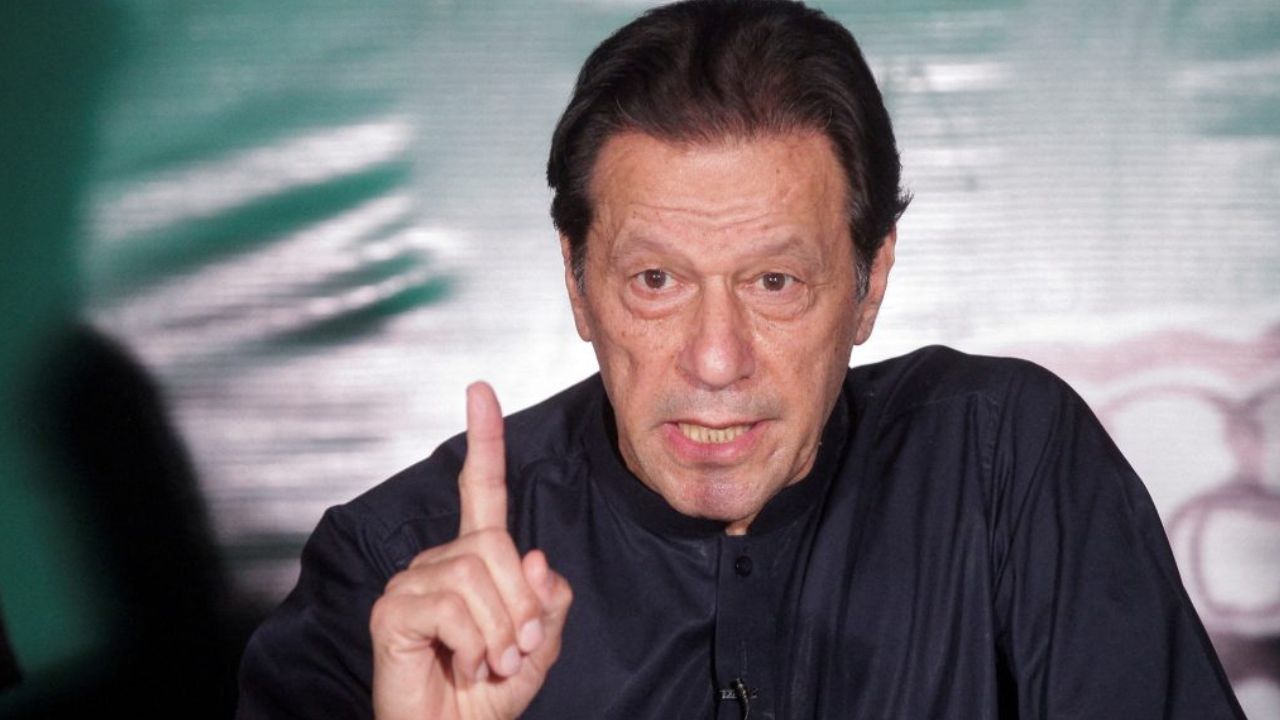
    Former Pakistani prime minister Imran Khan on Tuesday suggested that India must act responsibly in the “nuclear flashpoint” region as the two arch-rivals countries face-off amidst warmongering from Indian media. 

    A statement posted on Imran Khan’s official X (formerly Twitter) account reads, “Being a country of 1.5 billion people, India needs to act responsibly instead of messing with a region already known as ‘nuclear flashpoint’.”

    Reportedly, Imran Khan told the substance of the statement to his lawyers during a meeting at Adiala Jail in Rawalpindi.

    He recalled that when he was the Prime Minister in 2019, following the “false flag operation incident” in Pulwama in February of that year, his government had offered to extend all-out cooperation to India.

    “However, India failed to produce any concrete evidence. As I predicted in 2019, the same is happening again after the Pahalgam incident. Instead of introspection and investigation, Modi Sarkar is again placing the blame on Pakistan,” he said.

    Maintaining that peace is the priority of the country, he cautioned that it should not be mistaken for cowardice. “Pakistan has got all the capabilities to give a befitting response to any Indian misadventure, as My Government, backed by the whole nation, did in 2019,” he claimed.

    Imran Khan reiterated that India, led by RSS ideology, is a grave threat beyond the region. “Narendra Modi’s aggression has united the people of Pakistan in one voice against Indian hostility… we stand firmly as one Pakistani nation and strongly condemn Modi’s war-mongering and his dangerous ambitions that threaten regional peace,” he added.

    “Indian oppression in Kashmir, intensified after the illegal abrogation of Article 370, has further fueled the Kashmiri people’s desire for freedom.”

    Read More: ‘Credible intel’ indicates India intends military action against Pakistan within 36 hours: Tarar

    Separately, the United States (US) State Department Spokesperson Tammy Bruce said on Tuesday that Secretary of State Marco Rubio is expected to speak with the foreign ministers of both India and Pakistan.


    “We are reaching out to both parties, and telling them of course not to escalate the situation. The secretary is expected to speak with the foreign minister of Pakistan and India as early as today or tomorrow,” the State Department spokesperson said when a journalist posed a question during the press briefing.


    Following the Pahalgam incident, without providing verifiable evidence, India has attempted to link Pakistan to the attack. Pakistan has firmly denied the allegations and has offered to participate in a neutral and transparent international investigation.


    Bruce said that the Secretary of State is also encouraging other foreign ministers and national leaders to reach out to the nuclear-armed arch rivals in a bid to diffuse tensions, adding that action is being taken every day.

  • ‘Credible intel’ indicates India intends military action against Pakistan within 36 hours: Tarar

    ‘Credible intel’ indicates India intends military action against Pakistan within 36 hours: Tarar

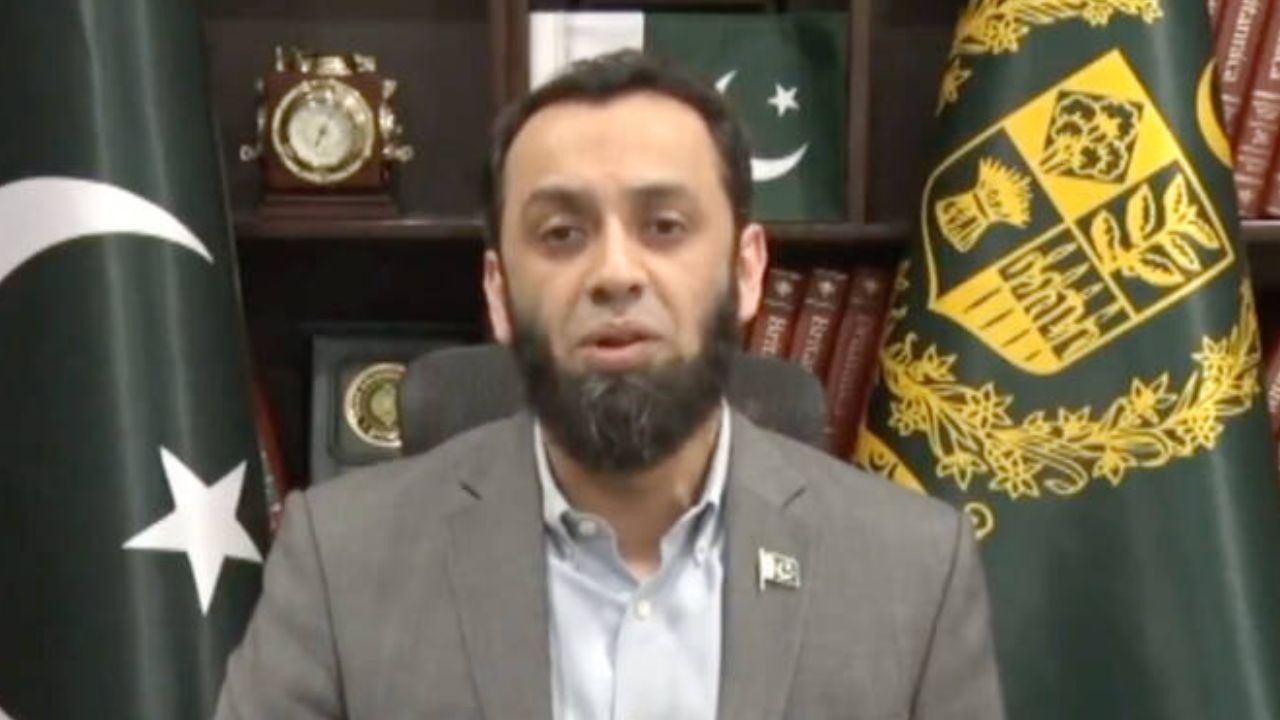
    Federal Minister for Information and Broadcasting Attaullah Tarar on Wednesday morning stated that Pakistan has “credible intelligence” indicating that India intends to conduct a military action against Pakistan in the next 24 to 36 hours on the pretext of baseless and concocted allegations of involvement in the Pahalgam incident in held Kashmir.

    The situation between the two countries remained tense following the attack in Pahalgam, a tourist spot, which had killed 26 people, including a Nepalese national. Without conducting a transparent investigation and concrete evidence, fingers were pointed towards Pakistan, alleging that it had orchestrated the attack. Pakistan has firmly rejected the accusations.


    Issuing a video statement on state television, the federal minister said that Pakistan strongly rejects India’s self-assumed hubristic role of judge, jury, and executioner in the region.

    He underscored that Pakistan itself has been facing terrorism for the past two decades and has consistently condemned terrorism in all its forms across the world. “Being a responsible state, Pakistan open-heartedly offered a credible, transparent, and independent investigation by a neutral commission of experts to ascertain the truth,” he said.

    The minister added that following the Pahalgam attack, Pakistan, as a responsible state, had offered to conduct an independent and impartial investigation. 

    He noted, however, that India has apparently decided to tread the dangerous path of irrationality and confrontation, which, according to him, will have catastrophic consequences for the entire region and beyond.

    Tarar further said that the evasion of credible investigations is in itself sufficient evidence exposing India’s real motives. “Consciously making strategic decisions hostage to public sentiments, purposefully trumped up for securing political objectives, is unfortunate and deplorable,” he added.

    Additionally, the federal minister made it clear that any kind of military adventurism from India will be met with a definite and decisive response. He emphasised that the international community must understand that the responsibility for the catastrophic consequences of war will lie solely with India.

    The minister’s statement came a day after Defence Minister Khawaja Asif, while appearing on a private media outlet, cautioned about the possibility of both countries engaging in war in the next two to four days.

    “There is a war looming on the horizon. A very vivid possibility is there that we can have a war in the next two to four days,” Asif said. However, he clarified that, not being a military strategist, he was making such a guess as a political worker.