Tag: meta

  • Meta sued by 40 US states for causing mental health problems

    Meta sued by 40 US states for causing mental health problems

    40 US states sued Meta — the owner company of Facebook and Instagram.

    The renowned tech company has been accused to have caused mental health crises in youth. The attorneys general said that these social media apps tend to “exploit and manipulate” children.

    The case highlights dangers of social media platforms stemming from their focus on financial gain. The young users are exploited using a business model to get them addicted to spending too much time on social media, which can consequently harm their mental health.

    According to the complaint, various researches show that youth using Meta’s social media platforms undergo depression, anxiety, insomnia, interference with education and daily life, and many other mental health related issues .

    The complaint was made in 2021 after Meta’s own research showed the company was aware of the harm Instagram was causing to young people, especially girls.

    These states have requested the court to impose heavy fines on Meta and order them to pay compensation.

  • Meta issues apology for labelling pro-Palestinian users as terrorists on Instagram 

    Meta issues apology for labelling pro-Palestinian users as terrorists on Instagram 

    Meta, the parent company of Instagram, has issued an apology for an incident where the term “terrorist” was added to the profile bios of certain Instagram users identifying themselves as Palestinian.

    The issue arose when the word “Palestinian” was written in English on their profiles, along with the Palestinian flag emoji and the Arabic phrase “Alhamdulillah” (which translates to “Praise be to God”). 

    Upon auto-translation to English, the phrase read: “Praise be to God, Palestinian terrorists are fighting for their freedom.”

    “We fixed a problem that briefly caused inappropriate Arabic translations in some of our products. We sincerely apologise that this happened,” a Meta spokesperson said.

    This translation error was pointed out by a TikTok user, khanman1996, who tested various combinations and found that they all translated to “terrorist.” It’s worth noting that @khanman1996, although not Palestinian himself, discovered this issue after being informed by a Palestinian friend. 

    Meta has acknowledged and rectified the problem, stating that it was a technical error rather than an intentional action. Additionally, the platform has faced accusations of suppressing content expressing support for Palestinians, particularly during the Israel-Gaza conflict.

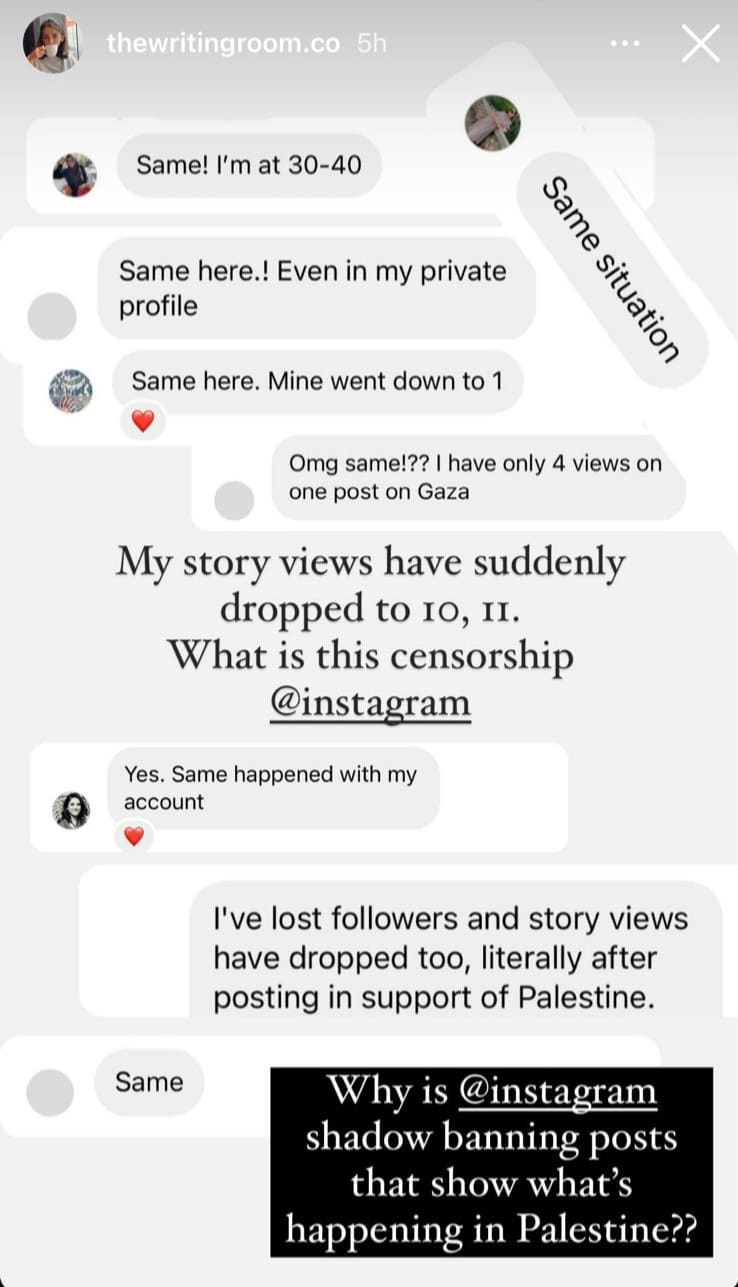
    Some users reported being “shadow banned,” a practice where posts are intentionally made less visible to others, allegedly due to their pro-Palestinian content. 

    Meta responded to these accusations, clarifying that a bug affecting Stories (a feature on Instagram) occurred, reducing the reach of posts, but insisted that it was unrelated to the content’s subject matter.

    The company stated that new measures have been implemented to tackle harmful content on their platforms, particularly during times of conflict, and denied deliberately suppressing anyone’s voice.

    This follows previous accusations of Instagram suppressing pro-Palestinian content, raising concerns about social media platforms’ handling of sensitive political topics. 

  • Instagram users say no views when people post pro Palestine content

    Instagram users say no views when people post pro Palestine content

    As the civilian death toll from Israel’s bombing of Gaza continues to rise Instagram users have complained that they are not getting views on pro Palestine content.

    While more than a 1000 Palestinians are dead, including more than 600 children, others are struggling to survive through Israel’s embargo on food, water, electricity, and other basic services.

    Israel’s atrocities in Gaza have resulted in people around the world raising their voice on social media and sharing footage.

    This also includes Pakistani influencers and Instagram users with a significant amount of following.

    They are now highlighting that the viewership on their Instagram stories has starkly decreased every since they started sharing pro-Palestinian content.

    This has not happened for the first time.

    Instagram (i.e. Meta) is known to deliberately restrict the outreach of content that is in support of Palestine or merely stating facts that put Israel in a bad light.

    Quds News Network, the largest Palestinian news outlet, has said that Meta has suspended it’s page on Israel’s complaint.

  • WhatsApp to introduce animated avatars for video calls soon

    WhatsApp to introduce animated avatars for video calls soon

    Meta’s messaging application, WhatsApp, is reportedly gearing up to introduce animated avatars for video calls. This anticipated feature, reminiscent of Apple’s Memoji, has been in development since the previous year.

    According to WABetaInfo, an independent source for real-time WhatsApp updates, the Messenger app has now unveiled the capability to use animated avatars during video calls in its latest Android beta version 2.23.19.14.

    WhatsApp is actively informing its users about this innovation through a pop-up notification. This notification provides the option to “utilise your avatar during calls,” offering the choice to either “switch to avatar” or defer the decision with a “not now” button.

    To employ this new video call avatar feature, users must select the “Switch to avatar” option. This function will replicate their facial movements and expressions in real-time through the use of an avatar character. Importantly, users retain the flexibility to disable this feature at any time through the settings, allowing them to reveal their true selves. Crucially, the introduction of the avatar feature will not compromise WhatsApp’s end-to-end encryption, ensuring the preservation of user safety and privacy.

    It’s worth noting that some data usage will be necessary to enhance the Avatar experience on the app. Additionally, WhatsApp is actively developing avatars for status updates, although there is no official information regarding their release at this time.

  • Sharing posts with ‘Close Friends’ on IG might happen at long last

    Sharing posts with ‘Close Friends’ on IG might happen at long last

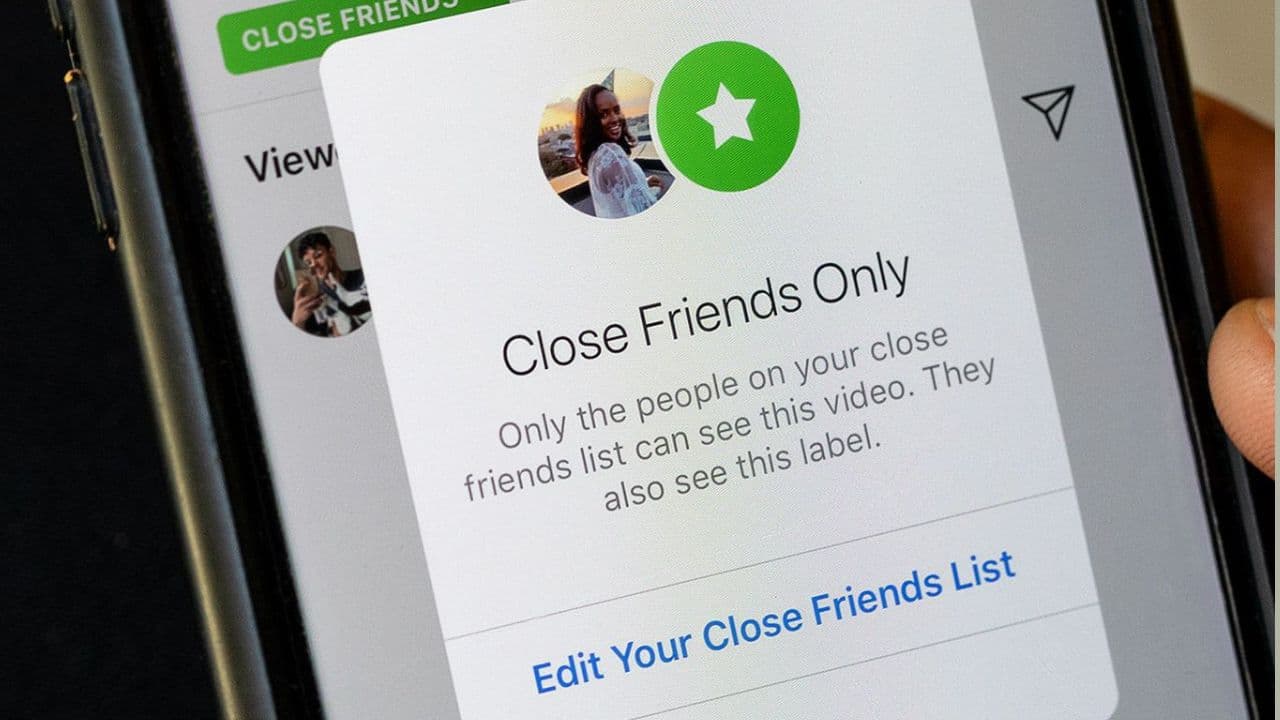
    Instagram is currently testing a feature that will allow its users to share feed posts with their ‘Close Friends’ group.

    Reportedly, a number of users have noticed the feature.

    TechCrunch reached out to the company which confirmed that it is testing the feature in a few countries, but didn’t specify which ones.

    “We’re testing the ability for people in select countries to share feed posts with their Close Friends. We’re always exploring new ways for our community to express themselves and connect on Instagram,” a Meta spokesperson said in a statement.

    If this feature gets officially launched, users will no longer have to create alternative accounts known as ‘finsta’ accounts.

    In 2018, users were introduced to the option of sharing Instagram Stories with a private list of ‘Close Friends’.

  • WhatsApp now lets users share videos in HD resolution

    WhatsApp now lets users share videos in HD resolution

    Shortly after introducing support for high-definition photos, Meta’s messaging app, WhatsApp, has now incorporated the capability for users to send videos in high-definition resolution as well. This enhancement has been made available to both iOS and Android users.

    Much like the previously launched high-definition photos feature, the inclusion of high-definition videos empowers users with the option to share videos in superior quality through WhatsApp. 

    Prior to this update, videos of high-definition quality would undergo compression, limiting them to 480p resolution. With the recent update, users are now afforded the choice to transmit videos in high-definition, although this is restricted to a maximum resolution of 720p.

    The process for sharing high-definition videos mirrors that of sharing high-definition photos. Upon selecting the desired video or videos for sharing, users will encounter a newly integrated HD button positioned atop the screen. Subsequently, a dialogue box will emerge, affording the user the decision to opt for Standard Quality or HD Quality. This dialogue box also provides insight into the associated file sizes. The sharing procedure is then finalized by selecting the “send” option, consistent with standard sharing practices.

    It is noteworthy that all images and videos exchanged on WhatsApp remain safeguarded through the company’s robust end-to-end encryption protocols. 

    According to Meta, this feature is currently being rolled out, indicating that users who have yet to access it will likely do so in the coming days.

  • Meta set to unveil web version of Threads, challenging X

    Meta set to unveil web version of Threads, challenging X

    Meta is getting ready to launch the web version of Threads, which is its rival to X (previously known as Twitter). This launch is expected to happen early this week, according to a report from The Wall Street Journal. Threads, which offers short-form posts, has been missing a web version since its start.

    Mark Zuckerberg, who is the CEO of Meta, mentioned that they’re working on adding this feature along with a better search function. Right now, the search function is quite limited; you can only search for usernames. These changes are expected to be ready in a few weeks.

    However, The Wall Street Journal’s sources say that the exact launch plans are not set in stone and could change. Adam Mosseri, who posted on Threads, shared that they’ve been testing an early version internally for a short time. But before it’s released widely, some more work is needed.

    Threads started as a basic version similar to Twitter just about a month and a half ago. Surprisingly, it quickly gained over 100 million users and attracted celebrities and brands. However, it has been missing some important features. The company has been slowly adding improvements, like a follow feed and the ability to verify a link using a Mastodon profile. This suggests that Meta might be considering integrating with the decentralised social network protocol Activity Pub.

  • Threads’ hype cools as user activity drops by 79%

    Threads’ hype cools as user activity drops by 79%

    Threads, Meta’s social media application, burst onto the scene in early July, making an impressive debut with an astonishing 5 million user registrations mere hours after its launch. This rapid uptake established it as the most swiftly downloaded app, with a staggering 100 million individuals signing up within the span of just one week.

    However, the initial excitement surrounding Threads has since fizzled out, as evidenced by the declining daily usage of the app.

    Despite its promising start, Threads is grappling with a marked reduction in user engagement. Data from Similarweb shows a notable drop of 79 per cent in active users from its peak of 2.3 million in July to 576,000 by August 7. This waning user activity raises concerns for Meta, given the initial buzz and rapid user acquisition.

    Moreover, significant brands such as Wendy’s, Anthropologie, and Rare Beauty are scaling back their presence on Threads, with reports of “Threads fatigue” indicating dissatisfaction with the platform’s performance.

    Threads’ struggle to compete with Twitter is evident, as even at its peak, Threads had less than half the daily users of Twitter, which boasts over 100 million active users. This discrepancy underscores the challenge Threads faces in unseating Twitter as the leading text-based social media platform.

    Threads was initially positioned to capitalise on the turmoil at Twitter following Elon Musk’s takeover. However, Twitter’s substantial changes, including layoffs and policy shifts, have negatively impacted user satisfaction and advertising revenue.

    Despite the rivalry between Mark Zuckerberg and Elon Musk, the concept of a cage fight has been abandoned. Zuckerberg expressed scepticism about Musk’s seriousness, signalling a shift in focus.

    The declining user engagement raises questions about Threads’ long-term viability. While Meta has refrained from commenting on the app’s performance, the departure of prominent brands and the downward trend in engagement suggest a struggle for Threads to regain its initial momentum.

    Threads’ explosive entry into the social media landscape has been followed by a notable decline in daily usage. The challenges faced by Threads, combined with changes at Twitter, highlight the difficulty of disrupting the text-based social media sector. The fate of Threads as a contender in the industry remains uncertain.


  • WhatsApp introduces multi-account feature for beta users

    WhatsApp introduces multi-account feature for beta users

    WhatsApp, owned by Meta, has rolled out a new multi-account system, streamlining the user experience. Users can now log into multiple accounts simultaneously, eliminating the need for device switching.

    The feature, after being tested in the WhatsApp Business beta, is now available for some beta testers through the Google Play Store update (version 2.23.17.8). Adding a new account is simple; tapping the arrow icon next to the QR code button allows users to switch between accounts easily. Added accounts remain on the device until logged out.

    This update simplifies the management of various conversations, from private chats to professional exchanges. Chats and notifications stay separate for each account, ensuring a smooth transition between them without requiring multiple devices or apps.

    WhatsApp’s website facilitates managing multiple accounts on one device without setting up separate configurations. This innovation underscores WhatsApp’s commitment to enhancing user connectivity and efficiency.

    As digital communication evolves, WhatsApp continues to pioneer practical solutions. The new multi-account feature reflects the platform’s dedication to adapting and empowering users in their digital interactions.

  • WhatsApp rolls out live screen sharing feature

    WhatsApp rolls out live screen sharing feature

    Mark Zuckerberg, the CEO of Meta, recently unveiled a new enhancement for WhatsApp, introducing screen-sharing functionality within video calls. This innovative feature boasts cross-platform compatibility, enabling seamless sharing of a real-time screen view with one or multiple participants engaged in the call.

    WhatsApp’s official press release articulates, “Whether sharing documents for work, browsing photos with family, planning a vacation or shopping online with friends, or just helping grandparents with tech support – screen sharing lets you share a live view of your screen during the call.”

    To access this feature, users are required to have the latest version of WhatsApp installed. While engaged in a video call, a novel ‘Share’ icon will be conspicuously positioned at the base of the screen. Upon activation, users will be prompted to authorise screen-sharing access. Subsequently, the content of their screen will be relayed to the other participant(s).

    It’s important to acknowledge that the deployment of this feature is being carried out in a phased manner. While a subset of users may already have encountered the feature within their WhatsApp interface, others may encounter a slight delay in its availability.

    Moreover, this advancement accommodates landscape mode for video calls, ensuring an expansive and immersive viewing experience. This capability proves particularly advantageous when sharing content from desktop platforms, providing a broader perspective.

    WhatsApp’s screen-sharing functionality extends its utility to group video calls as well, amplifying its relevance in professional scenarios. Users who previously relied on alternative platforms such as Google Meet and Zoom for screen-sharing purposes can now seamlessly integrate this function within the WhatsApp ecosystem.