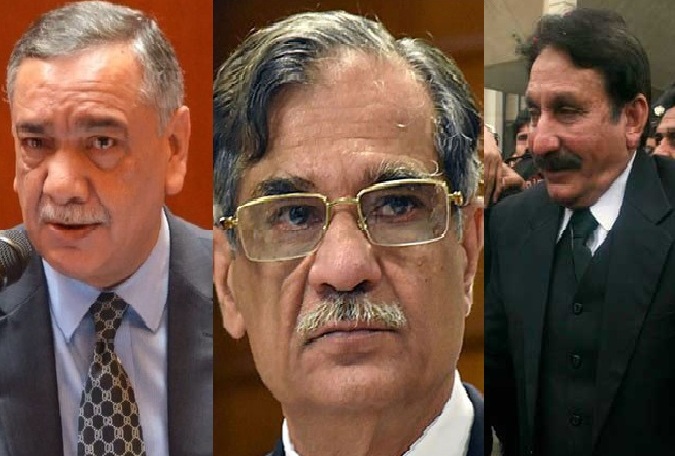
With Chief Justice of Pakistan (CJP) Asif Saeed Khan Khosa retiring and Justice Gulzar Ahmed being sworn in as the new top judge, The Current brings for you a personality quiz to find out which of the most popular CJPs are you.
[forminator_quiz id=”42802″]Tag: Pakistan
-
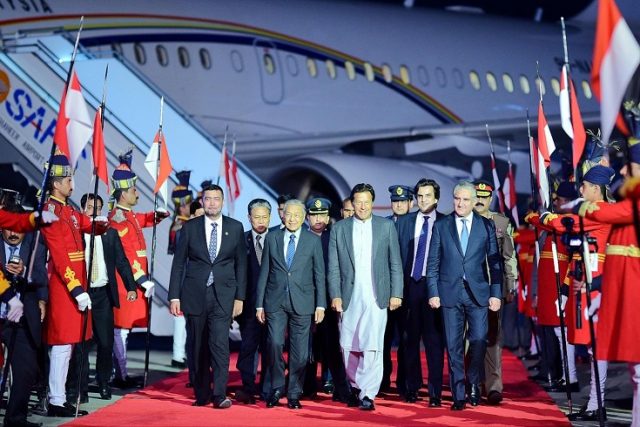
Muslim world should build its own market, technologies: Malaysian PM at summit skipped by Imran
Muslim-majority countries should build their own markets and produce their own technologies to become self-sufficient, Malaysian Prime Minister (PM) Mahathir Mohammad has said during the ongoing Kuala Lumpur Summit that was skipped by Pakistan.
“There are 1.7 billion Muslims. Obviously this is a big market if we decide to source our needs from Muslims and Muslim countries. Then we enrich ourselves,” he said while stressing the importance of technological and industrial progress in national development.
According to Anadolu Agency, the Malaysian premier said that Muslim countries did not have enough products by themselves and had to source most of their needs from other countries, as a result of which money flowed out.
“When money flows out, we become poor. But if we source, the things that we need from Muslim countries, then obviously our wealth will stay within the Muslim community, and we become richer,” he said.
“That is why among the things that should solve problems of Muslims is to build a market and produce the things and source them from each other but it is important we learn how to produce our own things,” he added.
He underlined that Muslim nations “will forever be playing catch-up” with the rest of the developed world “if we do not start creating and developing our own technologies.”
“We have no choice but to start working on this,” he said.
The three-day Kuala Lumpur Summit is ongoing in the Malaysian capital with the attendance of hundreds of government officials and representatives from civil society and business sectors from across the Muslim World.
While the Malaysian premier’s statements are much similar to those made by his Pakistan counterpart, Imran Khan, Islamabad has pulled out of the conference over concerns it could “divide” the Muslim world.
Pakistan’s Gulf allies, Saudi Arabia and the United Arab Emirates (UAE), had earlier expressed reservations over the country joining the summit, following which Foreign Minister Shah Mahmood Qureshi had confirmed that neither he nor PM Imran would be attending the summit.
“Pakistan pulled out of the summit due to concerns by Saudi Arabia that the meeting could create a new bloc that would rival the existing 57-member state Organisation of Islamic Cooperation (OIC),” he had said.
-
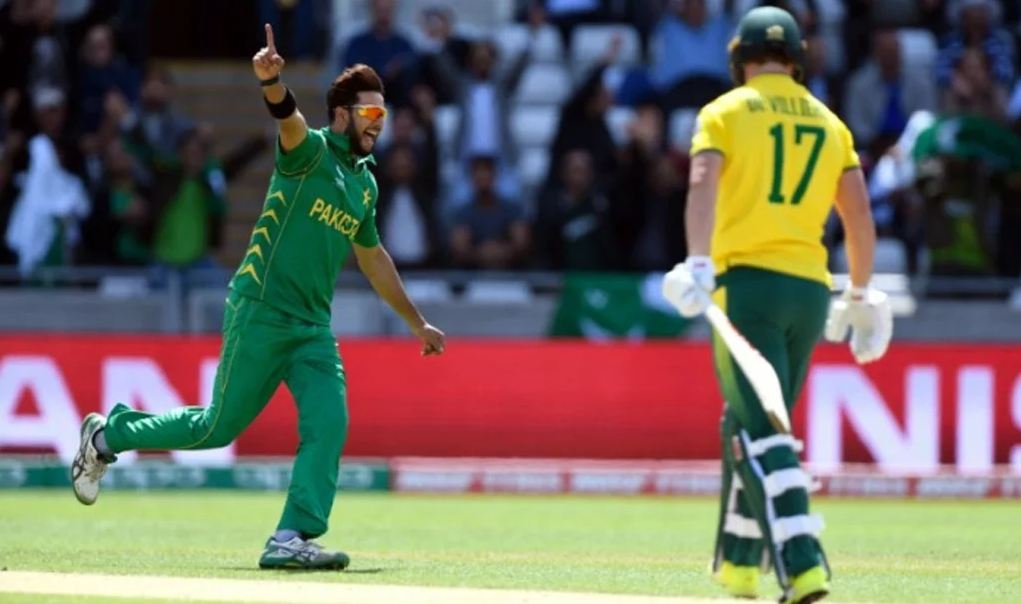
South Africa to visit Pakistan for T20 series in March
Cricket South Africa (CSA) has announced that it will be sending its team to Pakistan for the T20I series in March next year, a private news outlet has reported.
According to the details, the news was revealed by Pakistan Cricket Board (PCB) chief Wasim Khan, during a press conference ahead of the Pakistan-Sri Lanka’s 2nd Test match in Karachi.
The T20 series between Pakistan and South Africa is expected to take place after the Pakistan Super League (PSL).
Wasim Khan said, “The CSA has accepted our invitation and agreed to send their team to Pakistan next year to play three T20Is, most probably in March immediately after the PSL”.
Wasim also hoped that all the top South African players will visit to the country with the team and expects good news in the next few weeks’.
The official schedule is yet to be announced by the cricket board.
He further informed that Australia will be touring Pakistan in 2022 for a two-match Test series, however, the board is trying to convince Cricket Australia to play three matches instead of two.
-
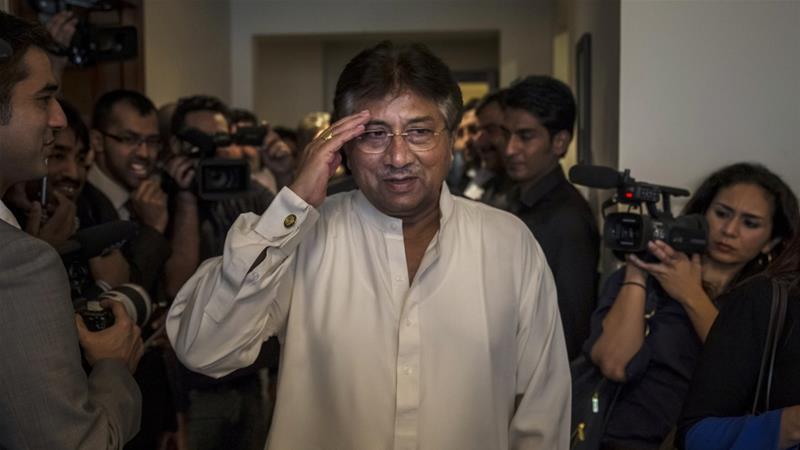
‘If found dead, Musharraf’s corpse should be dragged to D-Chowk, hanged for three days’
The special court that had earlier found former military ruler General (r) Pervez Musharraf guilty of high treason, on Thursday issued its detailed verdict, an excerpt of which has left Twitterati stunned.
“We direct the Law Enforcement Agencies to strive their level best to apprehend the fugitive/convict [Musharraf] and to ensure that the punishment is inflicted as per law and if found dead, his corpse be dragged to the D-Chowk, Islamabad and hanged for three days,” read the excerpt.
Here’s what Twitterati have to say about it:
The dooming excerpt was, however, a part of the dissenting opnion of one of the three judges, Justice Waqar Ahmed Seth. This was also confirmed by lawyer Reema Omer.
A copy of the detailed verdict has been handed to an official of the Ministry of Interior.
READ FULL VERDICT:
On Tuesday, the court had sentenced Musharraf to death for imposing a state of emergency on November 3, 2007, adding that it had found him guilty of high treason in accordance with Article 6 of the Constitution of Pakistan.
The case was heard by a bench comprising Justice Waqar Ahmad Seth of the Peshawar High Court (PHC), Justice Shahid Karim of the Lahore High Court (LHC) and Justice Nazar Akbar of the Sindh High Court (SHC).
The special court, in its detailed verdict authored by Justice Seth, stated that Musharraf “has been afforded more than his due share of fair trial” and “given every opportunity to defend himself”. The court said that “the facts of the case are well documented” and “clearly demonstrate the guilt on the part of the accused”.
“It proves beyond a shadow of reasonable doubt all the charges of High Treason levelled against the accused by the State,” the verdict adds.
“We, with the majority of 2 as to 1, allow the complaint and hold the accused guilty of high treason as defined at Article 6 of the Constitution and pass punishment under section 2 High Treason (Punishment) Act, 1973. Thus, the convict be hanged by his neck till he is dead,” it reads.
It was a majority verdict, with two of the three judges giving the decision against Musharraf.
-
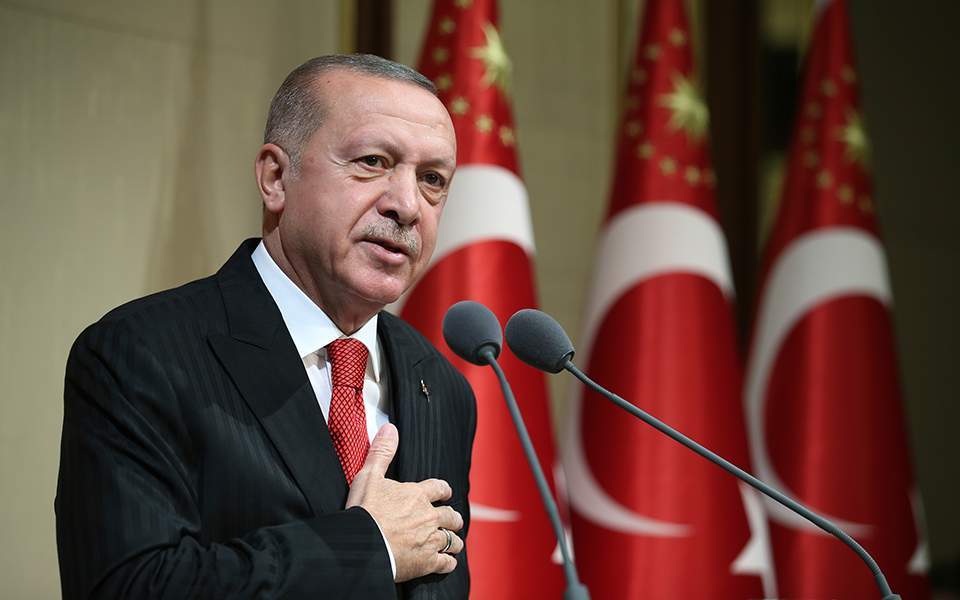
Fate of Muslims not in UN Security Council members’ hands: Erdogan at Kuala Lumpur Summit
Turkish President Recep Tayyip Erdogan on Thursday said that the fate of the world’s 1.7 billion Muslims was no longer in the hands of the five permanent members of the United Nations Security Council (UNSC).
According to Anadolu Agency, speaking at the opening ceremony of the Kuala Lumpur Summit in the Malaysian capital, Erdogan reiterated that the world was bigger than the five permanent UNSC members, whose veto power could prove catastrophic for smaller nations.
“The world is bigger than five” is a famous slogan repeatedly used by Erdogan to criticise the permanent council members that are China, France, Russia, the United Kingdom (UK) and the United States (US).
He also said that Turkey did not bow to pressure to silence it, including a coup attempt, economic terror and slander. “As they try to silence Turkey, we insist on calling attention to Palestine, Gaza, the Rohingya, Libya, Somalia, and Syria.”
Earlier at the opening ceremony, Qatari Emir Tamim bin Hamad Al Thani, Iranian President Hassan Rouhani as well as the host, Malaysian Prime Minister Mahathir Mohamad, delivered speeches.
Hundreds of government officials, businessmen, representatives of civil societies and experts from different sectors across the Muslim world, except Pakistan and Saudi Arabia, are taking part in the summit.
Islamabad reportedly decided not to participate in the moot after being told so by Riyadh.
-

VIDEO: Musharraf terms death penalty verdict as ‘personal vendetta’
Former military ruler General (r) Pervez Musharraf has said that the special court’s death sentence verdict against him was based on “personal vendetta”.
Musharraf in a recent video message released on Wednesday said, “I heard the special court’s verdict against me on television,” adding that “There is no example of such a verdict in the past where neither the defendant nor his lawyers were given permission to speak in his defence.”
Former dictator said that he had earlier offered to give his statement to a special commission if they visit him in Dubai, where Musharraf is currently undergoing medical treatment adding that “his request was ignored”.
Musharraf said that he respected the Pakistani judiciary and that, similar to Chief Justice Asif Saeed Khosa, he also believed that everyone was equal before the law.
“I call this verdict suspicious because supremacy of the law was ignored from the start to the end during the hearings of this case,” he added.
Musharraf said, “However, in my opinion, CJ Khosa showed his intentions and his determination to the public himself by saying that he ensured a speedy verdict in this case. How can the judges who gained personal benefits during my tenure issue a judgement against me?”
He thanked the Pakistani citizens and the country’s Armed Forces for remembering his services for the country.
“This is the biggest honour for me, which I will take to my grave,” he said, adding that he will announce his plan of action regarding the case after consulting his legal team.
-
Pakistani Hindus reject Indian offer for citizenship
Pakistan’s minority Hindu community has rejected India’s offer to grant them citizenship under a new law, a private media outlet reported.
Citing the harassment of minorities in Pakistan, Bangladesh, and Afghanistan, the Indian parliament recently amended its citizenship law, offering citizenship rights to Hindu, Buddhist, Christian, Parsi and Jain communities migrating from these countries.
The law, however, excluded Muslims, triggering mass protests across the country.
“Pakistan’s Hindu community unanimously rejects this bill, which is tantamount to dividing India on communal lines,” Raja Asar Manglani, patron of the Pakistan Hindu Council, told Anadolu Agency.
“This is a unanimous message from Pakistan’s entire Hindu community to Indian Prime Minister [Narendra] Modi. A true Hindu will never support this legislation,” he said.
He added that the law has violated India’s own constitution.
Anwar Lal Dean, a Christian member of the Pakistani parliament’s upper house or Senate, also said the law is meant to pitch religious communities against each other.
“This is a clear violation of fundamental human rights. We categorically reject it,” said Dean, a leader of the opposition Pakistan People’s Party.
“Through such unjust and uncalled steps, the Modi government wants to pitch religious communities against each other,” he said, citing scrapping of Jammu and Kashmir’s longstanding special rights law, Indian Supreme Court’s judgment on Babri Mosque, and growing violence against minorities in India.
Pakistan’s tiny Sikh community has also denounced the controversial law.
“Not only Pakistani Sikhs but the entire Sikh community in the world, including those in India, also condemn this move,” said Gopal Singh, leader of the Baba Guru Nanak.
“The Sikh community is a minority both in India and Pakistan. Being a member of a minority, I can feel the pain and the fears of the Muslim minority [India]. This is simply persecution,” he said.
Singh urged Modi not to push minorities “back to the wall.”
While introducing the citizenship law, Indian Home Minister Amit Shah told parliament that non-Muslim population in Pakistan has alarmingly decreased over the years.
He said the minorities comprised 23% of Pakistan’s population in 1947, when it was formed. “But now it has decreased to a mere 3.7%,” he said, adding that this means either they have been killed, migrated or forced to convert their religion.
The official figures available with the Pakistan Census, however, contest his claims.
The minority population was never 23% in the then-West Pakistan (present-day Pakistan).
According to the 1961 census, the non-Muslim population was recorded at 2.83%. A decade later in 1972, the census recorded non-Muslim population at 3.25% of the total population. That means, it increased by 0.42%.
In the 1981 census, the non-Muslim population was 3.30%. In the next census carried out in 1998, it was recorded as 3.70% of the total population.
Though Pakistan carried out a fresh census in 2017, its religious data has yet to be released. However, according to Pakistan Hindu Council leader Manglani, Hindus make up 4% of the total 210 million population. Nearly 80% of Hindus — Pakistan’s largest minority — inhabit the southern part of the Sindh province.
Pakistan’s government has accused India’s government led by Bharatiya Janata Party of toeing the ideology of “Hindutva Supremacy.”
“The Modi government continues to curb and undermine the rights of minorities in accordance with Hindutva supremacist ideology,” Foreign Minister Shah Mahmood Qureshi said in a series of tweets on Monday.
“Illegal annexation of Kashmir, [handing over of] Babri Masjid [to Hindus], and [the] Citizenship Amendment Bill which excludes Muslims, are all targeted towards subjugation of minorities,” he added.
Condemning the use of force against students protesting against the controversial bill in different parts of India, Qureshi said: “Concerned about the brutal and indiscriminate use of force by the state on Indian Muslim students of Jamia Millia Islamia and Aligarh Muslim University, protesting against the Citizenship Amendment Bill.”
Pakistan’s main opposition leader Shehbaz Sharif too decried the Modi government for stifling the voice of dissent through state force.
“Disturbing news and images emanating from India. The state fascism being perpetrated on students of Jamia Millia Islamia and Aligarh Muslim University, is a reminder that Modi’s hatred of Muslims is ideologically driven,” he said in a twitter post.
-
‘Who’s trying to save their dad?’ Bilawal asks PM Imran
A day after the government announced to review the death sentence awarded to former military ruler General (r) Pervez Musharraf, Pakistan People’s Party (PPP) chief Bilawal Bhutto-Zardari has taken a dig at Prime Minister (PM) Imran Khan by asking him that “who was trying to save their father”.
“Who is running a ‘Save the Dad’ (abbu bachao) campaign?” the chairman of the country’s second-largest opposition party said in a tweet that apparently came in response to Pakistan Tehreek-e-Insaf (PTI) ministers and the premier himself repeatedly calling out Bilawal and Pakistan Muslim League-Nawaz (PML-N) leader Maryam Nawaz for launching “Save the Dad” campaigns.
On Tuesday, a special court awarded death sentence to former military dictator Musharraf in absentia for suspending the constitution on November 3, 2007.
While the counsel for the convict and the armed forces’ media wing in separate statements strongly criticised the decision that they said was taken “in haste”, opposition parties maintained that “justice had prevailed”.
Meanwhile, Special Assistant to the Prime Minister (SAPM) on Information and Broadcasting Firdous Ashiq Awan has said that the government will “review in detail” the ruling.
“We will review in detail, today’s verdict as well as yesterday’s,” Dawn quoted her saying on Tuesday. She further said that legal experts would analyse all legal and political aspects as well as the impact on national interests, after which a government statement would be presented to the media.
In response to a question about whether the government will bring Musharraf back to Pakistan, Awan said the government would assess the matter with its legal team. “The premier himself will look at the relevant ground realities and legal framework, following which a final decision will be taken.”
-
Pakistan ranked 151 out of 153 in gender equality index: WEF
According to the Gender Equality Index report of the World Economic Forum, Pakistan stood 151 out of 153. The only two countries below Pakistan are Iraq and Yemen.
Though grand claims have been made about improving educational opportunities for youth, empowerment of democracy and the betterment of health facilities in the country, all have been shattered after the INGO placed Pakistan at number 150 in the list of economic participation and opportunities, 143rd in education attainment, 149th in health and survival and 93 in political empowerment globally.
While Pakistan stood 112th in 2006, the standing has drastically slipped to 151 in the the last 14 years.
The report highlights that there is a huge gap of 32.7 percent between men and women in the context of economic opportunities. The gap has also widened to 94.6pc – which means that women do not have the same facilities in comparison to men.

On the contrary, Bangladesh ranked 50, followed by Nepal 101, Sri Lanka 102, India 112, Maldives 123 and Bhutan 131.
-
Sri Lankan commentator Russel Arnold becomes a Biryani fan
Famous Sri Lankan cricket commentator Russel Arnold has become a fan of Karachi’s biryani. The former cricketer is now in Karachi with the ICC’s official commentators’ team for the second Test match between Pakistan and Sri Lanka.
Russel took to Twitter to express his love for biryani, stating Karachi as the ‘Biryani Capital’ of the world.
Unsatisfied with a single plate, Russel even hit an extra session in the gym to eat some more biryani.
The arrival of Sri Lankan cricket team has marked the return of Test cricket in Pakistan. With the first Test match in Rawalpindi being washed out by rain, everybody is now waiting for Karachi Test that will decide the series.
The matches are scheduled from December 19 (Wednesday) to December 23 (Monday) at the National Stadium, Karachi.