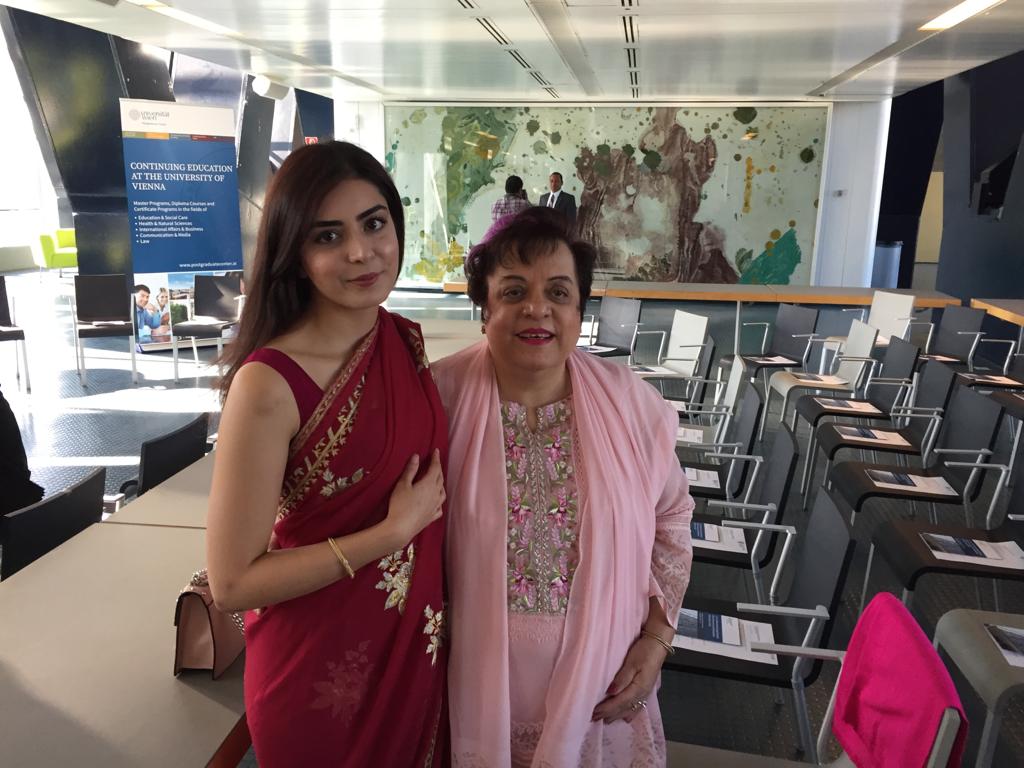
Federal Minister for Human Rights Shireen Mazari’s daughter, Imaan Zainab Mazari-Hazir, criticised the Pakistan Tehreek-e-Insaf (PTI) government in a tweet earlier today.
“If the country was to be run by magic, then why is the money of this nation being wasted on such a large cabinet,” Imaan tweeted.
“The country is being ridiculed due to witchcraft and you don’t want people to talk about those who practice magic. This will not happen,” she added.
اگر ملک کو جادو ٹونے سے ہی چلانا تھا تو پھر اس قوم کا پیسہ اتنی بڑی کابینہ پر کیوں ضائع ھو رہا ہے۔
ملک کا مذاق جادو ٹونے سے اڑایا جا رہا ہے اور آپ چاہتے ہیں کے جادو کرنے والوں پر بات بھی نا ہو۔۔۔ ایسا تو ہر گز نہیں ھو گا
Shireen Mazari responded to her daughter’s tweet for criticising the government without any proof. “I am ashamed you would resort to such low personalised unsubstantiated attacks esp since as a lawyer u shd know without any proof hurling such accusations is defamation. When all substantive issue-based criticism fails this level of a base personal attack is plain shameful,” the minister tweeted.
I am ashamed you would resort to such low personalised unsubstantiated attacks esp since as a lawyer u shd know without any proof hurling such accusations is defamation. When all substantive issue-based criticism fails this level of a base personal attack is plain shameful. https://t.co/drbLN5bq9w
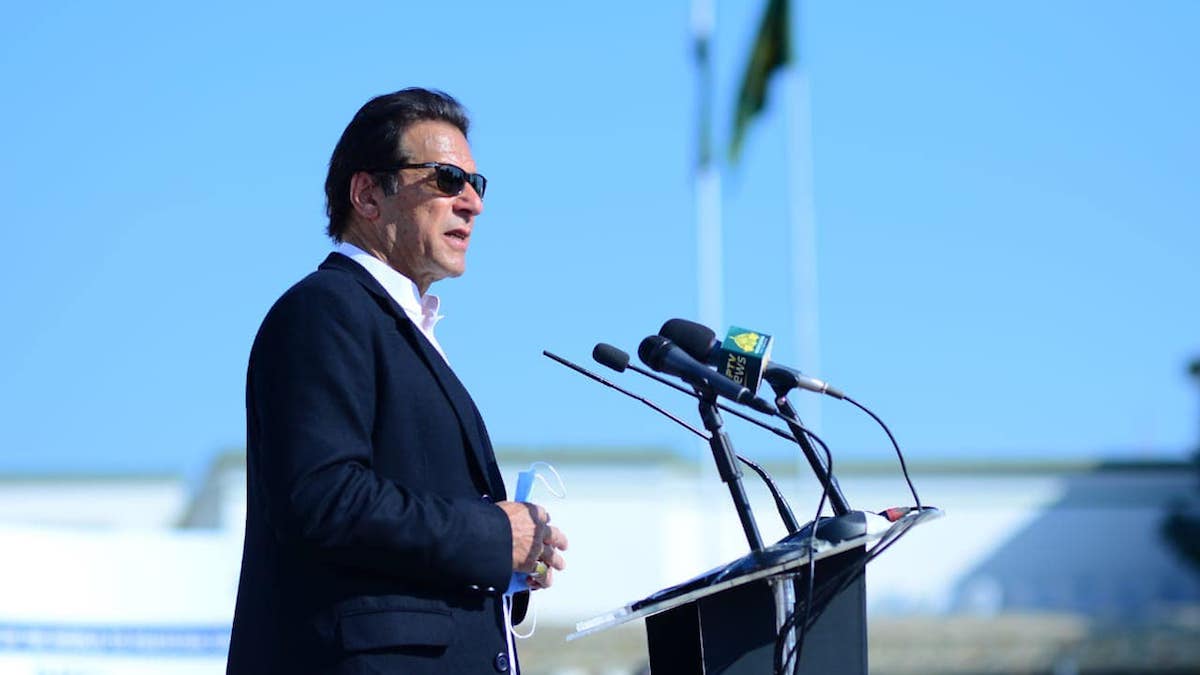
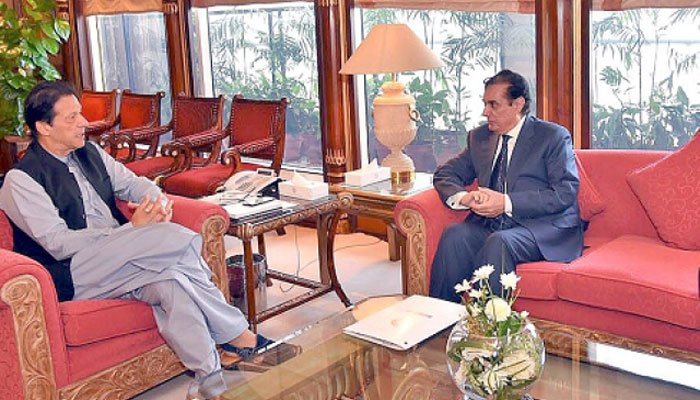
According to sources, a meeting was held in Islamabad under the chairmanship of Prime Minister (PM) Imran Khan to review the rising inflation and the overall economic situation in the country. The impact of the rising prices of petroleum products was also discussed in the meeting.
During the meeting, PM Khan issued orders to the federal ministers to take steps for the implementation of Price Control Committees.
The premier also directed the ministers to keep an eye on the artificial price hike in their constituencies and to take strict measures against hoarders
Addressing a news conference on Monday, Minister for Planning and Development Asad Umar said the government had decided to reduce GST rate and customs duty by half to 8.5 per cent and would abolish 2 per cent additional customs duty to cut cooking oil prices by Rs45 per kilo.
According to details, PM Khan will take his party members into confidence on important national issues. According to sources, several party members protested on being called for the meeting by the chief whip of the PTI, Malik Aamir Dogar.
Adviser to the Prime Minister on Parliamentary Affairs Babar Awan said that a summary for the joint session had been sent to the president by the Ministry of Parliamentary Affairs.
All party Members of the National Assembly (MNA) and senators are directed to attend the meeting.
وزیراعظم عمران خان نے تحریک انصاف کی پارلیمانی پارٹی کا ہنگامی اجلاس آج پارلیمنٹ ہاوس میں طلب کر لیا۔ وزیراعظم اہم سیاسی و قومی امور پر پارلیمانی پارٹی کو اعتماد میں لیں گے۔ تمام ارکان قومی اسمبلی اور سینیٹرز کو شرکت کی ہدایت۔
— Rizwan Ghilzai (Remembering Arshad Sharif) (@rizwanghilzai) October 14, 2021
It is likely that the government’s bill of electoral reforms, including the introduction of electronic voting machines and I-voting facility for overseas Pakistanis, and an ordinance concerning the powers of the National Accountability Bureau (NAB) will be tabled today in parliament, as per Geo News.
Special Assistant to Prime Minister (PM) on Political Communication Dr Shahbaz Gill said that no one can become Nawaz Sharif. “Such people are born this way,” said Gill while responding to Maryam Nawaz’s earlier comments about PM Khan. Maryam Nawaz had said that PM Imran Khan should not try to be Nawaz Sharif.
“These people are dangerous for the entire nation,” Gill said in a press conference, along with the Minister of State for Climate Change Zartaj Gul and Member of the National Assembly (MNA) Maleeka Bokhari.
While criticising Maryam Nawaz, Gill stated, “No one is safe from Maryam’s shadow, including her father [Nawaz Sharif] and her uncle [Shehbaz Sharif].”
“If you are talking about magic, tell us what kind of djinns helped you transfer your money abroad, tell us about the witches who helped you build these apartments [in London], which djinns and witches printed dollars for you to buy these apartments,” asked Gill, responding to Maryam’s comments about magic.
According to PM Khan, this initiative will bring improvement in the living standards of the public and his government is trying to change priorities to uplift unprivileged families.
While talking about the previous governments, he said that they had flawed policies which left behind the marginalized segments of the society and said that this project should have been launched 74 years ago.
“We made a huge mistake 74 years ago. We believed that we would make Pakistan a welfare state after there was prosperity and wealth in the country. The thought — that there needs to be surplus first and then we (government) will invest in the poor — I believe these were fundamentally wrong decisions,” said the premier.
Referring to China’s ideology, the PM said that Beijing took measures to facilitate the low sectors of people and became a developed country within 35 years.
The programme will be rolled out in phases. During the first phase, the loans will be provided to the deserving families in Gilgit-Baltistan, Azad Jammu Kashmir (AJK), Balochistan, Khyber Pakhtunkhwa (KP) and the underprivileged areas of Punjab and Sindh.
Under this, the government will provide Rs1.4 trillion micro-loans to 3.7 million households across the country.
This scheme has five components Kamyab Kissan, Kamyab Karobar, Naya Pakistan low-cost housing, Kamyab Hunarmand and Sehatmand Pakistan.
It also includes a user-friendly portal called Kamyab Pakistan Information System (KPIS). The portal will be integrated with Ehsaas and National Database and Registration Authority (NADRA) databases for verification of beneficiaries’ eligibility.
The rupee has been sliding down for the past many weeks and dollar is touching Rs170. This wave of devaluation has sparked speculation of further depreciation in the coming days. Should we be panicking and start hoarding dollars?
Probably not.
If anything, this is perfectly in line with market fundamentals. The reasons behind the current spell of depreciation are primarily the rising trade deficit and to some extent, the Afghanistan situation. Our imports have risen sharply in the last few months — predominantly due to rising international commodity prices such as for oil, gas, coal, steel, etc.
Some increase in imports can also be attributed to recovering economy fuelled by fiscal and monetary stimulus. In simpler terms, as the government injected more money into the market through the Covid stimulus package and other means and maintained interest rates at a low level, the demand increased leading to rebounding growth.
But with growth recovery, the demand for imports also increased, widening the trade deficit. Moreover, some of the recent increase in imports can also be attributed to the vaccine imports, the phenomenal increase in demand for automotive, capital imports under Temporary Economic Refinance Facility (TERF), etc.
What impact should the trade deficit and current account deficit have on the exchange rate?
As soon as the current IMF programme started, the government switched to a market-determined exchange rate. Notwithstanding the reports of some intervention by the State Bank in the market, the market-determined regime does not give the flexibility to the central bank to maintain the exchange rate at an artificial level. This in fact is the right strategy for a country like Pakistan, so that its hard-earned forex reserves are not burnt to preserve the exchange rate, indirectly subsidising imports at the cost of scoring political brownie points. The exchange rate, therefore, took the hit, and the rupee devalued.
But for now, the threat of any further significant devaluation is not in sight. The devaluation itself has made the imports expensive. In addition, the government is also considering increasing regulatory duty on luxury imports to further dampen the demand for these items. These measures are complemented by a change in monetary stance — an increase of 25 basis points, which is likely to be followed by further increases in the future — and passing on the energy price increases. All these measures are expected to immediately reign in the rising current account deficit. Hopefully, the current spell of rising international commodity prices should also be over in the next 6 to 9 months, further supporting an optimistic medium-term outlook.
But under this cyclical trend, lies the political economy of devaluation in Pakistan.
What we must understand is that historically the rupee has only gone down against the dollar and that’s the direction it will maintain in the medium-term, notwithstanding any short-term reverse movements. The reason for this perpetual devaluation is the underlying balance of exports and imports. Pakistan is a country with high imports and low exports. The difference is bridged through precious foreign exchange, earned from remittances, foreign direct investment, and external loans. Historically, the rupee has depreciated against the dollar by approximately 7 per cent per annum to account for the perpetual supply and demand gap. This gradual devaluation is in fact absolutely essential for Pakistan until the export composition and volume change significantly.
During PML-N’s tenure, we followed the managed float exchange rate regime. The then finance minister artificially maintained an overvalued exchange rate and pumped in foreign exchange in the market, whenever the demand for dollars increased. An overvalued exchange rate made exports expensive and imports cheaper, thus further widening the trade deficit. The industry suffered but the traders were happy. The citizens enjoyed quality imported goods at cheaper prices, not realising that they would have to pay the price later on. Therefore, as a result of artificially maintaining the exchange rate at an abnormally low level, our reserves took a serious hit, while imports continued to increase. This prompted a balance of payment crisis and necessitated the present IMF programme. Such an approach was economically disastrous.
If we don’t want to repeat the same mistake, we should be open to gradual devaluation depending on the current account balance. To manage the CAD, the fiscal and monetary policies have to work in tandem. It’s prudent to go slow and steady than to overheat the engine and lead to yet another balance of payments crisis.
The Ministry of Law and Justice has reportedly been preparing a summary to send to the Prime Minister (PM) Imran Khan regarding the extension of sitting Chairman of the National Accountability Bureau (NAB) Justice (redtd) Javed Iqbal, reported Malik Asad for Dawn.
The four-year term of Justice Iqbal as NAB chairman will expire this month. A senior official of the ministry has confirmed that they will send the proposal to the PM soon.
However, the government hasn’t taken a final decision yet. According to an official, in the proposal, the declaration of an ordinance for giving extension has been suggested.
“In case the PM decides to grant an extension to the chairman, the law ministry will draft an ordinance to amend the National Accountability Ordinance (NAO) and forward it to the president,” the sources said.
If PM agrees, an amendment will be made in sub-section b of Section 6, which states, “There shall be a Chairman NAB to be appointed by the President in consultation with the [Leader of the House and the Leader of the Opposition in the National Assembly] for a [non-extendable] period of [four] years on such terms and conditions as may be determined by the President and shall not be removed except on the grounds of removal of Judge of Supreme Court of Pakistan.”
Earlier, Information Minister Fawad Chaudhry said, “The government has decided not to consult Opposition Leader Shehbaz Sharif for the appointment of NAB chairman since he (Sharif) is accused in several corruption references filed by the bureau.”
Later, Pakistan People’s Party (PPP) chairman Bilawal Bhutto Zardari tweeted that PPP will forcefully oppose the illegal extension in the tenure of chairman NAB.
Pakistan Muslim League Nawaz (PML-N) president Shehbaz Sharif, in a press conference, said that the National Accountability Bureau (NAB) and Niazi [Imran Khan] nexus is a fixed match and Federal Investigation Agency (FIA) is also working on the government’s directions.
Talking about UK’s National Crime Agency (NCA) recent decision to unfreeze Sharif’s and his family account, he stated, “I was sent to jail twice during the last three years. The government failed to prove corruption against me and my children so they approached the agency.”
He claimed that the PTI-led government has been levelling fake allegations against him and his family for last over three years and said that the rulers had only wasted the nation’s time. “Those who are pretending themselves to be Sadiq and Ameen spent millions of rupees to defame me” he added.
According to him, the UK agency had asked the court that they wanted to end investigations and the UK court approved the request, as per Geo.
Earlier, the UK court had ordered the unfreezing of bank accounts for lack of evidence of corruption and money laundering.
Defamation case against Daily Mail
About the defamation case against UK’s newspaper, he clarified that he lodged a defamation case against the Daily Mail and asked it to provide evidence against him. But the Daily Mail is yet to submit evidence in the case.
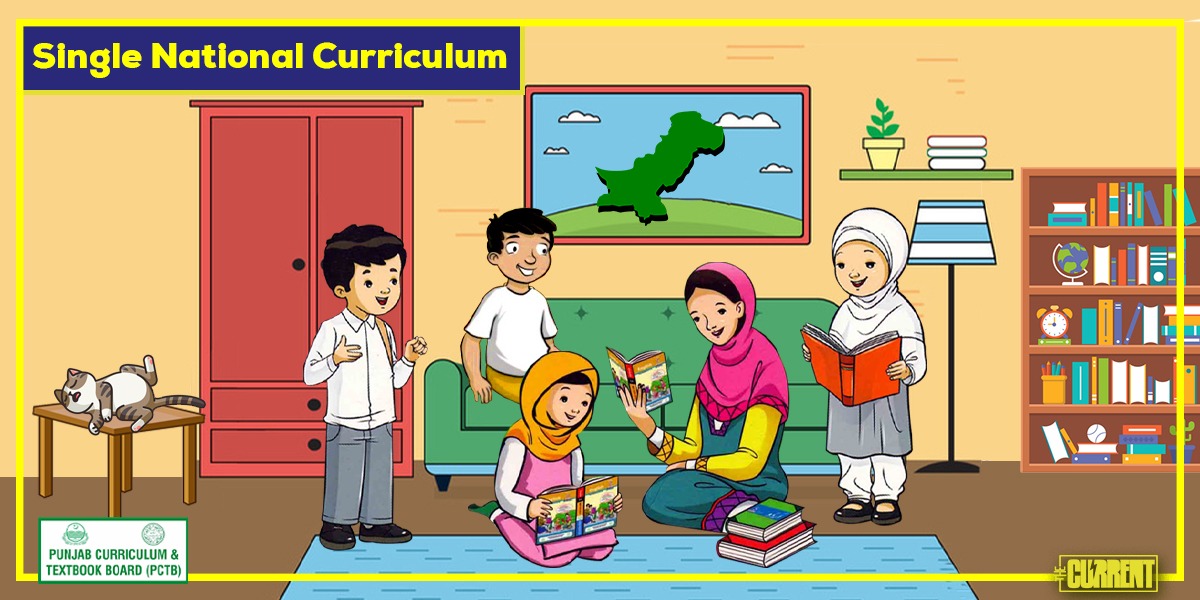
On August 16, 2021, Prime Minister Imran Khan officially launched the Single National Curriculum (SNC). The newly launched curriculum was prepared by the National Curriculum Council (NCC) and the Ministry of Federal Education, in consultation with the provinces. According to PM Khan, “SNC would transform the nation into a unified one.”
What is SNC?
According to the Ministry of Federal Education and Professional Training, the SNC is a ‘uniform’ system of education, which means the same curriculum for everyone. All public schools, private schools, and madrassas were meant to have the same curriculum so that the learning outcomes are similar and without any discrimination in teaching standards. This is not the first time SNC was imposed in Pakistan. It was previously introduced in 2006 by Former President Musharraf. Whereas the previous SNC was a curriculum-based initiative, the one introduced by the PTI government is imposing the use of the textbooks produced by the provincial boards.
Is it being implemented across the country?
No. Sindh has decided not to implement the curriculum since education is a provincial issue. Only Punjab and Khyber Pakhtunkhwa have enforced it so far. However, many schools in both provinces — including the prestigious Aitchison College, Lahore — expressed their concerns over the books in the curriculum. The Director of the National Curriculum Council (NCC), Dr Mariam Chughtai, has also said that madrassas will implement the SNC syllabus in five to six years, which undermines the reason why the government had wanted to introduce the SNC in Pakistan – to bring madrassas into the mainstream so students would be able to get jobs in other professions after they graduated.
Controversies surrounding the SNC
After the SNC syllabus was imposed on schools across Punjab, many controversies surrounding the books and the curriculum came forward. From the disparity in gender representation, the reinforcement of patriarchal gender roles, the lack of female heroes, and religious texts in the non-religious books.
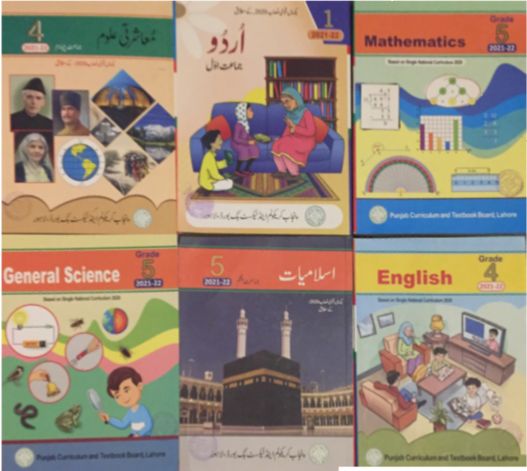
To see if the criticism is valid, The Current analysed the following books published under the Punjab Textbook Board (PTB):
Urdu books from grades 1 to 5, English books from grades 1-5, Mathematics books grades 1, 2, 4, and 5, General Science grades 4-5, Waqfiyat Aama grade 1 and 3, Social Studies 4-5, and Islamiat grade 1- 5.
Two books were not available at the time of research. Grade 3 Math and Waqfiyat Aama grade 2, which have not been included in the study.
The analysis here has been divided into two parts.
Part one comprises the data analysis of all the books included in the SNC by the Punjab Text Book board.
Part two comprises the data analysis of individual subjects being taught to the students.
We studied the total number of male and female representations in the books, a comparison of the eastern and western wear of both genders, the presence of religious (Islam and others) content in non-religious books, and studying the distribution of power roles assigned to both men and women.
Here is the list of most common criticism against the curriculum and the evidence we found:
SUMMARY OF CONTENT IN ALL SNC BOOKS
1- Disparity in Gender Representation:
One of the most debatable points in the entire SNC is the representation of men and women.
After a thorough evaluation, we found that the concerns about the disparity in gender representation are TRUE.
The study reveals that a total of 60.2 percent of the books have images of men, including boys and only 39.4 percent of the books have images of women, including girls.
2-Women represented in hijab vs non-hijab, and women in western clothes:
What the women are wearing became a source of contention in the discussion about the SNC, with critics suggesting that the women should equally represent the country in terms of the hijab, eastern clothes, and the choice to wear western wear.
It is TRUE that there is no equal representation of women’s appearance in the books.
Women’s appearance was divided into three categories.
A) Number of women wearing eastern clothes with hijab.
B) Number of women wearing eastern clothes without hijab.
C) Number of women wearing western clothes.
Our research shows that 41.6% of all women and girls in the SNC books are wearing a hijab, 28.9% are wearing eastern clothes without a hijab, and 29.4% of the images show girls wearing western wear. It is important to note that in the western wear percentage, almost all of the images are of young girls. Older women are not shown wearing western wear.
3-Men represented in eastern vs western clothes:
Since the appearance of women in eastern wear and hijab became controversial, we also studied how many times men appeared in western or eastern wear.
A massive 79.9 percent of men were seen wearing western clothes, in comparison to 20 percent dressed in eastern clothes.
4- More men in ‘power roles’ compared to women:
Another controversy suggested that the books did not show women in positions of ‘power’, and they were mostly listed as helpers or homemakers. While there were many images that showed women in ‘inferior roles’ to men, there were women that were shown in roles of power.
This controversy is TRUE.
We defined power roles shown in the books as doctor, pilot, lawyer, police officer, traffic warden, army sports personality, etc and after analysing all the books, we found that a men are given power roles three times more than women. The results in the graphic below are based on the total number of images shown of men and women in all the SNC Punjab books.
I
5. Religious content in non-religious books
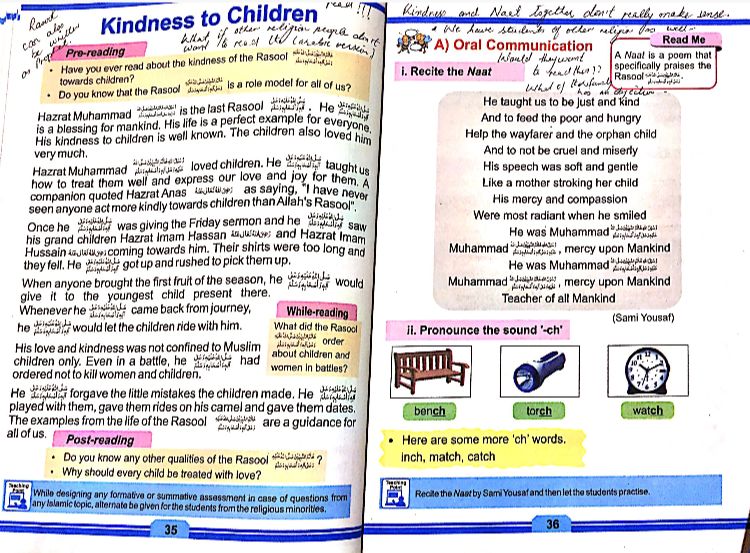
In almost all the books which were studied, we saw the presence of religious references or mentions in non-religious books. Minorities felt their rights were being compromised since books that are not for religious studies should not have references to a specific religion, which may come under the context of ‘preaching’.
In our analysis, we saw a total of 7.77 percent of religious text in all SNC non-religious books, which lends TRUTH to the fact that there is religious content in non-religious books.
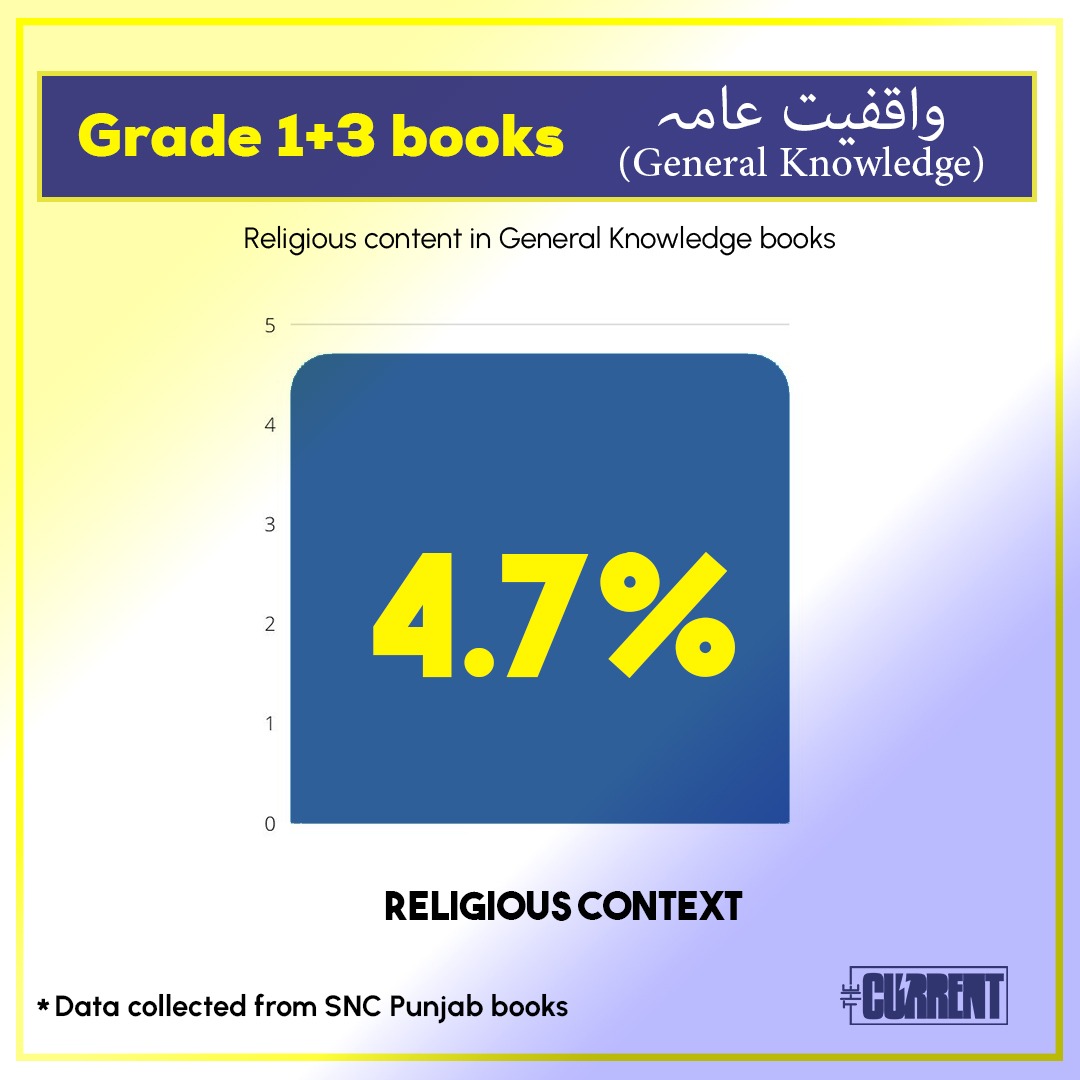
Religious content is present in 7.7 percent of English, Math, Social Studies, Urdu, Science, and General Knowledge books.
7.47 percent of books have references to Islam while 0.27 percent mention other religions in all non-religious books.
Dr Mariam Chughtai, while answering a question for The Current about the religious references in non-religious books, did not provide a clear answer but stated that these are model books that require changes.
SNC BOOKS ANALYSIS – SUBJECT ANALYSIS
This section of the report comprises an analysis of individual subjects being taught to students. The subjects under study were, Urdu books from grades 1-5, English books from grades 1-5, Mathematics books grades 1, 2,4, and 5, General Science grades 4- 5, Waqfiyat Aama (General Knowledge) grades 1-3, Muashrati Uloom (Social Studies) grades 4-5.
The graphical representation of the subject-wise evaluation is as follows:
English:
In 668 pages of English books, 58.1 percent have male representation while females have 41.8 percent.
29.7 percent of women are seen with Hijab and 70.2 percent are without Hijab.
There is a total of 9.8 percent presence of religious text in English books. This is based on the total number of pages in English books.
Mathematics:
In 672 pages of the Math books, when gender representation was analysed, 51.1 percent of the books have male representation and 48.8 percent have female representation.
A total of 53.9 percent of females are seen without hijab and 46 percent are seen wearing hijab.
The Math books have a 4.1 percent presence of religious text. This is based on the total number of pages in Math books.
Urdu:
The five Urdu books comprising 791 pages. A total of 59.7 percent presence of males are seen as compared to 40.4 percent of females.
58.5 percent of women/girls are seen wearing hijab and 41.4 percent are seen without hijab.
12.8 percent of religious text is present in Urdu books. This is based on the total number of pages in Urdu books.
General Science:
Out of 310 pages, 76.8 percent have male representation as compared to 23.1 percent female representation.
64 percent of women/girls are seen without hijab and 36 percent of women/girls are seen with hijab.
The General Science books have a 0.96 percent presence of religious content. This is based on the total number of pages in Science books.
Waqfiyat Aama (General Knowledge):
49.5 percent of male images are seen in comparison to 50.15 percent of females.
23.1 percent of females are seen with hijab and 76.8 percent without hijab.
There is a 4.7 percent presence of religious text in the books studied. This is based on the total number of pages in General Knowledge books.
Muasharti Uloom (Social Studies):
From 234 pages analysed, 65.1 percent of men/boys are represented in the books and 34.8 percent of females are shown.
36.8 percent of females are seen without hijab and 63.1 percent are seen with hijab.
10.2 percent of religious content is present in the books. This is based on the total number of pages in Social Studies books.
The last portion of the report highlights the pros and cons, which we have observed in almost all the books. We have provided both positive and negative outcomes deduced from the books after careful analysis.
The positive outcome deduced from the books:
1. The books are locally published and designed. The books are affordable, with a total set for one grade set at Rs. 800 per child according to Dr Chughtai.
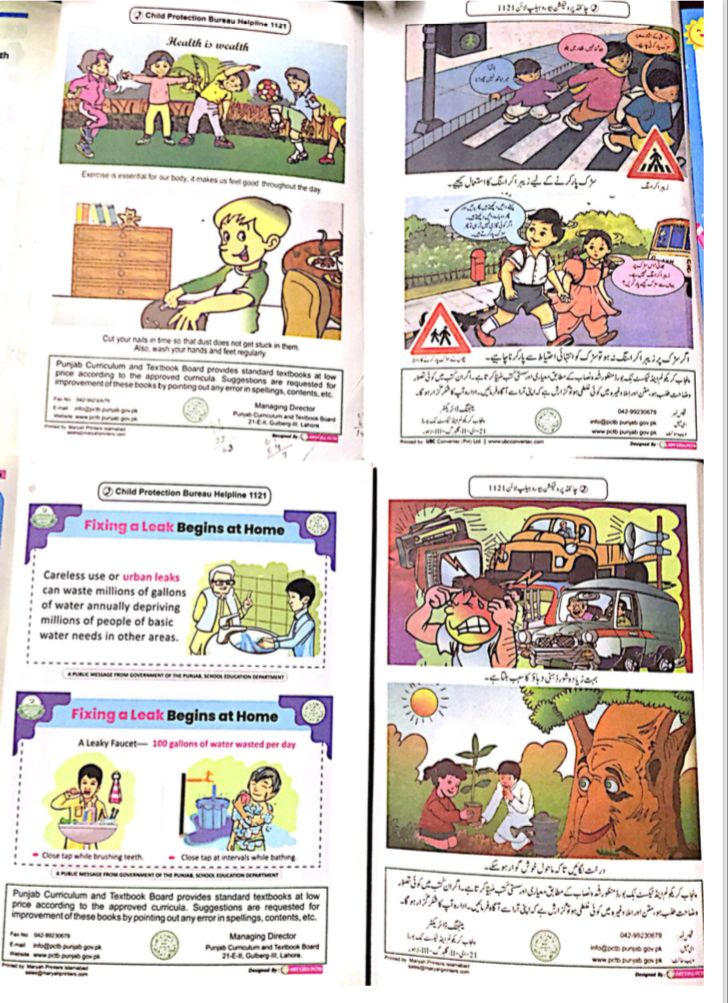
2. There is a public service message printed at the end of each book to raise awareness against talking to strangers, crossing the road, exercising, and even information about fighting dengue.
The possible negative impact of the books
1. After analysing the books, we deduced that mostly nuclear families have been shown in the books. No representation of single parents or children being raised by guardians is seen. Moreover, the presence of both parents is seen as almost essential in all stories in the books.
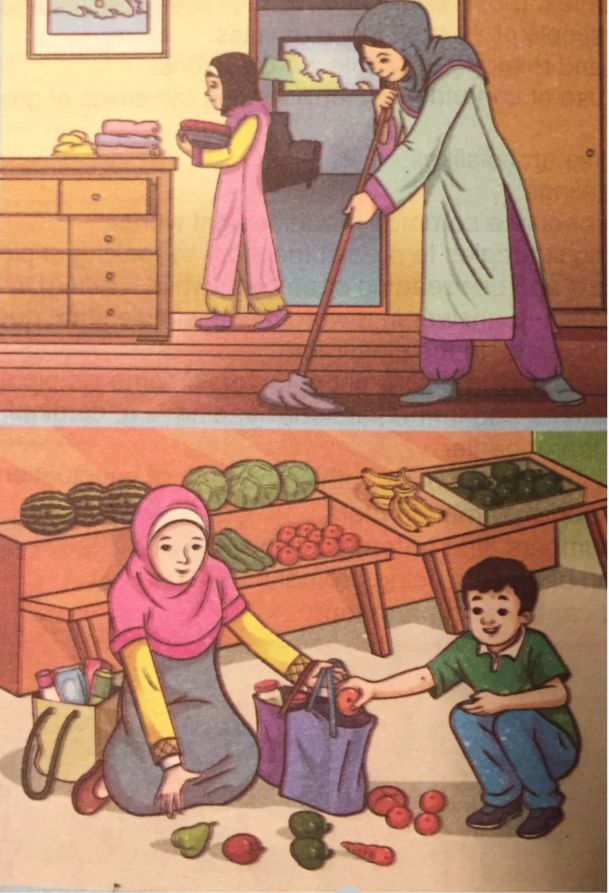
2. Women are mostly shown doing domestic work, taking care of the family, and looking after their children. In stories as well, they seem to come second to their male counterparts.
3. As discussed in detail above, there is the presence of religious text in non-religious books.
4. The stylisation of the books are difficult to understand, fonts and texts are way too clustered. The quality of the pages is not refined, making them unattractive and confusing for students.
CONCLUSION:
According to NCC director, Dr Chughtai, the curriculum is an evolving process and the books can be changed in future publications, based on the response by schools and parents. The biggest hurdle to the books is that the teachers have not been trained in teaching these new books and according to Dr Chughtai, it is up to the school to teach and implement the books. There are no worksheets given with the books and from initial student reactions, students are confused and wary of books that are laid out in a clustered fashion. There is also the subject of a language change. Where students study general knowledge, a precursor to Science, in Urdu, they switch to difficult English in grades 4-5.
While the government should be commended in trying to create a national syllabus, the forced enforcement of the books along with the lack of supplemental information and training will make this very difficult for teachers and students. Moreover, parents should be given a choice as to what they want their children to study. This implementation should be a free choice rather than that of enforcement. What would have been a practical approach is that the government should have improved the structure of the government/public schools, provided better teacher training, spent more on financially improving the conditions rather than lowering the standard for all.
*Graphics credits: Asma Ahmad (Graphic Designer)
How did we collect the data?
The percentage of male characters in the books: Divided the total number of male by the total number of characters. The percentage of female characters in the books: Divided the total number of female by the total number of characters.
The percentage of Islam: Divided the Islamic pictures or references given in the books by the number of total pages of all books. The percentage of other religion: Divided the other religions pictures or reference given in the books by the number of total pages of all books.
The percentage of female power roles: Divided the number of female by the total number of characters (female and male). The percentage of male power roles: Divided the total number of male by the total number of characters (female and male).
The same process/calculation/method was applied to the findings of each book.
“Just like this fake government, its vaccination record and entry data for vaccines is also fake,” said Pakistan Muslim League-Nawaz (PML-N) Vice President Maryam Nawaz when asked about the issue of fake vaccination data for Nawaz Sharif uploaded by National Database and Registration Authority (NADRA) portal. Maryam said she is concerned that the wrong entry of vaccination data can be an international embarrassment for Pakistan.
Maryam was talking to the media after she appeared before the Islamabad High Court (IHC) in a case against her conviction in Avenfield reference.
اگر یہ آپکا سسٹم ہے اگر اس طرح سے آپکا اندراج کیا جارہا ہے تو انکی نااہلی پہ اسکا انٹرنیشنل رد عمل آسکتا ہے جس پہ مجھے تشویش ہے.اس حکومت کی ہر چیز کی طرح انکا جو ویکسی نیشن کا اندراج ہے وہ بھی جعلی ہے.@MaryamNSharifpic.twitter.com/TqwlDKTI7j
Nawaz Sharif, who is currently in London for medical treatment, has received first dose of Sinovac vaccine in Lahore as per the data uploaded on NADRA portal. As per reports, this false information was entered using Nawaz Sharif’s CNIC at Government Kot Khawaja Saeed Hospital.