Tag: State Bank of Pakistan

  • Pakistan’s debt burden increases by Rs86.28 billion within seven days

    Pakistan’s debt burden increases by Rs86.28 billion within seven days

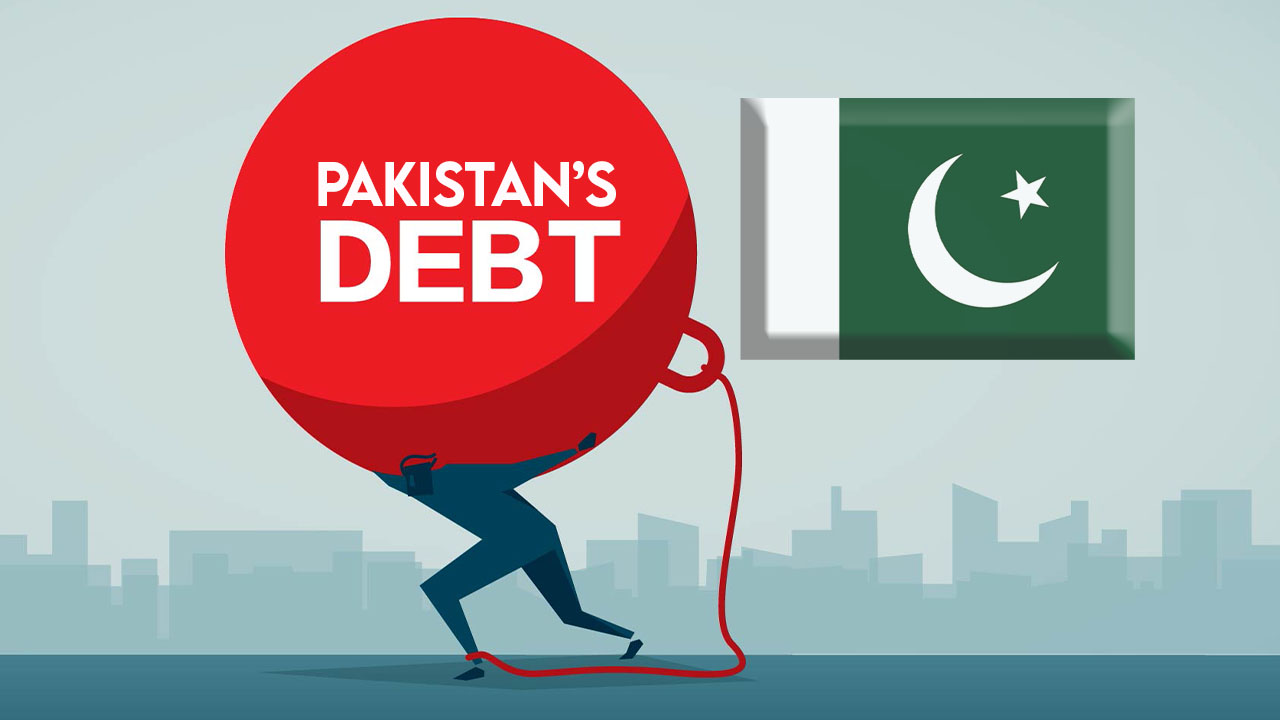
    In the week ending January 12, the government of Pakistan increased its debt burden by Rs86.28 billion, bringing the total net borrowing for the ongoing fiscal year 2024 to Rs2.57 trillion, as per the latest estimates from the State Bank of Pakistan (SBP).

    The government’s borrowings fall into three main categories: budgetary support, commodity operations, and others.

    The breakdown of the weekly net borrowing reveals that Rs87.7 billion was allocated for budgetary support, while Rs1.37 billion went towards retiring commodity operations.

    Additionally, Rs48.4 million was used for other purposes during the week.

    Cumulatively, this brings the borrowing figures for the fiscal year 2024 to Rs2.77 trillion for budgetary support, Rs193.72 billion for retiring commodity operations, and Rs1.1 billion for other purposes.

    The primary sources of financing for budgetary support are the State Bank of Pakistan and the Scheduled Banks. In the ongoing fiscal year, the government has repaid a net sum of Rs1.05 trillion to the central bank.

    The Federal Government accounted for Rs954.56 billion of this repayment, while the Provincial Government, AJK Government, and GB Government contributed Rs77.73 billion, Rs11.17 billion, and Rs2.05 billion, respectively.

    On the other hand, scheduled banks have extended a net total of Rs3.81 trillion in loans. The Federal Government borrowed Rs3.9 trillion, while the Provincial Government repaid Rs90.41 billion during this period.
  • Pakistani rupee gains 6 paisa against US dollar, closes at Rs279.79

    Pakistani rupee gains 6 paisa against US dollar, closes at Rs279.79

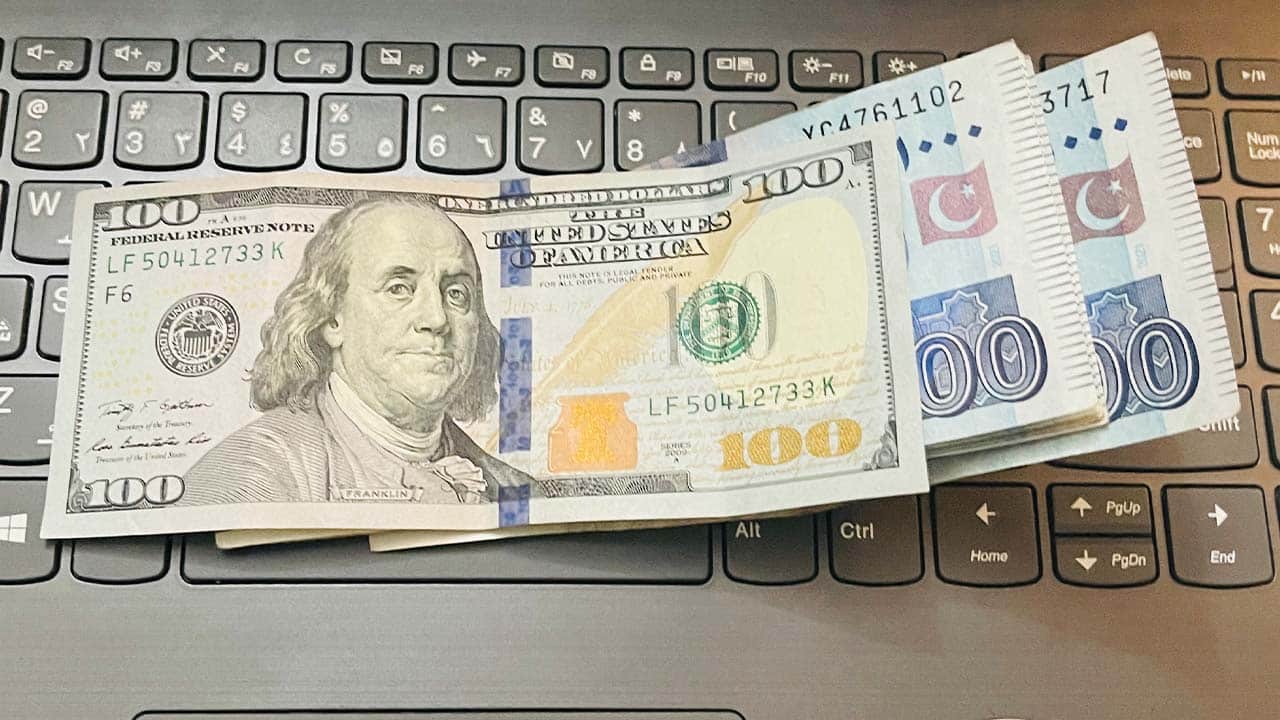
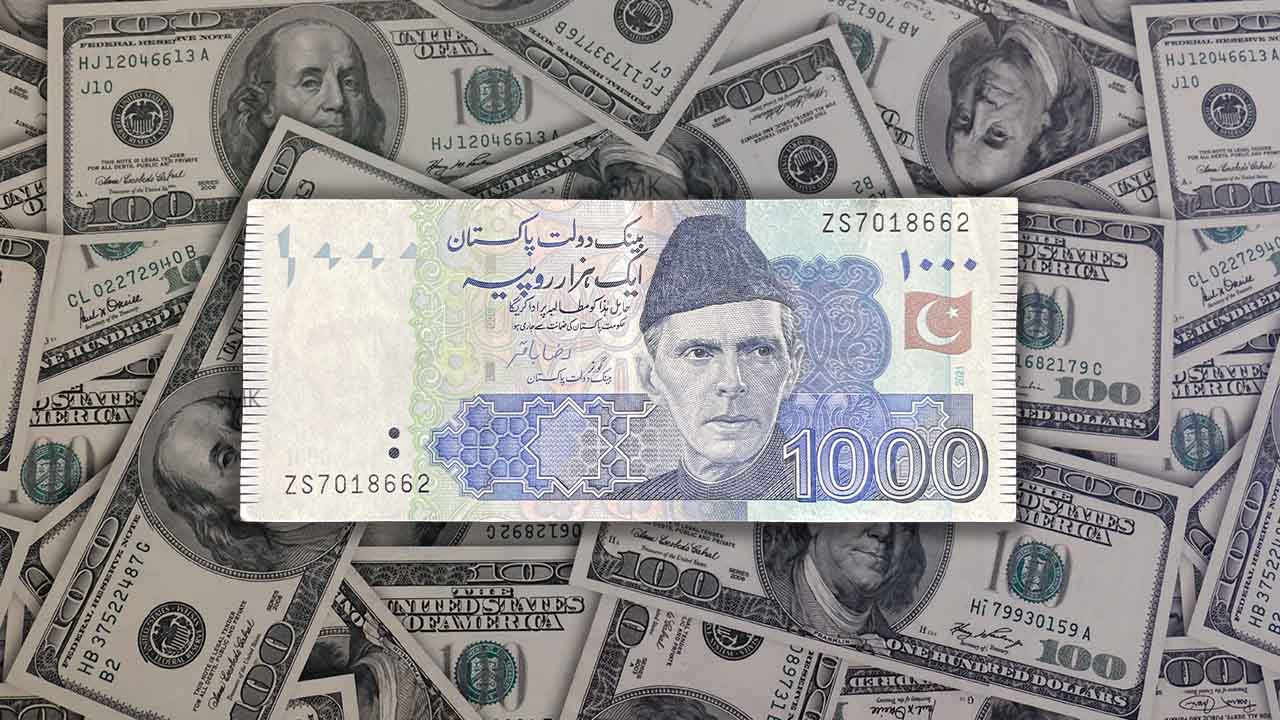
    The Pakistani rupee (PKR) continued its upward trend against the US dollar (USD) for the fifth consecutive session, appreciating by 0.02 per cent in the interbank market on Tuesday.

    Closing at Rs279.79, the local unit gained Re0.06 against the greenback.

    This follows Monday’s positive performance, where the rupee settled at 279.85 against the US dollar.

    A notable development on the economic front is the government’s active pursuit of a government-to-government (G2G) agreement with Saudi Arabia and the United Arab Emirates (UAE) for upfront foreign currency repatriation against future workers’ remittances. 

    Both Saudi Arabia and the UAE hold significant importance as countries contributing to foreign exchange through remittances from Pakistani workers. 

    Meanwhile, on the global stage, the US dollar experienced a slight easing, resulting in a 0.07 per cent increase in sterling, reaching $1.2720.

    Compared to major currencies, the Pakistani currency depreciated by 18.84 paisa against the Euro, closing at Rs305.03, as opposed to the previous value of Rs304.84.

    The British Pound strengthened, increasing by 1.02 rupees and closing at Rs356.34, compared to Rs355.33 from the previous day.

    The Swiss Franc exhibited gains of 54.58 paisa, concluding at Rs322.62, in contrast to the previous session’s value of Rs322.08.

    Against the Japanese Yen, PKR experienced a decrease of 0.98 paisa, closing at Rs1.8993 compared to Rs1.8895 a day ago.

    Conversely, the Chinese Yuan appreciated by 13.91 paisa, closing at Rs39.03 against the previous session’s Rs38.89.

  • Pakistani rupee shows marginal strength, gains 4.51 paisa against US dollar

    Pakistani rupee shows marginal strength, gains 4.51 paisa against US dollar

    In Monday’s interbank session, the Pakistani rupee (PKR) exhibited a slight appreciation of 4.51 paisa against the US dollar (USD), settling at PKR 279.85 per USD, compared to the previous closing of PKR 279.9 per USD. The intraday fluctuations showed a bid high of Rs280.1 and an ask low of Rs279.8.

    In the open market, exchange companies quoted the dollar at 279 for buying and 281 for selling. Notably, Pakistan received the second installment of SDR 528 million, equivalent to $705.6 million, from the International Monetary Fund (IMF) last week. 

    The first review report under the standby arrangement emphasised the importance of market-determined exchange rates and the gradual development of the foreign exchange (FX) market.

    Against major currencies, the PKR experienced fluctuations:

    Euro: lost 37.07 paisa, closing at 304.84 compared to the previous value of 304.47.

    British Pound: increased by 39.06 paisa, closing at 355.33 compared to 354.94 from a day ago.

    Swiss Franc: Saw losses of 20.03 paisa, closing at 322.08 compared to 322.28 in the previous session.

    Japanese yen: lost 0.19 paisa, closing at 1.8895 versus 1.8876 a day ago.

    Chinese Yuan: Lost 2.38 paisa, closing at 38.89 against 38.91 from the previous session.

    Saudi Riyal: Closed at 74.62 with a loss of 1.2 paisa from its value of 74.63 a day ago.

  • Interbank closing: PKR gains 8 paisa to close at Rs279.9 versus USD

    Interbank closing: PKR gains 8 paisa to close at Rs279.9 versus USD

    The Pakistani rupee (PKR) strengthened by 8.24 paisa against the US dollar (USD) in Friday’s interbank session, concluding the trade at PKR 279.9 per USD, surpassing the previous session’s closing rate.

    The local currency experienced an intraday high (bid) of Rs280.4 and a low (ask) of Rs279.9.

    In the open market, Exchange Companies quoted the dollar at Rs279.5 for buying and Rs281 for selling.

    Comparatively, against major currencies, the PKR gained 20.17 paisa against the Euro, closing at Rs304.47 in contrast to the previous value of Rs304.67. 

    The British Pound became more affordable by 30.06 paisa, concluding at Rs354.94 compared to Rs355.24 a day earlier. 

    The Swiss franc incurred losses of 1.38 rupees, settling at Rs322.28 compared to Rs323.66 from the previous session.

  • Pakistan’s forex reserves witness a dip of $127 million

    Pakistan’s forex reserves witness a dip of $127 million

    In a recent report, it was revealed that the foreign exchange reserves held by the State Bank of Pakistan (SBP) experienced a decline of $127 million during the week ending January 12, settling at $8.03 billion.

    The country’s total liquid foreign reserves, including those held by commercial banks, amounted to $13.15 billion. Specifically, commercial banks held net foreign reserves of $5.12 billion.

    The SBP attributed the reduction in reserves to debt repayments, stating, “During the week ending on January 12, 2024, the SBP’s reserves decreased by US$ 127 million to US$ 8,027.4 million due to debt repayments.”

    Notably, the previous week had also seen a decrease in Pakistan’s central bank reserves, amounting to $66 million.

    In a significant development, Pakistan received a tranche of $705.6 million from the International Monetary Fund (IMF), as confirmed in a statement by the SBP on Wednesday.

    The central bank stated, “The SBP has received SDR 528 million (equivalent to $705.6 million) on January 16, 2024, from the IMF following the successful completion of the first review by the Executive Board of the IMF under Standby Arrangement (SBA).”

    The impact of this disbursement will be reflected in the central bank reserves for the week ending January 19.

  • SBP receives second IMF installment, total disbursements reach $1.9 billion

    SBP receives second IMF installment, total disbursements reach $1.9 billion

    The State Bank of Pakistan (SBP) announced today that it has successfully received the second installment of SDR 528 million, equivalent to $705.6 million, from the International Monetary Fund (IMF).

    This disbursement, slated to be reflected in SBP reserves for the week ending on January 19, 2024, marks a significant step in the ongoing financial collaboration between Pakistan and the IMF.

    The latest disbursement brings the total disbursements under the stand-by arrangement (SBA) to a substantial $1.9 billion.

    It is noteworthy that the remaining $1.1 billion is expected to be received after another comprehensive review scheduled for February 2024.

    As of January 5, 2024, the State Bank of Pakistan’s total reserves stand at $8.15 billion, showcasing the positive impact of the financial support received through the IMF programme.

    To recall, Pakistan secured a $3 billion SBA from the IMF towards the end of FY23, crucially preventing the nation from defaulting on its sovereign debt.

    The disbursement of the IMF funds has been phased out over two installments, subject to meticulous reviews.

    On January 11, 2024, Pakistan successfully completed the first review of the economic reform programme, a significant milestone in ensuring the country’s financial stability.

    Following the board’s approval, the IMF highlighted that economic activity has stabilised, though acknowledging that the outlook remains challenging and is contingent on the implementation of sound policies.

    Pakistan’s 9-month SBA aims to provide a robust policy anchor for addressing both domestic and external balances, serving as a framework for continued financial support from multilateral and bilateral partners.

    This financial collaboration with the IMF is instrumental in navigating Pakistan through economic challenges, providing a solid foundation for sustained growth and stability in the region.

    The country remains committed to implementing prudent economic policies as outlined in the reform programme, with the ongoing support of international partners.

  • Pakistani rupee edges up against US dollar, marks 0.5% gain at closing

    Pakistani rupee edges up against US dollar, marks 0.5% gain at closing

    The Pakistani rupee exhibited a modest uptick of 0.1 per cent against the US dollar during the initial trading hours on Wednesday in the inter-bank market.

    At approximately 10:40 am, the local currency stabilised at Rs280.

    However, at the time of closing, the PKR experienced further appreciation against the US dollar, increasing by 0.05 per cent.

    According to the State Bank of Pakistan (SBP), the rupee concluded at Rs280.1, marking an increase of Re0.15 against the US dollar.

    In contrast, on the preceding day, the rupee experienced a dip, settling at Rs280.25 against the US dollar, as reported by the State Bank of Pakistan.

    Internationally, the US dollar index maintained a one-month high on Wednesday, propelled by comments from Federal Reserve Governor Christopher Waller that tempered expectations of a March rate cut. 

    Consequently, market projections for a March rate cut decreased from 76.9 per cent to 62.2 per cent, according to CME’s FedWatch Tool.

    Although the current market pricing aligns the Fed rate curve more reasonably, there are still a notable 157 basis points of rate cuts anticipated for 2024, suggesting potential for further adjustment.

    The dollar index, gauging the greenback against major currencies, concluded at 103.35, having reached 103.42 in the previous session—the highest level since December 13.

  • Pakistan records $397 million current account surplus as exports, remittances increase

    Pakistan records $397 million current account surplus as exports, remittances increase

    In December 2023, Pakistan’s current account exhibited a noteworthy surplus of $397 million, a stark departure from the $15 million deficit recorded in November, as reported by the State Bank of Pakistan (SBP) on Wednesday. 

    This surplus is attributed to heightened exports and remittances, coupled with a marginal decline in imports. Notably, there was a substantial improvement compared to the $365 million deficit posted in December 2022.

    According to SBP data, exports (goods and services) surged to $3.526 billion in December 2023, marking a 14 per cent increase from $3.089 billion in December 2022. Concurrently, remittances rose to $2.38 billion, a 13 per cent marginal increase from the same period last year. 

    Conversely, total imports saw a 2 per cent decrease, totaling $4.97 billion in December 2023, compared to $4.98 billion in the corresponding period last year.

    In the cumulative period of July–December FY24, Pakistan experienced a current account deficit of $831 million, a substantial reduction from the $3.63 billion deficit recorded during the same months in FY23—a remarkable decline of over $2.8 billion, or 77 per cent. 

    The SBP, in its recent Monetary Policy Committee meeting on December 12, highlighted a significant improvement in the current account balance, with the deficit narrowing by 65.9 per cent year-on-year to $1.1 billion during July-October FY24.

    The current account’s pivotal role is underscored by its impact on Pakistan’s economy, which is heavily reliant on imports. 

    A widening deficit exerts pressure on the exchange rate and depletes official foreign exchange reserves, making these recent developments crucial for the nation’s economic outlook.

  • PKR sustains positive momentum, gains 0.04% against US dollar in ninth consecutive session

    PKR sustains positive momentum, gains 0.04% against US dollar in ninth consecutive session

    In the inter-bank market, the Pakistani rupee continued its positive trend against the US dollar for the ninth consecutive session on Monday, appreciating by 0.04 per cent to settle at Rs280.24, reflecting a gain of Re0.12, according to the State Bank of Pakistan (SBP).

    During the preceding week, the Pakistani rupee sustained its upward movement, appreciating by Rs1.04 or 0.37 per cent against the US dollar, settling at 280.36 in the inter-bank market.

    This surge in value is attributed to the recent announcement of a staff-level agreement (SLA) between Pakistan and the International Monetary Fund (IMF) on the first review of the $3 billion Stand-by Arrangement (SBA). Consequently, the approval of the second tranche of the package ensued.

    The IMF Executive Board completed the first review of the SBA last week, facilitating an immediate disbursement of $700 million.

    As of January 5, the foreign exchange reserves held by the State Bank of Pakistan amount to $8.15 billion, with expectations of further augmentation through IMF inflows.

    On the global front, the US dollar experienced a decline on Monday amid renewed anticipations of a Federal Reserve rate cut in March.

    Simultaneously, the Chinese yuan faced challenges, hovering near a one-month low ahead of forthcoming economic data releases.

    The likelihood of a Fed cut in March gained traction following unexpected December data indicating a decline in US producer prices, prompting a slide in US Treasury yields. The US dollar index remained stable at 102.50, exhibiting minimal fluctuations in recent sessions.

    In the realm of oil prices, a significant indicator of currency parity, a slight uptick was observed on Monday. This movement was influenced by concerns over potential supply disruptions in the Middle East, following strikes by US and British forces aimed at preventing Houthi militia in Yemen from attacking ships in the Red Sea.

  • Pakistani rupee records 9th consecutive surge, gains Rs1.04 against US dollar

    Pakistani rupee records 9th consecutive surge, gains Rs1.04 against US dollar

    In the currency markets, the Pakistani rupee (PKR) maintained its winning streak for the 9th consecutive week, appreciating by 1.04 rupees against the US dollar.

    The local unit closed at PKR 280.36 per USD, showcasing resilience in the face of economic fluctuations. During today’s trading session, the PKR experienced fluctuations, reaching an intraday high bid of 279 and a low ask of 281.5.

    Exchange companies in the open market quoted the dollar at 279.15 for buying and 281.50 for selling, reflecting the ongoing strength of the PKR against the greenback.

    Notably, the PKR also demonstrated gains against major currencies, gaining 78.58 paisa against the Euro, closing at 307.85.

    The British Pound saw a decrease of 58.38 paisa, settling at 358.18, while the Swiss Franc experienced losses of 1.41 rupees, closing at 329.08.

    However, the Japanese yen posed a slight challenge, as the PKR lost 0.09 paisa, closing at 1.934 against 1.933 from the previous session.

    Overall, the PKR’s robust performance against the US dollar and several major currencies underscores the resilience and stability of Pakistan’s currency in the global financial landscape.