Tag: State Bank of Pakistan

  • Pakistan’s currency in circulation surges by Rs252.98 billion

    Pakistan’s currency in circulation surges by Rs252.98 billion

    The State Bank of Pakistan (SBP) has released provisional figures on Monetary Aggregates, revealing notable shifts in the country’s monetary landscape.

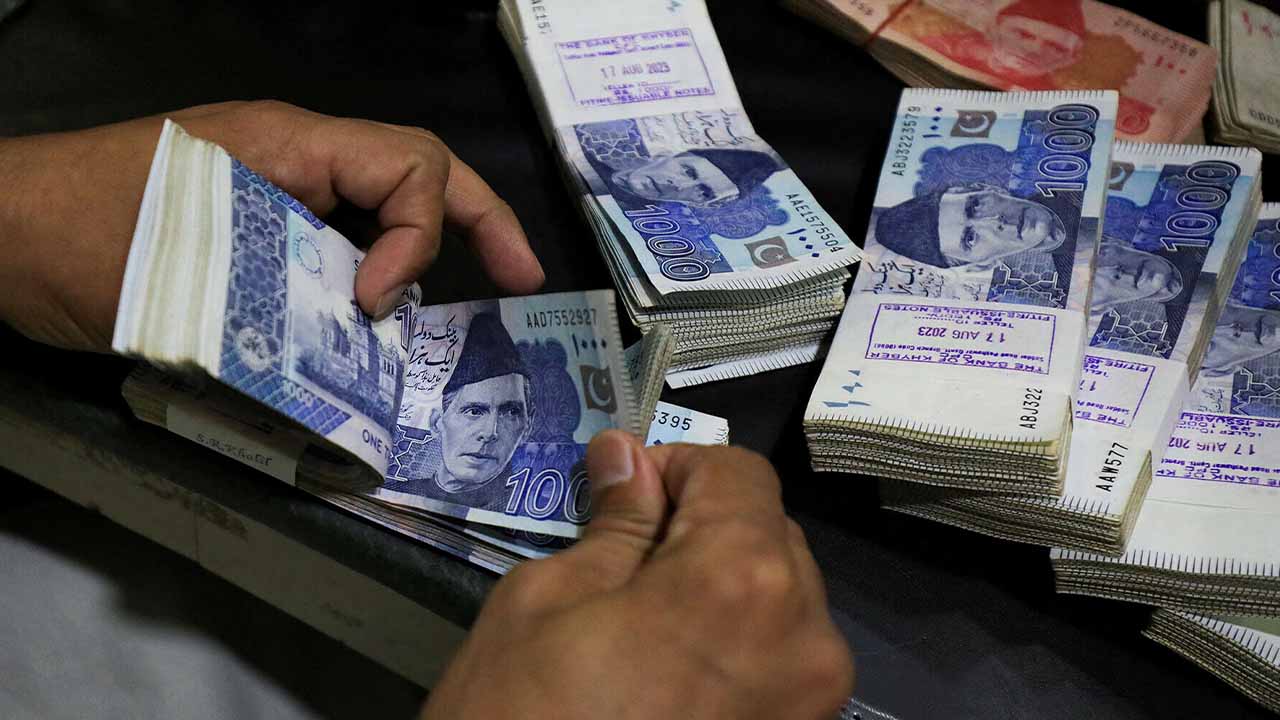
    As of March 8, 2024, the currency in circulation has seen a significant weekly increase, climbing by Rs252.98 billion to reach Rs8.66 trillion. This marks a substantial change within a short span.

    In contrast, the overall trend for the current fiscal year indicates a decrease in currency circulation, with a drop of Rs485.71 billion compared to the figure recorded at the end of June 2023, which stood at Rs9.15 trillion.

    Turning to broad money (M2), a key indicator of money supply in Pakistan, there has been a noteworthy decline of Rs206.59 billion week-on-week, bringing the total to Rs32.48 trillion by March 8, 2024.

    However, when juxtaposed with June 2023, M2 has experienced a significant increase, rising by Rs957.18 billion from the previous fiscal year’s end balance of Rs31.52 trillion.

    The ratio of currency in circulation to M2, a crucial metric for understanding liquidity dynamics, stood at 26.67%, indicating a slight uptick compared to the previous week’s 25.73% and a decrease from the June 2023 figure of 29.02%.

    Meanwhile, total deposits held with banks have shown mixed trends. The latest data reveals a weekly decrease of Rs468.69 billion, amounting to Rs23.69 trillion.

    However, on a fiscal year-to-date basis, there has been an overall increase of Rs1.43 trillion.

    It’s important to note that these deposit figures exclude certain categories such as inter-bank deposits, government deposits, and those from foreign entities.

    Currency in circulation encompasses the total value of banknotes and coins held by both the general public and financial institutions.

    In Pakistan, M2 serves as the primary measure of broad money, encompassing various forms of currency and deposits.

    From a liability perspective, M2 comprises currency in circulation, total non-government sector deposits (including resident foreign currency deposits), and other deposits held with the SBP.

    On the asset side, M2 includes the net domestic assets and net foreign assets of the banking system, incorporating both the SBP and scheduled banks.

  • SBP gears up for monetary policy meeting amid rate cut speculations

    SBP gears up for monetary policy meeting amid rate cut speculations

    The State Bank of Pakistan (SBP) has scheduled a meeting of its Monetary Policy Committee (MPC) for Monday, March 18, 2024, to deliberate on the nation’s monetary policy, as announced by the central bank on Friday.

    The SBP intends to release the Monetary Policy Statement on the same day, providing insights into its decision-making process.

    Anticipation looms as a prominent brokerage house foresees a noteworthy chance of the SBP reducing the key policy rate by 100 basis points (bps).

    Currently, the key policy rate stands at a historic high of 22 per cent.

    Arif Habib Limited (AHL) outlined in its recent report the likelihood of the SBP initiating a 100-bps cut in the upcoming policy, potentially marking the commencement of an interest rate reversal cycle.

    Despite Pakistan witnessing a decrease in headline inflation to 23.1 per cent year-on-year in February, as reported by the Pakistan Bureau of Statistics (PBS), down from 28.3 per cent in January, there are calls for cautious action.

  • SBP sees surge of over $17 million in forex reserves

    SBP sees surge of over $17 million in forex reserves

    The latest data released by the State Bank of Pakistan (SBP) revealed a notable rise in the country’s foreign exchange reserves. During the week ending March 8, 2024, SBP’s reserves increased by $17.2 million, marking a 0.22 per cent growth, reaching a total of $7.91 billion.

    Additionally, Pakistan’s overall reserves experienced a surge, ascending by $131.3 million, or 1.01 per cent, week-on-week (WoW), to a sum of $13.15 billion. This increase was further complemented by a rise in reserves held by commercial banks, which climbed by $114.1 million, or 2.23 per cent, to reach $5.24 billion.

    In a significant development, the second review of the stand-by arrangement (SBA) with the International Monetary Fund (IMF) is slated to take place from March 14 to 18, 2024. This review holds particular importance as it marks the final assessment under the SBA. Upon reaching a staff-level agreement, the final tranche of $1.1 billion will be disbursed, subject to approval by the Executive Board of the IMF.

    It is noteworthy that in the current fiscal year, Pakistan has witnessed a substantial increase in its total liquid foreign reserves, amounting to $3.99 billion, or 43.57 per cent. Similarly, the ongoing calendar year has seen a rise of $0.48 billion, or 3.77 per cent.

  • SBP reports marginal dip in bank deposits

    SBP reports marginal dip in bank deposits

    In January 2024, the total deposits held by scheduled banks in Pakistan experienced a robust year-on-year growth of 21.03 per cent, reaching Rs27.54 trillion.

    This marks a substantial increase from Rs22.75 trillion recorded in January 2023, as revealed by data released by the State Bank of Pakistan (SBP).

    However, on a month-on-month basis, there was a slight dip of 1.08 per cent in bank deposits compared to December 2024, where the total stood at Rs27.84 trillion.

    The data further highlights a positive trend in total advances, which saw a year-on-year increase of 3.74 per cent, reaching Rs12.09 trillion compared to Rs11.66 trillion in the same period last year.

     Conversely, on a monthly basis, advances experienced a marginal decline of 2.08 per cent from their December 2024 value of Rs12.35 trillion.

    The Advances to Deposit Ratio (ADR) exhibited a decrease, standing at 43.92 per cent, indicating a 732 basis points decline on a yearly basis and a 45 basis points decrease on a monthly basis.

    In terms of investments, scheduled banks in Pakistan reported total investments of Rs25.6 trillion in January 2024, reflecting a substantial year-on-year increase of 32.71 per cent from Rs19.29 trillion in January 2023.

    Additionally, there was a month-on-month increase of 1.28 per cent from the Rs25.28 trillion recorded in December 2024.

    The Investment to Deposit Ratio (IDR) witnessed a notable rise of 818 basis points, reaching 92.97 per cent, compared to the figures from January 2023. On a monthly basis, IDR increased by 216 basis points.

    These statistics indicate a significant positive shift in the financial landscape of Pakistan’s banking sector, with notable expansions in both deposits and investments.

  • FBR collects Rs5.15 trillion in taxes in less than eight months

    FBR collects Rs5.15 trillion in taxes in less than eight months

    The Federal Board of Revenue (FBR) has revealed that it has achieved a remarkable milestone by collecting revenue amounting to Rs5.15 trillion from July 2023 to mid-February 2024.

    This represents a substantial 30 per cent increase compared to the same period in the previous fiscal year, according to an official press release.

    The report indicates that the growth in tax revenue is attributed to a comprehensive strategy employed by the FBR, with a keen focus on both domestic and import taxes.

    Tax refunds during this period witnessed a substantial 28 per cent growth, further contributing to the positive financial trajectory.

    A breakdown of the month-wise revenue collection for the period from July 2023 to January 2024 reveals that overall growth in domestic taxes reached an impressive 40 per cent. Concurrently, import duty and related taxes experienced a significant uptick of 16 per cent.

    The surge in revenue collection aligns with the revival of the Gross Domestic Product (GDP) and increased scrutiny of FBR’s collection processes.

    However, growth in import taxes faced challenges, primarily due to downward adjustments in import tariffs over the years and recent restrictions on import licences imposed by the State Bank of Pakistan to address balance of payments concerns amid foreign exchange constraints.

    The report acknowledges that revenue collection from imports incorporates the impact of improvements in import valuations, resulting in an additional Rs151 billion in collections.

    Additionally, the anti-smuggling drive witnessed a substantial 69 per cent growth in the fiscal year compared to the previous year (FY 22–23).

    Despite these achievements, concerns were raised regarding the decline in the growth of import taxes. This decline is attributed to two main factors: the gradual reduction in import tariffs and recent restrictions on import licenses.

    The need for continued efforts in anti-smuggling activities was emphasised, particularly in Baluchistan, where the customs force currently consists of only 378 personnel.

    Strengthening the enforcement efforts by increasing personnel in this region was suggested as a potential solution.

    The report concludes on a positive note, highlighting that the revenue mobilisation from domestic taxes now accounts for over 64 per cent of the total revenues collected in the current financial year.

    Simultaneously, the share of import taxes has decreased to 36 per cent, marking a significant shift from the 50 per cent share observed just three years ago. This indicates a positive trend in the diversification of revenue sources for the FBR.

  • Factors behind the continuous decline in car financing in Pakistan

    Factors behind the continuous decline in car financing in Pakistan

    In January 2024, the automobile financing sector in Pakistan witnessed a significant downturn, as car financing recorded a notable decrease to Rs246.26 billion.

    This marks a 25.82 per cent year-on-year (YoY) decrease and a 1.98 per cent month-on-month (MoM) decrease compared to Rs331.98 billion in January 2023 and Rs251.25 billion in December 2023, respectively. The latest data from the central bank provides these insights.

    This decline in automobile financing extends to the nineteenth consecutive month, with a total decrease of Rs114.29 billion over the past 19 months.

    Several factors contribute to this decline, including higher interest rates, increased car prices, regulatory restrictions on acquiring loans, and elevated taxes on the import of automobiles and their parts.

    According to the State Bank of Pakistan (SBP) data, consumer financing for house building amounted to Rs207.62 billion by the end of January 2024.

    This reflects a 3.44 per cent YoY decrease compared to Rs215 billion in the same month last year. Looking at monthly changes, financing for house building saw a marginal 0.26 per cent MoM decrease compared to the previous month’s Rs208.15 billion.

    Financing for personal use stood at Rs243.1 billion, showing a 4.47 per cent YoY decrease and a 0.54 per cent MoM decrease.

    Consequently, the overall credit disbursed to consumers declined to Rs813.96 billion during the review month, registering a fall of 9.04 per cent YoY and 0.52 per cent MoM.

    The outstanding credit to the private sector also experienced a decline, decreasing by 0.76 per cent YoY to Rs8.35 trillion in January 2024. On a monthly basis, this represents a 2.21 per cent decrease compared to the credit of Rs8.54 trillion in December 2023.

    Analysing credit distribution to the private sector, loans to the manufacturing sector amounted to Rs4.81 trillion in the review period, showing a slight 0.33 per cent YoY increase. However, on a monthly basis, there was an 0.89 per cent MoM decline, as December recorded loans to this sector at Rs4.85 trillion.

    Borrowing from the construction sector stood at Rs190.15 billion in January 2024, experiencing a 0.97 per cent YoY decrease and a 5.05 per cent MoM decrease compared to the previous month.

    Looking ahead, the data indicates that loans to the agriculture, forestry, and fishing sectors rose to Rs397.27 billion in the month under review, marking a significant 16.95 per cent YoY increase.

    However, on a sequential basis, loans to this sector recorded a fall of 4.82 per cent MoM.

  • Pakistan records current account deficit of nearly $270 million

    Pakistan records current account deficit of nearly $270 million

    In the latest economic update, Pakistan has reported a current account deficit of $269 million for the month of February, according to data released by the State Bank of Pakistan (SBP).

    This shift is attributed to a notable decrease in exports coupled with a surge in imports.

    The data reveals that total exports experienced a 4.40 per cent month-on-month (MoM) decline, amounting to $3.37 billion in February, compared to $3.53 billion in the preceding month.

    However, on a year-on-year (YoY) basis, exports displayed positive growth, rising by 15.84 per cent from $2.91 billion in the corresponding month of the previous year.

    Conversely, total imports registered an 11.01 per cent MoM increase and a 21.33 per cent YoY surge, reaching $5.51 billion in February. This compares to $4.96 billion in December and $4.54 billion in January of the previous year.

    On a cumulative basis, the current account deficit for the first seven months of fiscal year 2023-24 (7MFY24) stands at $1.09 billion, showcasing a significant 71.21 per cent YoY improvement compared to the $3.8 billion deficit recorded in the same period of the previous fiscal year.

    Meanwhile, workers’ remittances for January saw a marginal 0.63 per cent MoM increase, reaching $2.4 billion, compared to $2.38 billion in the previous month.

    On a YoY basis, remittances experienced a substantial rise of 26.16 per cent, standing at $1.9 billion in January 2024.

    Looking at the cumulative figures for 7MFY24, workers’ remittances amounted to $15.83 billion, reflecting a 2.97 per cent YoY decrease from $16.32 billion in 7MFY23.

  • Political instability, IMF loan conditions threaten Pakistan’s economic growth

    Political instability, IMF loan conditions threaten Pakistan’s economic growth

    In January, Pakistan experienced a boost in economic activity, thanks to the financial aid provided by the International Monetary Fund (IMF), as reported by Bloomberg Economics Tracker.

    However, there are three key developments that may impact future economic conditions.

    Firstly, the aftermath of the inconclusive February 8 election has resulted in persistent political instability, presenting a potential obstacle to new investments.

    Secondly, there is a likelihood of more stringent conditions associated with additional IMF loans. Lastly, there is an increasing probability that the State Bank of Pakistan will delay rate cuts.

    Despite the challenges, January saw a positive trend with a 0.9 per cent increase in economic activity compared to December, breaking a four-month contraction streak.

    The injection of IMF loans and eased trade restrictions contributed to this improvement, enabling increased purchases of essential import supplies.

    Looking ahead, the unresolved election outcome may prolong political uncertainty, affecting potential investments.

    The recent hike in gas prices on February 15 will likely drive inflation higher, further reducing the chances of a March rate cut.

    Considering these developments, Bloomberg Economics is considering revising its growth outlook.

    While Bloomberg currently predicts 2.1 per cent GDP growth through June 2024 (up from a 0.2 per cent contraction in the previous fiscal year), the consensus estimate is 2.5 per cent, and the IMF forecasts 2 per cent.

    It’s essential to note that the Bloomberg Economics monthly tracker assesses inflation-adjusted indicators of activity.

  • SBP’s foreign exchange reserves rise by $13 million

    SBP’s foreign exchange reserves rise by $13 million

    In a positive development for Pakistan’s economic landscape, the State Bank of Pakistan (SBP) reported a weekly increase of $13 million in its foreign exchange reserves, reaching a total of $8.05 billion as of February 9, according to data released on Thursday.

    The country’s overall liquid foreign reserves now stand at $13.15 billion, with commercial banks holding a significant share of $5.1 billion in net foreign reserves.

    The central bank, however, did not provide specific details or reasons for the notable upswing in reserves during the mentioned week.

    In a statement, the SBP stated, “During the week ended on February 9, 2024, the SBP’s reserves increased by US$ 13 million to US$ 8,056.5 million.”

    This positive development comes on the heels of last week’s decrease in Pakistan’s central bank reserves, which experienced a dip of $173 million.

    The recent rebound signals resilience and stability in the nation’s economic standing, and financial analysts are likely to scrutinise the factors contributing to this uptick in the coming days.

    As the global economic landscape continues to evolve, Pakistan’s foreign exchange reserves play a crucial role in navigating economic challenges, and the recent increase reflects ongoing efforts to bolster the country’s fiscal strength.

    Experts anticipate that a robust foreign reserve position will provide a buffer against external shocks and instill confidence in the financial markets.

  • SBP reports 26% increase in overseas workers’ remittances

    SBP reports 26% increase in overseas workers’ remittances

    In January 2024, Pakistan witnessed a notable increase in the inflow of overseas workers’ remittances, reaching $2.4 billion, as revealed by data released by the State Bank of Pakistan (SBP) on Monday. This marks a 1 per cent rise compared to December 2023, where remittances stood at $2.38 billion.

    Year-on-year analysis underscores a substantial surge, with a 26 per cent increase from the same period last year, when remittances totaled $1.9 billion in January.

    The significance of these remittances cannot be understated, as they play a pivotal role in bolstering Pakistan’s external account and fueling economic activity. Additionally, they serve as a vital supplement to the disposable incomes of households dependent on remittances.

    Despite the uptick in January, the cumulative figure for July-January FY24 reflects a 3 per cent decline year-on-year, amounting to $15.83 billion, down by $386 million from the $16.32 billion recorded in the same period of FY23.

    Breaking down the sources of remittances, overseas Pakistanis in Saudi Arabia retained their leading position, contributing $587.3 million in January 2024. This marked a 2 per cent increase from the previous month and a substantial 43 per cent rise from the corresponding period last year.

    Remittances from the United Arab Emirates (UAE) experienced a slight dip of 3 per cent month-on-month, decreasing from $419.2 million in December to $407.6 million in January. However, the yearly comparison reveals a remarkable surge of nearly 51 per cent.

    The United Kingdom witnessed a marginal decline in remittances, with $362.1 million recorded in January, down by 2 per cent from December 2023.

    In contrast, remittances from the European Union saw a significant 20 per cent year-on-year increase and a 2 per cent monthly rise, totaling $290.1 million in January 2024.

    Meanwhile, overseas Pakistanis in the United States contributed $283.4 million in January 2024, marking a notable 32 per cent increase from the same period last year.

    The consistent flow of remittances, despite fluctuations in individual sources, underscores their enduring importance to Pakistan’s economy and the livelihoods of millions of households reliant on them.