Author: AFP

  • Heatwaves put millions of children in Asia at risk: UN

    Heatwaves put millions of children in Asia at risk: UN

    Massive heatwaves across East Asia and the Pacific could place millions of children at risk, the UN warned Thursday, calling for action to protect vulnerable people from the soaring temperatures.

    Global monitors have warned that 2024 is shaping up to be the hottest year on record, marked by climate extremes and rising greenhouse gas emissions.

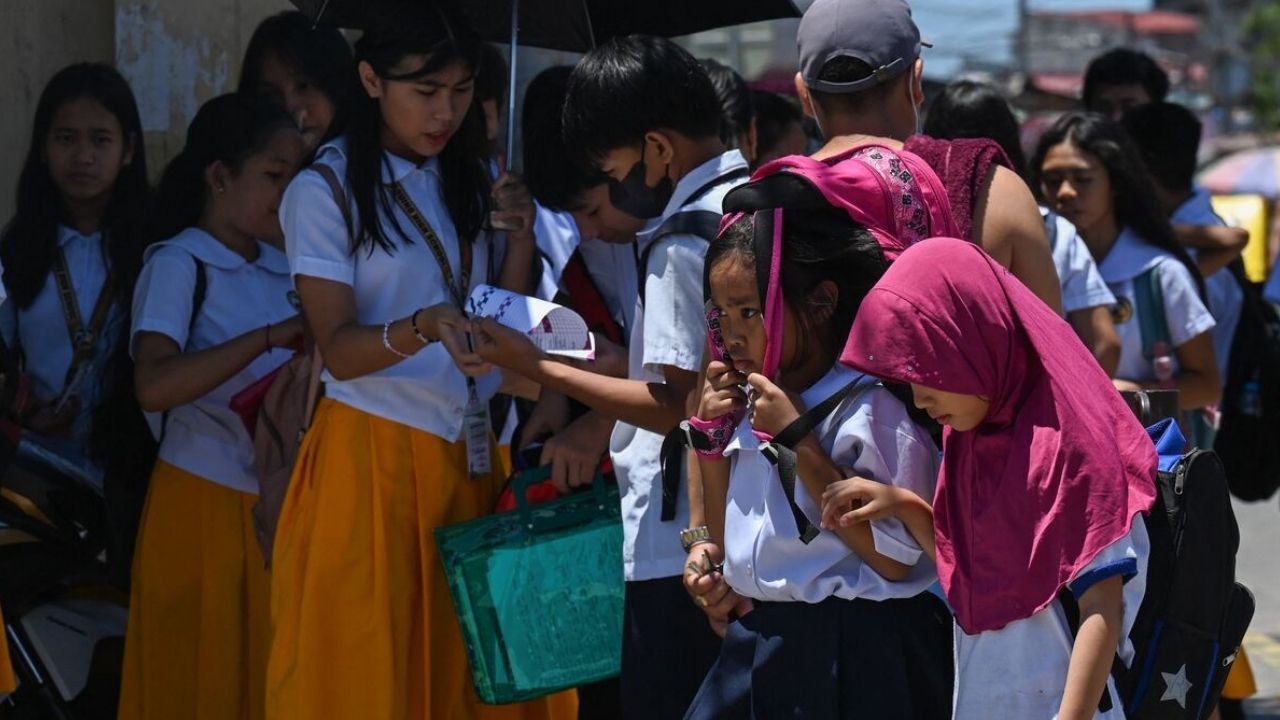
    The UNICEF data showed over 243 million children across the Pacific and East Asia were estimated to be affected by heatwaves, putting them at risk of heat-related illnesses and death.

    Several countries in the region are currently smouldering in the summer heat, with temperatures nearing record levels as they regularly hit over 40 degrees Celsius (104 degrees Fahrenheit).

    Local forecasters are predicting steeper rises in the coming weeks.

    Some Philippine schools suspended in-person classes in April, with the state weather forecaster saying temperatures could reach a “danger” level of 42 or 43 degrees Celsius in parts of the country.

    In Thailand, a temperature of 43.5 degrees Celsius was recorded in the northern province of Mae Hong Son earlier this week — just a few degrees shy of the record 44.6 degrees Celsius.

    Around 40 people die from heat-related illnesses annually, according to the Thai Ministry of Health.

    And in February, neighbouring Vietnam endured a monster heatwave in its southern “rice bowl” when temperatures reached up to 38 degrees Celsius — an “abnormal” high for the period.

    According to the UNICEF report, children are more at risk than adults as they are less able to regulate their body temperature.

    “Children are more vulnerable than adults to the effects of climate change, and excess heat is a potentially lethal threat to them,” said Debora Comini, Director of UNICEF Regional Office for East Asia and the Pacific.

    The report said heatwaves and high humidity levels — commonly experienced in the region — can have a deadly effect as the heat will “hinder the body’s natural cooling mechanisms.”

    “We must be on high alert this summer to protect children and vulnerable communities from worsening heatwaves and other climate shocks,” Comini said.

    The UN projected that over two billion children are expected to be exposed to heatwaves by 2050.

  • Iran’s Khamenei renews threat of counterattack against Israel

    Iran’s Khamenei renews threat of counterattack against Israel

    Iran’s supreme leader Ayatollah Ali Khamenei again warned Israel Wednesday that it “will be punished” for a Damascus air strike that killed seven Revolutionary Guards, two of them generals.

    “The evil regime made a mistake in this regard. It must be punished and will be punished,” Khamenei said in a televised speech after Eid al-Adha prayers in Tehran.

    Israeli Foreign Minister Israel Katz swiftly riposted with a Persian-language statement on social media site X.

    “If Iran attacks from its territory, Israel will respond and attack Iran,” he said.

    Khamenei said the April 1 strike, which levelled the five-storey Iranian consulate building in the Syrian capital, had run roughshod over international agreements providing for the inviolability of diplomatic premises.

    “The consulate and embassy offices in any country are the territory of that country,” he said. “When they attacked our consulate, it means they attacked our territory.”

    Khamenei has led Iranian officials in a succession of promises to avenge the strike, which was widely blamed on arch foe Israel.

    One of his senior advisers, Yahya Rahim Safavi, warned on Sunday that Israeli embassies were “no longer safe”.

    Israel said last week it was strengthening its defences and pausing leave for combat units following Iran’s retaliation threats.

    Iran does not recognise Israel, and the two countries have fought a shadow war for years.

    Iran charges that Israel was behind a wave of sabotage attacks and assassinations targeting its nuclear programme.

  • Gazans mark ‘saddest’ Eid with little to celebrate or eat

    Gazans mark ‘saddest’ Eid with little to celebrate or eat

    Gazans did their best to celebrate the end of Ramadan in the driving rain on Wednesday, as the genocide ravaged on with 14 killed, including children, in a strike on their home, the health ministry said.

    The Israeli military said it struck several targets on the first day of the Eid al-Fitr holiday, with a jet hitting a rocket launch site and troops killing a “terrorist cell” in close quarters fighting.

    An AFP photographer witnessed the aftermath of the the bombing of the home in Nuseirat refugee camp in central Gaza. Family members clutched the bodies of dead children at the Al-Aqsa Martyrs Hospital in nearby Deir el-Balah.

    There was no immediate comment from the Israeli army.

    Israel said 468 aid trucks — a record since the October 7 — were allowed into Gaza on the eve of the holiday which marks the end of the Muslim fasting month and is traditionally celebrated with family gatherings.

    But with the United Nations warning the besieged territory is on the verge of famine, there was little to feast on for the 2.4 million residents of Gaza, up to 1.5 million of whom are crammed into camps around the far-southern city of Rafah.

    The faithful gathered at dawn outside the city’s flattened Al-Farooq Mosque, where worshipper Khairi Abu Singer complained that Israel’s relentless bombardment had even “deprived Palestinians from praying inside their mosques”.

    Father-of-four Ahmed Qishta, 33, told AFP there was little to celebrate at what should be a joyous time.

    “We prepared sweets and biscuits from the aid we got from the UN and now we are giving it to the children. We try to be happy but it is difficult.”

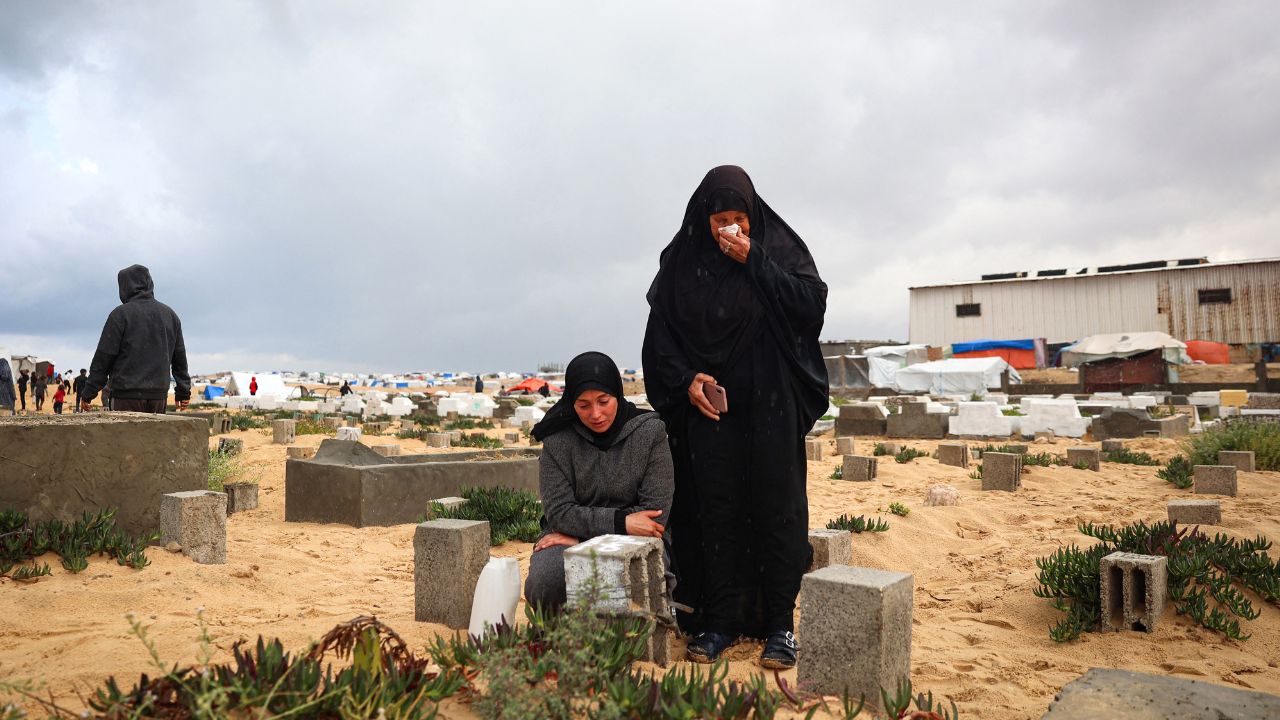
    He said they went to pray at the graves of family members killed in the war before going to the Ibn Taymiyyah mosque for Eid prayers.

    There has never been “such an Eid — all sadness, fear, destruction and a grinding war”, he said.

    Abir Sakik, 40, who fled her home in Gaza City with her family and is now living in a tent in Rafah, said she had no “ingredients for the cakes and sweets” she would usually make.

    Instead she made cakes from crushed dates. “We want to rejoice despite all the blood, death and shelling,” she told AFP.

    ‘Enough of war’

    Sakik said that despite it being a religious holiday, the Israeli military “committed a massacre and killed women and children” in the camp.

    “We are tired and weary — enough, enough of war and destruction,” she said, adding that Gazans were desperate for a truce.

    “We try to bring joy to the children. Before all this, there was a great atmosphere at Eid with the children’s toys, the Eid cakes, the food, the chocolates in every house — everything was sweet and beautiful.

    “But they destroyed all of Gaza,” she said.

    Nihaya Atallah, 49, from Jabalia camp in northern Gaza, also celebrated the festival in a tent in Rafah. “Our spirits are broken, our homes destroyed,” she told AFP.

    “There’s no Eid, no joy, only war and loss.”

    Rafah resident Moaz Abu Moussa said that “despite the pain and massacres, we will show our happiness in these difficult circumstances”.

    “We don’t care about the war, we will live Eid like other Muslims and show our happiness to the displaced people and families of martyrs and detainees.”

    Meanwhile in Jerusalem tens of thousands of worshippers poured into the Al-Aqsa mosque compound, Islam’s third holiest site, for morning prayers.

    “It’s the saddest Eid ever,” said nurse Rawan Abd, 32, from Israeli-annexed east Jerusalem. “At the mosque you could see the sadness on people’s faces.”

    In the occupied West Bank, the atmosphere was even more sombre, with many Palestinians in the flashpoint northern city of Jenin visiting its cemetery to pray for those who have been killed since the Israeli genocide in Gaza began.

    Israeli offensive has killed at least 33,482 people in Gaza, mostly women and children, according to the health ministry.

    bur-fg/hkb

    © Agence France-Presse

  • Hepatitis viruses kill 3,500 people a day: WHO

    Hepatitis viruses kill 3,500 people a day: WHO

    More than 3,500 people die from hepatitis viruses every day and the global toll is rising, the World Health Organization warned on Tuesday, calling for swift action to fight the second-largest infectious killer.

    New data from 187 countries showed that the number of deaths from viral hepatitis rose to 1.3 million in 2022 from 1.1 million in 2019, according to a WHO report released to coincide with the World Hepatitis Summit in Portugal this week.

    These are “alarming trends,” Meg Doherty, head of the WHO’s global HIV, hepatitis and sexually-transmitted infection programmes, told a press conference.

    The report said that there are 3,500 deaths per day worldwide from hepatitis infections — 83 percent from hepatitis B, 17 percent from hepatitis C.

    There are effective and cheap generic drugs which can treat these viruses.

    Yet only three percent of those with chronic hep B received antiviral treatment by the end of 2022, the report said.

    For hep C, just 20 percent-or 12.5 million people-had been treated.

    “These results fall well below the global targets to treat 80 percent of all people living with chronic hep B and C by 2030,” Doherty said.

    The overall rate of hepatitis infections did fall slightly.

    But WHO chief Tedros Adhanom Ghebreyesus emphasised that the report “paints a troubling picture”.

    “Despite progress globally in preventing hepatitis infections, deaths are rising because far too few people with hepatitis are being diagnosed and treated,” he said in a statement.

    Africa accounts for 63 percent of new hep B infections, yet less than one in five babies on the continent are vaccinated at birth, the report said.

    The UN agency also lamented that the affected countries did not have enough access to generic hepatitis drugs — and often paid more than they should.

    Two thirds of all hepatitis cases are in Bangladesh, China, Ethiopia, India, Indonesia, Nigeria, Pakistan, the Philippines, Russia, and Vietnam, according to the report.

    “Universal access to prevention, diagnosis, and treatment in these 10 countries by 2025, alongside intensified efforts in the African region, is essential to get the global response back on track,” the WHO said in a statement.

    Viral hepatitis is the second-biggest infectious killer, narrowly trailing tuberculosis.

  • Israel’s Netanyahu says ‘there is a date’ for Rafah invasion

    Israel’s Netanyahu says ‘there is a date’ for Rafah invasion

    Israeli Prime Minister Benjamin Netanyahu said Monday that a date has been set for a ground offensive in Rafah, which Israel says is one of the last Hamas strongholds in Gaza.

    Around 1.5 million Gazans are sheltering in the city, which has so far not experienced a large-scale Israeli ground assault.

    Netanyahu did not say when the invasion would occur but reiterated that victory over Hamas militants “requires entry into Rafah and the elimination of the terrorist battalions there.

    “It will happen — there is a date,” he said in a video statement.

    He was speaking as talks in Cairo over a Gaza ceasefire and hostage deal appeared to be gathering momentum.

    Netanyahu is under pressure at home from his far-right coalition partners who are angry at talk of a truce as well as Israel pulling its troops out of southern Gaza on Sunday.

    “Today I received a detailed report on the talks in Cairo,” Netanyahu said.

    “We are working all the time to achieve our goals, primarily the release of all our hostages and achieving a complete victory over Hamas.”

    The White House said on Monday that negotiators in the Egyptian capital had presented Hamas with a proposal for a ceasefire in the Gaza Strip and a hostage deal.

    “Now it’s going to be up to Hamas to come through,” it said, describing the talks as “serious”.

    Israeli genocide in Gaza has killed at least 33,207 people, mostly women and children, according to the health ministry.

  • China to criminally try three minors for child murder

    China to criminally try three minors for child murder

    China will put three minors on trial for allegedly murdering another child, a provincial prosecutor said Monday, in a case that has shocked the nation and sparked public debate over the treatment of juvenile offenders.

    The three suspects, all aged under 14 at the time of the murder, are accused of bullying a middle-school classmate surnamed Wang over a long period before killing him last month.

    The grim details of the case, in which the killers reportedly buried Wang’s body in an abandoned greenhouse, drew public attention to how the law deals with juveniles accused of serious crimes.

    In 2021, China lowered its age of criminal responsibility from 14 to 12 for “special cases” such as inflicting death by “extremely cruel means”.

    The Hebei case is thought to be one of the first to apply the lower age limit.

    The provincial prosecutor said Monday it had received a police request last month to criminally try the suspects, surnamed Zhang, Li and Ma.

    It said it had concluded that the three were between 12 and 14 when they “intentionally committed murder, causing the death of the victim Wang”.

    “The circumstances were serious and they should be held criminally responsible,” the provincial office said, adding that the country’s top public prosecutor had reviewed the decision.

    “While handling cases strictly in accordance with the law, the procuratorial organs will… further strengthen the prevention and treatment of juvenile crimes,” the provincial prosecutor continued.

    Under Chinese law, murder is punishable by imprisonment or the death penalty.

  • Why unprotected eclipse gazing will leave you seeing stars

    Why unprotected eclipse gazing will leave you seeing stars

    Just a single, unguarded glance at a solar eclipse can result in a lifetime of vision loss, eye health experts warn.

    On Monday, tens of millions of spectators across Mexico, the United States and Canada will witness the Moon completely obscure the Sun’s light, a rare celestial spectacle that won’t be visible for most of North America again until 2044.

    Medical literature is teeming with examples of people who suffered damage to their retinas — the layer of light-sensitive tissue at the back of the eye — and health professionals are offering advice on how to avoid becoming the next cautionary tale.

    Aaron Zimmerman, a clinical professor of optometry at the Ohio State University, told AFP that the dangers of sungazing during eclipses were discussed by the ancient Greek philosopher Socrates, but it wasn’t until recently that science really caught up with how eye injury happened.

    When it comes to eclipses, he explained, the main damage comes from “photochemical toxicity,” where short, high-energy wavelengths of light — blues, violets and non-visible ultraviolets — trigger chemical reactions that damage the rods and cones of the retina.

    Cue visits to the emergency department by people with complaints of blurry vision, changes in color perception, and blind spots, with the outlook for recovery far from certain.

    Human beings inherently look away from the Sun because of the discomfort it causes, but during eclipses “you can psychologically override” that instinct, explained Zimmerman.

    A famous journal report about the 2017 US solar eclipse involved a woman in her twenties who presented to the New York Eye and Ear Infirmary after looking at the solar rim “several times for approximately 6 seconds without protective glasses” and then later with eclipse glasses.

    Hours later, objects started to look fuzzy and out of shape, colors became distorted, and she developed a central black spot in her left eye.

    An advanced imaging technique was able to show the damage at the cellular level which persisted on her follow up six weeks later.

    Young adults might be more susceptible, the authors of the paper said, because of larger pupils, clearer eye structure, or “poorer recognition of the dangers” of viewing eclipses with improper eyewear.

    “In some cases, it’s just partially damaged and it may resolve so that you don’t notice it anymore,” Neil Bressler, a professor of ophthalmology at Johns Hopkins University and editor-in-chief of JAMA Ophthalmology told AFP. If recovery happens, it’s normally within the first six months.

    “But in other cases, it can leave a permanent blank spot… and we don’t have a treatment to reverse that. It’s like brain tissue, once you lose it, it won’t grow back,” added Bressler.

    The best way to view the eclipse is with eclipse sunglasses, which block out 99.999 percent of light. Always go for genuine products. To test if your glasses are up to standard, “find the brightest light bulb in your home — and then look at that from up close and you should barely be able to see the light,” said Zimmerman.

    If it’s too late to procure specialist eyewear, then there are indirect methods, such as punching a pinhole into a cardboard and letting the light shine onto another surface, or even using the humble kitchen colander to the same effect. NASA’s webcast is another option.

    Those fortunate enough to be in the “path of totality,” under which the Moon will fully block out the Sun, can look up without glasses and admire the Sun’s outer atmosphere, or corona, glowing from behind the silhouette of the Moon.

    But, said Bressler, the danger is not having protection before and after those precious moments, which can last anywhere from seconds to a few minutes, depending on your location.

    “You must know when it begins and use protection before that, and you may be enamored by looking at all this, but you must have some alarm to tell you it’s about to end,” he warned.

  • Swiss farmers dump dead sheep in protest against rising number of wolves

    Swiss farmers dump dead sheep in protest against rising number of wolves

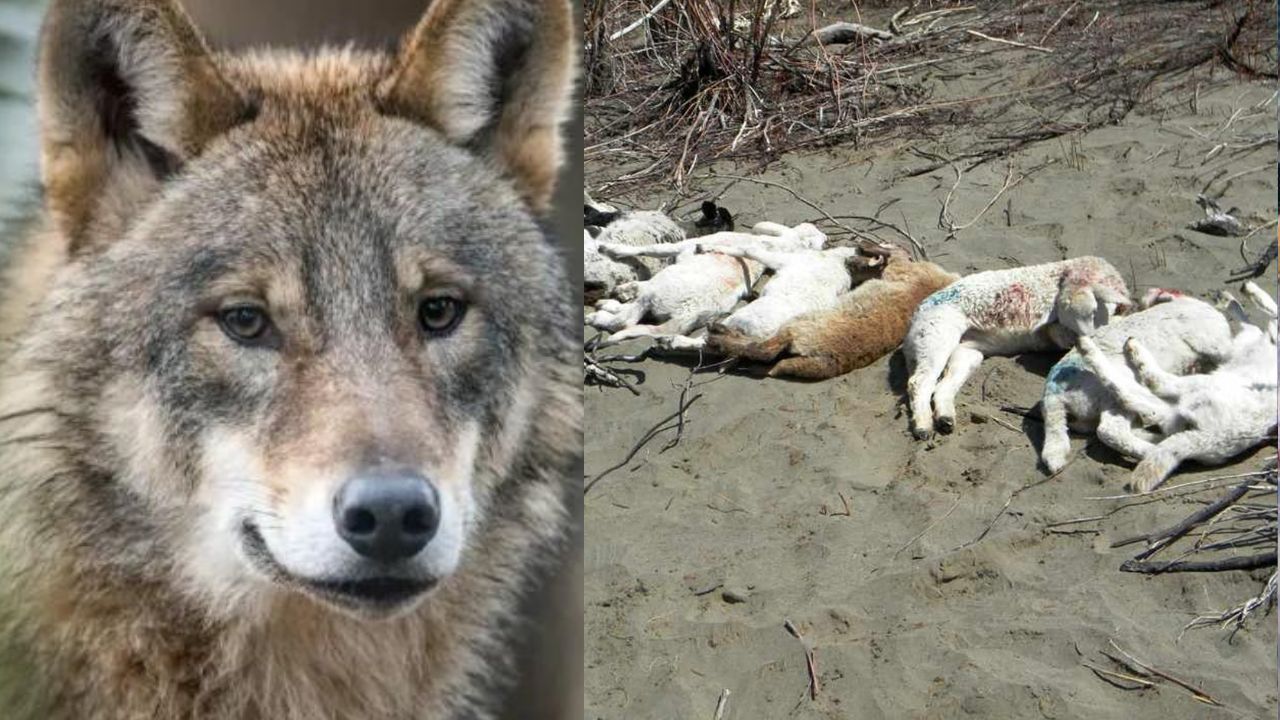
    Swiss sheep farmers on Saturday dumped the bodies of animals killed by wolves in front of a regional government building, demanding more action against the predators, Swiss media reported.

    Around a dozen breeders came from the Saint-Barthelemy area in the western Swiss canton of Vaud to lay out the carcasses of 12 sheep in front of the regional government headquarters in Lausanne, the Chateau Saint-Maire.

    “These sheep were killed last night,” Eric Herb, a member of a Swiss association demanding the regulation of big predators, was quoted as saying by the Keystone-ATS news agency.

    “It is really time to act.”

    “We are sick of this. We want the wolf killed,” agreed Patrick Perroud, a farmer and butcher from the nearby municipality of Oulens.

    “Cohabitation is not possible. Our territory is too small,” he told Keystone-ATS.

    The protesters told the news agency that wolves had killed 17 sheep in the same area late last month, two earlier this week and 13 overnight to Saturday.

    “The breeders have played nice until now, but this time it was too much,” Herb said.

    The protesters were planning to increase the pressure on the Vaud government environment minister, Vassilis Venizelos of the Green Party, he said.

    One of the protesters’ banners read: “Vassilis step down”, Keystone-ATS reported.

    The breeders had briefly negotiated with regional police before being allowed to lay down the animal carcasses on tarpaulin in front of the Chateau.

    Participants in the protest, which was supported by the regional chapter of the far-right Swiss People’s Party — Switzerland’s largest party — lamented that they were losing sleep.

    “We have to check on our animals every night,” one was quoted as saying.

    After being wiped out more than a century ago, wolves have in recent decades begun returning to Switzerland and to several other European countries.

    Since the first pack was spotted in the wealthy Alpine nation in 2012, the number of packs swelled to 32 last year, with around 300 individual wolves counted.

    Nature conservation groups have hailed the return as a sign of a healthier and more diverse ecosystem.

    But breeders and herders complain of attacks on livestock and have been ramping up demands to cull more wolves.

    Swiss authorities last year relaxed the rules for hunting the protected species, and decided to allow large preventative culls in the most affected cantons but swift legal actions put those plans partially on ice.

    The debate in several parts of Europe about wolves rose up the political agenda in September.

    In an open letter to the European Commission, eight leading conservation groups said there were ways to make coexistence easier between humans and large wild animals like wolves.

    “Damage to livestock is often linked to the lack of adequate supervision and/or physical protection,” they said. They pointed to strategies such as “the training of dogs to protect herds, education of herders, tools and technical solutions to deter wolves”.

  • World food prices rise for first time in seven months: FAO

    World food prices rise for first time in seven months: FAO

    Global food prices rose in March, the first increase since July, pulled higher by cooking oil prices despite the cost of grains continuing to ease, the UN’s Food and Agricultural Organization said Friday.

    The FAO’s overall Food Price Index climbed 1.1 percent over the month to stand at 118.3 points in March 2024. On an annual comparison it was 7.7 percent lower.

    The sub-index for vegetable oils jumped by 8.0 percent over the month to reach a one-year high. The FAO said prices for palm, soy, sunflower and rapeseed oils all climbed higher.

    Rising palm oil prices were driven by seasonal drops in output in leading producing nations that coincided with strong demand in Southeast Asia, while demand from the biofuel sector pulled up soy oil prices.

    Dairy prices rose by 2.9 percent in March on a monthly basis, while meat prices climbed 1.7 percent.

    Meanwhile, cereals prices slid 2.6 percent on a monthly basis, while sugar prices fell 5.4 percent.

    Food prices reached a record high after Russia invaded agricultural power Ukraine in February 2022 but have dropped since then.

    Last month’s uptick comes as inflation has slowed dramatically in many countries but a recent rebound in global oil prices has sparked concern it may persist at a level that could discourage central banks from cutting interest rates.

  • Palestinian Muslims mark sad and tense ‘holiest Ramadan night’ in Jerusalem

    Palestinian Muslims mark sad and tense ‘holiest Ramadan night’ in Jerusalem

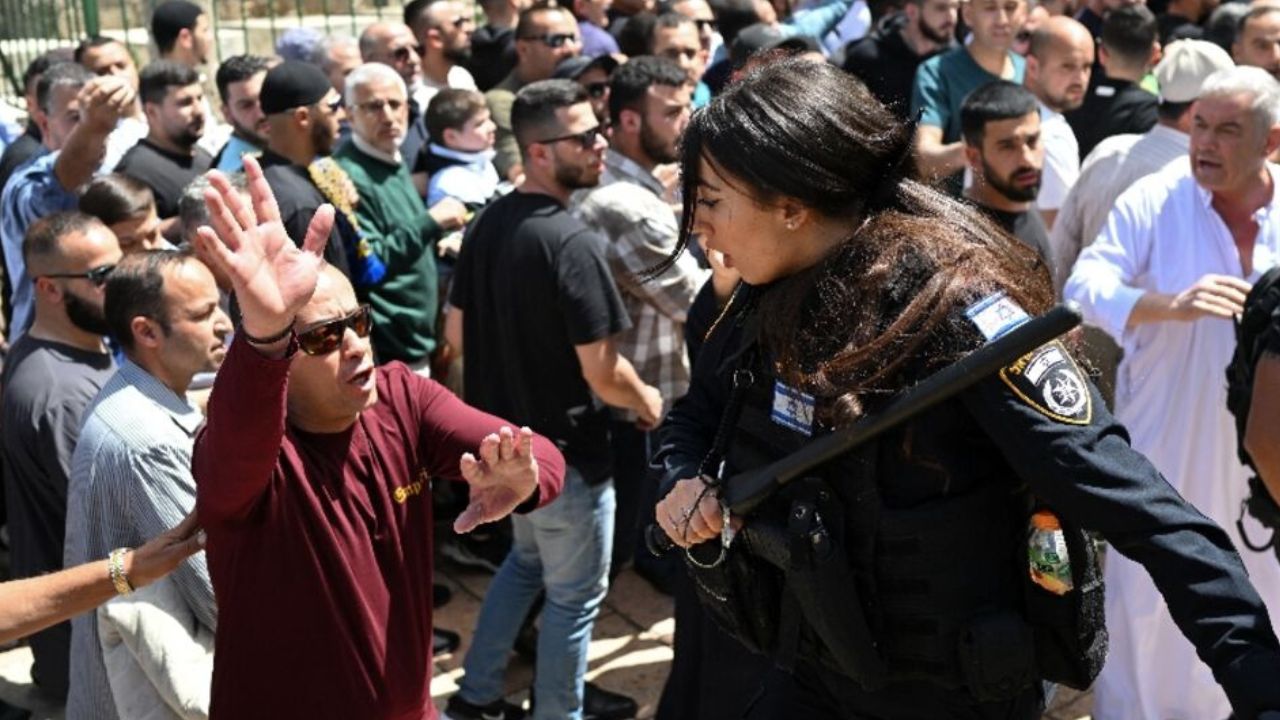
    Palestinian Muslims marked a tense and sombre last Friday of Ramadan in Jerusalem as Israeli police controlling the entrance to the Al-Aqsa mosque – the third holiest site in Islam – attacked worshippers.

    Some 120,000 people descended on the shrine, which dominates the Old City, officials said, with grand mufti Muhammad Ahmad Hussein urging the faithful to brave the heavy police presence because of the war in Gaza.

    Adli al-Agha, 53, from Jerusalem, told AFP that many people “had to flee dawn prayers” after Israeli police deployed a mini-drone spraying tear gas to disperse people chanting “Glory to God”.

    “In our soul and our blood, we sacrifice for you Al-Aqsa,” worshippers declared, according to Agha.

    Police said they arrested eight people for inciting terrorism.

    Yasser Basha, from Tulkarem in the Israeli-occupied West Bank, said police were restricting entrance to the mosque to the old and the very young. Only men over 55 and women over 50 were being allowed inside, he said.

    “If it wasn’t for the war, things would have been much easier,” he added.

    Friday also marks Laylat al-Qadr (“The Night of Destiny”), the spiritual climax of the Muslim holy month, which commemorates the moment the archangel Gabriel first appeared to Prophet Mohammed and began revealing the Koran.

    It is the night when Muslims believe their prayers are most likely to be granted, a festive moment while children stay up late and shops stay open till the small hours.

    But many Palestinians are not in the mood to celebrate and are praying for an end to the war in Gaza after almost six months of bloodshed.

    Sameeha Al Qadi, 55, who had come from near Bethlehem, said Jerusalem “is sad and has lost its light — we all feel what is going on in Gaza. We can’t escape it for a minute.”

    This year there are few Ramadan decorations or lights in the Holy City, with Palestinians instead having a bitter coffee and a date — traditionally to mark mourning — on Tuesdays and Wednesdays, when feasts are usually held.

    “There is sweet nothing about the feast this year. People are not celebrating,” said Sabah, 54, some of whose relatives have been killed in Gaza.

    “Everything is bitter in my mouth. It is so painful at this time which is all about family.”

    Easter was similarly subdued last weekend for Palestinian Christians.

    Adnan Jafar, 60, a sweet maker in the Old City, said usually in Ramadan his shop is at its busiest.

    “But I have never had a Ramadan like this. And we all know why. (Gaza) is not just affecting us, it is affecting the whole world.”

    Israeli genocide in Gaza has killed at least 33,091 people since October 7, mostly women and children, according to the territory’s health ministry.