Category: Business

  • Pakistan is the next IT powerhouse, says JICA

    Pakistan is the next IT powerhouse, says JICA

    Japan International Cooperation Agency (JICA) has said that Pakistan is the “powerhouse of the Information and Communication Technology (ICT) sector” as the country tech exports climbed six times in one decade.

    In JICA’s official statement, digital Pakistan policy 2018 is the key driving factor behind the success of the IT sector in Pakistan. Besides, six-time growth is the highest growth rate in entire South Asia.

    The fundamental reason behind the IT growth is the competitiveness and the presence of a large number of freelancers that are willing to give quality services at affordable rates.

    The report published by JICA was a year-long researched based study that was conducted in collaboration with Pakistan Embassy Tokyo.

    The publication has also placed Pakistan as a new partner for Japanese IT companies. The report gives an overview of the ICT industry in Pakistan, its performance in IT exports, the support structure provided by the Pakistani government, a pool of skilled and young human resource and achievements of a growth-led ecosystem equally owned by public and private sectors.

    This study includes an “IT skills survey 2021”, which found that Pakistani ICT engineers are highly skilled in programming, software development, data processing and analysis, infrastructure architecture and cloud engineering.

    The report also includes feedback on Pakistani ICT engineers already working in Japan who consider Pakistan an untapped market for Japanese IT companies, encouraging them to know more about Pakistan and its collective potential in ICT.

    Ambassador of Pakistan to Japan Imtiaz Ahmad welcomed the project team in March 2020, offering them complete support of the Mission while thanking JICA for its continued support in export and development sectors in Pakistan.

    In the past, the same team of experts from JICA has rolled out various projects for human resource development; value addition in textiles; technical training and water and sanitation infrastructure in Pakistan.


  • Facebook will now ask iOS users to allow data tracking for ‘better ads experience’

    Facebook will now ask iOS users to allow data tracking for ‘better ads experience’

    As per details, Facebook has started urging iPhone and iPad users to allow data tracking. The social media giant said that users should allow this for a better and personalized ads experience.

    Apple recently decided to ramp up privacy of its users, and gave users an option if they want to allow social media applications to track their data.

    Both companies are in some sort of war with each other, a war that has been raging for more than one decade now.

    The founder and CEO of Facebook Mark Zuckerberg recently termed Apple Inc. as the biggest competitor, and he said that the new privacy policy of Apple will cause “damage to the business of millions of users.”

    The very next day CEO of Apple Tim Cook, during a data privacy conference in Brussels, said: “If a business is built on misleading users, on data exploitation, on choices that are no choices at all, it does not deserve our praise. It deserves reforms.”

    The battle focuses on a unique device identifier on every iPhone and iPad called the Identifier for Advertisers (IDFA). Companies that sell mobile advertisements, including Facebook, use this ID to help target ads and estimate their effectiveness.

    With the latest iOS 14 update, each app that wants to use the tracker will have to seek permission from the user. Consequently, it will make the mobiles ads less effective.

    Facebook has already started warning investors that these changes will affect the business, and now the company is testing the effects of the new updates.

    Besides, form today when users will open the app, they will see a message box that will tell users why they must allow Facebook to track their data.

    “Allow Facebook to use your app and website activity?” and claims that Facebook uses that information to “provide a better ads experience.” It will then offer users a choice between “Don’t Allow” and “Allow.”

    No matter which selection users make on the Facebook prompt, if they choose not to allow tracking on the Apple pop-up, that choice will be final, and Facebook will honour it.

  • Biden returns billions Trump approved for US-Mexico border wall

    Biden returns billions Trump approved for US-Mexico border wall

    President of the United States (US) Joe Biden has decided to hold back funds of Pentagon that were directed by former President Donald Trump to build a wall on the US-Mexico border.

    The funds will be now used to fix the damages that were caused while the wall was under construction.

    According to reports, an official from the US government said that the Pentagon will begin cancelling all wall projects using the diverted funds, and the administration will take steps to return remaining unobligated military construction forms their appropriated purpose.

    The decision came when Joe Biden took over the office and signed a “proclamation” that directed the Pentagon to halt the flow of money to build the border wall, which was already ruled illegal by the federal court of US in June 2020.

    The Department of Homeland Security also announced plans to repair holes in flood levees at the Rio Grande Valley in Texas and fix soil erosion in San Diego created by border wall construction, neither of which will involve creating more barriers.

    The amount of money that the Trump administration allocated to build the wall was as high as $14 billion, says the official.

    According to the background details, the lawmakers of bipartisan put pressure on the government to make repairments against the damage caused due to the holes that drilled for wall construction.

    On this occasion, an influential American politician and attorney Ted Cruz commented that “I am pleased President Biden and the Department of Homeland Security are listening and now moving to shore up the levee wall system that had been unthoughtful. The repairs are necessary, crucial, and urgently needed.”

    In response, the chief critic senator Rick Scott uttered that “How can Biden possibly justify stopping wall construction?”, calling on Secretary of Homeland Security Alejandro Mayorkas and Secretary of Defense Lloyd Austin to “immediately explain President Biden’s ridiculous order, how it is compliant with federal law and the awful consequences it will have on the current crisis.”

  • KP assembly adopts resolution on Facebook’s monetisation

    KP assembly adopts resolution on Facebook’s monetisation

    The Khyber Pakhtunkhwa Assembly has unanimously adopted a resolution aimed at allowing Facebook’s monetisation in Pakistan.

    Moved by Member of Provincial Assembly (MPA) Ziaullah Bangash of the Pakistan Tehreek-i-Insaf, the resolution recommended to the provincial government to ask the federal government to take steps to “turn on” Facebook’s monetisation so that its users, especially the youth, could benefit from the positive use of the media platform and earn money.

    The resolution pointed out that the speaker of the National Assembly had already held a meeting with Facebook officials in which it was decided that steps would be taken to “turn on” monetisation of the platform in the country.

    It added that 50 million Facebook users in the country, especially the youth, could benefit from the move.

  • Pakistan exports to neighbouring countries drop by alarming level

    Pakistan exports to neighbouring countries drop by alarming level

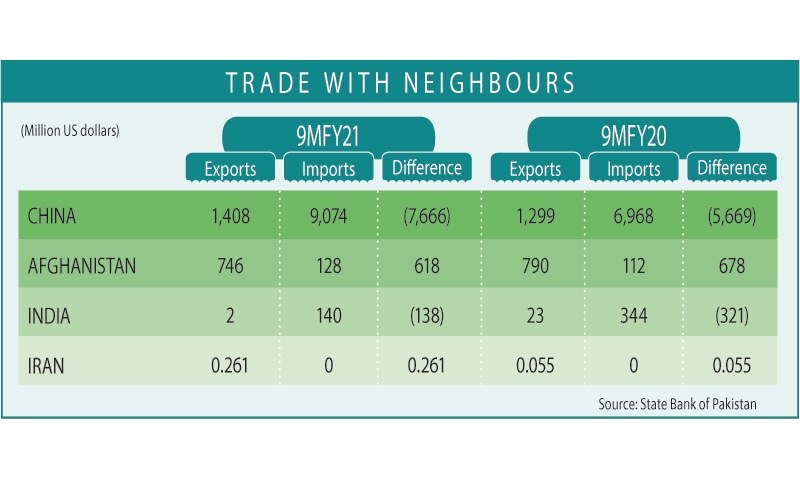
    Due to the COVID-19 crises, Pakistan exports in the region have dropped by 5.7 per cent in the nine months of the current fiscal year, the State Bank of Pakistan (SBP) revealed on Monday.

    Pakistan exported goods and services as little as $2.788 billion to neighbouring countries like Afghanistan, Bangladesh, Bhutan, Maldives, Sri Lanka, India and Iran.

    Data revealed by the State Bank of Pakistan (SBP)

    The figure is just 14.91 per cent of the total global export of Pakistan, which stood at $18.688 billion in the current fiscal year.

    Pakistan largely exported to China; they are at the top of the list, leaving India and Bangladesh behind.

    In terms of percentage, Pakistan exports to China are 50.46 per cent, and the remaining share is for eight other countries.

    Exports to China also experienced a growth of 8.4 per cent, which is $1.407 billion in FY2021 from 1.298 billion in FY2020.

    Unfortunately, the trade ties between Afghanistan and Pakistan have declined and faced political and policy turmoils. The exports to Afghanistan have fallen by 5.57 per cent that is just $746.328 million in FY2021. In FY2020, the exports between Afghanistan and Pakistan stood at $790,377 million.

    Afghanistan has also been removed as the second biggest trade partner of Pakistan, and Afghanistan replaced India as the most important trade partner.

    Trade ties between Pakistan and India are also topsy turvy. The government has suspended trade with India. Earlier, the Economic Corridor Committee (ECC) approved the import of cotton and yarn from India, but then the decision was reversed for political reasons.

    The exports to Iran jumped 374 per cent to $0.261m in 9MFY21 from $0.055m in 9MFY20. Most of the trade with Tehran is carried out through informal channels in border areas of Balochistan.

    Exports to Bangladesh decreas­­ed by 13.56 per cent that is $438.418m in FY2021. Islam­abad has recently reached out to Dhaka to revive talks to facilitate trade between the two countries.

    Similarly, exports to Sri Lanka dipped by 24.2 per cent to $185.883m from $245.131m in the previous year.

    During Prime Minister Imran Khan’s recent visit to Sri Lanka, both countries agreed to exploit the available potential of bilateral trade.

    Exports to Nepal dropped by 82.6 per cent to $3.502m from the previous year while those to the Maldives dipped by 28.96 per cent to $4.044m from $5.693m.

    Exports to Bhutan were recorded at $0.043m as compared to $0.094m over the last year. In March, no exports proceeds were sent to the Maldives.

    On the other hand, the country’s trade deficit with the region narrowed as imports from these countries also dipped.

  • Rich Indians reportedly fleeing to UAE on private jets, paying fare as high as $38,000

    Rich Indians reportedly fleeing to UAE on private jets, paying fare as high as $38,000

    Rich and affluent Indians are reportedly fleeing India to escape the COVID-19 pandemic, and the demand for private jets and fares has increased drastically.

    United Arab Emirates (UAE) decided to suspend flights from India and people had time till Sunday to travel back to UAE.

    Online price for one way fare has increased almost ten times. Flights from Mumbai to Dubai would cost as much as 80,000 Indian Rupees ($1,400).

    Tickets for the New Delhi to Dubai route were going for more than 50,000 rupees, five times more than the average rate. Moreover, no tickets were on offer from Sunday when the 10-day flight suspension comes into force.

    For private jets, the fare is ridiculously high. The spokesperson for a charter company total that
    “We have requested more aircraft from abroad to meet the demand. It costs $38,000 to $50,000 to hire a 13-seater jet from Mumbai to Dubai, and US$31,000 to hire a six-seater aircraft.”

    “People are making groups and arranging to share our jets to get a seat. We’ve had some queries for Thailand but the demand is for Dubai,” he maintained.

    According to the latest figures, UAE is home to around 3.3 million Indians which accounts to a third of Dubai’s total population.

    The UAE’s General Civil Aviation Authority has ordered that those who are coming from India must stay in 14 days quarantine.

  • Twitter censors tweets of lawmakers, filmmakers, MPs on Modi govt orders

    Twitter censors tweets of lawmakers, filmmakers, MPs on Modi govt orders

    At the request of the Modi government, Twitter has removed almost 50 tweets by influential people that criticised Modi for mishandling the COVID-19 pandemic.

    According to reports, the Indian government issued an emergency order to Twitter on Friday to censor 52 tweets.

    Among them were tweets from a lawmaker named Revnath Reddy, a minister in the state of West Bengal named Moloy Ghatak, and a filmmaker named Avinash Das.

    According to a spokesperson of Twitter, the accounts were notified in advance that their content will be withheld at the request of the Indian government.

    The spokesperson further added that the company made these tweets unable to be viewed because they violated the local law.

    Indian government cited Information Technology Act, 2020 that were violated by these Twitter accounts.

    “When we receive a valid legal request, we review it under both the Twitter Rules and local law. If the content violates Twitter’s Rules, the content will be removed from the service,” said the Twitter spokesperson. “If it is determined to be illegal in a particular jurisdiction, but not in violation of the Twitter Rules, we may withhold access to the content in India only. In all cases, we notify the account holder directly so they’re aware that we’ve received a legal order about the account.”

    Besides, this is not the first time Twitter has bowed down against the pressure of the Indian government. In February, when framers were protesting in Delhi, more than 500 Twitter accounts were removed at the request of the Indian government.

    The Indian government issued a notice of noncompliance to Twitter, and the employees could face jail time if the company refused to comply with the order.

    India is in the midst of a deadly second wave of COVID-19 cases, which has made ventilators, medicine, and oxygen scarce.

    According to the Johns Hopkins coronavirus resource centre, India reported 346,786 new cases of the coronavirus on Friday, a new record high, and 2,624 deaths, also a new record. Less than 1.5 per cent of the country’s population has been fully vaccinated.

  • FIA, NAB to start investigation for fuel shortage

    FIA, NAB to start investigation for fuel shortage

    The National Accountability Bureau (NAB) and the Federal Investigation Agency (FIA) have started an investigation against those who were responsible for the shortage of fuel in June 2020.

    The probe has been started because according to the reports, the shortage of fuel had caused a loss of Rs25 billion to the national exchequer in 2020.

    The agencies have asked the Petroleum Division to provide records along with Inquiry Commission reports. During the investigation, NAB will look into the role of Petroleum Division secretary, director general (DG) of oil at the Ministry of Energy (Petroleum Division), and oil marketing companies (OMCs) in the petrol crisis.

    Similarly, NAB will also examine the alleged connivance of government officials with OMCs.

    NAB will further investigate the officers of oil refineries, OMCs and the Inter-State Gas System (ISGS) because the provision of licences to the OMCs was a criminal act.

    NAB further added that the officers of different companies were appointed in the petroleum division, and they have allegedly been influencing the policy and decision making, which has resulted in massive losses to the national exchequer.

    According to sources, the federal cabinet had earlier advised the FIA to complete the inquiry within three months. The investigation would later be transferred to NAB from FIA for the collection of funds plundered from the national exchequer.

    Besides NAB, the FIA has also moved to take action and asked the petroleum division and the Oil and Gas Regulatory Authority (OGRA) to provide relevant details and records of OMCs and the inquiries did to unearth facts behind the petrol crisis.

  • Pakistan IT exports cross $1.5bn for the first time

    Pakistan IT exports cross $1.5bn for the first time

    The Pakistan Information Technology (IT) industry has experienced $1.5 billion in exports for the first time. In March, the industry received the highest export remittances of $213 million.

    According to data released by the State Bank of Pakistan (SBP, IT and IT-enabled services recorded a huge increase of $1.512 billion during the first nine months of the current fiscal year (FY) 2020-21.

    The industry observed an increase of $459 million, or 43 percent in comparison to the previous period in which the IT exports stood at $1.512 billion.

    The handsome growth in IT exports was driven through software consultancy, Business Process Outsourcing (BPO), e-commerce, telecommunication services, etc.

    Moreover, the Pakistani IT industry capitalized on the worst-hit market of India that is also a leading IT service exporter, but because of the COVID-19, the global industry has consulted experts in Pakistan.

    Pakistani software houses are getting a great influx of orders from countries like the US, UK, EU, and the East Easter or Gulf countries because they have a high demand for IT services.

    The country could further increase the exports from $2 billion to $3-3.5 billion in the next financial year if the stakeholders including software houses, the government, and concerned authorities develop an aggressive plan while minimising impediments in the IT sector.

    Furthermore, as per the old policies of the government, the IT sector was exempted from the tax network but the government has decided to reverse the decision.

    Companies are concerned about the immoral practices of government departments, and the recent raids on the IT companies from the intelligence agency also created a fearful working environment for the other software houses, which are considering setting up their offshore offices in different countries.

    On the other side, revenue experts said the IT industry with handsome balance sheets should contribute to support the ailing economy with taxes at a time when the industry is witnessing a peak time.

  • Record-breaking: Current account experiences surplus of $959m

    Record-breaking: Current account experiences surplus of $959m

    According to reports, Pakistan’s current account witnessed an increase of $900 million during the first nine months of the current fiscal year (FY) 2020-21.

    The State Bank of Pakistan (SBP) released new data that shows a surplus of $959 million from July to March 2020-21. The surplus is big in comparison to the account deficit of $4.1 billion in the last fiscal year 2019-20.

    In March 2021, the current account also witnessed a slight deficit of $47 million. The reason for the deficit is huge import bills that stood at $5.22 billion. The import bill of services remained controlled at $628 million.

    On the other hand, the exports of goods and services also stood high at $2.64 billion and $564 million in March 2021.

    The remittances and strong support of overseas Pakistanis also exhibited a phenomenal contribution with record inflows of $2.72 billion.

    From July to March, the trade deficit of goods and services stood at $20.01 billion, which is seven per cent higher than the previous fiscal year.

    On the other hand, remittances witnessed a surplus of 26.2% or $4.4 billion. High remittances are one of the core reasons for the increase in the current account.

    According to experts, with almost three months left in the closing of the current financial year, the current account would likely remain in surplus.

    In addition to the inflow of foreign exchange, the financial support from the International Monetary Fund (IMF) and Euro Bonds also made the external account comfortable despite the fact that several debt repayments are pending.

    The value of the Rupee is volatile against the Dollar, but it remains within a range-bound limit, thereby favorable to the economy.