Category: Business

  • Has State Bank really restricted ATM withdrawal limit to Rs1,000?

    Has State Bank really restricted ATM withdrawal limit to Rs1,000?

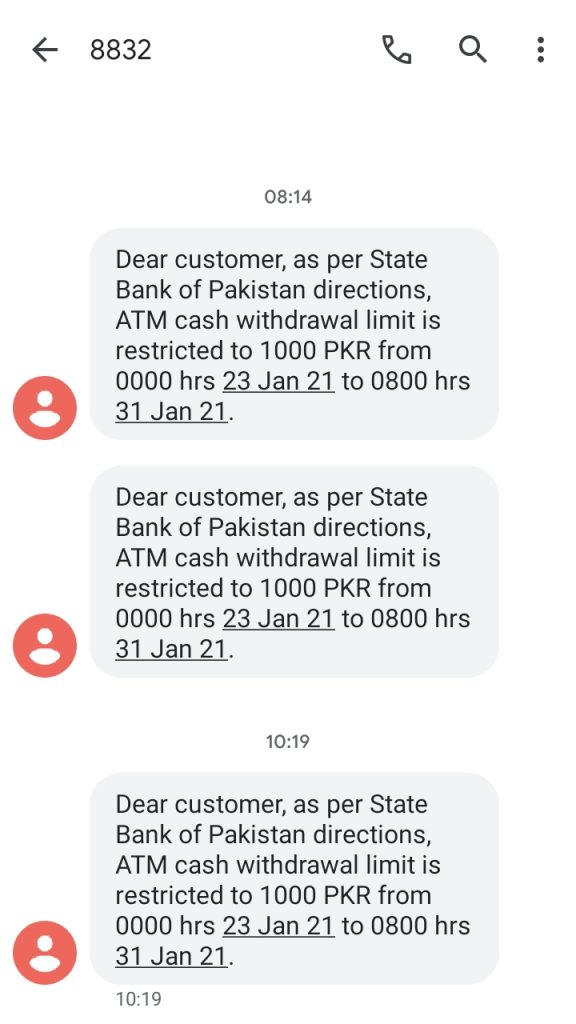
    People are receiving an alleged message from the State Bank of Pakistan about restrictions on ATM cash withdrawals till the end of the month.

    The peculiar message that you may receive from ‘8182’ or ‘8832’ will read: “Dear Customer, as per State Bank of Pakistan directions, ATM cash withdrawal limit is restricted to 1000 PKR ” till Jan 31.

    However, the central bank has distanced itself from these messages. It said the decision to set withdrawal limit is taken by the banks, not the SBP.

    Meanwhile, the SBP also sent a message to the banks, asking them to “send appropriately worded messages” to their consumers to curb the flow of misinformation.

    In a the message to the banks, the SBP said that it has received “multiple reports…that customers are receiving messages with the context that SBP has put some kind of restrictions on ATM cash withdrawals”.

    “The SBP has not given any such instructions to the financial institutions,” the statement clarified.

    “In this regard, kindly make sure to send appropriately worded messages to your customers on urgent basis, reassuring them regarding this false spread of messages,” the SBP clarification read.

  • Has Elon Musk trolled Pakistan for ‘no electricity’ while PM plans to meet Tesla executives?

    Has Elon Musk trolled Pakistan for ‘no electricity’ while PM plans to meet Tesla executives?

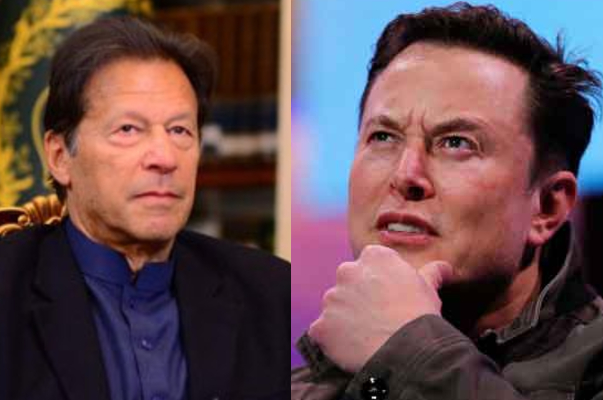
    With multiple media outlets reporting that Prime Minister (PM) Imran Khan will be meeting Tesla executives to discuss investment opportunities in the Pakistani Electric Vehicle (EV) market, the screenshot of a tweet by Tesla Chief Executive Officer (CEO) Elon Musk “mocking” Pakistan has started doing the rounds on social media.

    Tesla Inc is an American EV and clean energy company based in California. Its current products include electric cars, battery energy storage from home to grid-scale, solar panels and solar roof tiles, as well as other related products and services.

    PM Imran is reportedly due to meet Tesla executives as Pakistan announces its plans to promote EVs and India gears up to welcome the Musk-run company.

    However, the news of the premier’s meeting was followed by a screenshot of the tweet wherein Musk had purportedly taken a dig at Pakistan’s power shortage vows.

    “First bring electricity,” read the tweet that seems to be nothing more than a meme since it could not be found on Musk’s Twitter handle.

    As for the PM’s reported plans of meeting Tesla executives, the news came from renowned journalist Sabir Shakir via a video clip shared on Javed Afridi’s social media page.

    In the video, Shakir states that Afridi, who is a key stakeholder in MG Pakistan, has already had a couple of meetings with the officials at Tesla Motors. He said that the world’s largest and most prolific EV maker had already expressed interest in investing in the Pakistani automotive market.

    Pakistan’s new EV policy was introduced by the government late last year, wherein it had announced a number of benefits and incentives for both interested investors in the local EV sector and potential buyers.

    Reports say Afridi has been at the forefront of campaigning for EVs to be made the norm in Pakistan. Additionally, MG is also set to introduce the ZS EV in Pakistan, reportedly in the first quarter of 2021.

  • CPEC to come down crashing? Foreign media report claims ‘most serious disagreement’ between Pakistan, China

    Pakistan and China are embroiled in their most serious disagreement relating to the Belt and Road Initiative, causing the annual bilateral summit of the China-Pakistan Economic Corridor (CPEC) to be delayed, the world’s largest financial newspaper has claimed.

    The Joint Cooperation Committee (JCC) is CPEC’s principal decision-making body. It is jointly chaired by Pakistan’s minister for planning, development and special initiatives and the vice chairman of China’s National Development and Reform Commission.

    The first JCC meeting was held in August 2013 and the last in November 2019. The 10th JCC was scheduled for early 2020, but remains postponed.

    Initially, the COVID-19 pandemic was the reason, but later disagreements between the two countries over the Main Line 1 (ML-1) railway project and special economic zones became the main points of disagreement, Nikkei Asia has learned from informed sources.

    Asad Umar, Pakistan’s minister for planning, development and special initiatives, told local media in November that the 10th JCC would be held the following month. However, officials in the Planning Commission of Pakistan, who asked not to be named, recently told Nikkei that the meeting will not take place for at least three months — by far the longest JCC gap to date.

    ML-1 is the largest CPEC project and worth $6.8 billion. China is expected to lend $6 billion of this, which Pakistan wants to borrow at a concessional interest rate of less than 3%.

    China offers a mixture of concessionary and commercial loans for such projects. This could significantly increase the aggregate interest rate Islamabad will face, according to the planning commission officials.

    “China is reluctant to lend money for ML-1 because Pakistan has already sought debt relief to meet G-20 lending conditions and it is not in a position to give sovereign guarantees,” Nasir Jamal, a senior journalist in Lahore covering business and the economy, told Nikkei. He said Beijing’s appetite for lending money for large infrastructure projects has diminished because these projects are vulnerable to local politics that delay returns on investment for China. That has hindered agreement on the finance framework for ML-1.

    Andrew Small, a senior trans-Atlantic fellow with the Asia program at the German Marshall Fund, a U.S. think tank, said China tends to base its decisions about interest rates for loans to Pakistan on a couple of criteria. Firstly, do low-interest rates encourage projects that do not make sense financially? Secondly, what precedents are set for other countries looking for similar concessions?

    “China is much more comfortable deferring payments or providing new financing than it is offering concessional rates in the first place,” Small told Nikkei. He said this approach provides Beijing with greater leverage and control even if they are willing to be very flexible at the back-end.

    With host countries under pressure to repay at higher rates, China trades payment deferments in return for influence, which helps it get more favorable arrangements.

    The delayed JCC meeting and unsettled ML-1 financial framework is complicating matters for Pakistan. Early this month, Pakistan Railways asked the government for 11 billion rupees ($69 million) to provide ML-1 security. Without the Chinese financing framework being agreed by the JCC, it is hard for Islamabad to come up with such a large amount given the state of the economy and severe budgetary constraints.

    The other major disagreement between Beijing and Islamabad delaying the JCC meeting relates to SEZs. In the second phase of CPEC scheduled for 2020 to 2025, Chinese companies are due to start producing goods in Pakistan and exporting from there.

    Currently, the industrial cooperation framework for the SEZs is limited to a memorandum of understanding without detailed modalities. Matters such as tax exemptions and requirements for employing local labor have not been finalized. These need to be agreed by China for confirmation at the JCC. The Board of Investment of Pakistan submitted the draft agreement for the industrial cooperation framework to the Chinese government last month and is still awaiting a response.

    In December 2020, during a meeting of the Joint Working Group on Industrial Cooperation under CPEC, Asim Ayub, the project director for industrial cooperation at the Board of Investment, pressed for early signing of the industrial cooperation framework agreement.

    The seriousness of the delay is clear from China’s unprecedented reluctance to schedule a JCC meeting. In the past, JCCs were always held in time, and China agreed to Islamabad’s requests most of the time. Some experts believe the delay is evidence that CPEC is derailing.

    According to Small, there were plenty of announcements about CPEC last year, but actually setting deals in motion was another matter. “The optics do matter to China so I still expect them to figure out terms in the end, and certainly to keep some narrative of continued progress alive,” Small told Nikkei. “But that doesn’t mean they’re willing to agree on something that doesn’t make sense for other reasons just to speed things up a little.”

    Pakistan is currently renegotiating its $6 billion extended fund facility with the International Monetary Fund (IMF), which was suspended in April 2020. The IMF reportedly will only resume the program if Pakistan does not take out any new commercial loans, and that is one of the reasons it is looking for concessions on loans for the ML-1 project.

    An important long-term implication of this case for other BRI countries could be that China will be more wary of lending to countries that have entered loan agreements with global lenders such as the IMF.

    Hasaan Khawar, an Islamabad-based public policy analyst, views the situation from a different perspective. “The back-and-forth with China by Pakistan on the interest rate and additional guarantees for the ML-1 project is a good sign,” he told Nikkei. “The Pakistani side is appraising the terms carefully and trying to negotiate a better deal.”

    The report originally appeared on Nikkei Asia
  • Foreign investment falls by 30%

    Foreign investment falls by 30%

    Foreign direct investment (FDI) fell by 30 per cent in the first half of the current fiscal year (H1FY21), according to data released by the State Bank of Pakistan (SBP).

    According to a report based on the data compiled by a local media outlet, Pakistan received $952 million in foreign investment during July-December FY21 compared to $1.357 billion in the corresponding period last year.

    In addition to the damage done by the pandemic, the impact of heavy outflow from the portfolio also played a key role in making the balance sheet poorer in the first half of FY21. The data shows that the outflow during July-December was $244m compared to a net inflow of $18.8m in the same period last year.

    The breakup further shows that China made 38pc contribution to the overall $952m FDI the country received in July-December period of FY21. However, the FDI inflows from China also contracted to $359m in the period under review compared to $396m in the same period of last fiscal year.

    The other significant contributions were from the United States and UK at $65m and $63m, respectively, both improved from $44m and $58m in the same period of last fiscal year. The United Arab Emirates (UAE) has started disinvesting; however, in July-December FY21, the inflow was $16.3m.

    The country received the highest foreign investment of $261m in electricity, gas, steam and air conditioning supply sectors. While an inflow of $137m was noted in financial and insurance sectors.

  • Pakistan ranks 2nd in South Asia in terms of ease of starting a business: World Bank

    Pakistan has improved its position in the World Bank’s Ease of Doing Business Index for the second year in a row.

    According to the latest rankings released by the global organization, Pakistan has improved its position by an impressive total of 28 points, surging from 136th place to 108th on the rankings. The World Bank report calls this an “unprecedented improvement”, and it is highly indicative of the country managing to exceed even its own expectations yet again.

    Out of the six reform areas highlighted in the 2020 edition of the report, Pakistan made the highest improvement in the “Starting a Business” indicator, which is an area largely being revolutionized by the Securities and Exchange Commission Pakistan (SECP).

    Pakistan’s ranking in this indicator has improved from 130 to 72 and is placed at second position in South Asian countries in terms of ease of starting a business.

    The improvement, according to the SECP, is primarily due to the integration of e-services with the Federal Board of Revenue (FBR) and the Employees Old Age Benefits Institution (EOBI) at the federal level and with business registration portals of Punjab and Sindh at the provincial level.

    After this integration, SECP’s e-services offer a one-window facility for company registration with FBR, EOBI, provincial employees social security institutions, the labour department and excise and taxation departments of Punjab and Sindh.

    As a result of this reform, the number of procedures to start a business, as recorded in the Doing Business Report 2020, have been reduced from ten to five and Pakistan has managed to rank “among the top ten reformers globally”.

    Pakistan emerging as an increasingly business-friendly nation is massively good news for the local hustle culture and the entrepreneurship environment that has rapidly been garnering interest over the past few years.

  • Petrol price up by Rs3.20/litre after govt approves another hike in January

    Petrol price up by Rs3.20/litre after govt approves another hike in January

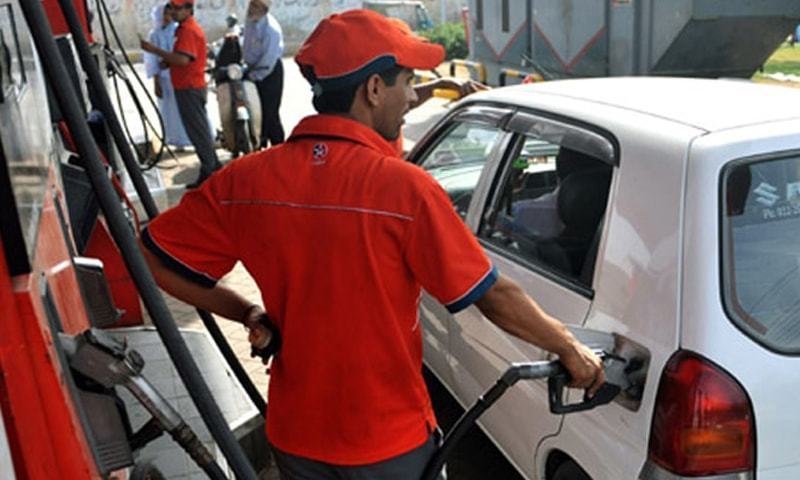
    The government on Friday decided to increase the price of petrol and diesel by Rs3.20 per litre and Rs2.95 per litre, respectively, for the months of January and February.

    The price of kerosene oil has been hiked by Rs3, while light diesel prices have been increased by Rs4.42, reported Geo News.

    This is the second time that the government hiked the prices of petroleum products in a month. Earlier this month, there was an increase of Rs2.31 and Rs1.80 in the prices of petrol and diesel, respectively.

    “While considering relief for the people, Prime Minister Imran Khan approved the minimum possible increase in prices of petroleum products against OGRA’s [Oil and Gas Regulatory Authority] recommendations,” a Prime Minister’s Office (PMO) press release had said at the time.

    OGRA had sought an increase of Rs10.68 in petrol price and Rs8.37 in diesel price, whereas it asked the government to increase the price of kerosene oil by Rs10.92 and light diesel oil (LDO) by Rs14.87.

    The price of Liquefied Petroleum Gas (LPG) had also increased earlier this month. According to OGRA, the LPG prices were raised by Rs16 per kg amid an increase in demand.

    With the increase, the LPG cylinder for domestic users will be up by Rs188 and commercial users by Rs722.

    It may be noted here that the consumers are already facing a shortage of gas nationwide and have to rely on LPG cylinders instead.

  • Man about to lose over $300 million after forgetting Bitcoin password

    Man about to lose over $300 million after forgetting Bitcoin password

    A San Francisco computer programmer has just two password attempts left if he is to unlock a Bitcoin wallet worth more than $300 million.

    If Thomas fails and burns through his final two of 10 attempts, he will lose 7002 Bitcoin, currently worth an eye-watering and lifechanging $303 million. The forgotten password which is keeping Thomas awake at night would let him unlock a small hard drive, known as an IronKey.

    The IronKey contains the critical private keys to Thomas’ digital wallet, where the Bitcoin fortune is locked up. If Thomas makes 10 failed IronKey password attempts, the hard drive will seize up and encrypt everything for eternity.

    According to The New York Times, Thomas lost the piece of paper he wrote the IronKey password on. “I would just lay in bed and think about it,” he says.

    “Then I would go to the computer with some new strategy, and it wouldn’t work, and I would be desperate again.”

    His plight has drawn the attention of hard drive and password crackers, offering their services for a slice of the quarter-billion-dollar pie. Alex Stamos, an internet security expert at Stanford Internet Observatory, claimed he can crack the password within six months. His price? Stamos wants a 10 per cent cut (roughly $30 million) of the fortune.

    “Um, for $220m in locked-up bitcoin, you don’t make 10 password guesses but take it to professionals to buy 20 IronKeys and spend six months finding a side-channel or uncapping,” Stomas tweeted, adding that he would make it happen for 10%.

    https://twitter.com/alexstamos/status/1348999178702057476

    Thomas was paid the Bitcoin for making a video about how the cryptocurrency worked, back when it was worth around $5 a coin. Last week, on the back of a record-breaking run, Bitcoin was trading at more than US$40,000.

    Perhaps the best-known case of anyone losing their Bitcoin fortune was James Howells, a Welsh IT worker, who in 2013 unintentionally threw 7500 Bitcoin in a landfill.

    Howells’ Bitcoin would also be worth more than a quarter-billion-dollars on today’s rate.

  • ‘Good news for market’: IMF programme to restart soon, says SBP chief

    Pakistan is in talks with the International Monetary Fund (IMF) to put the fiscal support programme back on track, State Bank of Pakistan Governor Dr Reza Baqir said on Monday.

    Baqir said he was optimistic about the economic outlook despite the fallout from the coronavirus pandemic and the central bank was eyeing 1.5pc to 2.5pc GDP growth in the current fiscal year.

    With dwindling foreign exchange reserves and a struggling economy, Pakistan entered a three-year $6 billion IMF bailout programme in 2019, but is yet to have its second review approved, which has been pending since early last year.

    “We hope to have good news for the market and the world that we are putting the programme back on track,” Baqir said in an interview on Monday at the Reuters Next conference.

    Last year, staff from the IMF and Pakistani authorities reached an agreement to pave the way for a disbursement of $450 million in IMF funds pending approval from the global lender’s executive board, which is yet to take place.

    Baqir said there was no disagreement on the end goal between the two sides, and that Pakistan needs to increase its low tax-to-GDP ratio.

    Pakistan and the IMF have been working to implement IMF-supported economic reforms, in particular tax collection, aimed at stabilising the economy and shoring up a yawning fiscal deficit.

    Though the bailout programme is still pending, Pakistan received $1.4 billion in emergency financing from the IMF to allow it to fund targeted and temporary spending increases aimed at containing the pandemic and mitigating its economic impact.

    Authorities are counting on the IMF bailout package to bolster Pakistan’s fiscal position and increase global confidence in its economy.

    “Pakistani authorities and the IMF team remain closely engaged, discussions are going on, both teams are working very hard and non-stop to bring the programme review to positive conclusion,” IMF’s Resident Representative to Pakistan, Teresa Dabn Sanchez, told Reuters.

    Baqir also said he is more optimistic about the outlook even as Pakistan battles a second wave of the coronavirus outbreak.

    “We are prepared for the challenges that may come about. We are already in the middle of Covid without any vaccine and once the vaccine comes, it will only makes this better,” he said.

    Baqir added that an economic recovery is underway and the bank’s job is to support the rebound until a vaccine is available.

    1.5 to 2.5% GDP GROWTH:

    Pakistan is aiming to achieve 1.5pc to 2.5pc GDP growth in the current fiscal year, Baqir said. “I think the next two or three years should bring some good news on the economic front.”

    Pakistan’s economy contracted 0.4% in the last fiscal year ended June 30, 2020, as the pandemic hit. Baqir added that an economic recovery was under way and the bank’s job was to support the rebound until a vaccine was available.

    “I think the next two or three years should bring some good news on the economic front,” he said.

    Baqir said Pakistan’s growth in its foreign exchange reserves from $7 billion to $13 billion in recent months was not due to borrowing.

    He said Pakistan needed “a rollover of the support” of friendly countries that had parked money in the bank to shore up reserves, but did not need new loans.

    Among those countries is Saudi Arabia, which recently asked Pakistan to repay $2 billion of its loan. Islamabad returned $1 billion to Riyadh in December last year and was to pay another $1 billion this month.

  • Signal, Telegram see spike in demand after WhatsApp policy change

    Signal, Telegram see spike in demand after WhatsApp policy change

    After WhatsApp’s new terms sparked debate on social media, other messaging apps like Telegram and Signal are witnessing a surge in demand.

    WhatsApp, which uses Signal’s encryption technology, laid out fresh terms on Wednesday, asking users to agree to let owner Facebook Inc and its subsidiaries collect user data, including their phone number and location.

    Some privacy activists questioned the “accept our data grab or get out” move on Twitter, and suggested users to switch to apps like Signal and Telegram.

    Signal’s popularity shot up further on Thursday after it was endorsed by Elon Musk, who has one of the most-followed accounts on Twitter and by the micro-blogging site’s top boss Jack Dorsey.

    More than 100,000 users installed Signal across the app stores of Apple and Google in the last two days, while Telegram picked up nearly 2.2 million downloads, according to data analytics firm Sensor Tower.

    New installs of WhatsApp fell 11% in the first seven days of 2021 compared with the prior week, but that still amounted to an estimated 10.5 million downloads globally, Sensor Tower said.

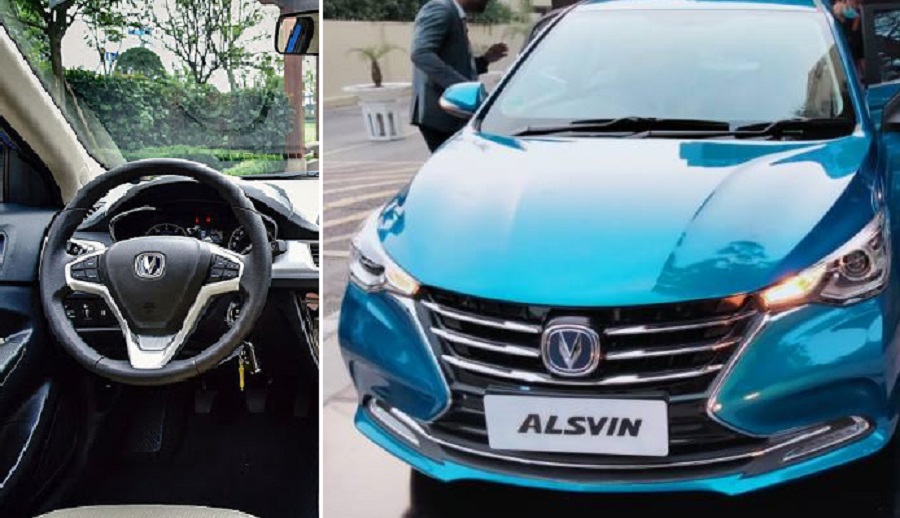
  • You can get the new Alsvin in Pakistan for a price way cheaper than you think; lower than Rs25 lacs

    You can get the new Alsvin in Pakistan for a price way cheaper than you think; lower than Rs25 lacs

    Changan Pakistan has announced the pricing for its most anticipated car, the new Alsvin. 

    According to the announcement made Monday, Alsvin will be offered in three variants, the prices of all variants are as follow:

    VariantPrice
    1.37L BASE with 5 Speed Manual TransmissionPKR 2,199,000
    1.5L COMFORT with 5 Speed Dual Clutch Transmission PKR 2,399,000
    1.5L LUMIERE with 5 Speed Dual Clutch TransmissionPKR 2,549,000

    The booking will start on January 14, 2021, with an advance booking amount of Rs750,000.

    The vehicle comes with a three-year/100,000km warranty, whichever comes first, and will be available in multiple colours, including Steller White, Lunar Silver, Galaxy Black, Cosmic Red, Nebula Blue and Space Gray.

    Click here for further details.