Category: Business

  • 46pc believe taxes not spent on public good: survey

    46pc believe taxes not spent on public good: survey

    A global poll conducted by AccaGlobal to survey if citizens agree that taxes are paid in exchange for services, has displayed shocking results. As per the details, the poll suggested that just one-third of the population sees the social contract of taxation to be a deal that works in practice.

    Taxes are levied on the general public to provide public goods that everyone can utilise. Popular examples of public goods financed by taxation are toll free roads, public hospitals and public schools.

    Every individual has equal access to public goods and services, and cannot be excluded from utilising them. In line with this thinking, 52 percent of poll respondents felt that taxes were a contribution to the community rather than a cost.

    Poll respondents believed that public goods and services were a necessity. However, 25 percent disagreed, stating that in their opinion, taxes were a cost and not a contribution to the community.

    It is to be noted that only 33 percent of poll respondents believed that tax revenues collected in their country were actually used to provide public good while 46 percent outright refute this belief.

    There are two possible reasons as to why respondents believe their tax funds are not spent on them. The first of these is the level of corruption within the country. This could indicate that taxpayer funds are being misused as government officials consider said funds to be a source that can be used to illegally enrich themselves.

    The second reason concerns only the elite. This is because as wealth rises, it is unlikely that an individual would be a consumer of public goods and services. An example here could be a wealthy individual choosing to seek care at a private hospital as opposed to a local public hospital.

    Since both of these segments of society do not expect the funds to be spent on them, they believe that their funds never actually serve them.

    Poll respondents from Latin America displayed the most amount of pessimism regarding their tax funds being allocated to services they need. This makes sense as countries like Brazil and Argentina score abysmally low on the corruption index with scores as low as 36 out of 100 – the lower the score, the more rampant corruption is in the country.

    The chief executive of AccaGlobal has highlighted how public trust in taxation systems is necessary for an economy to attain prosperity. These arguments can also be applied to Pakistan as higher transparency and lower corruption levels might boost tax levels, resulting in citizens believing that their funds are truly spent on them.

  • Debt surges by 28 percent in Khyber Pakhtunkhwa, sparking concerns

    Debt surges by 28 percent in Khyber Pakhtunkhwa, sparking concerns

    International lenders have grown worried over Khyber Pakhtunkhwa’s rising debt levels as it surged by 28 percent in just a year. As per Dawn, the outstanding debt KP is liable to pay stands at a staggering 680 billion rupees.

    While this might not seem alarming at first glance, financial experts are predicting a drop in the development potential of KP as risk indicators continue to worsen in the province. As it stands, the provincial government of KP has been alerted by international creditors regarding the potential solvency issues that the government might run into.

    In a meeting with KP leadership, international lenders suggested a solution- austerity measures.

    As per Dawn News, the reason KP finds itself in constant need to borrow funds is because of PTI leadership’s focus on political issues rather than the economy. The claim has some merit to it as constant rallies to Islamabad and protests cause members of the provincial assembly to leave Peshawar largely unattended. This has created a vacuum for guidance within the decision makers, especially regarding matters pertaining to the economy.

    The rising debt burden comes at an inconvenient time as IMF expects budget surpluses of large magnitudes from both the provincial and federal government. The IMF condition in reference here requires all four provincial governments to generate a budget surplus of 1.127 trillion rupees.

    However, with KP relying on debt to finance government expenditures, lawmakers in Islamabad are worrying that the third largest provincial economy within the country may not be able to record a sizable budget surplus to meet IMF requirements.

    This is largely due to the fact that in the coming months, the burden of interest payments is expected to rise. For businesses across the province, this spells bad news as the government might try to levy additional taxes or try to expand the tax net in an attempt to meet IMF guidelines.

    The sectors where KP might attempt to increase tax collection will most probably be agriculture, automobiles, services, property and stamps. The reasoning behind this is that provinces are allowed to collect taxes on activity from these sectors.

    For the upcoming fiscal year 2024-25, KP has budgeted a staggering 67 billion rupees for debt payments. Of this total amount, over 40 percent will be purely to pay back interest on the principle amount.

    The interest repayments reduce KP’s ability to fund public projects within the province as the government will cut back expenditure on projects to pay back interest instead. The loss of potential public development initiatives is alarming as the current unemployment rate in KP stands at an uneasy eight percent which may rise even further if the government starts shelving projects as part of the stipulated austerity measures of the IMF.

  • PSX recovers 3,000 points after historic drop amid speculative buying

    PSX recovers 3,000 points after historic drop amid speculative buying

    Stock brokers saw a sharp rise in the Pakistan Stock Exchange (PSX) as bullish speculators participated in the exchange. The KSE-100 which is the benchmark index of the PSX recorded a 3,000-point recovery in the index after two full days of profit taking.

    Earlier in the week, the KSE-100 recorded the largest single day decline in its history of 4,795 points as panic selling gripped investors. Investors are growing weary of the unprecedented level of volatility in the exchange.

    Experts are predicting that the profit taking behavior could have been due to a recent bill that was proposed in Islamabad earlier this week. The proposed bill seeks to impose restrictions on the trading of securities by non-filers and tax evaders.

    While this bill has its merits and will be invaluable in the Islamabad’s journey to curb tax evasion, it is impacting businesses significantly. While experts were initially highlighting how the bill could be detrimental for business growth, it seems like it is not the case.

    It is possible that non-filers sold off their shares in order for a tax paying member of their household to purchase them instead. Such behaviors are common are probably what led to the sharp decline and rise in the PSX as the bill would have frozen non-filer trading activities.

    If a significant amount of non-filers end up permanently pulling their funds out of the exchange before the restrictions are levied, the market will suffer. The downward trend that took charge of the market earlier could return as currently, investors have lost some of their trust in the market. This is likely to fuel further profit taking.

    In the event of a persisting slump in the PSX, firms will not be able to raise funds easily. They will now have to issue more shares to gather the same amount of money now. This is because earlier, share values tanked with some companies such as Mari Petroleum losing as much as 10 percent of their value.

    The fall in share prices and the high fluctuations in the exchange are likely to cause a trend in company executives to favor the use of debt for operations instead of the sale of more equity. However, this will reduce dividend payments to shareholders as cash inflows from projects will then be used to finance interest payments on loans instead and lower dividends might reduce share values further.

    However, the low stock prices paved way for speculators as they saw an opportunity to make a quick profit due to market volatility. For now, experts have their eyes set on the PSX and are wondering if it can continue to exhibit steady growth rates as it has in the past few months or if the surge in volatility has just begun. 

  • Islamabad’s noose tightens around tax evaders but could strangle economy instead

    Islamabad’s noose tightens around tax evaders but could strangle economy instead

    Islamabad is continuing its crusade against tax evaders as a new bill was proposed to enforce tax compliance. Dawn News reported that tax authorities will be given sweeping powers to ensure that all tax laws are being followed.

    The new bill will grant authorities the right to shut down non-complying businesses on the spot and seize assets at their own discretion. Moreover, non-filers will no longer be able to partake in a plethora of economic activities such as real estate transactions, trading securities, or even purchasing automobiles.

    If enforced properly, the Federal Board of Revenue (FBR) could report a substantial surge in tax collection levels. This is because, in FY 2023-24, tax evaders were able to withhold a staggering $13.8 billion, which the FBR has set its eyes on now.

    While the ‘war’ on evaders will boost tax collections and be lauded as a political victory for Islamabad, genuine business activities could get caught in the crossfire. For instance, the volume of sales in the automobile sector is expected to decline now as tax evaders will not be able to purchase cars more than 800cc.

    Automobile giants such as Honda Atlas Cars and Toyota Indus both manufacture cars solely above 800cc and are expected to see a decline in sales volume and, ultimately, market share if the proposed bill is passed. Experts are speculating a possible drop in the value of both Honda and Toyota (traded on the stock exchange under the name ‘Indus Motor Company’). However, local car dealerships specialising in the sale of imported 660cc cars may benefit as they might witness a greater number of customers.

    The real estate market is another agent in the economy that will suffer tremendously due to the crackdown on non-filer realty transactions. It is an open secret that the real estate market practically runs on black money, and as per Imlaak, the true amount could be in the trillions of rupees.

    Tax evaders have exploited the gap between FBR and market valuations of land by paying the FBR value to the seller via official channels and paying the rest of the market value to the seller under the table. This land is then sold later officially at market value which allows them to launder their money.

    The bill, however, proposes that non-filers shall not be able to buy property at all, resulting in a slowdown of the real estate market. This will likely hurt those individuals who have invested their life savings into real estate, as reduced demand for land will result in a fall in property prices.

    Another cause for concern for businesses is the unchecked power that tax officials will obtain. The bill will allow tax officials to usurp business assets as they see fit if the business is evading taxes. Business owners are uneasy about these developments and are considering hiring auditors to ensure they are indeed complying with tax laws, which obviously comes at a cost to the business.

    With the majority of economic agents viewing the bill in a negative light, it will be interesting to see if Islamabad will soften its stance against tax evaders. Only time will tell.

  • As Bitcoin’s value rises, luxury brands consider accepting crypto payments

    As Bitcoin’s value rises, luxury brands consider accepting crypto payments

    Bitcoin’s soaring value has attracted the attention of luxury fashion brands and retailers, prompting further interest in offering cryptocurrencies as a means of payment to tap into fresh pockets of wealth and build loyalty with crypto investors, Reuters reported Wednesday.

    Until recently, only a handful of luxury brands, including LVMH watch labels Hublot and Tag Heuer, as well as Kering-owned fashion brands Gucci and Balenciaga, have experimented with crypto payment offers.

    In recent weeks, upscale French luxury department store Printemps announced it was teaming up with the world’s largest crypto exchange, Binance, and French financial tech company Lyzi to accept cryptocurrencies including bitcoin and ethereum in its stores in France — becoming the first European department store to do so.

    The move, coming as bitcoin rises, has been noticed by other brands and retailers who are showing interest in joining in.


    “There have been quite a few calls — it’s generated interest,” said David Princay, president of Binance France, who said the company is in talks with other luxury labels.

    Luxury lighter and pen maker S.T. Dupont told Reuters that it aims to accept cryptocurrency payments in two Paris stores before the holidays.

    In the realm of experiences, cruise company Virgin Voyages began this month offering its first product accepting Bitcoin as a payment option — a $120,000 annual pass for up to a year of sailing on its cruise ships.

    Regulators have long warned that cryptocurrencies like bitcoin are high-risk assets, with limited uses in the real world. High volatility has been another barrier to wide adoption as a means of payment.

    But pledges of support from US President-elect Donald Trump, who is expected to bring in more friendly e-currency regulation, have fueled record-breaking rises for bitcoin.

    S&P analysts say the narrative is starting to shift, noting that blockchain innovation in financial markets could increase predictability for cryptocurrencies.

    Seeking innovative branding


    Luxury labels have long sought to cater to affluent shoppers from the tech industry by opening stores in upscale Silicon Valley malls and issuing products like the Hermes Apple Watch, for example, which combines signature, stitched leather straps of the French Birkin bag maker with tech giant Apple’s connected timepiece.

    Now, new wealth generated by bitcoin’s recent highs — topping $107,000 on Monday — comes as the luxury industry faces its biggest slump in years and searches for new sources of growth.


    Offering cryptocurrency payments can be a way for companies to brand themselves as innovative rather than a stuffy old brand that’s only selling to the boomers, said Andrew ONeill, digital assets lead analyst at S&P Global Ratings.

    The payment option remains largely symbolic. Retailers usually reconvert the funds to euros or dollars to offset risks of volatility, while for most shoppers, payment methods are seen overall as something that has been solved already by such transaction platforms as PayPal or Venmo, said O’Neill.

    But for bitcoin investors who have seen a strong rise in the value of their investment, luxury goods — a designer handbag or high-end watch — are an obvious choice for diversifying one’s portfolio, analysts say.

    In a sign of growing interest from designer labels, Balenciaga recently issued a leather card holder designed to hold Stax hardware from crypto wallet company Ledger.

    The black leather accessory, which retails for 350 euros ($368), includes a keychain and Eiffel Tower charm, and an NFC chip fitted underneath the brand logo. Ledgers Stax Crypto hardware, its recently developed higher-end hardware with a curved touch screen, sells for $399 at Best Buy.

    The company’s Flex hardware, which resembles a mini Amazon Kindle, sells for $249 while the Nano version, which looks like a USB key, sells for $79.

    Reaching younger clientele


    Gregory Boutte, chief client and digital officer for luxury conglomerate Kering, has described the group’s strategy when it comes to technology as test and learn rather than wait and see. He emphasised the embrace of new technologies as key to reaching younger and Asian clientele.

    Kering’s star label, Gucci, has since 2022 made purchases available through 10 cryptocurrencies for most of its products in the United States.

    Printemps is working to expand its crypto payments service to New York City, where it plans to open a multibrand retailer in the Wall Street district in March.


    Bitcoin’s rise in late 2021 prompted an initial flurry of interest from luxury brands with Tag Heuer, headed at the time by LVMH luxury scion Frederic Arnault, as well as Gucci, accepting payments in cryptocurrency the following year for some purchases in the United States.

    One crypto advocate who recently used digital assets to make luxury purchases is Eunice Wong, an investor and influencer known as “Eunicorn”.

    Wong said she used cryptocurrency to buy several high-end watches this year including an Audemars Piguet Royal Oak model. But she is not interested in being drawn in by high-end brands seeking to build a closer client relationship, preferring to bypass traditional retail stores and sales routines.

    That takes too much time, in her view.

    “If I will buy, I’ll buy on the secondary market, not through them,” she told Reuters. “I want it now.”
  • FBR launches crackdown against Shark Tank Pakistan contestants

    FBR launches crackdown against Shark Tank Pakistan contestants

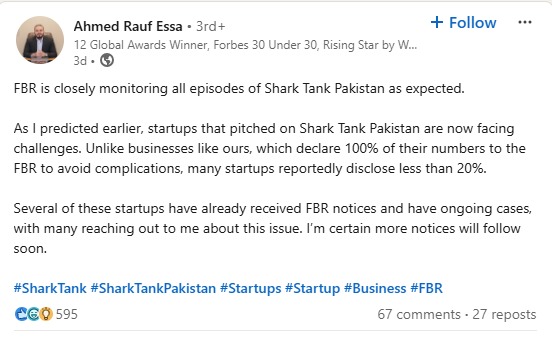
    Startups that participated in the first season of Shark Tank Pakistan are reportedly under investigation by the Federal Board of Revenue (FBR) over potential tax discrepancies. The news came to light through a LinkedIn post by Ahmed Rauf Essa, CEO of Telemart, who revealed that multiple startups from the show have received tax notices from the FBR, and some are facing legal action for allegedly underreporting their financials.

    1734088755-UISV6FD472.jpg

    As per a report by TechJuice, Essa pointed out that several of these startups have disclosed less than 20% of their financial figures to the tax authorities, a stark contrast to businesses like his own, which report 100% of their financial data to avoid complications. He expressed that he had foreseen such scrutiny, noting that the FBR had been closely monitoring businesses featured on the show. Some startups have already reached out to Essa for advice regarding their ongoing legal cases.

    This development underscores the challenges startups in Pakistan face, particularly those that gain public attention through platforms like Shark Tank Pakistan. It highlights the importance of transparent financial reporting and compliance with tax regulations.

    Industry experts recommend that startups prioritize professional financial management and adherence to tax laws to avoid such issues. Legal advisors stress the importance of accurate reporting, particularly for businesses pitching on national platforms where they attract significant scrutiny.

    Reactions within the startup community have been mixed. While some entrepreneurs support the push for greater transparency, others are concerned about the potential negative impact on innovation and growth. Many argue that the country’s tax policies need to be more supportive of startups to foster a conducive environment for entrepreneurship.

    The FBR has not yet issued a public statement on the matter, while the startups involved continue to deal with the complexities of compliance, transparency, and legal scrutiny.

    A few days ago, Shark Tank Pakistan saw its biggest investment ever when Usman Bashir, CEO of BrakeTime, invested Rs1.5 billion ($5 million) in Saraaf, a Karachi-based startup specializing in commodity and mineral sourcing. The deal included Rs80 crores for 20% equity and Rs70 crores as a line of credit with a 3% royalty fee. This record-breaking investment showcases the growing potential and confidence inPakistan’ss entrepreneurial sector, surpassing even the largest deals made on other Shark Tank shows worldwide.

  • Car sales go up by 62pc in November

    Car sales go up by 62pc in November

    Car sales in the country have increased by 62% in November 2024 as compared to November 2023, data from the Pakistan Automotive Manufacturers Association (PAMA) showed Thursday.

    According to reports, the year-on-year increase was noted with 7,909 units sold in November 2024 as compared to a mere 4,875 units during the same month last year.

    Car sales, however, recorded a 25% drop on a month-on-month basis with 10,557 units sold in October this year.

    According to reports, car sales rose by 50% to 38,534 units against last year’s 25,746 units for the first five months of the current fiscal year (July-November).

    “This positive sign brings some motivation for the industry as it steadily moves back on track. Projections suggest that January to June 2025 will perform better than the previous fiscal year, indicating a recovery in the sector,” reports quoted Mashood Khan, an expert from the auto sector, as saying.

    These trends, however, could be temporary for long-term sustainability owing to domestic political instability and limited purchasing power restricting consistent growth, he added.

    As per PAMA data, sales of 1300cc and above cars were recorded at 3,930 units, up 93% compared with November 2023 sales of 2,033 units. During this period, 1,000cc cars recorded sales of 381 units against 729 units during the same month last year. Below 1,000cc vehicles recorded a sale of 3,598 units, up 70% against 2,113 units in November 2023.

    The sale of buses and trucks increased to 328 units in November 2024 from 145 units in November 2023. The sale of jeeps and pick-ups increased to 2,191 units from 1,600 units sold during the same period in 2023, data revealed.

    The sale of rickshaws and motorbikes increased to 120,484 units during November 2024 against 88,493 units in the same period in 2023. Expanding on the statistics, reports quoted Myesha Sohail at Topline Securities as saying that the month-on-month decline was mainly due to the end-of-year effect, as buyers delay deliveries/purchase of the car in a bid to get new year registrations.

    “Going forward, we expect sales to post strong growth from January 2025 owing to a recovery in auto finance amidst falling interest rates. While in December 2024, we may see some decline owing to the year-end impact.”

    As of 2023, Pakistan was the 15th largest producer of automobiles with a contribution of nearly $5.4 billion to the national exchequer. The country’s auto market is among the fastest growing in Asia.

  • Stock market regains momentum after Tuesday’s 1,000-point drop

    Stock market regains momentum after Tuesday’s 1,000-point drop

    The stock market is bouncing back from the steep decline recorded Tuesday, which led to the slashing of over 1,000 points from the KSE-100 Index.

    According to reports, the Pakistan Stock Exchange’s (PSX) benchmark KSE-100 Index gained 1,277.16 points, or 1.17%, to reach an intraday high of 110,173.81, reflecting sustained investor interest amid broader economic stability.

    Wednesday’s rebound, reports said, was driven by renewed investor optimism and anticipation of an upcoming rate cut by the State Bank of Pakistan (SBP).

    The market’s rally reflected strengthened sentiment, as participants shifted focus from Tuesday’s volatility to the broader economic recovery narrative.

    Key drivers include a stable rupee, government incentives for legal remittance channels, and the emigration of over one million skilled workers in the past three years. Reforms targeting illicit foreign exchange trading and easing global inflation have also supported growth.

    Remittance inflows reached $14.8 billion during the first five months of FY2025, marking a 33.6% year-on-year increase, according to the SBP. November inflows alone added up to $2.9 billion, up 29.1%, as compared to the same period last year, though slightly lower than October’s figure.

    Macroeconomic improvements continue to underpin positive market sentiment. Inflation dropped to 4.9% in November, its lowest level since April 2018, paving the way for monetary easing. Analysts widely expect the SBP’s Monetary Policy Committee to cut interest rates by 200 basis points during its December 16 meeting, following a cumulative 700bps reduction since June.

    Foreign reserves received a boost from Saudi Arabia’s extension of a $3 billion deposit for another year and trade agreements worth $560 million. Petroleum sales surged to a 25-month high of 1.58 million tons in November, while the government’s Rs353 billion Ijarah Sukuk auction provided additional liquidity.

    Investors are closely monitoring the government’s fiscal measures aimed at taxing bank profits from investments in government securities. A seven-member committee, led by Deputy Prime Minister Ishaq Dar, has been tasked with reviewing the advance-to-deposit ratio (ADR) framework and building consensus with stakeholders.

    Recommendations are expected by December 31, focusing on meeting revenue targets while encouraging private-sector lending. These measures could significantly impact banking profitability and market sentiment.

    Despite recent volatility, analysts remain optimistic about the PSX’s trajectory. Strong macroeconomic fundamentals, easing inflation, and robust remittance inflows are expected to drive continued market momentum.

    The KSE-100 Index had on Tuesday reached an intraday high of 111,759.58 before profit-taking, geopolitical tensions, and global equity sell-offs, triggered a plunge. The index had closed at 108,896.65, down 1,073.73 points.

  • Is the dollar really worth only Rs 211? Tola Associates blame IMF for high rate

    Is the dollar really worth only Rs 211? Tola Associates blame IMF for high rate

    Tax advisory and consultancy firm Tola Associates has said in an Economy Alert note released on Wednesday that the average rupee-dollar value would be 211.5 rupees instead of the current 277 rupees by the end of October this year if International Monetary Fund (IMF) conditions were excluded, The News reported.

    However, the State Bank of Pakistan (SBP), responsible under the law for managing the exchange rate regime, has long been arguing that the current rupee-dollar parity is as per market conditions.

    According to the advisory firm, Pakistani rupees have been traded at a higher value for the past three years, severely affecting the Pakistani economy.

    As per the advisory firm, had the rupee been trading around its estimated three-year average of (Rs211 =1$), the average 8.7 per cent inflation for the July-October period could have turned into deflation of 4.67 per cent.

    In September 2024, following a staff-level agreement between Pakistan and the IMF in July 2024, the executive board of the Fund approved Pakistan’s long-awaited $7 billion loan programme that will last 37 months and help boost Pakistan’s economic doldrums.

    Inflation has fallen to 4.9 per cent as compared to 40 per cent in May 2023.

    The advisory firm further estimates that a one per cent decline in interest rate would decrease domestic debt repayment by Rs475 billion in the current fiscal year.

    Former chairman of the Reform and Revenue Mobilisation Commission Ashfaq Tola told The News on Wednesday that if there were no IMF conditions about the exchange rate, the rupee would not have been equivalent to Rs278 to a dollar in 2023-24, stressing that it would also have been much lower in the preceding year.

    He said that following the IMF’s condition, the rupee was trading around Rs238 to a dollar in September 2022, but within the first week of Ishaq Dar’s tenure as Finance Minister, the dollar sank to Rs218 without any fundamental economic changes.

    Stock exchange market experts criticised the central bank for claiming benefits from an undervalued rupee by purchasing dollars from the open market in the absence of major foreign debt-related inflows.

    In the last fiscal year, the central bank bought over $6 billion from the market, which was only possible due to the undervalued rupee. In July alone, the central bank bought about $722 million from the local market, The News added.

  • PIA’s comeback: Ban reversal opens European skies, new opportunities

    PIA’s comeback: Ban reversal opens European skies, new opportunities

    The board of directors for airline companies set their eyes on Europe as it opened its metaphorical doors to them. This good news comes as Pakistan International Airlines (PIA) was finally able to comply with the safety standards of the European Union Aviation Safety Standards (EUASA) after four grueling years.

    The ban was initially imposed due to the results of a post-crash investigation, that claimed the lives of approximately 100 people, revealing that around 40 per cent of PIA pilots were flying with forged licenses.

    The truth is, when PIA flight 8303 crashed in Karachi, it took the whole company down with it. PIA lost the rights to fly to various high traffic destinations such as the United States, Canada and the European Union (EU), to name a few. While most bans didn’t stick, the EU remained adamant to keep PIA on its ‘blacklist’.

    However, with the ban being reversed, PIA stands to benefit immensely from the new revenue stream. After PIA had been blacklisted, the company suffered a loss of 40 billion rupees as per Reuters. However, it will be an easy task for PIA to capture their customers back.

    According to Geo News, ticket fares from United Kingdom to Pakistan skyrocketed by a staggering 300 per cent after PIA was banned from operating flights to the country. Airlines that could still run flights to Pakistan were able to raise prices of tickets as PIA was not around to put up any competition.

    However, with PIA resuming flights, airfares from the EU to Pakistan are expected to drop to more reasonable levels. There is another reason behind experts predicting airfares to drop though: EUASA has allowed Air Blue to operate flights to Europe too. According to the principles of basic economics, it is evident that the increased supply of commercial flights will drive prices down.

    Aside from the executives of airline companies, lawmakers in Islamabad are also pleased about PIA’s resumption of services. Investors were not particularly interested in purchasing a company that was crippled due to not being able to operate flights to numerous countries.

    Financial experts certainly believe that international investors will now be more inclined to purchase PIA off of Islamabad’s hands. However, many are now wondering if it would even be worth considering PIA if the profitable routes open up again.

    Local businesses, especially those located at popular tourist destinations, are also pleased with the reversal of the ban, expecting to see a greater number of European tourists flooding into the hotspots.

    It is certain that the ban reversal is good for Pakistani businesses. One thing is not certain: If privatizing PIA is still the best course of action.