Category: Business

  • Power play: Hope for businesses with 8.55 billion rupee reduction in bills

    Power play: Hope for businesses with 8.55 billion rupee reduction in bills

    Businesses and consumers prepare to celebrate as they may soon see a reduction in their utility bills of up to PKR 8.55 billion. This is because the Central Power Purchasing Agency-Guaranteed (CPPA-G) has proposed for Discos (electricity distribution companies) to decrease the per unit price of electricity by PKR 0.7.

    The lower cost of electricity will serve to greatly benefit households and industries, which consume 47 per cent and 28 per cent of the electricity used, respectively. Businesses in the cement, steel and textiles sectors stand to benefit in the form of higher profits, as they are large consumers of electricity.

    Textile exporters stand to benefit the most as their products will become more attractive to customers in international markets due to their lower prices. Textile exports already stand at an impressive USD 16.655 billion in 2023, with more to gain if the proposal goes through.

    While discos are to return this amount, this won’t be too tough on most of them as they are owned by the government directly. However, the owners of K-electric will not be too thrilled if the proposal is accepted, as it is privately owned, and it will reduce earnings due to the PKR 0.7 negative adjustment.

    For average households and above, this adjustment will reduce the monthly electricity bill by about PKR 150 to PKR 450, resulting in them having more money available. When this money is available to consumers, it will likely create more sales for the goods and services of local businesses.

    Aside from the negative adjustment charges, the coming of winter will also greatly reduce the average electricity bills, allowing local businesses to cash in on consumers having more money available.

    The reduced electricity bills are likely to help grow local businesses while also improving the overall standard of living for Pakistanis. However, businesses are experiencing uncertainty in decision-making with the constantly changing electricity tariffs and adjustment charges.

    While there is a negative adjust charge right now, many speculate that discos are likely to advocate for higher tariffs in the near future to recuperate any losses.

    Businesses are aware of this potential scheme and are weary of the constant changes in electricity, which is a major input in the production of most goods.

  • PSX closes at new record high of 86,466 points

    PSX closes at new record high of 86,466 points

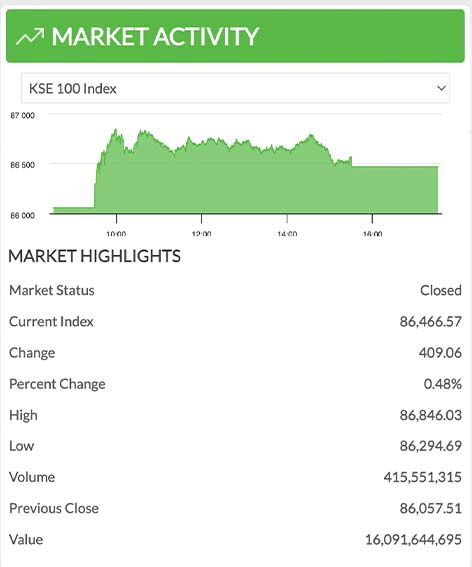
    Pakistan Stock Exchange (PSX) opened Tuesday on a positive note and managed stay nearly 600 points up throughout the trading session.

    The benchmark KSE-100 index was seen at its highest level during the day session when it surged to record peak of 86,846.03 points at 9:59 AM after rising by 788 points from its last close of 86,057. This occurred when the volume stood at 36,842,210.

    Interestingly, the lowest point PSX witnessed was also recorded at the opening hour, around 9:30 AM, when the stock market was seen at its lowest point for day, reaching 86,294.69.

    Pakistan Stock Exchange

    Still, throughout the day, the KSE-100 index managed to stay in in the positive territory and ended the second trading session of the week in green with a new record high of 86,466.57.

    The total volume of the KSE-100 index was 415.551 million shares.

    The PSX closed with a gain of 409 points or 0.48 per cent.

    Market summaryDetails
    Overall performance63 companies closed up, 34 closed down, 3 were unchanged.
    Top gainersKEL (+13.41%), ATRL (+8.28%), SYS (+7.44%), CHCC (+6.03%), MEHT (+5.19%)
    Top declinersPAKT (-6.18%), PGLC (-5.41%), PIBTL (-4.40%), EPCL (-2.95%), YOUW (-2.42%)
    Index-point contributors (Up)SYS (+174.04 points), LUCK (+62.46 points), HUBC (+51.71 points), ATRL (+48.33 points), KEL (+44.48 points)
    Index-point contributors (Down)FFC (-108.64 points), PAKT (-29.07 points), PSO (-21.78 points), BAHL (-20.80 points), EFERT (-17.23 points)
  • Pakistan’s current account sees $119 million surplus in September

    Pakistan’s current account sees $119 million surplus in September

    Pakistan’s current account saw a surplus of $119 million in September 2024, a notable improvement from the $218 million deficit in the same month last year, according to data from the State Bank of Pakistan (SBP).

    This marks second straight month of current account surplus, and it’s the biggest since March 2024.

    The surplus for August 2024, which was initially reported around $75 million, was revised down to $29 million in the latest data.

    In the first three months of the current fiscal year (3MFY25), the overall current account deficit stands at $98 million. This marks a significant 92 per cent reduction from the $1.241 billion deficit recorded in the same period in 2023.

    Breakdown of September 2024

    Trade (September 2024)Value (Sept 2024)Value (Sept 2023)Improvement
    Exports of goods and services$3.302 billion$2.999 billion+10%
    Imports of goods and services$5.574 billion$4.845 billion+15%
    Worker remittances$2.849 billion$2.209 billion+29%

    Exports: Pakistan’s total exports of goods and services reached $3.302 billion, a rise of over 10 per cent compared to $2.999 billion in September 2023.

    Imports: Imports surged nearly 15 per cent year-on-year, reaching $5.574 billion in September 2024.

    Worker remittances: Remittances amounted to $2.849 billion marking a 29 per cent increase compared to last year.

    Reasons behind the improvement

    The reduction in the current account deficit is partly due to not so impressive economic growth and high inflation, which have curbed demand for imports. The increase in exports, higher interest rates, and some import restrictions have supported the government’s efforts to narrow the deficit.

    3MFY25 performance

    From July to September 2024, exports totalled $9.4 billion, while imports reached $16.83 billion. Worker remittances during the same period were recorder at $8.79 billion, showing almost 39 per cent jump from the same period in 2023.

    Why it matters?

    The current account is a critical indicator for Pakistan’s economy. this is due to its reliance on imports. A widening deficit can weaken the Pakistani currency and deplete foreign exchange reserves, while a surplus helps stabilise both.

  • Gold price in Pakistan increases Rs6,300 in a week

    Gold price in Pakistan increases Rs6,300 in a week

    Gold price in Pakistan witnessed an increase of Rs6,300 per tola within six trading sessions during the week ending on October 19, 2024.

    On a week-over-week basis, the price of 24-karat gold surged by Rs6,300, breaking all-time high record and ending the week at a new record high rate of Rs281,800 per tola as compared to its price recorded on October 12, when the yellow metal was priced at Rs275,500 per tola in the local gold market.

    A number of experts have attributed the latest surge in local and international gold prices to escalating tensions in the Middle East, along with uncertainties regarding US elections, coupled with relaxed monetary policy expectations.

    The latest increase in gold’s rate was witnessed on Saturday, when gold prices saw an increase of Rs900 per tola ad closed at new historic high.

    According to All-Pakistan Gems and Jewellers Sarafa Association (APGJSA), which shares gold prices on a daily basis, the ten-gramme gold also witnessed a single-day surge of Rs772, clocking in at Rs241,598.

    The recent surge in local gold rates comes after gold prices, in the international market, were seen at their highest level after rising by $9. As per APGJSA, the price of gold was recorded at $2,721 per ounce, including a premium of $20.

    Silver prices in the local market were also up for the second straight session. According to the associaton, silver rate was recorded about Rs50 up, settling the week at Rs3,150 per tola.

  • Cotton’s potential revival: Strong harvest drives 52 per cent increase in ginning factories

    Cotton’s potential revival: Strong harvest drives 52 per cent increase in ginning factories

    Cotton farmers breathed a sigh of relief as the final bale of their successful harvest was loaded onto trucks en route to the ginning factories. After a 48 per cent decline in cotton output from last year, the first fortnight of October recorded an 8.87 per cent increase compared to the same period last year, reigniting the hopes of many in the cotton industry.

    The cotton harvest crossed the one million bale mark compared to the same time last year. This increase in the yields, amounting to an extra 90 thousand bales of cotton, resulted in 184 ginning factories reopening. That is an incredible 52.27 per cent increase in the number of operational factories. The owners of these factories are set to benefit as the factories have gone from collecting dust to receiving cotton trucks.

    At these factories, cotton is cleaned and refined by separating it from impurities such as leaves, dirt and, most importantly, cotton seeds. These seeds are a major byproduct of the purification process and a source of profit for the factory. If farmers manage to increase yields, factory owners can count on getting more seeds with each additional deposit of raw cotton to the factory.

    The availability of these extra seeds will likely translate into an increase in the production of cottonseed oil and animal feed. This is going to spell good news for businesses involved in poultry as the increased supply of animal feed in the market will potentially result in lower feed prices for their hens.

    Due to lower cotton production levels earlier in the year, import deals to bring in approximately 3 million bales of raw cotton have been formalised. However, the cotton is still not on Pakistani shores.

    The wait times associated with the import of cotton by Pakistan from the United States, which sources most of Pakistani cotton imports, is a staggering 44 days. If this cotton was sourced internally from local farmers, however, this time could be cut down to just 2-3 days. Unfortunately though, farmers cannot currently scale up production to meet the domestic demand of cotton.

    If cotton farmers can continue to ramp up production, the business community will not be the sole beneficiary. Pakistan has been importing billions of dollars of cotton, recently being the 5th largest importer of the raw material in 2022. If local farmers can meet domestic demand, the economy will be spared a huge import bill, thereby reducing the balance of the trade deficit, which stood at a glaring $24.8 billion in FY 2023.

    October may mark the end of the woes faced by farmers this year. However, only time will tell if they can reach the level of production they enjoyed just a year prior.

  • Experts believe SBP has more room to cut policy rate as inflation declines

    Experts believe SBP has more room to cut policy rate as inflation declines

    The State Bank of Pakistan (SBP) is likely to reduce policy rate by 400 basis points this year, as a notable drop in the country’s inflation gives room for continued monetary easing to support economic growth.

    According to Topline Securities, inflation in Pakistan is expected to remain low in October but may rise a little on a monthly basis.

    The Consumer Price Index (CPI) for this month is estimated to stay between 6.5 per cent and 7.0 per cent year-on-year, with a 0.9 per cent rise month-on-month. This can bring the average inflation rate for first four months of FY25 to 8.6 per cent compared to 28.5 per cent during the same period in 2023.

    What experts are calling “the faster-than-expected ease in inflation” is largely because of the delays in raising administered electricity prices, somewhat favourable global oil and food prices, and a stable Pakistani rupee.

    Recent estimates suggest headline inflation will drop from 23.4 per cent in FY24 to around 9 per cent in FY25. In response to this trend, the SBP has already cut its policy rate by 450 basis points, lowering it to 17.5 per cent in September from 22 per cent in May 2024.

    Read more: Gold hits historic peak of Rs280,900 per tola in Pakistan

    To note, inflation in the previous month crashed to its lowest level in nearly four years, with consumer prices rising by 6.9 per cent year-on-year, within the central bank’s target range of 5-7 per cent. However, economic growth remains modest.

    The Gross Domestic Product (GDP) rose 2.5 per cent in FY24, after a contraction the previous year, but this is still below the long-term average growth rate.

  • Gold hits historic peak of Rs280,900 per tola in Pakistan

    Gold hits historic peak of Rs280,900 per tola in Pakistan

    The gold price in Pakistan continued its upward trend and surged to a level never seen in the history of Pakistan.

    All-Pakistan Gems and Jewellers Sarafa Association (APGJSA), which releases gold rates in the local market on a daily basis, reported that the price of 24-karat gold was seen at a new record high of Rs280,900 per tola.

    As per the APGJSA, the gold price recorded a massive increase of Rs3,000 per tola during the day and rose to its all-time high level.

    Interestingly, this is the third straight record high price recorded for gold within this week.

    The last record high price of 24-karat gold was recorded on Thursday when the association quoted the precious metal’s rate at Rs277,900, which was the then-record high.

    The previous record high, before today’s peak, was seen after the yellow metal witnessed a single-day surge of Rs700 in its earlier price of Rs277,200 per tola, recorded on Wednesday.

    The price for ten-gramme gold also spiked and was recorded at Rs240,826 after an increase of Rs2,572.

    Finally, silver prices also rose in the local market on Friday as the per tola rate jumped by Rs50 to Rs3,100 per tola.

    Today’s surge comes after the gold price saw an unexpectedly big increase of $30 in the international market, clocking in at $2,712 per ounce. This price is inclusive of a premium of $20.

  • Reko Diq to possibly secure $4.5 billion in loans and investments

    Reko Diq to possibly secure $4.5 billion in loans and investments

    Bilateral sources line up to extend loans totalling USD 4.5 billion to Pakistan for the Reko Diq mining operation. Business owners surrounding the mining facility prepare to celebrate as the influx of funds will serve to promote business activity in the region.

    The greatest potential lender is the EXIM (Export-Import) Bank of the United States, which is interested in lending USD 1.5 billion to the Reko Diq mining operation.

    Other lenders like the World Bank, Asian Development Bank and bilateral sources like Canada, Japan, and Germany, among many others also expressed their interest in the project by offering to pitch in the combined value of three billion dollars in loans.

    The inflow of foreign investments and loans is bound to improve the transportation infrastructure of the area around the extraction site – primarily roads. Saudi Arabia has already offered to invest USD 150 million in infrastructure as part of the Saudi investment package into Reko Diq, which has still not been accepted by Pakistan.

    The new roads that will get paved for transporting gold and copper out of the mines will also be used by local businesses to move goods from warehouses to stores. Travel times and costs will witness a drop, helping businesses in the area improve their supply chain.

    This will also make the area around Reko Diq more accessible to tourists and travellers, which will rake in more traffic. With the increase in visitors, local shops, restaurants, rest stops, and other businesses will have the chance to attract more customers.

    Moreover, foreign investments will bring foreign workers to the mining zone who will need housing, food, and other services. New businesses could spring up to meet these needs, which will likely create jobs and reduce the current unemployment rate of 9.13 per cent, which is second only to Kashmir.

    The Government of Balochistan owns a 25 per cent stake in the mining operation. If the loans flow in, Balochistan’s economy will likely see an improvement along with the businesses that call it home.

  • Iran-Pakistan trade talks could yield sugar exporters a 500 million dollar sweet deal

    Iran-Pakistan trade talks could yield sugar exporters a 500 million dollar sweet deal

    Businessmen across Pakistan watched the developments of the meeting between Iran’s Minister of Trade, Mohammad Atabak, and Pakistan’s Commerce Minister, Jam Kamal Khan.

    The meeting ended with an agreement to remove the existing barriers to trade that could greatly increase trade and business activities on both sides of the border.

    The meeting in Islamabad sparked hope for future trade with Iran as the delegation from Tehran invited Pakistan to attend further talks regarding the improvement of economic ties.

    Pakistani sugar exporters would benefit enormously if talks between Islamabad and Tehran led to trade deals. This is because Iran currently spends over half a billion dollars annually to meet its sugar demand – a potential market for Pakistani exporters.

    This is prime time for sugar producers to capture lucrative export deals as the ECC (Economic Coordination Committee) has already directed banks to facilitate the export of an additional half a million tons of sugar.

    Currently, Iran imports sugar from as far away as Belgium and Brazil, a process that can take a staggering 40 days. The Pakistani market, however, could supply sugar to Iran within just 3-4 days due to the fact that the two countries are neighbours. 

    Pakistani businessmen in the agricultural sector will also reap a lot from this potential partnership, just like sugar producers. That’s because in 2023 alone, Pakistan imported nearly half a billion dollars worth of fertilisers, and Iran is a net exporter, so a trade deal between the two neighbours is possible.

    If realised, the import of Iranian fertilisers is likely to drive down fertiliser prices locally, which would benefit farmers. The lower production costs would help increase profitability for farmers and could also make Pakistani agricultural exports even more competitive than they already are in the global market.

    Perhaps the most exciting possibility, however, is the potential for the export of Iranian petroleum to Pakistan. With petrol prices sitting at an uneasy PKR 247 per litre, importing oil from Iran at special rates due to “special clauses” in trade deals could provide relief to both businesses and consumers.

    Atabak has extended an invitation to Jam Kamal Khan for further talks in Tehran, sparking speculation that a trade deal could soon become a reality, which would mark a major step forward in bilateral relations.

    If the discussions result in trade agreements, businesses from both nations will benefit. Industries and citizens are expected to enjoy lower costs and shorter delivery times for imports. The future could very well see Iranian fertilisers being used to grow Pakistani sugarcane, only for that same sugar to make its way back to Iran – a sweet cycle of trade.

  • 24-karat gold price hits fresh record high in Pakistani market

    24-karat gold price hits fresh record high in Pakistani market

    After increasing in the international markets, gold prices climbed in Pakistan and were seen at their highest-ever level on Thursday.

    The All-Pakistan Gems and Jewellers Sarafa Association (APGJSA), which shares gold rates on a daily basis, reported that the price for 24-karat gold recorded a single-day surge of Rs900 per tola, which pushed the precious metal’s rate to a new all-time high of Rs277,900 per tola in Pakistani gold markets.

    The previous all-time high was recorded on Wednesday, when gold’s price in Pakistan was recorded at a then-high of Rs277,200 per tola, after witnessing a massive single-day increase of Rs2,200 per tola.

    It is worth adding here that the latest surge follows a notable increase in the price of gold in international markets. According to the APGJSA, the price for one ounce of gold was recorded at $2,682. This price also includes a premium of $20.

    The total surge the yellow metal witnessed in the global market was $7 per ounce.

    Despite gold surging to its highest-ever level in the history of Pakistan, silver prices remained unchanged and were recorded at Rs3,050 per tola.