Category: Lifestyle

  • Arshad Khan’s ‘Chaiwala’ company in financial trouble because of non-payment

    Arshad Khan’s ‘Chaiwala’ company in financial trouble because of non-payment

    Arshad Khan, a tea-stall owner who rose to fame for his exceptionally good looks is in news again as the famous Chaiwala has run into serious financial troubles. He launched his Chaiwala London café a year ago in London, England with the help of two franchise owners, who also happen to be cousins.

    Arshad Khan has not been paid royalty as promised by UK franchise owners, according to an insider. He has been requesting the London café owners who have refused to pay him because of business losses. Additionally, they also refused to pay rent to the landlord.

    Background

    Arshad Khan’s brand was brought to the UK last year by two cousins: Nadir Khan Durrani and Yaver Akbar Durrani. UK Companies House record shows that Yaver Akbar Durrani registered Cafe Chaiwala Ltd under company number 13205566.


    Nadir is a UK national and Yaver Akbar Durrani is a Canadian national who lives in the United States. They registered the company in early 2021 and are currently running the business actively.

    Café Chaiwala Arshad Khan is located in East London on 229 Ilford Lane. The situation is bad to the extent that the café never opened its ground floor section to the public because of poor quality of service. It was a big hit when it opened last year but the poor quality, mismanagement and lack of hygiene at the café deterred the customers, according to reports.

    When opening the café last year in London Yaver Akbar Durrani and Nadir Durrani announced that they would open several franchises of “Café Chaiwala Arshad Khan” in the United Kingdom, Europe, North America, Asia, Australia, and the Middle East.

    Now the two cousins have run into a legal dispute with the owner of the building after failing to pay rent of over six months, citing business losses and complaining that that the rent is too much and should be reduced. Yaver Durrani met Arshad Khan in Islamabad and made promises to clear the pending monthly royalty but later on told him he cannot pay him until the business goes into profit. He told Arshad Khan that too many Chai cafes have opened nearby on the same street and that has damaged the business. Arshad Khan has been trying to keep the issue private to protect his brand, he says. Durrani is also accusing Arshad Khan of not delivering the full recipes to the London café as promised originally.

    Failed Promises

    A source at Arshad Khan Chaiwala told Pakistan Today that Arshad sold the international franchise to the Durrani brothers but they have broken the contract and agreement by not paying royalties to Arshad Khan and continuing to use his name. Therefore, Arshad Khan will not allow them to use the brand and franchise anymore. “Both sides have threatened legal action against each other,” said the source from Islamabad.

    During the London launch, the Master Franchisees-UK promised that Arshad Khan will visit London soon to meet his fans and to brew ‘karak’ chai for them. Later, they didn’t make arrangements for his travel to the UK as the non-payments estranged the two parties.

  • Azma Bukhari shares details of Maryam Nawaz’s wardrobe and this will boggle your mind

    Azma Bukhari shares details of Maryam Nawaz’s wardrobe and this will boggle your mind

    Information Minister from Punjab Azma Bukhari recently appeared in an Eid interview with Geo Pakistan where she was asked about Chief Minister Punjab and her Party’s (PML-N) leader Maryam Nawaz’s looks and styling.

    To this she replied, “I can categorically say that she just applies a thing or two on her face (cosmetics) and gets simple lawn dresses worth 700-800 stitched and wears them.” Azma further added that “it is not about the cost of the items but the way you carry them,” adding that she is inspired by Maryam Nawaz because she carries the clothes well.

    The video surfaced on social media a day earlier and has taken the net by storm as people are grilling Azma for being so oblivious of current prices.

    A number of users commented that not even a lawn shirt cost 800 now let alone a whole dress. Some quipped that they want the address of the place Maryam Nawaz gets her dresses from.

    Many other lambasted Azma by pointing out the expensive collection of shoes and bags Maryam Nawaz uses on daily basis which are worth hundreds of dollars.

    A user commented that CM Punjab should suffix the cheap dresses with costly bags and shoes actually.

    On her oath-taking as Chief Minister Punjab, Maryam wore a dress worth Rs. 60,000.

    She donned a Saira Habib dress paired with Dior sandals at the oath-taking of her uncle Shehbaz Sharif on his oath-taking ceremony as Prime Minister of Pakistan. The look in totality is worth way more than Rs800 contradictory to what Azma claimed.

    Maryam Nawaz is famous for her styling and her daily looks are a topic of discussion all over on social media.

  • Weather alert: Rain spells entering Pakistan

    Weather alert: Rain spells entering Pakistan

    The meteorological department has predicted rains in various parts of the country, reports Geo.

    The weather became pleasant with thundershowers in many cities of Punjab including Rajanpur and Bhakkar.

    Khyber Pakhtunkhwa’s Parachinar city and adjacent areas received rain and snow on the mountains. In Quetta and its surrounding areas there were heavy spells of rains.

    Azad Jammu Kashmir’s Neelum valley also experienced overcast along with strong winds.

    The sand storm from the border desert of Afghanistan entered the Pakistani areas due to which trees were uprooted, mud walls and solar panels fell in many areas including Chaman, Qila Abdullah, Pashin, Gulistan, Jangal Pir Alizai, Saranan due to which high alert was issued.

    Gusty winds will continue intermittently in South Punjab, Khyber Pakhtunkhwa, Balochistan, Gilgit-Baltistan and Kashmir according to the Department of Meteorology. Heavy rain and hail may also occur at some places.

    Apart from this, the weather department has also that there is a possibility of rain in Karachi today and tomorrow (Saturday and Sunday). 

  • Man murders wife, seven children in axe attack

    Man murders wife, seven children in axe attack

    A man killed his wife and seven children with an axe in Alipur Tehsil of Muzaffargarh. Police have arrested him along with recovering the instrument of murder.

    Sajjad Khokhar killed his wife and children in Mudwala area of Alipur after a domestic dispute erupted at home.

    The ages of the children are between six months and eight years, said the police. Funeral prayers of the eight victims have already been carried out.

    Police later arrested the suspect who was walking with a limp. Preliminary investigations indicate that Sajjad massacred his family due to poverty and growing domestic disputes.

  • Maulana Tariq Jamil becomes emotional as he remembers son

    Maulana Tariq Jamil becomes emotional as he remembers son

    Maulana Tariq Jamil has opened up about the death of his younger son, a tragedy that befell the family a few weeks ago.

    Asim Jamil, who was battling depression, passed away in what was reported as a huge shock for the family. Maulana talked openly about how much his son suffered and how heartbreaking it is to lose him. This Eid is the first one he is celebrating without his son.
    During a conversation with Hafiz Ahmed, Maulana shared, “I and my wife, we both feel that a parent’s love is the greatest. But the love we had for Asim, whom Allah has called back, was the most intense for us both. He had engraved himself in our hearts with his qualities. Allah had only given him such a short life.”

  • How humanitarian aid reaches war-torn Gaza

    How humanitarian aid reaches war-torn Gaza

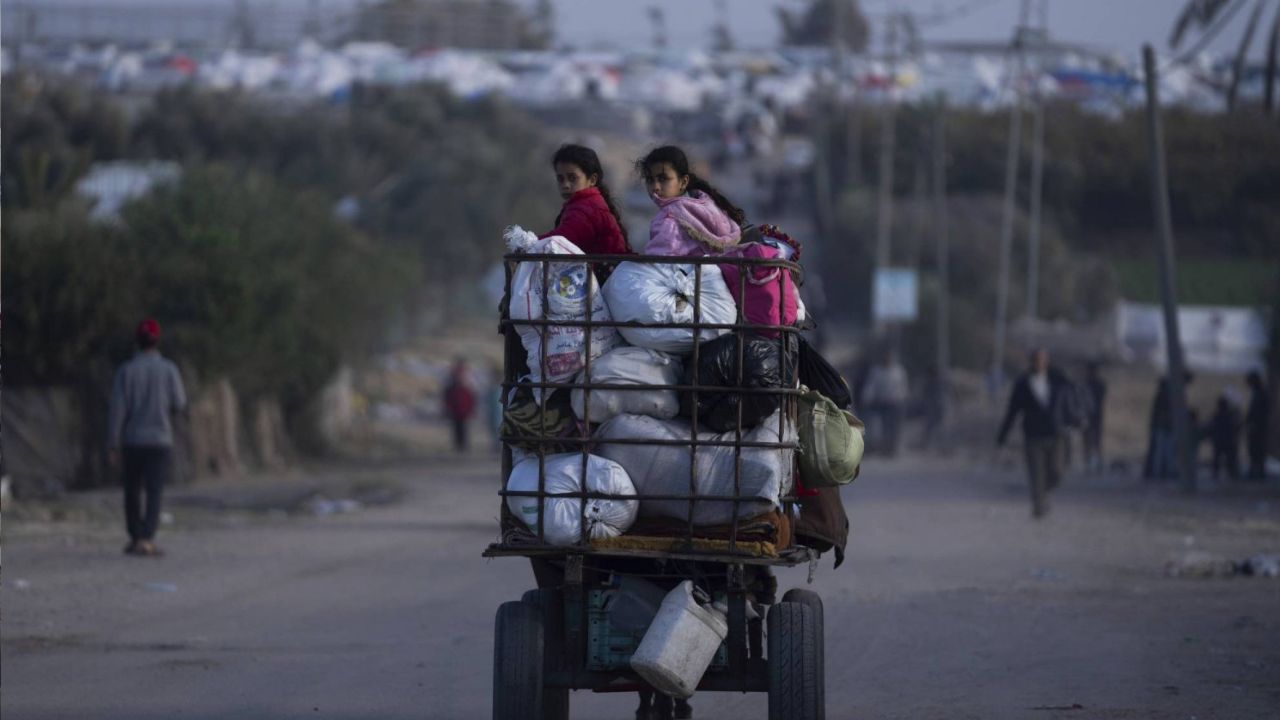
    Most aid bound for war-ravaged Gaza arrives overland from neighbouring Egypt but Israel and UN agencies clash on how much actually makes it inside the Palestinian territory.

    The volume of aid entering Gaza by road each day through the Rafah crossing from Egypt is insufficient, aid workers say, blaming rigorous Israeli inspections at least in part.

    With no truce in sight to pause the Israel-Hamas war, here is a look at how aid currently reaches Gaza and what alternatives are being weighed to alleviate the crisis in the besieged Palestinian territory.

    First stop: Egypt

    Most Gaza-bound goods arrive by sea in the Egyptian ports of Port Said or El-Arish.

    El-Arish is closer to Gaza but also smaller, and was quickly overwhelmed by the volume of shipments arriving, aid groups say.

    Israeli authorities, who have blockaded Gaza since Hamas took sole control of the Palestinian territory in 2007, require that all aid entering Gaza be inspected by them.

    The main inspection area for goods is Kerem Shalom in southern Israel, not far from the Rafah crossing.

    Another inspection area exists in Nitzana, on the Israeli-Egyptian border about 40 kilometres (25 miles) to the southeast.

    Long wait for trucks

    Before reaching the inspection areas, many aid trucks wait for days at the Egyptian side of the Rafah checkpoint.

    Once inspected, goods that are cleared to enter by Israel are unloaded from the mostly Egyptian trucks in the zone between Egypt and Gaza.

    The supplies are then loaded onto separate vehicles, driven by Gazans working for aid groups, for distribution inside the Palestinian territory.

    Cumbersome screenings are a major reason shortages are so glaring, aid workers say.

    Israel blames a lack of sufficient capacity on the Palestinian side to distribute the aid once it gets in.

    In recent days, Israel took issue with UN figures on the number of trucks entering Gaza, accusing UN Palestinian refugee agency UNRWA of counting only trucks it had processed, not those processed by Israel.

    Heading north

    For months, aid groups and foreign governments including top ally the United States have urged Israel to reopen border crossings into the north of Gaza, where the humanitarian crisis is most severe.

    Israel announced that six World Food Programme (WFP) aid trucks entered the north directly from its territory in early March, in what it described as a “pilot project”.

    The trial was not extended, however, and aid convoys bound for northern Gaza must travel the length of the territory negotiating battlegrounds, Israeli bombardments and mobs of desperate civilians.

    In March, the WFP said one of its convoys had been blocked by Israeli forces inside Gaza before it could reach the north.

    After turning back, the agency said the convoy was looted by a “crowd of desperate people”.

    According to Israeli authorities, 28 trucks reached northern Gaza on Wednesday.

    They were among 298 trucks that Israel said entered Gaza on Wednesday, still far below the number aid groups say is needed to sustain the territory’s 2.4 million people.

    Under pressure from the international community, Israel announced on April 5 that it would open a new crossing directly into northern Gaza, without specifying its exact location or when it would open.

    By air and by sea

    In a bid to get round the logjam, several Arab and European governments, later joined by Washington, began carrying out aid airdrops over Gaza, particularly the north.

    But the airdrops have proved controversial, with multiple deaths among civilians on the ground who were crushed by aid crates when parachutes failed to open, or drowned trying to reach others accidentally dropped in the sea.

    There has also been an attempt to establish a maritime aid corridor from the Mediterranean island of Cyprus but it has largely fizzled out after seven aid workers were killed by Israeli fire on April 1 as they unloaded food from the second flotilla to make the crossing.

    Even though the Cypriot government insists it has not given up on the aid corridor, no further crossings are currently planned after the US and Spanish charities behind the first two suspended their operations in the region.

    UN agencies have in any case said repeatedly that road convoys are the only practical way of meeting Gaza’s needs.

  • Heatwaves put millions of children in Asia at risk: UN

    Heatwaves put millions of children in Asia at risk: UN

    Massive heatwaves across East Asia and the Pacific could place millions of children at risk, the UN warned Thursday, calling for action to protect vulnerable people from the soaring temperatures.

    Global monitors have warned that 2024 is shaping up to be the hottest year on record, marked by climate extremes and rising greenhouse gas emissions.

    The UNICEF data showed over 243 million children across the Pacific and East Asia were estimated to be affected by heatwaves, putting them at risk of heat-related illnesses and death.

    Several countries in the region are currently smouldering in the summer heat, with temperatures nearing record levels as they regularly hit over 40 degrees Celsius (104 degrees Fahrenheit).

    Local forecasters are predicting steeper rises in the coming weeks.

    Some Philippine schools suspended in-person classes in April, with the state weather forecaster saying temperatures could reach a “danger” level of 42 or 43 degrees Celsius in parts of the country.

    In Thailand, a temperature of 43.5 degrees Celsius was recorded in the northern province of Mae Hong Son earlier this week — just a few degrees shy of the record 44.6 degrees Celsius.

    Around 40 people die from heat-related illnesses annually, according to the Thai Ministry of Health.

    And in February, neighbouring Vietnam endured a monster heatwave in its southern “rice bowl” when temperatures reached up to 38 degrees Celsius — an “abnormal” high for the period.

    According to the UNICEF report, children are more at risk than adults as they are less able to regulate their body temperature.

    “Children are more vulnerable than adults to the effects of climate change, and excess heat is a potentially lethal threat to them,” said Debora Comini, Director of UNICEF Regional Office for East Asia and the Pacific.

    The report said heatwaves and high humidity levels — commonly experienced in the region — can have a deadly effect as the heat will “hinder the body’s natural cooling mechanisms.”

    “We must be on high alert this summer to protect children and vulnerable communities from worsening heatwaves and other climate shocks,” Comini said.

    The UN projected that over two billion children are expected to be exposed to heatwaves by 2050.

  • 150 Jewish celebrities show support for director’s pro-Palestine Oscars speech

    150 Jewish celebrities show support for director’s pro-Palestine Oscars speech

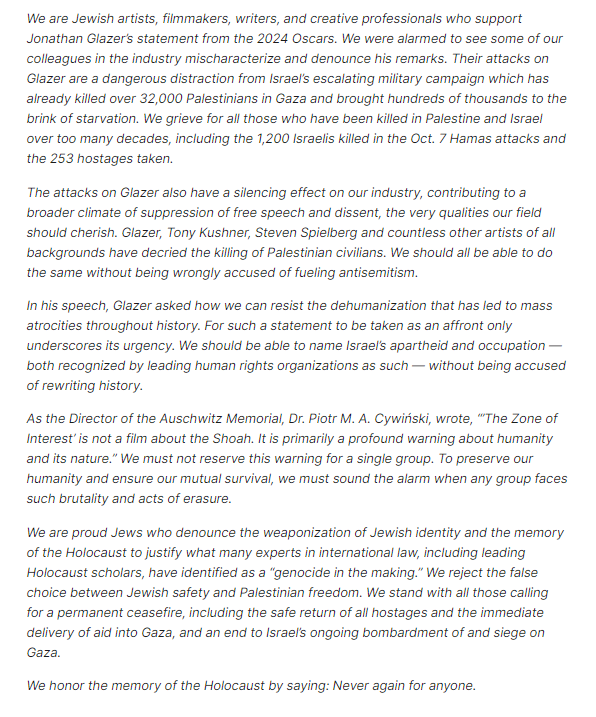
    More than 150 Jewish creatives have signed an open letter supporting Oscar Winner Jonathan Glazer’s pro-Palestine Oscars speech.

    The British filmmaker, Jonathan Glazer, who won the Best International Feature Oscar for his film ‘The Zone of Interest’, has been at the centre of an ongoing debate in Hollywood. He was under fire for his pro-Palestine speech at the Oscars. Glazer, who is Jewish himself, has now received support from heavyweight names.


    Jonathan Glazer’s speech is continuing to become one of the Oscars’ most debated and polarizing moments after many media outlets called it “anti-semitic”
    While accepting Best International Feature for his Holocaust film The Zone of Interest, Glazer drew a parallel between his film and the current conflict in Gaza: “Right now, we stand here as men who refute their Jewishness and the Holocaust being hijacked by an occupation, which has led to conflict for so many innocent people – whether the victims of October the 7th in Israel or the ongoing attack on Gaza – all the victims of this dehumanisation…”

    Now, the director has received fresh and welcome support through a new letter, whose signatories include major Jewish creatives like Nan Goldin, Joaquin Phoenix, Tom Stoppard, Elliott Gould, Debra Winger, Joel Coen, Emma Seligman, Nicole Holofcener, and Boots Riley.


    They are among more than 150 Jewish creatives who have signed the open letter supporting Glazer’s Oscars speech, writing that they were “alarmed to see some of our colleagues in the industry mischaracterize and denounce his remarks”.


    “In his speech, Glazer asked how we can resist the dehumanization that has led to mass atrocities throughout history,” read the letter. “For such a statement to be taken as an affront only underscores its urgency.”


    The letter also criticized the earlier condemnations of Glazer, saying they “have a silencing effect on our industry, contributing to a broader climate of suppression of free speech and dissent, the very qualities our field should cherish.”


    “We should be able to name Israel’s apartheid and occupation – both recognized by leading human rights organizations as such – without being accused of rewriting history.”


    The letter concluded: “We stand with all those calling for a permanent cease-fire, including the safe return of all hostages and the immediate delivery of aid into Gaza, and an end to Israel’s ongoing bombardment of and siege on Gaza.”

  • Hepatitis viruses kill 3,500 people a day: WHO

    Hepatitis viruses kill 3,500 people a day: WHO

    More than 3,500 people die from hepatitis viruses every day and the global toll is rising, the World Health Organization warned on Tuesday, calling for swift action to fight the second-largest infectious killer.

    New data from 187 countries showed that the number of deaths from viral hepatitis rose to 1.3 million in 2022 from 1.1 million in 2019, according to a WHO report released to coincide with the World Hepatitis Summit in Portugal this week.

    These are “alarming trends,” Meg Doherty, head of the WHO’s global HIV, hepatitis and sexually-transmitted infection programmes, told a press conference.

    The report said that there are 3,500 deaths per day worldwide from hepatitis infections — 83 percent from hepatitis B, 17 percent from hepatitis C.

    There are effective and cheap generic drugs which can treat these viruses.

    Yet only three percent of those with chronic hep B received antiviral treatment by the end of 2022, the report said.

    For hep C, just 20 percent-or 12.5 million people-had been treated.

    “These results fall well below the global targets to treat 80 percent of all people living with chronic hep B and C by 2030,” Doherty said.

    The overall rate of hepatitis infections did fall slightly.

    But WHO chief Tedros Adhanom Ghebreyesus emphasised that the report “paints a troubling picture”.

    “Despite progress globally in preventing hepatitis infections, deaths are rising because far too few people with hepatitis are being diagnosed and treated,” he said in a statement.

    Africa accounts for 63 percent of new hep B infections, yet less than one in five babies on the continent are vaccinated at birth, the report said.

    The UN agency also lamented that the affected countries did not have enough access to generic hepatitis drugs — and often paid more than they should.

    Two thirds of all hepatitis cases are in Bangladesh, China, Ethiopia, India, Indonesia, Nigeria, Pakistan, the Philippines, Russia, and Vietnam, according to the report.

    “Universal access to prevention, diagnosis, and treatment in these 10 countries by 2025, alongside intensified efforts in the African region, is essential to get the global response back on track,” the WHO said in a statement.

    Viral hepatitis is the second-biggest infectious killer, narrowly trailing tuberculosis.

  • Know all about Eid predictions here

    Know all about Eid predictions here

    There is a strong possibility that the Shawwal moon will be visible in Pakistan today.

    The age of the moon will be complete enough to be visible to the human eye this evening, according to experts of Meteorological Department. However, the final announcement of the moon of Shawwal will be made by the central Ruet-i-Hilal Committee.

    The moon of Shawwal has not been seen in Saudi Arabia, in view of which, Eid-ul-Fitr will be held tomorrow, Wednesday, in Saudi Arabia.

    In addition to Saudi Arabia, Qatar, the United Arab Emirates, Bahrain, and Kuwait will celebrate Eid tomorrow, according to media reports in the Gulf-based newspapers. Simi­larly, Australia has also announced that Eid will be observed on Wednesday.

    The central moon-sighting body will meet at the roof of the Federal Secreta­riat’s Kohsar Block in Islamabad, while meetings of zonal and district Ruet-i-Hilal committees will be held at their respective headquarters concurrently.

    In a statement on Mon­day, the committee requ­es­ted citizens to share any information regarding sightings of the moon with the committees in their respective areas.

    If the committee manages to spot the new moon today, then Pakistan will also celebrate Eid with the rest of the world.