Category: Opinion

  • Pakistani Love: Love in Expected Places

    Pakistani Love: Love in Expected Places

    I was 23 years old when I met my husband for the first time. After a whirlwind courtship of gorgeous flowers and overseas calling cards, we were married a short eight months later. By the time I was 28, I had three beautiful babies.

    Becoming a mother was the most momentous and profound turning point of my life. I realized with every sleepless night, with every poop call, every gurgle of laughter, the resilience I was capable of. It seems trite to say, but for the first time, I knew what it felt like to love unconditionally; blindly and completely. To know that forevermore, I will think of others before even beginning to consider myself.

    As the children’s demands grew, date nights were few and far in between, travelling seemed overwhelming, showering appeared to be a luxury and doing anything for myself, an unnecessary and guilty indulgence. In these years, I YouTubed fervently, teaching myself how to do my own hair. I researched to figure out the shortest and most effective forms of exercise at home and to keep my separation anxiety at bay, googled how to make my own candles while the kids were at pre-school.

    Juggling being a mother, a wife, a daughter and daughter-in-law occupied all of my time and my life was full to the brim. Occasionally, my husband and I would go out with friends. Out at dinner or to a party, in the midst of the fun and revelry I would realize that as much as I was glad to be out, I would much rather be doing something else.

    In 2014, we moved to Dubai. Being a pakka Karachite, it was emotional suicide. Outside my comfort zone, it was also when I realized I had stopped having an opinion. I began to wake up to the sudden thought that while living for others is a natural by-product of being a mother and wife, forgetting to think of yourself is not.

    But old habits die hard, and I continued delaying everything I wanted for the benefit of the greater good. It was always about what other people expected of me, what I needed to be doing, what I had to be responsible for. I seemed to be guided completely by the wants and needs of everyone around me.

    It took losing my father this year to absorb something multitudes of books and thousands of songs push on repeat: learn to love yourself.

    No one really explains how losing a parent changes you. For me, it made me reevaluate everything I have ever believed in. It’s almost as if something tangible breaks inside of you, and you have to put yourself back together again, piece by piece.

    Except now, you can decide what to put back and what not to.

    What tiny bit of yourself to leave out and what to glue back. There is also the huge piece of you that will remain forever missing, and you have to learn to factor that in too. With grief, you are irrevocably changed, in a way no motivational talk can achieve.

    Losing my father taught me that life is fleeting. You will never find the right time to be or do what you want- except now. So in the midst of my turmoil, I am learning to fall in love with myself again. To give myself time to heal, to be myself, to say no, to say yes. To teach the people around me to give me space; to learn it myself.

    I still have a long way to go, but I no longer accept invitations that I feel I have to. When I’m mired down in a conversation about clothes and jewelry, I feel no guilt in zoning out. When I really should go to that dinner, I stay in to watch Netflix. I stand up for what I believe in and no longer apologise for what I don’t. When I’m exhausted but bored, I force myself to get dressed up and go out. I make time for yoga, I order in that burger and when I get a strong feeling, I trust my instincts.

    But when my journey began to feel a tad too self-indulgent and a bit rebellious, one recent Sunday night the whole family was sitting and watching Jurassic Park. I got up to check why my seven-year-old wasn’t back from the bathroom. When I saw her peacefully coloring in her room, I asked her why she wasn’t watching the movie with the rest of us. What she said was a validation of sorts:

    “I don’t feel like watching Jurassic Park again, mama. I just want some me-time and do what I feel like”.

    I felt like clapping, loving the fact that I was teaching my daughter to love herself.

    I have learnt, until I am as giving and kind to myself as I am to others, I can never really love completely. No one will look after you, except you.

    This Valentine’s Day, let that be a priority. Today, I hold my loved ones close and pray that of all the lessons I teach my children, I really, really hope they always remember this one.

    Read the other ‘Pakistani Love’ stories here:

    Pakistani Love: The Story of Survivors
    Pakistani Love: They wanted to dream

    Pakistani love: The Pleasure Quartet and Black Ships

  • Pakistani Love: They wanted to dream

    Pakistani Love: They wanted to dream

    The first time I saw her, she was wearing a beautiful blue shirt, seemingly lost in a deep conversation with herself on the balcony. It was one of the most intriguing moments in my life. She stood there, lean, tall and a head full of short brown curls. I couldn’t hear what she was saying to herself and I felt this urge to lean in and listen to her. Her warm, brown eyes met mine and she gathered herself. I had entered her personal space but she didn’t seem to mind. She smiled at me, awkwardly, and went back inside. 

     I wanted to meet her again.

    It wasn’t even a question because I wasn’t allowed to ask any. I belong to a desi, typical, religious family in Pakistan. Parents who were slaves to their patriarchal mindset and bound by the stereotypical standards set by society. There was constant shame. Shame for wanting to understand myself, asking about and saying words like sex, vagina, menstruation, puberty.

     Little brown bags hiding the shame of being a natural woman. 

    If it wasn’t for my sister, I would have never had the guidance that every girl needs. 

    After I hit puberty, I realized I didn’t fit. I wasn’t like the others. And there was no one I could tell. It’s the loneliest feeling in the world. Not having the courage to tell your family who you are. Tell them there is nothing wrong with me. I just love differently. Please let me. Accept me. I’m gay. And that’s okay. 

    It was fate. There is nothing that can convince me otherwise. A few days after I saw her on the balcony, I saw Sara* in a park. I walked past her and looked back. It was her. Fidgeting with her headphones. I walked on but I felt her gaze on me. I turned around. She was staring at my legs and when she saw me look at her, face flushed pink with embarrassment. 

    I smiled. 

    “Hi.”

    “Hey.”

    “Do you…want to jog together?”

    “Sure.”

    My curly brown girl.

    I felt suffocated and I wanted to scream. 

    “I am a lesbian!” I screamed, but not out loud. In one instant, every moment, I was two different people. I sat in a room with people defining the ‘normal woman’, and I felt this heavy burden. My heart, my mind desperately wanted everyone to know. My face revealed nothing. Being part of the LGBTQ community in Pakistan is a huge struggle. I do not have the courage to come out to my family because the chances of acceptance by my religiously inclined family are very thin. 

    Can anyone hear me?

    I dreamed sometimes. I would tell my parents, my sister, sitting down in our living room, me, sitting opposite them all. 

    I’m gay, I’m different.

    The burden would magically be lifted. I would be one person.

     They would sit silently as I would die a little inside. Tears streaming down their faces. Father, stoic. Mother, silent. And a crack would emerge.

     They would smile and say, it’s okay. We love you, just the way you are.

    I would cry tears of joy. And then I would drift out of my head and the dream would walk away. It would come back but would never stay. 

    I tried to kill myself many times. 

    Maybe in death, the dream would stay on.

    “I’m from Lahore,” Sara said. 

    “Why did you move to Karachi?” I asked

    “I’m a journalist, so for work really,” she replied, “but I don’t have any friends…” 

     “You have me.”

    Sara was luckier than I was. Smarter.  She had never tried to end her life, had gone for therapy but she faced the same internal struggle. We formed a bond that I always craved. 

    She was the image that stayed on.

    It’s been more than a year since I told her I loved her. We are happy. But there’s a cloud that forever hangs over my head. I know nothing good ever lasts. This society cannot digest the relationship Sara* and I dream about. But for now we are lucky to have each other.

     There are so many others like us. 

    They dream.

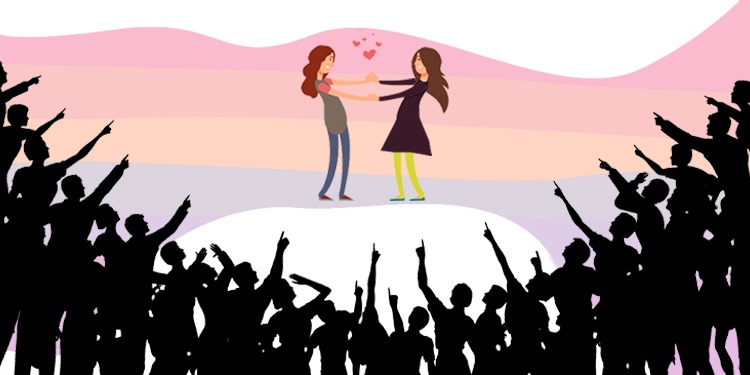
     They want to be able to find a partner who they can bring home. Smile with, hold hands with, be with. But they can never say it. They go missing from their homes, live their lives in despair. 

    God’s mistake. 

    There is no mistake in the love I feel for Sara. But there is a sadness attached to it. My parents will never know who I love. They will never feel the love their daughter feels. They will never hold my face in their hands and know, “She is happy”. They will never accept.

    As our fingers touch in secret, there are times I let myself drift. The dream changes. I am no longer sitting in that room alone, facing my parents. I sit with Sara.

    “Abba, this is Sara. Ami, Sara,” I would nudge her. 

    She would smile, her awkward smile.

    “Salaam Sara beta, it’s so very nice to meet you.”

    *Names of the author and characters have been changed to protect their identities.

  • Multicultural casting now bordering on the absurd

    The opposite of blackface is not illogical casting

    A new film adaptation of David Copperfield has the central character played by Dev Patel. So here David is brown but his mother is white while his late father’s sister is a very, very pale white. The character of Agnes is played by a black actor while her father is played by a Chinese actor, Steerforth is played by a white actor while his haughty and snobbish mother is played by a black one. Should all of this matter in this age of political correctness? The answer is that to a film viewer it does matter. It really does.

    Armando Iannucci’s screen version of the Dickens classic challenges all the preconceptions that criticism of the closed nature of the industry have highlighted: its tendency to tell white people’s stories, written by white people, directed by white people and featuring white actors. But the reason it doesn’t work is, essentially, that there is no attempt to be visually convincing.

    Let’s be clear here: when you are casting a classic story you attempt to be true to both the story and to the character. Hence Laurence Olivier playing Othello blacked up his face attempting to look like a Moor as did Al Jolson attempting to look like a black American musician — yet in the Iannucci film nobody bothers to look like anything but themselves. This might work in an independent theatre production but in an ambitious feature film it just doesn’t do the trick: film is a visual medium which is fairly reliant on the intimacy afforded by the camera close-up so it’s not enough to insist on the idea that ‘any actor can play any role.’

    In any case, it’s a false premise that any actor can play any role – every casting director will tell you that. When you are casting you look for acting ability plus a degree of physical resemblance and if the latter is absent, then you try to create resemblance through various means such as make-up etc. For example, you wouldn’t have a fat, heavily built actor playing the part of a slight and undernourished character any more than you’d have an eighty-year-old actor playing a teenager… Does this make the casting either ‘fatist’ or ageist and hence reprehensible? No, it’s all just a bit of common sense.

    For the past few years every time the Oscars and BAFTA award season comes around, we are reminded anew of the issue that mainstream films tend to ignore and sideline non-white talent and that the Hollywood film industry has a bias that favours white professionals. This is a completely valid concern but the superficial way in which some people are choosing to redress the balance is fairly ridiculous. The David Copperfield film is a perfect example of this – just because men used to play female roles in 17th-century productions of Shakespeare or white actors used to play Chinese or non-white roles in early cinema, does not mean that the inverse is okay – indeed such casting defies the very basis that such criticism is based upon i.e. that casting could be more authentic and more convincing if the opportunity was opened up to more people fitting the physical description better.

    At this point, you may disagree and ask “Well, what about Hamilton?”. Hamilton is, of course, the runaway hit musical by Lin-Manuel Miranda that casts non-white actors as America’s founding fathers and other historical figures. But Hamilton works because it is theatre rather than film and the story-telling methods are non-traditional.  What works on stage doesn’t necessarily work on the large screen – and certainly not where kinship is suggested, after all, we tend to look for some sort of resemblance even between non-white actors if they are cast as blood relatives, it’s just something that’s part of our cinematic expectation.

    It’s right and timely that we recognise and deal with the issue of prejudice and marginalisation in mainstream cinema and we attempt to correct conscious and unconscious biases within the industry, but the way to do this is not through random and unconvincing casting. The multicultural nature of the casting of the new Charles Dickens adaptation proves this convincingly. I’m not sure why filmmakers keep remaking perfectly good films but in the case of Copperfield, it marks no improvement on its predecessors. (Unfortunately, it’s difficult to discuss this widely enough because so few people nowadays seem to have read David Copperfield!)

    At any rate, when you see #OscarsSoWhite trending again this year, do think about the whole issue again. Hopefully, you’ll agree that merely ticking boxes and casting without logic does not redress any sort of historical imbalance it just makes for weak cinema.

  • Woke students in ‘secular’ India

    The BJP coming to power has only removed the lid from the internal realities of the unsuccessful story of Indian democracy.

    Unlike Pakistan, where student unions were banned during the military rule of Ziaul Haq, in India, student unions on campuses have successfully sustained till date. In the past few years, Jawaharlal Nehru University (JNU) has been mentioned as a refrain in discussions on student politics — particularly in terms of burgeoning progressive politics — the spillover effect of which has reached not only Pakistan, but major parts of the globe as a good omen for the oppressed.

    The student union of JNU, better known as JNUSU, was recognised as a symbol of resistance, the voice of voiceless and a representative of the marginalised and vulnerable communities within India. JNUSU gained popularity across the world after its former president Kanhaiya Kumar was arrested from campus in 2016 due to his association with a protest gathering held at JNU.

    The protest was organised by some students of the varsity on February 9, 2016, in order to commemorate the judicial killing of Afzal Guru (hanged Feb 9, 2013) and also to question the violation of human rights by the Indian state in Indian occupied Kashmir (IoK).

    Consequently, the fascist Bharatiya Janata Party (BJP) government pressed charges against the students who had organised the protest, as well as Kanhaiya, who had addressed the protest gathering. Kanhaiya, Umar Khalid and Anirban Bhattacharya were the three students who were jailed following the registration of an FIR [First Information Report] against them.

    With already popular Azadi slogans taking a different tone following Kanhaiya’s arrest, students – especially Kashmiri — took a tone that went on to prove their courage at the forefront of the struggle against Indian Prime Minister (PM) Narendra Modi’s fascist regime.

    The recent wave of mass-mobilisation in India started in the aftermath of the controversial Citizenship Amendment Act (CAA) that grants the government the right to declare people, unable to produce citizenship documents, as “illegal immigrants” and allows any declared illegal immigrant, except Muslims, to become a citizen of India on the grounds of persecution in neighbouring Muslim states.

    CAA’s implementation, however, comes after forming a National Register of Citizens (NRC). NRC has been implemented in the Indian state of Assam where people, who have not made it to the register, have either already been detained in camps or are facing the threat of landing in the same since there is no way to prove which countries do these allegedly illegal immigrants belong to.

    The massive mass-scale protests in India against the discriminatory CAA law drew much attention after the December 15 protest led by students of Jamia Millia Islamia University in a Muslim locality of New Delhi. With police cracking down on these protesting students by not only baton-charging but also shooting them, and that too on campus, tables started to turn on the Indian state.

    With students of Aligarh Muslim University protesting on campus against the brutality met out to their peers from Jamia Millia Islamia University, a new wave of resistance took over India. Fierce confrontation meted out to the cops, especially by female students, in what turned out to be the defining moment for the anti-CAA movement, as more people, although largely Muslims, joined the protests, and the same still goes on.

    Outside their campuses, students of Jamia Millia and Aligarh University are much more involved in mobilising and organising the ongoing protests. However, they are subsumed by the grandiosity of JNU and its student leadership that has expressed solidarity to Jamia students by joining one of the protests outside JNU.

    Despite a huge communication gap and both Pakistan and India’s coercive forces employed to keep people away from each other, the engagement of student-political activists gives us hope that a broader united front to fight injustice and oppression will someday be built.

    While mass participation of students, youth and religious minorities in the protests against BJP’s plan of constructing a Hindu Rashtra, which according to their publicised map, is extended to Afghanistan, seems insufficient to deal with, it is important, as well as necessary, to demand that the newly-passed legislation by the parliament be rolled back.

    But would it ensure peace and security for Muslims and other marginalised communities like Dalits, who too are at risk after the promulgation of CAA and NRC? Or in other words, does the struggle for safeguarding Indian constitution in itself, guarantee protection to religious minorities?

    Apart from the popular discourse propagated around the Indian constitution that claims it is ‘secular’, the deployment of state apparatus against lower caste people within Hindus and other marginalised and religious minorities, tell a different story, which has become clearer under the BJP. The destitution of religious minorities in terms of poverty, employment, education and above all, political representation, stands in testimony to the fact that they were reduced to ‘second-class citizens’ in the largest democracy of the world even when BJP was not in power.

    The BJP coming to power has only removed the lid from the internal realities of the unsuccessful story of Indian democracy. Therefore, it becomes much more significant for the protesters from Asam to Uttar Pradesh and from Jamia Millia to Shaheen Bagh to consolidate these anti-BJP forces in one political project which possibly would push the current discourse beyond constitutionalism, instead of leaving the burden of saving constitution and secularism on the shoulders of already underprivileged Muslim community of India.

    Amid all the recent political developments in Pakistan and India, there has been a convergence of progressive ideas across the border which is largely manifested in the unconditional solidarity extended by the Progressive Students’ Collective (PSC) among other progressive student organisations in Pakistan to their counterparts in India.

    Despite a huge communication gap and both the states’ coercive forces employed to keep people away from each other, the engagement of student-political activists gives us hope that a broader united front to fight injustice and oppression will someday be built.

  • Mere Paas Tum Ho: A male lens into infidelity

    Mere Paas Tum Ho: A male lens into infidelity

    In a story as old as time itself, a male author has, through Mere Paas Tum Ho, tapped into archaic notions of what constitutes a moral vs an immoral woman, in a topic as complex as infidelity.

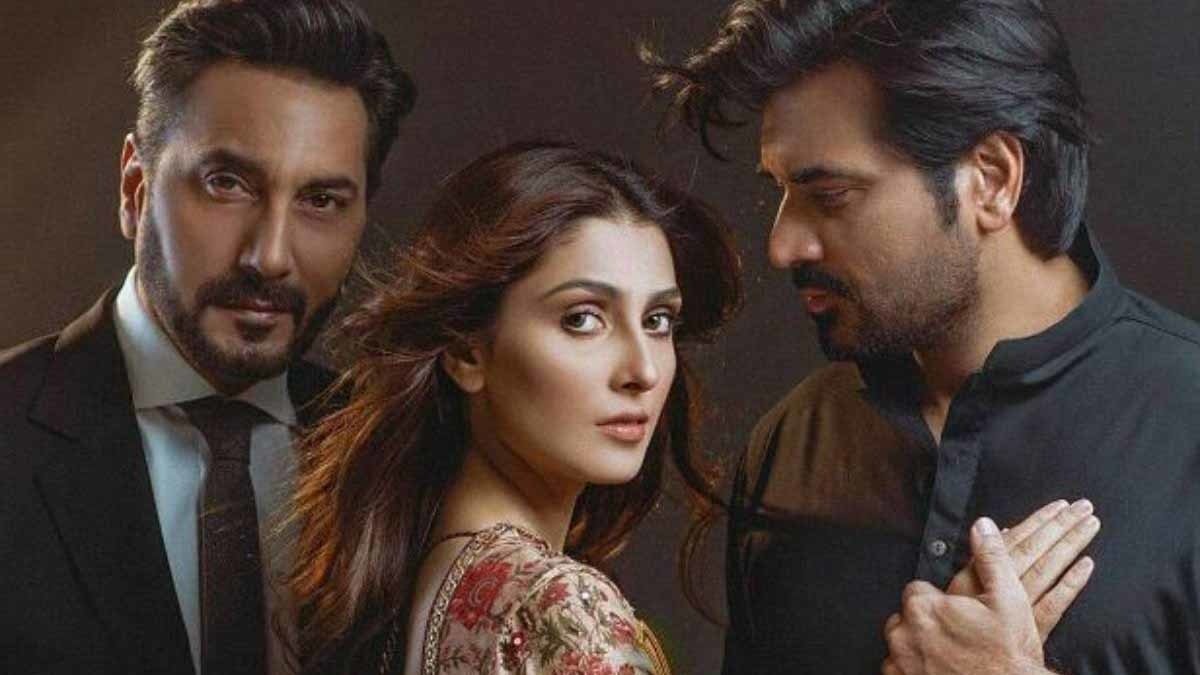
    Today marks an almost historic day in Pakistani television history as “Mere Pass Tum Ho” (MPTH), which has become one of the most successful dramas in our history, is all set to end with its mega finale.

    This has become such an anticipated ending that in an unprecedented move, cinema houses have decided to showcase the entire episode, and it is expected that we will witness packed houses. However beneficial this may be for our television industry’s commercial growth, MPTH has uncovered the deeply sexist faultiness within our onscreen depiction of women, as well its widespread acceptance within society.

    More so than the actors, the drama’s writer, Khalilur Rehman Qamar, who has written hits like “Pyare Afzal’ and “Sadqay Tumhare”, has been in the limelight for the past few months due to his shockingly misogynistic views. And he has rejected, shunned and castigated his haters in a way that only someone possessing extreme male privilege would be able to do.

    There have been a few key issues in the debate surrounding MPTH — the first, and perhaps most significant, has been whether and to what degree do the on-screen portrayal of women and men, as well as the dynamics between the genders, impact the mindsets of viewers. Is the media merely a depiction of what actually happens in society, or can it be an engine that drives social change?

    This debate has been around for decades. An argument can clearly be made that media is not monolithic, and can have both a representative, as well as a progressive role. The problem, however, seems to be that the Pakistani television industry has almost one-sidedly been playing a regressive role in its portrayal of problematic cultural and social norms, where formulaic and one-dimensional characterisations of social issues are carefully depicted as a means of appeasing the audience and driving commercial success.

    Very few channels have been bold enough to tackle topics that may receive criticism or force the viewers to think outside their preconceived notions. In a country that ranks third lowest in the world on gender parity, a more responsible role by the media industry should be expected.

    In a similar vein, and in a story as old as time itself, a male author has, through MPTH, tapped into archaic notions of what constitutes a moral vs an immoral woman, in a topic as complex as infidelity. Qamar’s personal views come through very clearly via his writing, where a one-dimensionally “evil” Mahwish, is pitted against an equally one dimensional “pure” Danish. The fundamental problem lies not as much in the motivations behind infidelity, but in the consequences, which seem to be drastically different for men and for women.

    There have been countless dramas in which the male protagonist has been unfaithful to his wife, but he has received forgiveness from her, and this has satiated our audience’s desire for maintaining a warped gender dynamic especially on the issue of infidelity. In the case of MPTH, which is also perhaps one of the first-ever portrayals of a female protagonist cheating on her husband, this issue has been handled through an exclusively male lens. Mahwish’s character has been reduced to being a “2 takay ki aurat“, whereas Adnan Siddiqui has been accepted, albeit reluctantly, by his first wife.

    This issue has been made worse by the drama writer’s own personal views on gender and infidelity, where he has unabashedly stated that a woman who cheats loses her very essence and he considers her to be a “non-woman”. Unfortunately, Qamar’s opinions are not rare, and we live in a society where gender disparity is so entrenched that men have even earned the right to cheat without glaring consequences.

    The pain of infidelity has been experienced by countless individuals, but it’s the woman who is constantly expected to think of her home, her children’s future, and society’s expectations. Surely, one of the biggest indicators of gender equality should be equal punishment for the same crime. What has made this experience even more unbearable has been Qamar’s constant presence on television, where he has been outdoing himself with his own misogyny. His lack of knowledge and facts on society’s deep-rooted prejudices becomes more apparent with each interview.

    The case of MPTH depicts how badly our television writers and their characters need a touch of complexity and diversity. The tired, black and white portrayals of morality need a dash of empathy and realism. The constant parade of similar narratives written by privileged men with regressive views needs a major refreshment and a modern touch. But more so than anything, our television industry needs daring writers — those whose vision goes beyond commercial success, or what the audience will blindly accept, to actually exploring unique topics, deeper human emotions and contemporary realities. In 2020, we need a braver lot.

  • Why did the Newsline project matter?

    Why did the Newsline project matter?

    Newsline was always so much more than just a publishing project… it was always about making the dream of editorial integrity a reality

    The announcement that the December issue of Newsline magazine would be its last, was greeted by rather emotional comments on social media from people who had been associated with the venture or somehow touched by it.

    Their often emotional comments expressed a real sense of sadness and almost personal loss, and while these remarks may have seemed surprising to those unfamiliar with the Newsline project, they really resonated with those who had lived through General Zia’s — direct as well as indirect — martial law periods.

    This is because Newsline was not just another publication: for those in journalism, it was a venture that symbolised hope — the hope of the triumph of the journalist over the seth or owner/proprietor/media baron.

    Newsline was founded by a group of women journalists in late 1988. The team was led by Razia Bhatti, the longtime editor of The Herald, the Dawn Group monthly that was famous for its stylish production values and its hard-hitting content.

    Razia, perhaps the best editor Pakistan has ever produced, was summoned by management and told it was time for her (after some two decades) to leave. This happened soon after General Zia dismissed the civilian government and announced fresh elections and it was a time when the military establishment was seeking to regain control of the political narrative and tame the increasingly outspoken media.

    The editorial team was so appalled by the management’s decision to get rid of Razia that most of us opted to resign in protest and leave with her. I was a newcomer in the group (as was Tehmina Ahmed). I’d been with the team for less than a year, but my other colleagues were well-known names in the field, particularly Rehana Hakim, Samina Ibrahim and Sairah Irshad. Talat Aslam stayed on as did Zahid Hussain, our star reporter, who then joined us several months later.

    Soon afterward, Razia had the bright idea that we should start our very own magazine. It seemed a complete impossibility, but we began to work on developing the idea anyway. Zia, the cause of most of our woes, had been killed in the Bahawalpur crash and within a few months of that the country’s publishing laws were liberalised and we were able to get a publishing license or ‘declaration’. 

    We decided we must have a controlling interest and so we invested whatever we could in the company and were also lucky enough to find some investor friends who wanted to come in not for the profit (there never were any), but because they had faith in the venture.

    The first issue came out in July 1989 and the legend of Newsline gained strength with every new issue. The legend was that the journalists had won, that editorial integrity would not be compromised, that the news narrative was not tailored according to financial or political interests.

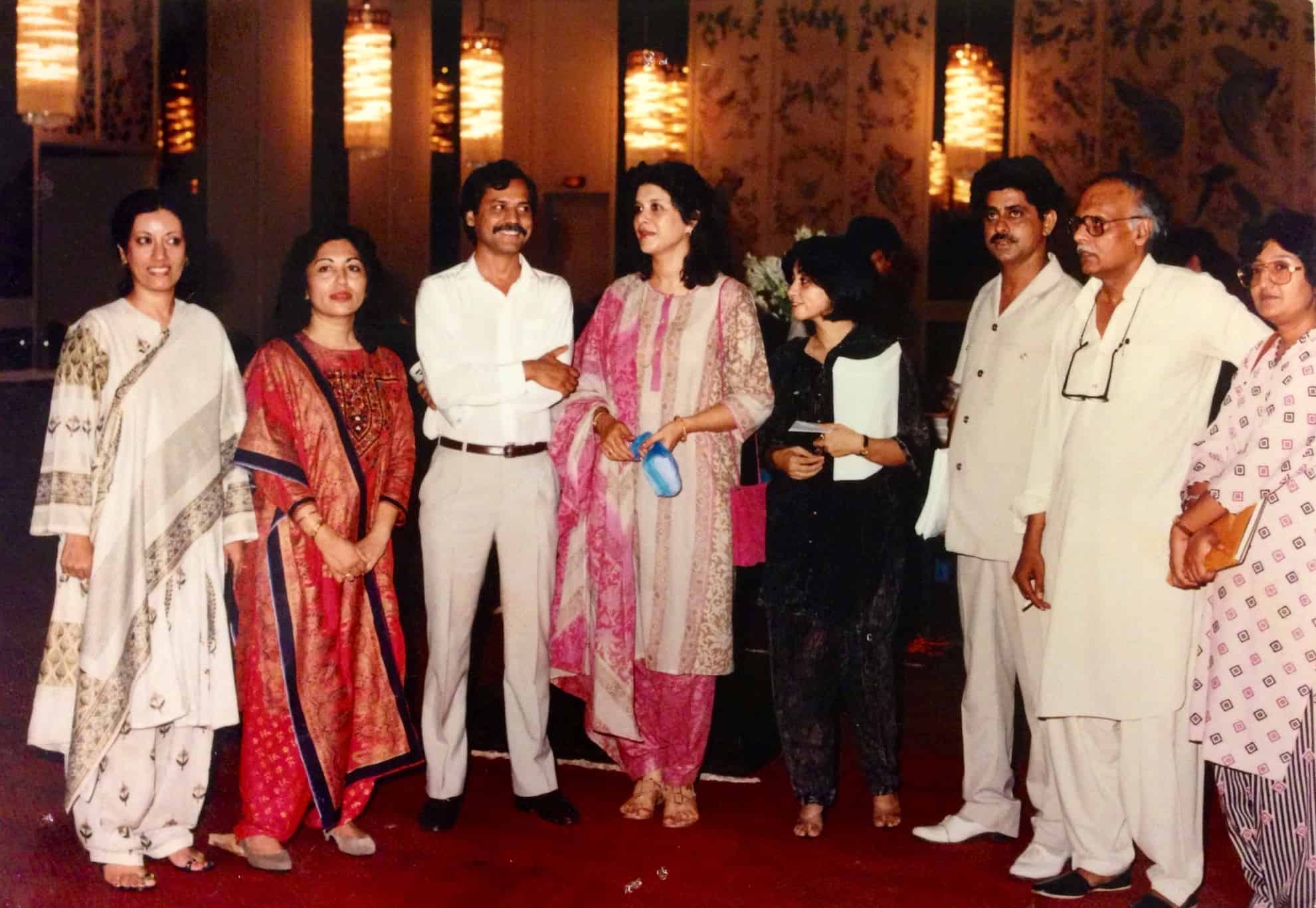
    The Newsline launch, Karachi July 1989. L to R: Rehana Hakim, Razia Bhatti, Zahid Hussain, Samina Ibrahim, Umber Khairi, S.A. Baqri, Baseer Ashraf, Tehmina Ahmed

    But keeping the legend alive and carrying the torch for this sort of idealism was not an easy task. Financially we struggled and the pressures we faced were many, but we carried on.

    Even after Razia died suddenly in 1996, Rehana and the team kept the flame of this hope alive. The names of staffers who passed through the intense training ground that was the Newsline office reads like a Who’s Who of journalism, politics, literature and academia (Abbas Nasir, Mohammed Hanif, Nafisa Shah, Naziha Syed Ali, Marvi Memon, Kamila Shamsie to name just a few). But apart from the commitment of the core team what perhaps helped most to keep the venture alive was the support and good wishes of so many people – friends, colleagues and readers.

    But eventually, we reached a stage where the magazine could no longer function as a small independent operation and we became part of a media group (again) when we sold Newsline to the HUM group. When I told a friend about this she asked, “If you sold it and it didn’t belong to you, why are you getting so worked up about it?”

    She’s right of course. Legally, we no longer owned Newsline and the decision to cease publication was rightfully the owner’s, but emotionally and idealistically perhaps we will always own Newsline because it was always so much more than just a publishing project… it was always about making the dream of editorial integrity a reality.

  • Arts vs Politics: A contentious debate engulfing India

    Arts vs Politics: A contentious debate engulfing India

    The criticism of spinelessness and shamelessness is perhaps validly applied to the fraternity, although this covers players as diverse as the Hindutva poster-boy, Akshay Kumar, and the liberal-with-a-saviour-complex, Aamir Khan.

    As two of Bollywood’s most popular Khans, Aamir and Shah Rukh, join a procession of celebrities who now regularly play courtiers to the country’s Public Relation (PR) minister, sorry prime minister (PM), the morale of progressive India is at its lowest ever and Bollywood finds itself, yet again, in the midst of an intense debate on arts versus politics, best showcased in the 1984 film Party.

    In that classic, a young, idealistic K K Raina sees this as a false binary, but after a heated argument with the more jaded Om Puri, he realises that making a choice between the two might, someday, become inevitable. The argument we see today in Bollywood is one of its worst iterations.

    Those who willingly become Modi’s props are using the “arts, not politics” justification with as much vigor as those who make good, political cinema while claiming to be apolitical.

    The criticism of spinelessness and shamelessness is perhaps validly applied to the fraternity, although this covers players as diverse as the Hindutva poster-boy, Akshay Kumar, and the liberal-with-a-saviour-complex, Aamir Khan.

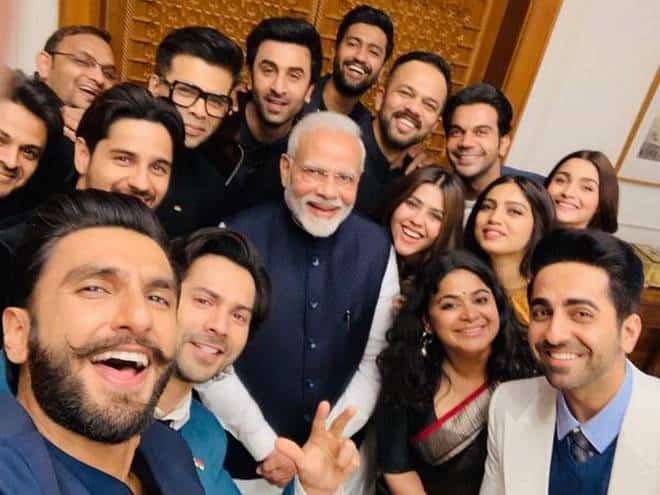
    The median truth is perhaps to be found in Ranveer Singh, who embraced Modi with a big bear-hug Modi himself reserves for heads of states, before facetiously explaining to Anupama Chopra that he is very apolitical. He was piggy-backing on a more carefully worded statement by his Gully Boy co-star Alia Bhatt who claimed, “I don’t think we give out a strong political vibe as actors.”

    Bhatt goes on to obliquely refer to the effects of trolling before concluding that she would rather focus on making movies than getting into any legal trouble. Chopra, at this point, is ready to let go but Singh insists on describing himself as an apathetic man who only cares about his films and his own life.

    The interview summarises the crisis in Bollywood, showcased this week by the presumed betrayal of Aamir and SRK. There are celebrities like Bhatt, who has a political view but is keeping it to herself because there is much to lose and then there are those like Singh, who has no qualms publicly stating that he doesn’t care about anyone but himself. They shower Modi with love when the PM is only coercing Bollywood to be his personal marching band.

    According to a HuffPost article, Modi’s PR team has been putting enormous pressure on Bollywood to participate in their events and follow them up with social media posts. Those who did not post their PM selfies were “gently reminded” to complete their homework.

    Whether they are spineless or shameless or both, they are under pressure. As Deepika Padukone, who happens to be Singh’s wife, could testify, even people with relative power can be vulnerable in the face of relentless right-wing hysteria whipped up in campaigns such as the anti-Padmaavat one.

    SRK and Aamir are not insulated from this world – Aamir has had several ugly episodes with the right-wing already. Modi’s machinery works on both ends – the endless appetite for trolling and threats of violence is the ugly underbelly for such glitzy PR events.

    The pathetic state of Bollywood stars today, reduced to playing cheerleaders, mirrors the larger public sphere. Some chose to enthusiastically follow Modi or due to a herd mentality; others kept their politics private due to fear of repression or routinely protest despite shrinking civil liberties.

    Regardless of these differences, we, today, stare at a breakdown of collective morale and an inclination, as a society, to surrender.

    The stakes are only higher for the Indian Muslim community. This month also saw liberal stalwarts like Zameeruddin Shah and religious establishments like the Sunni Waqf Board surrendering their community’s claim over the Babri Masjid land if it could end the unbated communal hatred and violence.

    The fall of King Khans represents nothing more than a symbolic victory march for an emperor who is parading the more colorful representatives of a collective that has now surrendered. The question of arts versus politics holds no weight in a world without choice.

  • The curious case of three Khans of Bollywood

    The curious case of three Khans of Bollywood

    I can’t help worrying about Shah Rukh’s health. Can a damaged spine send wrong signals to the brain?

    Ever since I suffered a back injury a few years ago, I have been deeply interested in the functioning of the spinal cord. Especially, of celebrities I admire.

    Shah Rukh Khan, the Badshah of Bollywood, headlines my list. For years, I have been closely following details of his knee, shoulder and back injuries and his pain management technique(s). I admire his ability to endure excruciating pain with a chuckle.

    I have seen pictures of him walking away wearing his characteristic dimpled smile after surgical procedures as I sat around worried about being rendered spineless, at least literally if not metaphorically.

    My hero, going strong on the other side of 50, has continued to stun me with real-life lessons on how to survive successfully with pain in the spine. Just a few years ago, he won a million more fans, and me all over, when he articulated his angst against the growing intolerance in India. “…religious intolerance and not being secular… is the worst kind of crime that you can do as a patriot,” he was quoted as saying by the media back then.

    This Shashi Tharoor of Bollywood has cast a spell on almost everyone with his insights on such soul-stirring issues and more. However, his latest lesson – batting for a totally spine-free existence – has left me stumped.

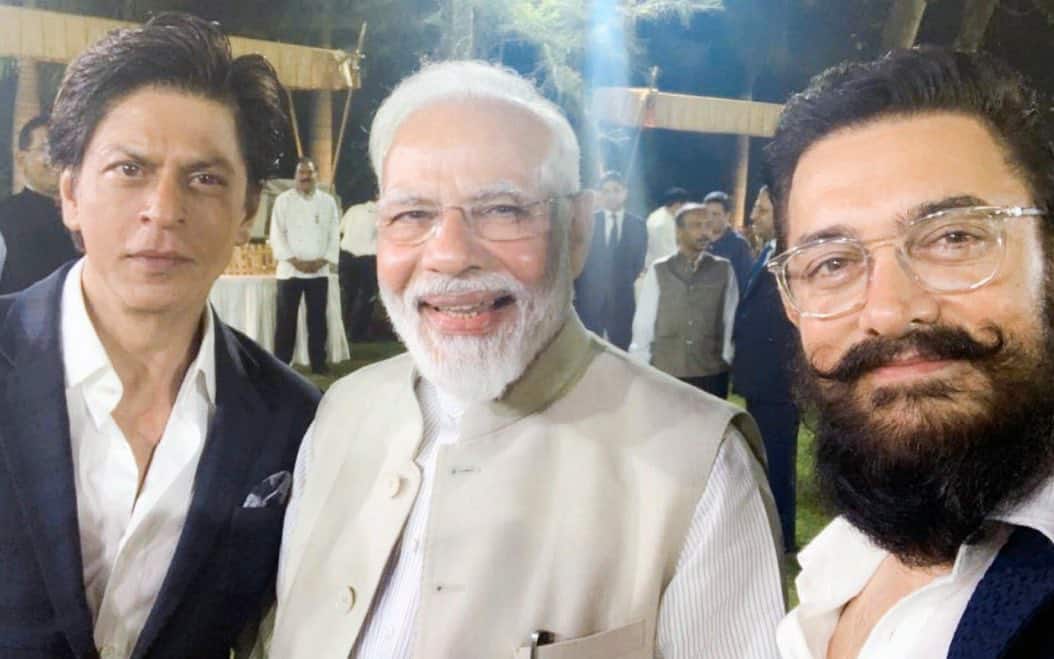
    Earlier this week, a much haggard version of Shah Rukh was seen taking a selfie with the prime minister (PM) of India, Narendra Modi, to commemorate the 150th anniversary of the Father of the Nation, Mahatma Gandhi, at an event called #ChangeWithin.

    The resultant candid shot, Shah Rukh smiling ear-to-ear, along with another famous Khan of Bollywood, Aamir Khan, was telling of the early onset of degenerative and, perhaps, irreversible changes in Shah Rukh’s spine.

    Eloquence has been Khan’s constant companion right from the days when he had an impeccable spine. “Thank u @narendramodi for hosting us & having such an open discussion on #ChangeWithin & the role artistes can play in spreading awareness of the msgs of The Mahatma. Also, the idea of a University of Cinema is extremely opportune!” he later tweeted.

    That’s the #ChangeWithin, if you like.

    And, now I can’t help worrying about Shah Rukh’s health. Who would have thought that the many expensive surgical interventions would not have helped his nerves behave better? I know that messages are sent from the brain through the spinal cord to the different parts of the body, but I am left wondering if the reverse is true too? Can a damaged spine send wrong signals to the brain? Or do brain cells, at the tail end of their life, only send signals to parts of the body that are able to decode words that are spelling variants of the word money?  

    Which brings me to the curious case of the other Khan of Bollywood I admire – Aamir. The man who has long exemplified Mahatma Gandhi’s three monkeys – hear no evil, speak no evil and see no evil. His larger-than-life image, thanks to his choice of films and his association with social issues (spoke out against the Gujarat genocide of 2002), was bolstered by his flagship television show a few years ago “Satyameva Jayate” (Truth Shall Prevail).

    Aamir raised issues that are usually brushed under the carpet and exposed India’s hypocrisy. He talked about LGBT rights and honour killings, and there was an hour-long episode on elections and corruption. That Aamir posed with the PM barely hours before Maharashtra state was to go to polls may be a coincidence, but what wasn’t was that he was also smiling through an increasingly intolerant India he expressed shock at a few years ago. An India where lynching of minorities is no longer news.

    In a film called “Ghajini”, Aamir plays a tycoon suffering from acute short-term memory loss and he does everything possible to preserve that memory. In real-life, Aamir, the tycoon, seems to be suffering from long-term memory loss. A messed up nervous system?

    This brings me to the third Khan of Bollywood – who rules hearts, owns roads and also a clothing line called Being Human. I was never a fan of Salman. I always dismissed him as an overgrown kid whose nervous system liked sending wrong messages to his body all the time — kill wildlife, run over pedestrians, punch women.

    However, in this vicious circle of pain called Khans, I would vote for a familiar pain near the spine. Let’s call it Salmanitis.

  • Raheela: The Girl Child

    It’s the International Day of the Girl and Pakistan is shamelessly on the bottom of the global ranking in empowering them. They face death; stunted growth; violence; child labour and limited or no access to education and medical care.

    I took a dirt road two hours away from Peshawar in 2017 to find out more about how young girls with no access to education can be brought back into the gig economy.

    I spoke to about a dozen young girls and recorded their interviews to put a report for the people who were working to change the traditional set up in the conservative Khyber Pakhtunkhwa (KP) district.

    I spoke to the adolescent girls learning vocational skills like tutoring, tailoring and computer skills. Some girls between 15 and 19 were clad in burqas, others in chadors and most, in a deep sense of shame. Their body language was subdued and their presence was mild like they were a bit too grateful for the donor support I had gone to assess.

    Raheela was an unforgettable young girl. She was a Frida Pinto lookalike, big eyes and a chiseled jawbone with fierceness about her life story that both humbled and awed me. She was what we call a success story that we were to tout for more funding in the area of adolescent girls, where government support failed or was neglectful.

    Raheela had learned to make a lot of money over the past few months. She was given a grant to receive a brand new Singer sewing machine. The machine allowed her to sell clothes to local women that she sewed faster and better. She could now afford to send her younger siblings to school. That month, she made more money in thirty days than her drunk and abusive father made in a year.

    Many would consider this a success, but for Raheela, it meant a disrupted order of status quo that led her father to rage and episodic beatings.

    She looked at me to answer questions with a black eye that she unsuccessfully attempted to mask under a cheap concealer, three shades lighter than her wheat skin colour. I had to, so I asked her about the black-blue eye.

    Her face comes to me like a floating ghost when I hear politicians rattle their podiums and make big promises. When big men with power claim justice for the common people who are facing stagflation in the economy, I wonder if they really ever see Raheela.

    Am I ugly, bad and unworthy? She asked me in response.

    No.

    I said she was beautiful and good and worthy and that it was the people who exploited her that should be put away.

    She was not fearless, but she was incredibly brave.

    Today, we mark the International Day of the Girl Child, so I went back to my notes from that day I met Raheela.

    I often think of Raheela because she is far away from the cult of cool that many young adolescent girls her age are obsessed with. She cares more about how to hide her siblings when her father picks up the rod than she does about getting the corners of her wing eyeliner right. Her life is more immediate and her troubles are not imagined.

    Her face comes to me like a floating ghost when I hear politicians rattle their podiums and make big promises. When big men with power claim justice for the common people who are facing stagflation in the economy, I wonder if they really ever see Raheela. I wonder if they hear the tremble in her voice when she describes going back to a home where she faces chronic punishment for working to support her family. I wonder if they even know that in this country, girls are prematurely sexualised and prematurely made into grown-up adults when they are too young to even understand their own bodies.

    I’m going to dare to dream a world for her today because that is what the day calls for – after all the GirlForce is unscripted and unstoppable.

    If I could reimagine a world for Pakistan’s Raheela, I would dare to dream that she has a lot of hygiene. That she has access to sanitary pads that are biodegradable and safe. Many girls in the programme who enter puberty end up missing their vocational classes just because they are on their period. The norm is unsanitary cloth packs that leak and limit their mobility. I want a world where a period doesn’t signal young women’s child-bearing age, but an age that needs care and protection from people who have an exploitative mindset. Commercial sanitary pads are prohibitively expensive in rural areas and there is no education on how to maintain mobility during menstruation. As a result, menstruation is used as a weapon to ground Raheela.

    I often think of Raheela because she is far away from the cult of cool that many young adolescent girls her age are obsessed with. She cares more about how to hide her siblings when her father picks up the rod than she does about getting the corners of her wing eyeliner right.

    I would also imagine a world for her where the road to the vocational centre would not be planted with land mines of honour culture. Where the local village perverts won’t call her a slut for wandering instead of being invisible. I’d want local police to punish those men if they dare make her feel threatened. Instead, local police usually victim-blame young women who face eve-teasing and sexual harassment. Raheela was asked to go back home and fetch her abusive father before a legal complaint is lodged. She ended up not complaining and facing the men in her path day after day, passively.

    It would be rather nice if Raheela had a basic smartphone that allowed her to receive her stipend in a mobile wallet, safe from the drug-addiction ambitions of her father. A mobile wallet that allows her to buy her mother the medicines she needs to repair her mental health, her self-esteem and her social embarrassment for only giving birth to girls.

    Access to the internet would be great for Raheela. She could get socially connected to friends and family she trusts and can rely on. She could even search the latest fashion trends to remix in the clothes she designs and sells in larger cities. She could learn English, the language the internet uses and sharpen her Urdu skills using tutorials. She could search for entertainment and watch shows that give her respite from her reality. She could use YouTube to research how to manage money and do basic bookkeeping so her business can stay afloat longer.

    I’d want a world where Raheela knows that elsewhere in the universe, there are doctors who perform surgeries remotely; that holograms exist; that future jobs will focus on creativity and collaboration; that there are smart shoes that measure everything including steps. Most importantly, that she can protect her digital footprint and have her cyber world secure from prying eyes of men who can hurt her now or in the future. She could know her rights as a citizen. She would know then, that the state has promised to protect her, educate her for free and punish anyone who harms her physically. That would change her mindset.

    I want Raheela to know that clothes look better when you wear them on your back while standing up straight, chin up, shoulders back. Raheela is not ugly, not a bad person and she is not unworthy of this dream I have dreamed entirely on her behalf.

    I’d like to give her some representation in the local government, perhaps even as a citizen. She could understand that there are others like her suffering in the community and hold a town hall with them to support community involvement. Raheela could help create public pressure to have easier access to schools, transport, healthcare and plumbing by speaking up for more young women.

    I want Raheela to know that clothes look better when you wear them on your back while standing up straight, chin up, shoulders back. Raheela is not ugly, not a bad person and she is not unworthy of this dream I have dreamed entirely on her behalf.

    It’s the International Day of the Girl. Pakistan is shamelessly on the bottom of the global ranking in empowering them. Girls in Pakistan face death; stunted growth; violence; child labour and limited or no access to education and medical care.

    It’s too late for Raheela, by now she may have a few girls of her own, her father may have won at patriarchy and she may have lost at it. Can we please get this dream in a politician’s speech so it could maybe… maybe become a part of the cult of cool that some girls can never reach.

  • Dog culling: You don’t have to be an animal lover, but at least be human

    Dog culling: You don’t have to be an animal lover, but at least be human

    We starve them, kidnap them and even murder them, but the moral community that rejects the abuse of humans, does not consider what we are doing to animals as something wrong.

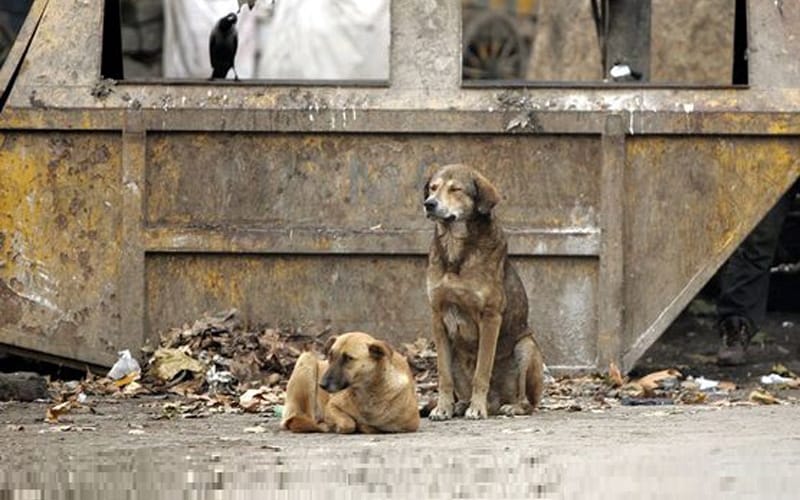
    If you reside in any of the big cities of Pakistan, you must have woken up to the sounds of gunshots every few months. Gunshots, loud whimpers, more gunshots and then complete silence… a deafening silence.

    Dog culling, which basically means to kill, takes place to reduce the population of stray dogs and the occurrence of rabies. It is a brutal and outdated practice that still exists in a few countries around the world — Pakistan being one of them.

    As per a study by the World Health Organisation (WHO) in 2010, around 97,000 dog bite cases are reported every year in Pakistan, however, there are still no exact figures of the number of deaths caused by rabies. And the governments’ solution to combating the spread of the deadly disease, is dog culling.

    Every year, thousands of dogs are brutally murdered by being shot or poisoned. The government, under the municipal department, hires ‘dog shooters’, whose only job is to kill all the dogs in any area. These shooters are given old guns, which mostly miss the target, resulting in injured dogs suffering for hours as they slowly bleed to death.

    According to the World Animal Protection (WAP), “Culling dogs is not the solution to rabies”. It is also not the solution to decrease dog population, because, for every dog that’s left, eight more puppies will be born and with the imbalance created in the environment due to dog culling, more food will be available for the new ones.

    The surviving animals will keep on reproducing and these new dogs will then move to areas that were previously made ‘dog-free’. This cycle continues every year, the dog population doesn’t decrease and nor is rabies contained. So what is the solution that can eliminate both rabies and dog population? It is TNVR.

    TNVR stands for Trap, Neuter, Vaccinate and Return. You pick up dogs from the streets, spay/neuter them so they can no longer reproduce; vaccinate them so they do not get rabies, tag them or chip them and then return them to the area they were found in. This way, stray dogs will not only be free of rabies, but their population will also gradually start to decrease.

    As per WAP, “the only way to eliminate the virus is through vaccination. Vaccinating at least 70% of the dogs in an area creates herd immunity, slowing the spread of rabies until it dies out”.

    A single female can produce up to 2,048 puppies in just four years! Now imagine the effect of spaying one female. A study in India (Reece & Chawla, 2006) reported a decrease of 31.8% to 51% in dog population in six years when 50% or 70% of the population was spayed and neutered. Meanwhile, Thailand has seen a decline of 50% in just five years.

    If we just talk about rabies drives, countries as Panama, Chile, Brazil and Argentina initiated countrywide rabies vaccine drives that have led to them being rabies-free for over 10 years now.

    One of the major reasons why no time is spent on campaigns such as TNVR is because of the public opinion regarding dogs. In our society, dogs are looked down upon, and we consider them as non-feeling, non-thinking beings.

    However, according to a 2012 University of Cambridge study, animals have a conscience, which means they think, feel and respond to the world in the same way as humans, but just because they express their emotions differently, we tend to overlook them.

    The result of this willful forgetfulness is reflected in the way we treat dogs. We stone, beat and even shoot them dead every day.

    Imagine the same for a human being; where he or she is starved, kidnapped, poisoned, murdered, shot or tortured. Most governmental bodies around the world, NGOs and individuals would agree that such acts are wrong. They would criminalise such acts and punish those who commit them.

    Sadly, the same cannot be said for animals, their abuse is accepted by the same moral community that rejects the abuse of humans. As a society, we still do not see what we are doing to animals as something wrong. We are okay with watching animals suffer; we are okay with the constant and widespread abuse of animals.

    Perhaps it is time for the citizens of this country to wake up and take a good hard look in the mirror. Have we become the very monsters we speak of? Have we become so selfish that we refuse to acknowledge the abuse that takes place outside our homes every day? Have we become so arrogant that we deny basic rights to other living beings around us? Have we completely lost humanity and compassion? But most importantly, are we even human anymore?