Tag: China

  • ‘Modi has decided when India would be at war with Pakistan, China’

    Bharatiya Janata Party’s (BJP) Uttar Pradesh (UP) unit chief Swatantra Dev Singh has claimed that Indian Prime Minister (PM) Narendra Modi has “decided” on a time when India would be at war with Pakistan and China.

    A minister in UP Chief Minister (CM) Yogi Adityanath’s cabinet, Swatantra Dev Singh made the remark during an event at the home of BJP’s Sikanderpur lawmaker Sanjay Yadav.

    In a video clip of Swatantra Dev Singh’s remarks, the BJP’s UP chief draws parallels between the abrogation of Article 370 in held Kashmir, construction of a Ram temple in Ayodhya where the Babri Masjid once stood, and the ongoing India-China military standoff in eastern Ladakh.

    “Like the decisions on Ram Mandir and Article 370, PM Narendra Modi has decided when there would be war with Pakistan and China,” news agency PTI quoted Swatantra Dev Singh as saying in a video posted on social media by Yadav.

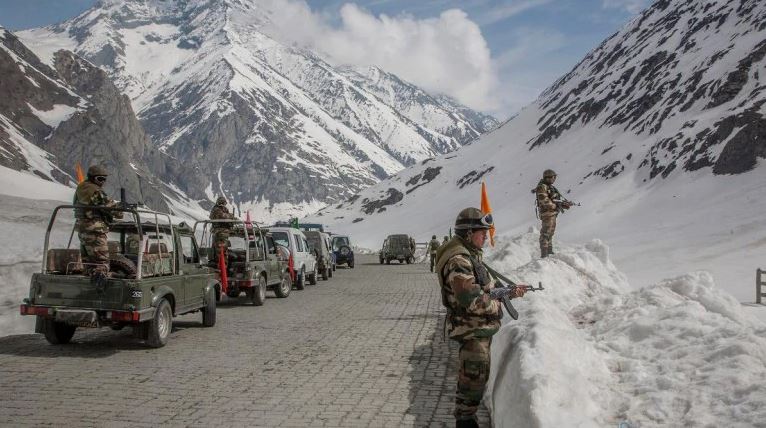
    The BJP leader’s controversial remarks come amid an intense standoff between the Indian and Chinese armies in eastern Ladakh. Both countries have held multiple rounds of diplomatic and military talks to achieve disengagement in the region.

    However, Defence Minister Rajnath Singh’s statement on Sunday contradicts the remarks made by Swatantra Dev Singh. While reiterating that India is seeking an end to the border tussle with China, Singh had said that New Delhi will not allow anyone to take away “even an inch” of Indian land.

    Launching an attack on the BJP-led Centre, Congress lawmaker Shashi Tharoor tweeted:

    “Amazing. So the PM (who will not even name the state that has encroached upon our land) is planning a war against an Unnamed Enemy, over territory he claims has never been taken, on a date that only he knows? So is this what he meant by “minimal government”!?” he said while referring to Swatantra Dev Singh’s remarks.

  • Imran’s national security aide terms Chinese persecution of Muslims a ‘non-issue’

    Imran’s national security aide terms Chinese persecution of Muslims a ‘non-issue’

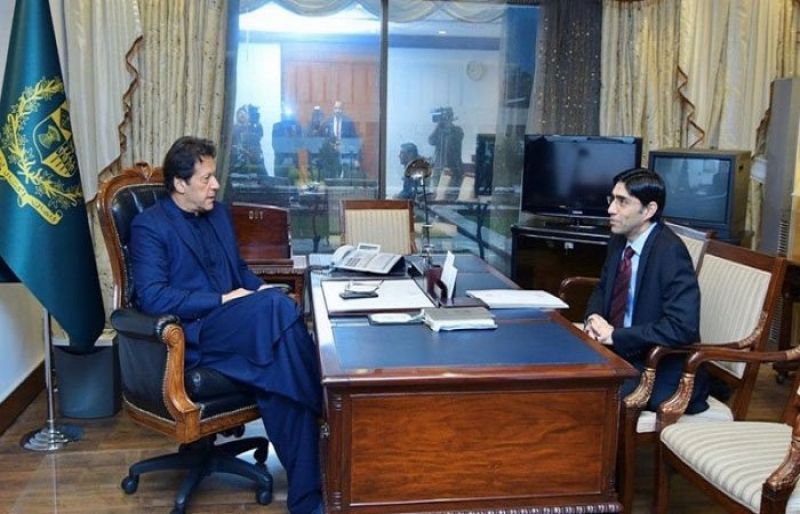
    Special Assistant to the Prime Minister (PM) on National Security aide Dr Moeed Yusuf has termed the Chinese persecution of Uyghur Muslims a “non-issue”.

    In an interview with Indian media outlet The Wire, Yusuf on Tuesday revealed that India had expressed a “desire for conversation” but said that Pakistan’s agreement to talks would be conditional.

    While his statements and Pakistan’s pre-conditions for the resumption of “meaningful dialogue” with India to resolve all outstanding issues have made headlines, the details less reported are of what he had to say about Chinese persecution of Muslim minority Uyghurs in its Xinjiang region.

    Even though China is facing growing criticism over its crimes against the said minority group, huge numbers of whom are allegedly being held in internment camps, Pakistan has been accused of turning a blind eye towards the same.

    READ: In a first since Kashmir’s 2019 siege, Imran’s national security aide gets interviewed by Indian journalist

    On Tuesday, when asked why PM Imran Khan had never raised his voice for the Uyghur community in China, the SAPM said, “China and Pakistan are friends like no other. We have a completely transparent relationship; virtually everything under the sky, we discuss.

    “Uyghurs is a non-issue […] Our delegations have visited, we’ve seen and we are a 100 per cent satisfied that it’s a non-issue. The West can say what it wants. I am telling you as a responsible official: we know everything we need to know about the Uighurs and everything else in China as they do about us.”

    Thapar quoted an interview PM Imran gave to the Financial Times last year, where the premier had said: “Frankly, I don’t know much about” the Uyghur issue. Yusuf, however, continued to insist that the matter was a non-issue and said that he had briefed the premier about it.

    YUSUF UNDER FIRE:

    Among the many prominent persons who reacted to Yusuf’s remarks was Omar Waraich, who is the South Asia deputy director of global rights group Amnesty International.

    Here’s what he had to say:

    Several others also called Imran’s aide out.

  • VIDEO: Pangong Lake of ‘3 Idiots’ fame now a part of China?

    VIDEO: Pangong Lake of ‘3 Idiots’ fame now a part of China?

    Amid the ongoing border standoff between Chinese and Indian soldiers in Ladakh, it is being speculated that the Pangong Tso area under Indian control, and of Bollywood flick ‘3 Idiots’ fame, has been taken over by China.

    As per the details, a video clip of Chinese tourists enjoying a boat ride purportedly at the Pangong Tso Lake, which among many others was also shared by Indian National Congress (INC) leader Salman Nizami, has gone viral.

    Pangong Tso is an endorheic lake in the Himalayas. Situated at an elevation of 4,225 metres, it is 134 kilometres long and extends from Ladakh in India to the Tibetan Autonomous Region in China. Line of Actual Control (LAC) between China and India also passes through the Pangong Lake, effectively dividing it into two parts.

    India controls the 45 km-long western portions of the 135 km-long lake while the rest is under Chinese control. The picture-perfect lake is also the place where 3 Idiots’ ending with Aamir Khan, Kareena Kapoor and co was shot.

    “Chinese tourists in Ladakh’s Pangong Lake. Can someone ask ’56 inch’ Chowkidar [offensive comment apparently against Indian Prime Minister (PM) Narendra Modi] if Indians now need a visa to visit Pangong Lake?” Nizami tweeted.

    https://twitter.com/SalmanNizami_/status/1303254283207413765

    National convener of INC’s social media department, Saral Patel, also shared the video.

    It was retweeted by INC spokesperson Shama Mohamed with the comment, “Chinese tourists are apparently vacationing at Pangong Tso & PM [Narendra] Modi is still in agreement with China’s lie that there have been no incursions or annexation of Indian territory.”

    While there have been no official statements over the status of the lake from Beijing or New Delhi, it is likely that the videos being circulated have been shot on the Chinese side of the lake, which is reportedly open for tourists.

    Earlier, an advertisement video shared by some Twitter users had claimed that China will facilitate the return of international tourists to Pangong Tso.

    The 45-second footage on Twitter showed the scenic landscape of the Pangong Tso.

    The ad video, which has received several retweets, was uploaded by users who used both Mandarin and Chinese as the medium of communication. Although they appeared to be handles managed by Chinese nationals, it could not be confirmed as none of the accounts were verified by Twitter.

    https://twitter.com/evazhengll/status/1301555381810991111

    “You only need to take a Chinese visa to enjoy cold air, flocks of birds and blue water. We have also placed a monument on a place where movie 3 idiots was made. Come, visit and enjoy China,” one of the users tweeted.

    https://twitter.com/CNPakWW/status/1301557920472141828

    Even though the video appears to have been produced in China, it could not be ascertained whether the clip is new or old.

    However, Shen Shiwei, a Chinese journalist working for state-owned CGTN, tweeted that the lake was open for tourists for quite a long time.

    “Pangong Tso in China is open to tourists at home and abroad for quite a long time. The lake is near the Chinese national highway and is a good place for self-driving travel. We have a resort on the lake here,” he said.

  • Enjoy high-speed internet while travelling along Makran Coastal Highway, NH 10

    The Universal Service Fund (USF) has announced that high-speed internet is installed at National Highway-10 (NH 10) Makran Coastal Highway and National Highway-25 (NH 25) Uthal to Quetta Highway.

    USF Pakistan tweeted that: ” USF in partnership with Ufone continues to make progress in National Highway-10 (NH 10) Makran Coastal Highway and NH 25 Uthal to Quetta Highway. Computers are now reaping benefit from high-speed broadband over 640 Kilometre of road segment covering areas of Kech, Awaran, Gwadar, and Lasbella district.”

    Makran Coastal Highway stretches to 653 Kilometres (Km). The road also covers the Arabian sea coast of Pakistan from Karachi in Sindhi to Gawadar in Balochistan and passes through Omara and Pasni.

    Along with the Ministry of Information and Technology (MoIT) and Pakistan Telecommunications Limited (PTCL), the USF Pakistan has installed 85 kilometres of optic Fiber cable to connect nine unserved Tehsils in North Waziristan and South Waziristan.

    The Optical Fiber cable is going to provide high-speed broadband connectivity to regions like Spinwam, Wana, ToiKhulla, Jandola, Sarwakai, Sararogha, and Barwand Tehsil.

    Last week, The board approved contracts to Jazz — Pakistan Mobile Communications Limited (PMCL), Zong — China Mobile Pakistan (CMPAK), and Ufone — Pakistan Telecom Mobile Limited (PTML), for the provision of next-generation internet.

  • Pakistan gets most advanced Chinese warship amid New Delhi’s tensions with Beijing

    Pakistan gets most advanced Chinese warship amid New Delhi’s tensions with Beijing

    China has launched an advanced warship for Pakistan, the largest it has built for any country, and the first among the four most sophisticated naval platforms it is readying for the Pakistan Navy amid deepening military and strategic ties.

    According to reports, the Type 054A/P, a guided missile frigate, is the largest combat ship China has sold to a foreign navy and is “an important milestone” for China’s military export sector.

    The acquisition of the warship will double the combat power of the Pakistani Navy’s surface fleet, Chinese state media reported. By 2021, the Pakistan Navy is expected to have three more similar warships in its fleet.

    The Chinese state-owned Hudong Zhonghua Shipyard in Shanghai held the launch ceremony for the advanced warship with top officials and naval officers attending the function.

    The shipyard is a wholly owned subsidiary of the China State Shipbuilding Corporation, the largest builders in the country.

    The ship launch took place two days after Foreign Minister Shah Mahmood Qureshi discussed the situation in the Indian occupied Jammu and Kashmir region with his Chinese counterpart Wang Yi during the second round of the China-Pakistan foreign ministers’ dialogue in Hainan.

    The development comes at a time while New Delhi is locked in tension with both Pakistan and China over disputed boundaries and the abrogation of Article 370 in the troubled valley.

    India is reportedly closely monitoring the military cooperation between its two neighbours.

  • Qureshi leaves for ‘very important’ China visit to represent Pakistan’s civil, military stance

    Qureshi leaves for ‘very important’ China visit to represent Pakistan’s civil, military stance

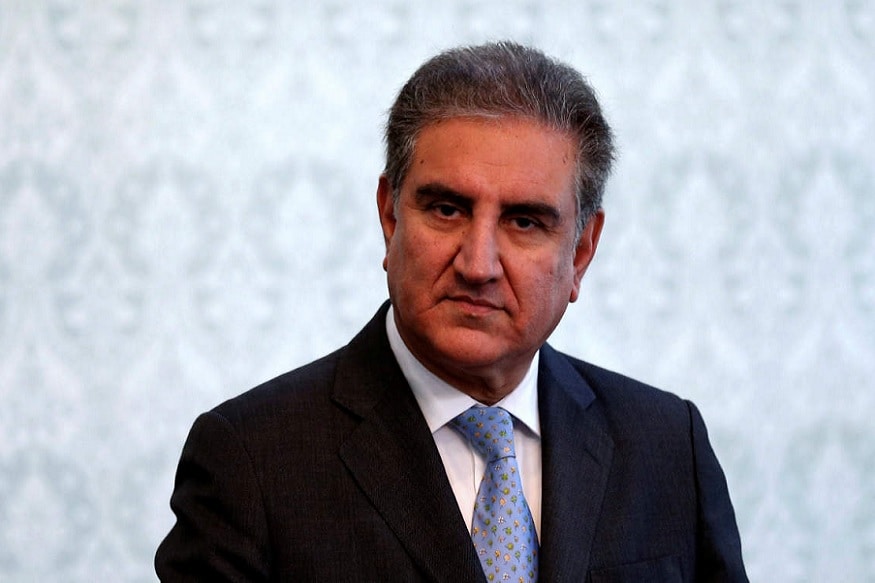
    Foreign Minister Shah Mahmood Qureshi has left for a two-day visit to China to attend the second round of the China-Pakistan Foreign Ministers’ Strategic Dialogue, a statement from the Foreign Office said on Thursday.

    In a video message released before his departure, the foreign minister said he was going on a “very important trip to China” and that he had a discussion with Prime Minister (PM) Imran Khan before leaving.

    “I am leaving on a very important visit to China. I had a discussion with the prime minister regarding this visit yesterday. My delegation will represent the stance of the political and military leadership of the country. I am hopeful that my meeting with Foreign Minister Wang Yi will prove to be beneficial for both countries,” Qureshi said.

    WATCH VIDEO:

    Qureshi, who is accompanied by senior officials, will visit China’s Hainan province where he will lead the Pakistani delegation in the dialogue, the FO statement added. He is scheduled to return tomorrow (Aug 21).

    State Councillor and Foreign Minister Wang Yi will lead the Chinese side during the dialogue, according to the statement.

    “During the dialogue, both sides will discuss cooperation on COVID-19, bilateral relations and regional and international issues of mutual interest,” the FO said.

    “The visit will play an important role in further strengthening Pakistan-China ‘All-Weather Strategic Cooperative Partnership’ and deepen strategic communication and coordination with China on a range of issues.”

    The first round of the China-Pakistan Foreign Ministers’ Strategic Dialogue took place in March 2019 in which both sides vowed to protect the $60 billion China-Pakistan Economic Corridor (CPEC) from “all kinds of threats”.

    Reports emerging on Wednesday suggested the foreign minister will “hold meetings with his Chinese counterpart and senior leadership while important decisions will be taken regarding the visit of the Chinese president to Pakistan.”

    He was also expected to call upon Chinese President Xi Jinping during the trip.

    The trip comes after PM Imran, earlier this week, said it should be clear that Islamabad’s future is tied to Beijing which has stood by Pakistan through thick and thin.

    Speaking to senior journalist Kamran Khan during a wide-ranging interview, he said that both countries recognised each other’s importance and were further strengthening mutual ties. “Unfortunately, western countries are using India against China,” he added.

    The premier also said that Chinese President Xi Jinping was scheduled to visit Pakistan in May this year but his visit was delayed due to the coronavirus outbreak. “His visit is now expected towards the end of the year.”

  • You can now join CPEC as an intern, here’s how

    China-Pakistan Economic Corridor (CPEC) Authority Chairperson Lt Gen (r) Asim Saleem Bajwa has announced the launch of a three-month internship aimed at human and social development.

    In a series of tweets, Bajwa said in the spirit of youth empowerment, CPEC has offered the youth an opportunity to develop skills and experiences that would allow the country to grow and prosper in the future.

    With 60 per cent of the population falling under the youth category, a tremendous opportunity exists to develop young leaders with maximum productivity vis-à-vis other regional economies, he said.

    The initiative has been well-received by Twitterati.

  • Naya Pakistan: Optical fiber operationalised from Khunjerab to Islamabad

    Naya Pakistan: Optical fiber operationalised from Khunjerab to Islamabad

    China-Pakistan Economic Corridor (CPEC) Authority chairman and Special Assistant to the Prime Minister (SAPM) on Information and Broadcasting Lt Gen (r) Asim Saleem Bajwa has said that new optical fiber cable has been operationalised from Khunjerab to Islamabad.

    An optical fiber is a flexible, transparent fiber made by drawing glass or plastic to a diameter slightly thicker than that of a human hair. It is used most often as a means to transmit light between the two ends of the fiber and find wide usage in fiber-optic communications, where they permit transmission over longer distances and at higher bandwidths (data transfer rates) than electrical cables.

    In a tweet on Sunday, Bajwa said that in the next phase it will be laid from Islamabad to Karachi and Islamabad to Gwadar as part of the digital highway plan.

    He also said that foundation for the digital revolution project was being processed in conjunction with China.

    Earlier on Friday, the CPEC Authority chief said that the Kohala and Azad Pattan power projects would generate 8,000 jobs and an investment of $4 billion over the years.

    Pakistan and China have signed an agreement for the construction of these two projects as part of the CPEC project. With an investment of $1.5 billion, the Azad Pattan project will involve no fuel import, enabling the country to move towards cheaper and greener power generation while creating local job opportunities.

  • India accuses China of preparing attack on border troops

    India accuses China of preparing attack on border troops

    India has accused Chinese troops of meticulously preparing an attack on its soldiers on the treacherous Himalayan border, claiming they erected a tent on the Indian side, dammed a river, brought in machinery and then lay in wait with stones and batons wrapped in barbed wire, The Guardian reported.

    The incident on Monday night, in which 20 Indian soldiers died and 76 were injured, was the worst violence between India and China in 45 years. China has not said whether it sustained any casualties.

    Ten Indian soldiers who were reportedly captured by Chinese troops during the attack were back in India on Thursday night. China said it had not seized any Indian personnel.

    Both sides continue to blame the other for the clash. China is now claiming sovereignty over the Galwan valley in Ladakh, where the attack happened, and has accused Indian troops of three times crossing into its territory. “The responsibility entirely lies with Indian side,” said Zhao Lijian, a spokesman for the Chinese ministry of foreign affairs.

    India accused China of carrying out a “premeditated and planned action” on its side of the border. Satellite images of the Galwan Valley taken by Planet Labs, an imaging company, in the days before the clash appear to show increased activity on the Chinese side, including the damming of a river and the movement of troops and machinery close to the disputed and poorly defined border.

    The Australian Strategic Policy Institute said its analysis of satellite images found there was “evidence that strongly suggests People’s Liberation Army forces have been regularly crossing into Indian territory temporarily on routine patrol routes”.

    Indian officials said commanders from the Indian and Chinese sides had met on 13 June and agreed to each retreat back two kilometres in the Galwan valley and Pangong Lake area.

    But rather than retreating, the officials said, Chinese troops erected a tent in disputed territory close to what is known as Patrolling Point 14. They said India’s 16 Bihar Regiment, led by Col Santosh Babu, dismantled the structure in an attempt to push back the PLA troops.

    According to accounts given to the Hindu newspaper, when Babu and his troops later approached the Chinese side to challenge the refusal to retreat, they were ambushed by PLA forces on the steep mountain precipice. The Chinese allegedly unblocked the dammed river, releasing a rush of water to destabilise Indian soldiers, and they attacked with stones and makeshift spiked weapons.

    Indian troops retaliated, it was reported, and reinforcements were summoned on both sides until there were upwards of 600 soldiers in hand-to-hand combat in the dark and icy conditions. No shots were fired.

    There were reports that the Indian soldiers were unarmed, but India’s external affairs minister, Subrahmanyam Jaishankar, said: “Let us get the facts straight. All troops on border duty always carry arms, especially when leaving post. Those at Galwan on 15 June did so.”

    Due to the treacherous conditions, many of the bodies of the Indian soldiers could not be retrieved until the next morning, by helicopters working with troops and border police. The injured were taken to hospitals in the Ladakh city of Leh.

    India and China have agreed to continue the process of disengagement that was first agreed on 6 June, and discussions are ongoing through political and diplomatic channels. Army generals from both sides have also had three days of talks at Patrolling Point 14. However, the Indian army and air force in Ladakh remain on high alert.

  • Projection: August likely to be the worst month for Pakistan with one million coronavirus cases

    Projection: August likely to be the worst month for Pakistan with one million coronavirus cases

    The effects of poorly managed or no lockdowns at all are raising their ugly heads as Pakistanis has reached the 14th position in the global ranking of countries most affected by the new coronavirus — COVID-19 — with 165,062 cases, while it now ranks 6th among nations with the most number of active cases around the globe, as per Worldometers.

    The World Health Organization (WHO) earlier this year warned that South Asia could become yet another new epicenter of the pandemic, however, despite the warning and rapidly increasing number of coronavirus cases, Prime Minister (PM) Imran Khan has only announced the imposition of “smart lockdowns” with only certain areas in worst-hit cities being put under restrictions.

    The decision was taken keeping in view the consequent struggles of the poor, whom the government believes might not be able to survive a complete lockdown and its effects on the already deteriorating economic conditions.

    While experts, including Dr Attaur Rahman of PM’s task force, believe the government has already failed to deal with the pandemic and is grossly under-reporting both COVID-19 fatalities and infections, the virus is yet to peak — by the end of July or August –, data suggests.

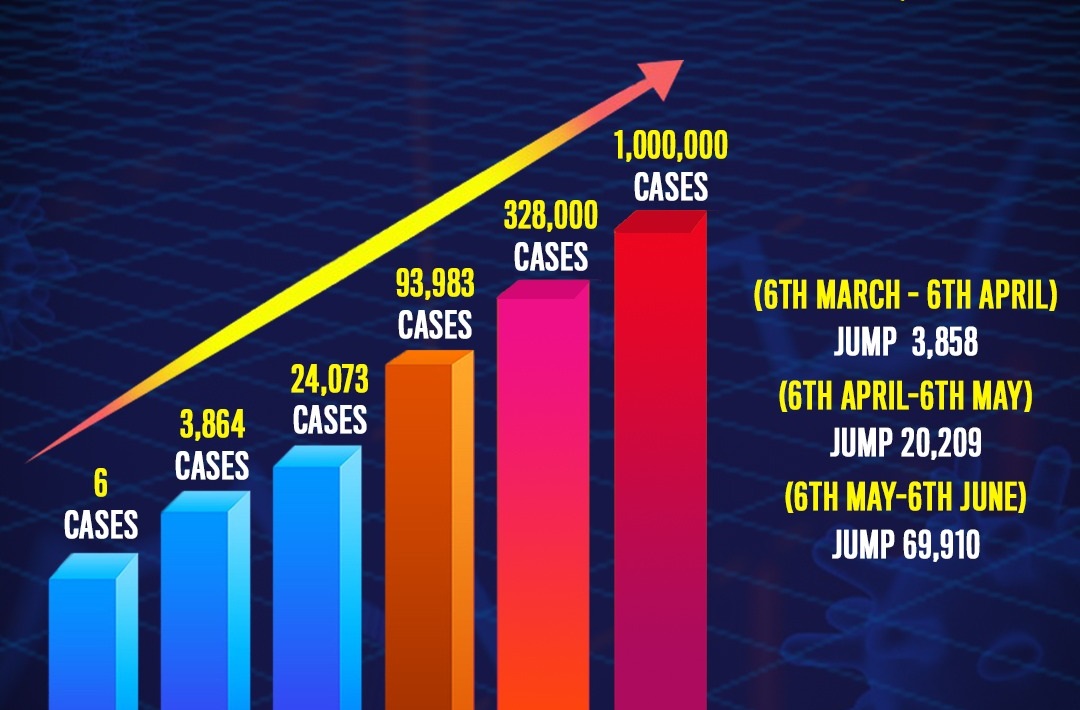
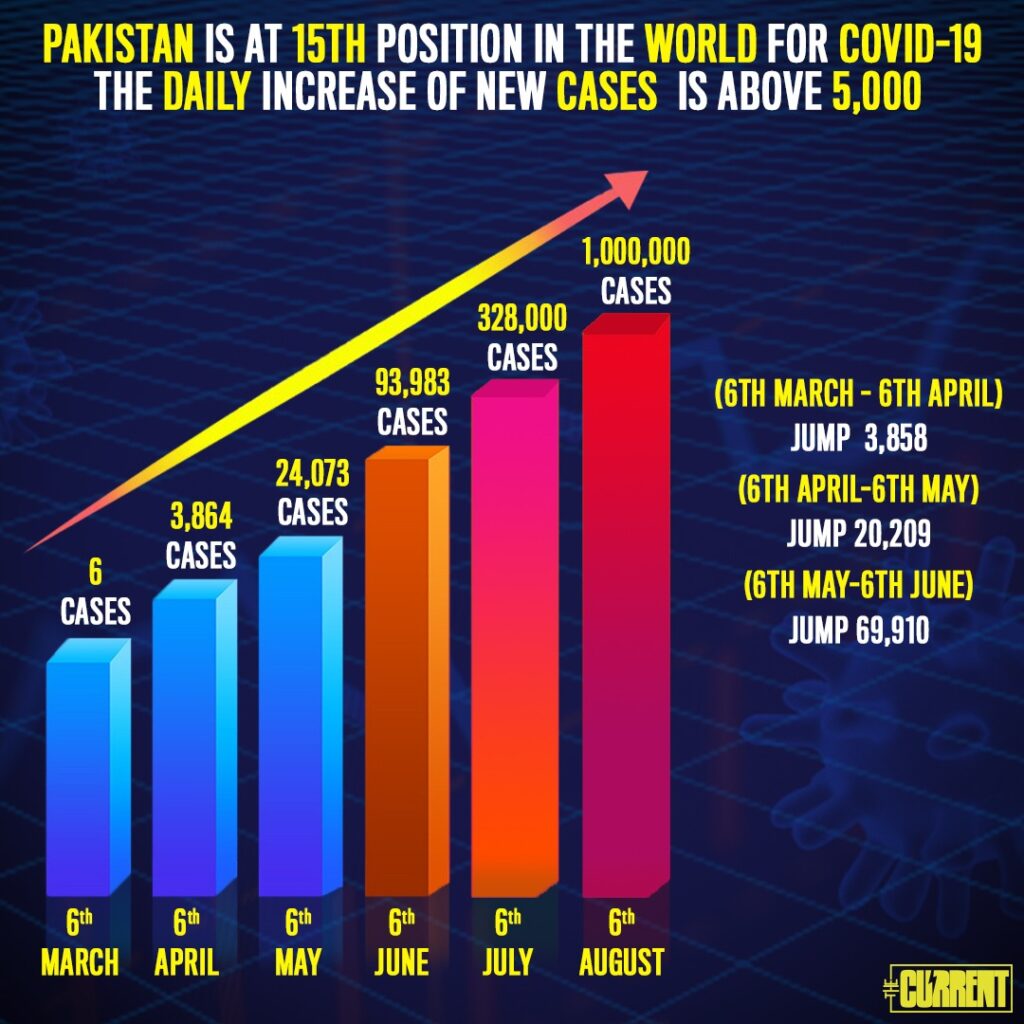
    An analysis by The Current showed that before lockdown restrictions were eased in Pakistan ahead of Eidul Fitr, the highest number of confirmed coronavirus cases stood at 24,648 during the first week of May. The figure then crawled up to 122,574 by June 11, while the number of coronavirus cases as of this moment stands past 165,000 with thousands of cases being reported every day despite a low testing capacity.

    It is estimated that the actual number of infections is very high with Lahore alone having more than 2 million cases by now.

    Pakistan has experienced its largest month-wise jump since the pandemic began, with 69,910 cases being reported between May 6 to June 6. Earlier, 3,858 COVID-19 cases were recorded between March 6 and April 6 while 20,209 were reported between April 6 to May 6.

    According to projections, the figure is likely to reach a million by August 6 if strict lockdowns aren’t imposed and social distancing guidelines are not followed.

    A comparison with the best and worst managed lockdowns from across the globe also puts things into perspective.

    CountryOutcome
      New Zealand
    Prime Minister Jacinda Ardern announced a strict lockdown on March 25 when 100 people had tested positive and no deaths had been reported.  After a 76-day lockdown, New Zealand lifted all restrictions, declaring the country ‘corona free’ but borders remain closed. No new case for more than two weeks has been reported in the country except three suspected ones.
    Wuhan
    The capital of Hubei province of China was the origin of the deadly virus, where 11 million residents were locked up at their homes since January.After an effective 77-day lockdown, Hubei reports zero COVID-19 infections and the country has reported zero coronavirus deaths since January.        

    On the other hand:

    CountryOutcome
    India
    On March 25, India imposed a countrywide lockdown that was called a curfew by PM Narendra Modi. The development had come when 519 confirmed cases and 10 deaths had been reported across India.  A bit over two months later, with India easing lockdowns and shopping malls, restaurants as well as temples being re-opened, it has become the country with 4th highest number of coronavirus cases in the world.
    Iran
    Iran shut schools, postponed events and discouraged travel since the country reported its first COVID-19 death in February. Despite these measures, the number of deaths and infections continued to grow until a countrywide lockdown was imposed in March.  With the lockdown being eased from mid-April to May 26 when everything was reopened, including shopping malls, parks, religious shrines, restaurants and historical sites, the number of deaths has jumped to nearly 10,000 with over 200,000 infections.

    By the time this report was filed, Sindh topped the chart with most infections in Pakistan (62,269), with Punjab trailing behind at 61,678, Khyber Pakhtunkhwa (KP) at 20,182, Islamabad at 9,941, Balochistan 8,998 and Gilgit-Baltistan and Azad Jammu Kashmir (AJK) at 1,225 and 769 infections, respectively.