Tag: FBR

  • Ishaq Dar takes notice of ‘illegal, unwarranted’ leak of Gen Bajwa’s family’s tax records

    Ishaq Dar takes notice of ‘illegal, unwarranted’ leak of Gen Bajwa’s family’s tax records

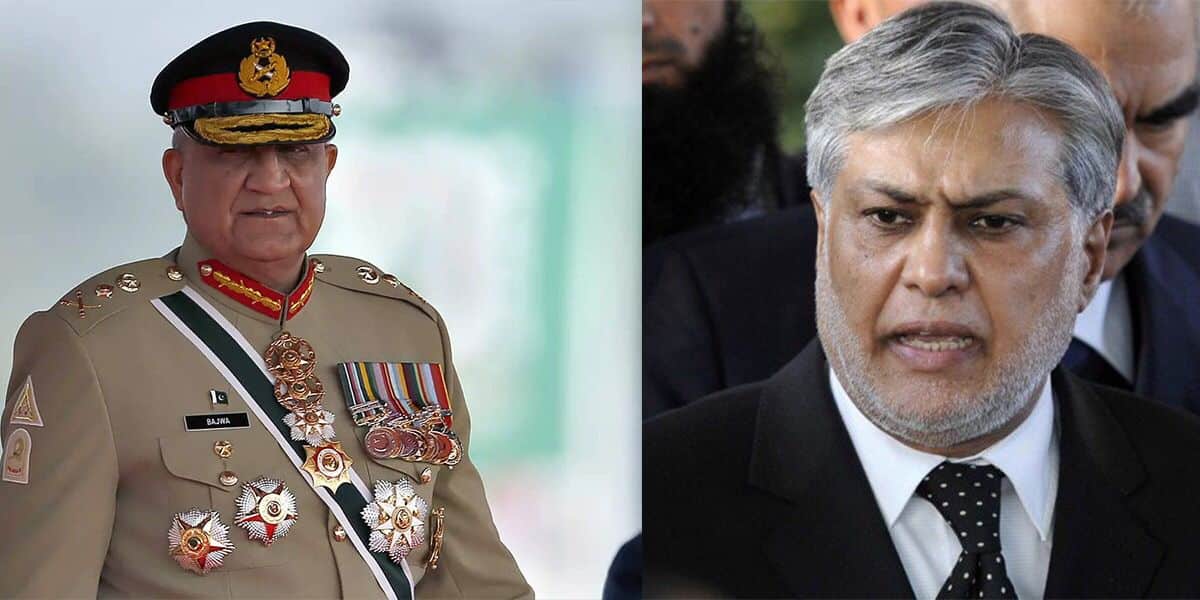
    Finance Minister Ishaq Dar on Monday took notice of the “illegal and unwarranted” leakage of tax information of Chief of Army Staff (COAS) General Qamar Javed Bajwa’s family members.

    An official statement from the Finance Division states, “This is clearly a violation of the complete confidentiality of tax information that the law provides.”

    This statement comes a day after a report by investigative news website FactFocus, which cited alleged tax returns and wealth statements, claimed that the COAS’ family had amassed billions of rupees in the last six years.

    “In view of this serious lapse on the part of to-date unknown functionaries, the finance minister has directed the Special Assistant to the Prime Minister (SAPM) on Revenue, Tariq Mehmood Pasha, to personally lead an immediate investigation into the violation of tax law[s] and breach of Federal Board of Revnue (FBR) data, affix responsibility and submit a report within 24 hours,” the handout said.

    According to the FactFocus report, the current market value of the known assets and businesses of the army chief, both within and outside Pakistan, amounted to Rs12.7 billion.

    The report also shared the alleged wealth statements of Gen Bajwa and his family from 2013 to 2021.

    According to the publication, it was unable to obtain data about assets in the name of Gen Bajwa’s two sons.

    FactFocus has claimed that after the publication of the story, the traffic on its site was “disrupted” and the website had been “banned”.

  • Poor performance forces govt to extend income tax return filing deadline to November 30

    Poor performance forces govt to extend income tax return filing deadline to November 30

    The Federal Board of Revenue (FBR) has managed to reach its four-month target of Rs2.14 trillion despite poor performance in increasing the tax base because of a 34 per cent decrease in income tax returns filed.

    Ishaq Dar, the finance minister, was forced to once again push the deadline for filing returns due to the dismal results in increasing the tax base. The new deadline is November 30; within this time, FBR must receive an additional Rs1.3 million in returns only to match the amount from the previous year.

    The FBR collected Rs2.148 trillion in taxes, as opposed to the objective of Rs2.143 trillion set for the period of July to October, according to FBR officials. Tax revenue increased by 16 per cent, or Rs305 billion, as compared to the same period in the previous fiscal year.

    This increase was slower than the 23 per cent inflation rate that was in effect at the time. but adequate for the first four months of the fiscal year to keep the tax department on pace.

    According to Express Tribune, the FBR had taken in Rs1.84 trillion in tax revenue during the first four months of the previous fiscal year. The economy’s slowdown, however, makes it appear as though the FBR may fall short of its tax goals for the upcoming months.

    A decrease in imports was the main reason the FBR could not meet its monthly tax goal of Rs 534 billion, which it missed by Rs 22 billion. Although there was a 15 per cent increase in revenue over the Rs445 billion collected in October of last year, the monthly goal was not met.

    The Inland Revenue Service (IRS) exceeded its July–October goal, largely mitigating the effects of the Customs Department’s low collection rate.

    As long as less than 2.5 million people file income tax returns, the tax system will not be able to increase the tax base, which has shrunk by 34 per cent during the previous tax year. Up to Rs3.8 million worth of returns have been submitted for the 2021 tax year.

    By extending the tax base to include traders, Pakistan had promised the International Monetary Fund (IMF) that it would increase the tax base by a minimum of 700,000. Instead, it is approximately Rs1.3 million below the total from the prior year. The FBR’s base really falls two million short of its own conservative goal.

  • FBR must collect Rs120 billion in two days to meet monthly target of Rs684 billion

    To reach its monthly goal of Rs684 billion by the end of the current month, the Federal Board of Revenue (FBR) must collect approximately Rs120 billion in the final two days of September.

    The FBR’s preliminary revenue collection as of September 2022 was over Rs565 billion compared to the target of Rs684 billion, representing a shortfall of over Rs119 billion.

    To reach the monthly goal of Rs684 billion, the FBR needed to collect about Rs60 billion every day during the final two days of September 2022, according to Brecorder.

    The government would be forced to implement emergency collection measures, such as imposing a sales tax on petroleum items, if the FBR is unable to meet the monthly target of Rs684 billion. To avoid taking emergency revenue measures, the FBR has increased efforts to reach the desired revenue collection objective.

    The tax collecting system currently has a difficult task ahead of it: achieving the assigned revenue collection target of Rs684 billion in September 2022.

    In order to maximise revenue collection, tax authorities have developed a plan in conjunction with the chief commissioners of the LTOs and heads of MTUs.

    The final day to pay advance tax instalments was September 25, and the majority of the corporate sector had already paid their owed advance tax instalment by that date.

    The FBR examined the big tax offices’ and medium tax offices’ revenue results via the video link. The meeting also covered the potential reduction in income collection under a few heads as a result of the severe floods.

    In comparison to the target of Rs483 billion, the FBR had tentatively collected net revenue of Rs489 billion for August 2022, representing an increase of Rs6 billion.

    In comparison to the set revenue collection target of Rs926 billion during the first two months of July and August in 2022–2023, the FBR has collected Rs948 billion. The Board has so far surpassed the specified target in the current fiscal year 2022–2023 by Rs22 billion.

    The FBR collected net revenue of Rs489 billion during August 2022, exceeding the objective of Rs483 billion compared to Rs448 billion collected during the same period last year, according to provisional figures.

  • FBR surpasses revenue collection target by Rs15 billion for July

    FBR surpasses revenue collection target by Rs15 billion for July

    The Federal Board of Revenue (FBR) revealed the provisional revenue collection data for July 2022, which came to Rs458 billion.

    The FBR generated net revenues of Rs458 billion in July, which was Rs15 billion more than its goal of Rs443 billion.

    These collections—which represent an increase of roughly 10 per cent over the Rs417 billion collected during the same time last year—are the biggest ever for the month of July.

    The gross revenue increased from Rs438 billion in July of the previous year to Rs486 billion, a rise of 11 per cent. Similarly, the amount of refunds given out in July increased by 32 per cent to Rs28 billion from Rs21 billion paid in the previous year.

    Domestic taxes made up 55 per cent of the total collection while import taxes kept their 40 per cent share.

    Previously, 52–53 per cent of the total revenue was collected via taxes at the import stage. Similarly, the increase in domestic income tax is close to 31 per cent, which the FBR described as a dramatic move toward direct taxation.

    The Advance Tax collected in July has increased significantly. Due to the implementation of a withholding provision that is applicable regardless of the holding term, there is also a 118 per cent rise in the advance tax on the sale of properties under Section 236-C.

    Similarly, a change in the tax rate has led to a 40 per cent increase in Advance Tax under Section 147, particularly from financial companies.

    Raising the FED rate on tobacco and cigarettes has also paid off. Sales tax from the tobacco sector increased by a record-breaking 67 per cent, while the FED from tobacco saw a record-high growth of over 47 per cent, or Rs2.6 billion.

    Additionally, the FED for international flight travel has climbed by more than 200 per cent. Additionally, Pakistan Customs saw a modest 2.58 per cent increase in revenue under the heading of customs duty during July 2022 compared to Rs65 billion collected during the same time last year.

    However, it fell short of the Rs77 billion target set for July as a result of the government’s import compression policy, which aims to limit the outflow of US dollars.

    In addition, the FBR lost around Rs11 billion in sales tax due to the zero-rating of petroleum goods.

    It is important to note that the number of income tax returns for the tax year 2021 has increased by 13 per cent to 3.4 million from 3.0 million for the tax year 2020.

  • Government will soon lift the import ban on certain items

    Government will soon lift the import ban on certain items

    The government will lift the import ban on some items in the upcoming weeks, according to Finance Minister Miftah Ismail, but restrictions for cellphones, cars, and home appliances will remain in place.

    He stated that the Commerce Ministry has sent a summary to the federal cabinet for removing restrictions on the import of non-essential and luxury items while speaking at a seminar about the performance of state-owned enterprises (SOEs) here in the federal capital.

    According to the finance minister, the decision was made in light of a lower import bill as a result of restrictions placed on the import of new machinery and raw materials, as well as lower oil prices on the global market. “In the upcoming months, we anticipate a decrease in petroleum product imports. Lower imports will enable Pakistan to conserve its foreign currency, he continued.

    He continued by saying he was hopeful for higher dollar inflows compared to outflows starting in the upcoming month, which would ease pressure on the local currency.

    “Imports in Pakistan as of July 25 were $3.758 billion and our total imports are likely to be $4.824 billion. This number will be less than our exports plus remittance”, he had written on Twitter a day earlier.

    The ban on 30 categories and 83 Customs headings was reportedly requested to be lifted by the finance minister on Tuesday to Prime Minister Shehbaz Sharif.

    He did, however, suggest that the Commerce Ministry keep the ban on completely built units (CBUs), cars, and home appliances in place.

    Speaking with Profit, sources said that between May 19 and July 19, 2021, Pakistan imported CBU automobiles, mobile phones, and home appliances worth Rs399 million. However, after the ban was imposed on May 19, 2022, the trend of importing these items decreased.

    Pakistan imported goods worth Rs123 million between May 19 and July 19, 2022, a difference of Rs276 million compared to the corresponding months of the previous fiscal year.

    It is important to note that the government has outright banned the import of cars, mobile phones, home appliances, dry fruits (aside from those from Afghanistan), crockery, shoes, chandeliers, lights (except energy savers), headphones, and loudspeakers.

    Some items on the list included condiments, doors and window frames, travel bags and suitcases, sanitary ware, fish and frozen fish, preserved fruits, tissue paper, furniture, shampoos, confectionery, luxury mattresses, and sleeping bags, jams and jellies, cornflakes, toiletries, heaters, blowers, sunglasses, kitchenware, aerated water, frozen meat, juices, pasta, ice cream, cigarettes, shaving supplies, luxury leather apparel, and musical instruments.

  • Pressure on Pakistani rupee may decrease in August

    Pressure on Pakistani rupee may decrease in August

    Finance Minister Miftah Ismail expressed his continued faith in Pakistani rupee’s (PKR) ability to withstand pressure despite the PKR continuing to hit historic lows versus the US dollar and suffering its biggest weekly slide in more than 20 years.

    The finance minister stated in an interview with Radio Pakistan that the political climate and the fact that import payments are being made for shipments beginning in June are both contributing factors to the pressure on the PKR.

    “Import of $80 billion were made during the last fiscal year. We are still making payments for energy commodities purchased last month. Therefore, the rupee is under pressure. However, as we are importing less in July, its effect would be reflected from next month or, I should say, next week.”

    “The rupee’s fall is connected to the political situation as well. Before July 17, the situation wasn’t like this,” he added.

    Miftah also spoke about Pakistan’s economic issues, stating that the poor export base continues to be a matter of concern.

    The local currency has continued to depreciate against the US dollar, losing 7.6 per cent last week, more than what businesses typically account for in terms of annual currency depreciation, as the inter-bank market experienced a turbulent five sessions due to renewed political uncertainty and increased worries about Pakistan’s external financing needs.

    He also revealed that one friendly country is ready for an instant investment in Pakistan.

    It is worth noting that Pakistan anticipates receiving the next International Monetary Fund (IMF) tranche before the end of the following month following the board meeting.

  • FBR collects highest-ever tax of Rs6 trillion in FY22

    FBR collects highest-ever tax of Rs6 trillion in FY22

    The Federal Board of Revenue (FBR) achieved a significant feat by collecting a record Rs6,000 billion in revenue during the previous fiscal year 2021–2022.

    The FBR reported that during the current fiscal year, it collected Rs2,205 billion in income tax, Rs2,773 billion in sales tax, and Rs1,007 billion in customs duty. The organisation in charge of collecting taxes also released Rs305 billion in refunds during that time.

    According to former finance minister Shaukat Tarin, the government of Imran Khan’s policies and the country’s economic growth allowed FBR to meet its revenue goals.

    Tarin insisted that the government should continue enforcing the prior administration’s tax laws. According to Tarin, the government shouldn’t impose additional taxes on the current taxpayers. Heavy taxes shouldn’t be imposed on the economy’s productive sectors, he continued.

    The government has given the general public significant tax breaks on a number of necessities, but the FBR claims that these tax breaks haven’t prevented revenue collection from continuing on an unprecedented and constant growth trajectory. Sales tax on all POL products has been eliminated for the first time in the nation’s history, costing the FBR Rs45 billion per month.

    In order to maximise revenue potential through digitization, transparency, and taxpayer facilitation, the FBR has implemented a number of novel interventions at both the policy and operational levels. In addition to ensuring transparency, facilitating taxpayers, and making business easier, this has led to a steady increase in revenue collection.

  • Imposing super tax on the rich will reduce budget deficit: Miftah

    Imposing super tax on the rich will reduce budget deficit: Miftah

    The government’s recently announced indirect tax (super tax) is intended to assist the country in increasing tax revenue and lowering the budget deficit, according to Finance Minister Miftah Ismail.

    He was relating to the large industries’ 10 per cent super tax or poverty alleviation tax.

    13 industries, including LNG terminals, sugar, cement, steel, textile, tobacco, fertiliser, banks, oil and gas, beverages, automobiles, and steel, will be subject to this one-time levy, according to Miftah. The government labelled these 13 industries for a special tax as they made significant profits last year.

    Companies in these sectors earning more than Rs300 million will be subject to a 10 per cent super tax, he added.

    According to the finance minister, this tax is a one-time levy that will only be in effect for fiscal year 2022–2023.

    He clarified on Twitter that the 4 per cent super tax will be imposed on all industries.

    “For the specified 13 sectors, another 6 per cent will be added for a total of 10 per cent,” he said. “So their tax rates will go from 29 per cent to 39 per cent. This is a one-time tax needed to curtail the previous four record budget deficits.”

    The imposition of a super tax on the wealthy, according to Finance Minister, will lessen the country’s reliance on foreign aid, lower the budget deficit, and bring the country closer to financial stability.

    Other businesses that make over Rs150 million will be subject to a 1 per cent super tax, and those that make over Rs200 million will be subject to a 2 per cent tax. On top of the current rates, it is worth noting that these taxes are additional.

    Businesses that earn more than Rs250 million in revenue will pay a 3 per cent super tax, and those that earn more than Rs300 million will pay a 4 per cent super tax.

    He continued, citing statistics, that there were 9 million retail and wholesale establishments in Pakistan, and that the government wanted to bring an additional 2.5–3.5 million into the tax system.

    “We are linking the income tax and sales tax of these shops with the electricity bill,” Miftah said. “Now, small shops will pay a fixed tax of Rs3,000 and large shops will pay Rs10,000.”

    Only 22 of Pakistan’s more than 30,000 gold trading companies, he claimed, were registered, and their average annual sales came to Rs4,000.

    Sales tax and a fixed income of Rs40,000 will now be paid by gold shops of 300 square feet or less.

    He said that the government would lower the sales tax on large stores from 17 per cent to just 3 per cent.

    The withholding tax on jewellery sales to gold shops by the general public has been reduced from 4 per cent to 1 per cent.

    According to Miftah, fixed tax structures similar to these will be introduced for real estate agents, car dealers, and builders. Since this tax only applies to income and not to spending, inflation will not rise.

    Additionally, the withholding tax for the IT sector has been eliminated. Sales and income taxes would not apply to IT companies with annual revenue of less than Rs80 million.

    Miftah emphasised that Pakistan needs the IMF programme to resume as the country’s foreign exchange reserves are at a critical point.

  • Punjab’s ePay system collects over Rs90 billion tax revenue through 17 million transactions

    Punjab’s ePay system collects over Rs90 billion tax revenue through 17 million transactions

    Since its launch in October 2019, e-Pay Punjab, an online payment solution developed by the Punjab Information Technology Board (PITB) and the Punjab Finance Department, has collected over Rs90 billion in tax revenue through 17 million transactions.

    As per details released by the PITB on Friday, e-Pay Punjab has collected a total of Rs57 billion in sales tax, Rs11.5 billion in token tax, Rs9 billion in property tax, Rs4 billion in traffic challans, and Rs440 million in vehicle transfers.

    It’s worth noting that e-Pay Punjab now accepts online payments for 23 taxes and levies from ten different departments. Its 1-Link network integration with the State Bank of Pakistan (SBP) and all scheduled banks makes it a secure and dependable payment channel.

    The e-Pay Punjab application, which has over 1 million downloads, generates a unique PSID number that is accepted by banks across Pakistan through their various channels, including Internet and Mobile Banking, ATMs, and physical branch visits.

    It is also a secure, smart, and fast online payment option for the annual Token Tax. Vehicle owners can use e-Pay Punjab to pay their Token Tax from the comfort of their own homes.

    The app’s primary objective is to make it convenient for the government to gather revenue in the form of taxes through a simple solution. With Pakistan’s first digital tax aggregator, the app demonstrates how Pakistan and its government are rapidly integrating financial technology (fintech) into their processes.

  • IMF rejects proposed tax relief for the salaried class

    IMF rejects proposed tax relief for the salaried class

    The International Monetary Fund (IMF) has rejected the government’s proposed tax cut in the Personal Income Tax (PIT) to the tune of Rs47 billion, leaving the government with no choice but to reconsider amendments in order to revive the remaining funds.

    According to The News, the Federal Board of Revenue (FBR) granted relaxation to salaried workers earning up to Rs1.2 million annually, top official sources claim that the IMF has expressed strong misgivings about the planned PIT rate.

    To assist the urban middle class, the International lender recommends that the assistance be limited to persons earning up to Rs0.2 million per month, and that tax rates in other slabs be raised afterward.

    Compensation in PTI’s tenure

    During the sixth review under the PTI-led government, the FBR offered compensation to those making up to one million rupees per month in salary in the budget for 2022-23 through Finance Bill 2022 in Parliament, which was set as a structural benchmark under the Fund agreement. If the proposed PIT rates are not adjusted, it could become a major roadblock to reaching an agreement with the IMF at the staff level.

    The international lender intended to improve tax collection by Rs125 billion by putting PIT in a progressive manner, but the government went the other way, making it impossible for both parties to get a staff-level agreement under the $6 billion Extended Fund Facility (EFF) with the current PIT proposal.

    Proposed tax for salaried class in Finance Bill 2022

    According to the Finance Bill 2022, those earning up to Rs1.2 million will pay only Rs100 in tax. Previously, those earning up to Rs800,000 per year had to pay Rs10,000, those earning up to Rs1.2 million Rs30,000, and those earning up to Rs2 million Rs120,000. According to the suggested rate, a salary employee earning Rs2 million per year will only have to pay Rs56,000.

    The tax burden for salary earners up to Rs3 million was formerly Rs282,000 per year, but now it is projected to be Rs159,000. Up to Rs4 million in salary, a salary earner had to pay Rs470,000 in income tax, but under the proposed rate, the tax payment is reduced to Rs304,000. The tax due for a salary earner earning up to Rs5 million was Rs670,000, but it was cut to Rs479,000 under the proposed rate.

    The Finance Bill 2022 recommends providing relief up to Rs one million in salary earner who had to pay Rs1.845 million in tax, but now the tax burden has been lowered to Rs1.554 million for salary income up to Rs one million per month under the proposed Finance Bill 2022. The planned tax rates were amended upward in the remaining slabs up to Rs20 million, Rs40 million, Rs60 million, and Rs80 million.

    Increased taxable limit

    The FBR increased the taxable ceiling limit from Rs600,000 to Rs1,200,000 in the Finance Bill 2022, and the number of slabs in the PIT regime was decreased from 12 to 7.

    Where the taxable income does not exceed Rs600,000, there would be no tax, according to new slabs imposed for the salaried class. A tax of Rs100 would be levied on taxable income exceeding Rs600,000 but not exceeding Rs1,200,000.

    There would be a 7 per cent tax on the amount beyond Rs1,200,000 if the taxable income exceeds Rs1,20,000 but not Rs2,400,000.

    If an individual’s taxable income is over Rs2,400,000 but not over Rs3,600,000, you would be charged Rs84,000 plus 12.5 per cent of the amount over Rs2,400,000 per year. The FBR will levy a tax of Rs234,000 plus 17.5 per cent of the amount over Rs3,600,000.

    If the taxable income is more than Rs6,000,000 but not more than Rs12,000,000, the FBR will deduct Rs654,000 plus 22.5 per cent of the amount over Rs6,000,000.

    When taxable income reaches Rs12,000,000, the FBR will assess a tax of Rs2,004,000 plus 32.5 per cent of the amount over Rs12,000,000 every year.