Tag: NEPRA

  • NEPRA wants fixed charges on electricity bills from July

    NEPRA wants fixed charges on electricity bills from July

    The National Electric Power Regulatory Authority (NEPRA) has decided to impose a new electricity tariff by imposing monthly fixed charges for residential consumers from July 1, ARY News reported.


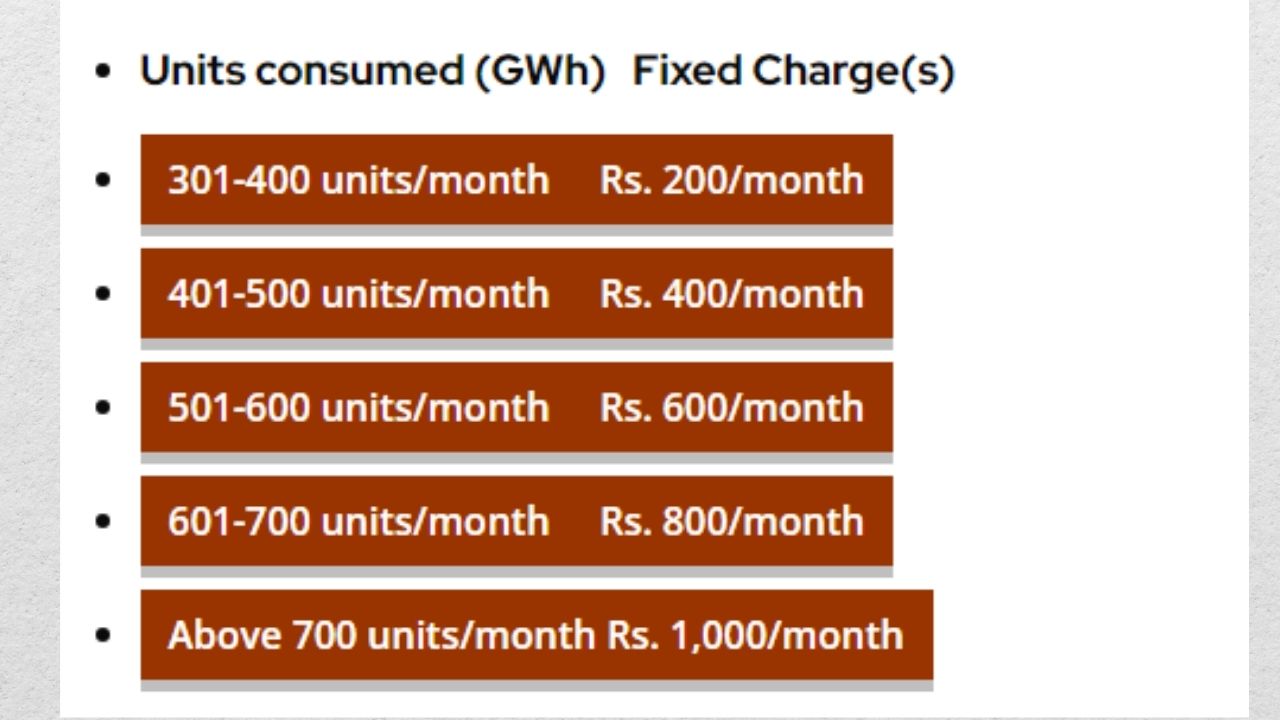
    NEPRA has proposed fixed charges of Rs200-1,000 a month in electricity bills, which the government has yet to approve.


    As per the proposal, domestic consumers using 301-400 units a month will pay Rs 200 per month from July 1, 2024, while those using 401-500 units will pay Rs400, and end electricity consumers consuming 501-600 are to pay Rs600.


    The residential consumers who use the 601-700 units will pay Rs800 a month, and those who use above 700 units will pay Rs1,000 a month.


    Residential consumers using the ToU (time of use) meter will also pay Rs1,000 fixed charges a month.


    Commercial consumers having load less than five kilowatt will also pay Rs1,000 a month as fixed charges. However, users consuming loads of five kilowatt and above will now pay Rs. 2,000 from the existing Rs500, an increase of 300 percent.


    Currently, the total cost of electricity unit comprises 72 percent fixed charges and 28 percent variable charges, according to ARY News.


    After Budget 2024-25, the federal government added Rs. 5.72 per unit in power tariff.


    NEPRA had already announced that the average electricity tariff would rise to Rs. 35.50 per unit from the current Rs. 29.78.

  • NEPRA hikes basic electricity tariff by Rs5.72 to Rs35.50 per unit

    NEPRA hikes basic electricity tariff by Rs5.72 to Rs35.50 per unit

    The National Electric Power Regulatory Authority (NEPRA) has announced an increase in the basic electricity tariff by Rs5.72 per unit, effective from July 1, 2024. This hike will raise the current base tariff from Rs29.78 to Rs35.50 per unit.

    The capacity charges, which form a significant portion of the base price, amount to Rs18.10 per unit, constituting 51 per cent of the total cost. Consequently, the total capacity payment is projected to reach approximately Rs2.091 trillion for the fiscal year 2025.

    This proposal has been submitted to the federal government for final approval. The government will decide whether to implement the increase immediately or phase it in over time.

    It is important to note that in the current fiscal year (FY24), the electricity tariff was increased by Rs7.50 per unit, while in the previous fiscal year (FY23), the government implemented an increase of Rs7.91 per unit.

    In a contrasting move, Prime Minister Shehbaz Sharif announced on Friday a substantial reduction of Rs10.69 per unit in the electricity tariff for the industrial sector. This reduction is part of the Prime Minister’s historic power package aimed at bolstering the country’s industrial sector.

    Additionally, the petrol price has been reduced for the fourth consecutive time, decreasing by Rs10.20 to Rs258.16 per litre.

  • NEPRA announces tariff hike of Rs3.33 per unit for ex-Wapda distribution companies

    NEPRA announces tariff hike of Rs3.33 per unit for ex-Wapda distribution companies

    The National Electric Power Regulatory Authority (NEPRA) has sanctioned an increase of Rs3.3321 per kilowatt-hour (kWh) in the electricity tariff for ex-Wapda distribution companies (XWDISCOs), according to a notification issued on Thursday.

    This tariff adjustment is attributed to fluctuations in fuel charges for April 2024. The increased rate will be itemised separately on consumers’ bills based on the units consumed during that month.

    NEPRA clarified that the revised tariff will apply to all consumer categories except Electric Vehicle Charging Stations (EVCS) and lifeline consumers.

    Previously, the Central Power Purchasing Agency (CPPA), a subsidiary of the Power Division, had requested an additional Rs3.49 per unit to cover the higher fuel costs for April 2024.

    The CPPA-G reported that the actual pooled fuel cost for April 2024 was Rs8.9801/kWh, significantly higher than the reference fuel cost of Rs5.4918/kWh, resulting in a difference of Rs3.4883/kWh.

    “After incorporating the aforementioned adjustments, NEPRA reviewed and assessed a national average uniform increase of Rs3.3321/kWh in the applicable tariff for XWDISCOs on account of variations in the fuel charges for April 2024,” the notification stated.

    Consumers can expect to see this adjustment reflected in their upcoming bills as NEPRA continues to address the variations in fuel costs impacting the electricity sector.

  • K-Electric seeks Rs10.69 per unit hike in basic power tariff

    K-Electric seeks Rs10.69 per unit hike in basic power tariff

    K-Electric has proposed a substantial increase in its basic power tariff, seeking to raise the rate by Rs10.69 per unit to reach Rs44.69 per unit.

    This proposal has been made under the 7-year Multi-Year Tariff (MYT) framework.

    Currently, K-Electric’s average basic tariff stands at Rs34 per unit. The utility company has detailed its request, including specific components for the proposed increase. The Energy Purchase Price (EPP) component is to be set at Rs18.88 per unit.

    Additionally, transmission charges are projected to be Rs3.48 per unit, and distribution charges at Rs3.84 per unit. Operation and maintenance costs are requested to be Rs0.42 per unit, while the retail margin is sought to be Rs0.59 per unit.

    Furthermore, K-Electric has asked for the recovery of lost allocation at Rs2.88 per unit and working capital at Rs2.07 per unit.

    The National Electric Power Regulatory Authority (NEPRA) has invited stakeholders to submit their feedback on K-Electric’s request within the next seven days.

    A decision on the proposal is anticipated soon. If approved, the new tariff will impact millions of electricity consumers in Karachi and its surrounding areas.

    Last month, K-Electric submitted a request for a significant hike of Rs18.86 per unit in the power tariff. This adjustment was based on the Fuel Charge Adjustments (FCA) for seven months, submitted to NEPRA.

    Concurrently, K-Electric also requested a reduction in the power tariff by Rs0.29 per unit for a two-month period.

    In another development, the federal government has outlined a plan to privatise several profit-making power distribution companies (Discos). The companies slated for privatisation include Lahore Electric Supply Company (LESCO), Faisalabad Electric Supply Company (FESCO), Gujranwala Electric Power Company (GEPCO), Multan Electric Power Company (MEPCO), and Faisalabad Electric Supply Company (FESCO).

    These developments come at a critical time for Pakistan’s power sector, where tariff adjustments and privatisation efforts are expected to have significant implications for both the economy and consumers.

  • NEPRA approves power tariff increase of Rs2.8372 per unit

    NEPRA approves power tariff increase of Rs2.8372 per unit

    In a recent announcement, the National Electric Power Regulatory Authority (NEPRA) has approved a tariff increase of Rs2.8372 per kilowatt-hour (kWh) for all ex-Wapda distribution companies (XWDISCOs).

    This adjustment, reflected in a notification issued by NEPRA, is a result of fluctuations in fuel charges observed during March 2024.

    The tariff adjustment will be applied to consumer bills based on the units billed in March 2024. This increase will be listed separately in consumer billing statements to reflect the additional cost due to fuel charge variations.

    However, NEPRA clarified that this adjustment will not apply to certain categories of consumers, including Electric Vehicle Charging Stations (EVCS) and lifeline consumers, who benefit from lower electricity rates.

    This development follows a request made last month by the Central Power Purchasing Agency (CPPA), a subsidiary of the Power Division, which proposed an additional fuel charge of Rs2.94 per unit to cover the higher costs experienced in March 2024.

    The CPPA reported that the actual fuel cost for the month stood at Rs9.3819/kWh, significantly higher than the reference fuel cost component of Rs6.4417/kWh, leading to the proposed increase.

    After reviewing the CPPA’s request and the associated fuel cost variations, NEPRA concluded that an increase of Rs2.8372/kWh in the national average uniform tariff was justified.

    This adjustment is intended to balance the higher fuel costs incurred in March and ensure that the tariff structure remains aligned with the cost of energy production.

    Consumers are advised to review their electricity bills for March 2024 to understand how this adjustment will impact their total energy costs.

  • Nepra approves Rs7.056 per unit hike for power consumers

    Nepra approves Rs7.056 per unit hike for power consumers

    In a setback for the already burdened public grappling with inflation, the National Electric Power Regulatory Authority (Nepra) has greenlit a fuel cost adjustment, paving the way for a Rs7.0562 per unit increase in tariffs for March 2024.

    This decision grants state-run power distribution companies the authority to impose additional charges, projecting a staggering financial burden of around Rs56 billion on consumers.

    This figure could potentially soar to nearly Rs66 billion, taking into account the 18 per cent general sales tax (GST).

    It’s important to note that this tariff adjustment is applicable across all consumer categories, except for electric vehicle charging stations (EVCS) and lifeline consumers.

    The Central Power Purchasing Agency (CPPA), representing the distribution companies, had initially sought Rs7.13 per unit in its petition.

    Earlier this month, The News highlighted the plea from ex-Wapda distribution companies (XWDiscos) seeking Nepra’s approval for the Rs7.13 per unit increase.

    This was attributed to a significant drop in hydropower production and systemic constraints, such as the incapacity of the high-voltage direct current (HVDC) transmission line to efficiently transport economically viable power from southern producers to the north.

    Amidst these developments, commentators express concern over the substantial surge in fuel costs, reaching Rs14.6206/kWh for January 2024.

    In response, Nepra has taken decisive action, initiating an investigation under Section 27-A of the NEPRA Act to uncover the reasons behind this significant fuel cost, as claimed by CPPA-G for January 2024.

  • Economic challenges await next govt as Pakistan votes

    Economic challenges await next govt as Pakistan votes

    Pakistan is set to hold its national elections on Thursday, a crucial event for the country grappling with multiple crises.

    As the new government prepares to take charge, it faces daunting challenges in stabilising the economy.

    Last summer, Pakistan narrowly avoided a sovereign default through a last-minute $3 billion bailout from the International Monetary Fund (IMF).

    However, this lifeline is set to end in March, and officials anticipate the need for a new, extended programme.

    Negotiating this program swiftly is imperative for the incoming government, as the economy is burdened by record-high inflation and slow growth resulting from stringent reforms.

    The country’s headline inflation stood at 28.3 per cent year-on-year in January, slightly lower than December’s 29.7 per cent. Despite government expectations, citizens are anxious for the new administration to address the soaring inflation that has significantly impacted their daily lives.

    Moreover, recent increases in gas prices, with a 35.13 per cent hike for Sui Northern Gas Pipelines Limited (SNGPL) and 8.57 per cent for Sui Southern Gas Company Limited (SSGC), add to the economic challenges. The move, effective from January 1, 2024, is the second increase in gas prices this fiscal year.

    In addition to rising gas prices, the cost of petrol and diesel has surged, with a notable increase of Rs13.55 per litre announced on February 1, 2024. This hike is attributed to the ongoing tensions in the Middle East, including Israel’s conflict with Gaza and Houthi attacks in the Red Sea.

    Amid these economic hardships, the National Electric Power Regulatory Authority (NEPRA) has approved an increase in electricity tariffs for distribution companies (Discos) by Rs4.57 per unit for December 2023. This adjustment addresses the escalating fuel costs impacting the power sector.

    The new government is also expected to address the exchange rate concerns as the Pakistani rupee struggles against the US dollar, currently standing at around Rs279.

    The disparity has led to increased prices for essential commodities, further straining the population.

    Adding to the complexity of the upcoming elections is the high political tension, with former prime minister Imran Khan describing a crackdown on him and his party.

    Khan, who has been in jail since August, faces pending cases, including accusations of ordering violent attacks on military installations.

    Despite his imprisonment, Khan maintains substantial popular support, and continued political unrest could jeopardise the stability needed for economic recovery and foreign investment.

    As Pakistan stands at a critical juncture, the incoming government’s ability to navigate these challenges will determine the nation’s economic trajectory in the coming years.
  • Electricity bills to reflect Rs3.07 per unit hike in December

    Electricity bills to reflect Rs3.07 per unit hike in December

    The National Electric Power Regulatory Authority (NEPRA) has officially sanctioned a Rs3.07 per unit increase in electricity prices for October 2023, attributed to Fuel Charges Adjustment (FCA), as communicated in its notification on Tuesday.

    This tariff adjustment will be separately reflected in the power bills based on the units consumed by consumers of all ex-Wapda DISCOs (XWDISCOs) during October 2023. NEPRA has specified that XWDISCOs are to incorporate the FCA in the billing cycle for December 2023.

    It is important to note that this tariff adjustment does not apply to K.Electric (KE) consumers, Electric Vehicle Charging Stations (EVCS), or lifeline consumers.

    The adjustment in the approved tariff for Ex-WAPDA DISCOs was prompted by variations in fuel charges for October 2023, as indicated in the request submitted by CPPA-G via a letter dated November 15, 2023, the authority clarified. NEPRA emphasised the need for XWDISCOs to adhere strictly to court orders while implementing the FCA.

    In a separate development, a NEPRA inquiry report disclosed that numerous electricity consumers in Pakistan were overcharged during July and August of the current year. 

    The report highlighted that distribution companies (DISCOs) billed consumers for over 40 days, leading to widespread overbilling. NEPRA identified MEPCO, followed by GEPCO, FESCO, LESCO, and HESCO, as the main contributors to this overbilling, holding all DISCOs responsible for this unjustified practice.

    The report recommended legal actions against power distribution companies, including K-Electric Limited (KEL), under NEPRA Fine Regulations, 2021, for violating the provisions of the NEPRA Act, Consumer Service Manual (CSM), and tariff terms and conditions.

  • NEPRA exposes overbilling scandal impacting thousands of electricity consumers 

    NEPRA exposes overbilling scandal impacting thousands of electricity consumers 

    An investigative report by the National Electric Power Regulatory Authority (NEPRA) unveiled a disconcerting situation in Pakistan, affecting thousands of electricity consumers during the months of July and August this year.  

    The report disclosed that distribution companies (Discos) had billed consumers for over 40 days, a major contributor to the issue of overbilling in the mentioned months. Notably, MEPCO, followed by GEPCO, FESCO, LESCO, and HESCO, were identified as the Discos significantly involved in this overbilling, implicating all Discos collectively in this unjustified practice. 

    As a response to these findings, NEPRA recommended initiating legal proceedings against the power distribution companies, including K-Electric Limited (KEL), under NEPRA Fine Regulations, 2021. The basis for these actions lies in the violation of the provisions outlined in the NEPRA Act, Consumer Service Manual (CSM), and tariff terms and conditions. 

    Expressing concern, NEPRA emphasised the unfortunate deliberate malpractices by distribution companies undertaken to conceal their inefficiencies. These practices resulted in higher electricity bills for thousands of consumers.  

    The report highlighted the failure of Discos to adhere to the percentage checking mechanism outlined in the Consumer Service Manual (CSM), along with the unauthorised charging of detection bills, contravening Clauses 9.1 and 9.2 of the CSM, which provide a specific procedure for charging detection bills. 

    NEPRA noted with concern that detection bills charged by Discos were found to be fake and frivolous, contributing to a significantly low recovery ratio in certain Discos.  

    The authority initiated an inquiry in response to widespread complaints from consumers across the country regarding excessive, inflated, and erroneous bills during July and August 2023. A hearing was conducted on November 13, 2023, wherein CEOs of all distribution companies participated online, presenting their perspectives. 

    During the proceedings, it was observed that numerous distribution companies were charging metre readings, with discrepancies between snap readings and the readings recorded on consumers’ bills. 

    Additionally, some cases were identified where snaps of metre readings were either invisible or intentionally not taken. Monthly metre readings were reported to be taken beyond the standard billing cycle of 30 days in certain instances, leading to undue and inflated charging of upper slab bills for less frequent users and a consequent change in category from protected to unprotected. 


  • Nepra allows passing Rs3.53 per unit burden on power consumers

    Nepra allows passing Rs3.53 per unit burden on power consumers

    National Electric Power Regulatory Authority (Nepra) has provisionally approved distribution companies (Discos) to recover Rs32.7 billion at Rs3.53 per unit from consumers for October 2023.

    Central power purchasing agency highlighted a negative impact of paisa 20 per unit for the Fuel Cost Adjustment (FCA), which rose to Rs3.53 per unit with Rs28.33 billion added in previous adjustments.

    China Power and Thar Coal Block-1 Power also had shares in the adjustments.

    Due to a potential negative impact on consumers, there’s a proposal to stagger the amount in the winter months. Electricity sales decreased by over 10 per cent, reaching 9.63 billion units in October 2023, and a 28 per cent reduction in demand occurred compared to September 2023.

    Concerns were raised about the decline in demand, with Nepra noting alarm if it’s due to reduced industrial consumption.

    In a public hearing, the National Transmission and Despatch Company (NTDC) representative urged a review of the “disallowed mechanism” due to financial difficulties, with Rs42 billion withheld, impacting salaries and pensions.

    In terms of electricity generation, various sources contributed differently in October 2023. Hydel generation was 32.54 per cent, local coal-fired plants were 13.94 per cent, and imported coal was 3.51 per cent.

    Gas-based plants generated 7.35 per cent, RLNG contributed 20.25 per cent, nuclear sources provided 19.08 per cent, and electricity imported from Iran constituted 0.24 per cent.

    Wind and solar energy made up 3.08 per cent and 0.79 per cent, respectively. The total energy generated was 9,572 GWh at Rs8.2605 per unit, with a cost of Rs79.066 billion.

    Discos received 9,253 GWh at Rs11.4277 per unit, totaling Rs105.737 billion in October 2023. The situation raises concerns about the financial viability of power entities and their potential impact on consumers.