Category: Business

  • World Bank reverses suggestion to tax Pakistanis earning below Rs50,000 

    World Bank reverses suggestion to tax Pakistanis earning below Rs50,000 

    The World Bank has retracted its previous recommendation to include individuals earning less than Rs50,000 in the tax system. This reversal comes as the Federal Board of Revenue (FBR) reports that the salaried class has outperformed exporters and the real estate sector in tax contributions over the last three months. 

    The World Bank clarified its stance, stating that it does not endorse reducing the existing nominal tax threshold. The initial suggestion may have been misleading, according to their spokesperson. The organisation now acknowledges that their recommendation was based on 2019 data and should be updated to account for the recent surge in inflation rates and changes in the labour market to safeguard the interests of low-income groups. 

    The World Bank’s previous analysis, which used 2019 data, indicated the potential for a lower tax exemption threshold for salaried individuals within a reformed income tax structure. However, this analysis needs to be revised to reflect current economic conditions. The goal is to ensure that low-income earners are not adversely affected. 

    The World Bank also noted that their recommendation in the Pakistan Development Update (PDU) should have been more explicit about the necessity for new analysis using up-to-date data to inform tax reform decisions. 

    In addition to these points, the Washington-based lender reiterated its suggestion for comprehensive tax reforms aimed at creating a more progressive tax system and placing a greater tax burden on higher-income individuals.

    According to The News, these reforms would involve reducing subsidies, eliminating regressive tax exemptions, and increasing taxation for individuals with higher incomes. The World Bank also recommended improvements in the taxation of agriculture, property, and retail sectors. 

    The statement from the World Bank emphasised that any adjustments to tax thresholds should be based on recent survey data and designed to protect the income levels of those with lower earnings. 

    The initial World Bank suggestion had raised concerns among individuals earning Rs50,000 or less, who are currently exempt from direct taxes. These concerns were driven by the backdrop of soaring inflation and an increased cost of living that has placed significant strain on this income group. 
  • Pakistan expected to secure second IMF tranche despite missed deadlines

    Pakistan expected to secure second IMF tranche despite missed deadlines

    Pakistan is poised to secure the next installment of its $3 billion stand-by arrangement (SBA) with the International Monetary Fund (IMF), despite potential delays in meeting certain deadlines, as indicated in a recent brokerage report. 

    Topline Securities, in its analysis, acknowledged that Pakistan had achieved the prescribed targets for net international reserves, net domestic assets, and foreign currency swap/forward positions as of the close of June 2023.  

    However, it also pointed out that Islamabad had fallen short in meeting the targets for the primary deficit, which assesses the fiscal balance excluding interest payments as well as external public debt disbursements. 

    Furthermore, the report highlighted that Pakistan had yet to implement a gas price adjustment agreed upon with the IMF, which was a prerequisite for completing the second review of the program. 

    Pakistan initially received a $1.2 billion installment from the IMF’s stand-by arrangement in July after the IMF’s Executive Board approved the bailout package to stabilise the country’s economy.  

    Under the agreement, the remaining $1.8 billion is set to be disbursed in two tranches following reviews in November and February. 

    The current IMF programme outlines nine performance criteria, four indicative targets, and ten structural benchmarks for the upcoming review. 

    In a briefing for analysts on September 14, the Governor of the State Bank of Pakistan confirmed that all quantitative performance targets related to the central bank, including net domestic assets, swaps, and net international reserves, had been met.  

    Similarly, the Finance Ministry expressed its commitment to maintaining fiscal discipline and achieving primary balance targets. 

    Despite challenges and some unmet targets related to external funding, the primary deficit, gas price adjustments, etc., Topline Securities remains optimistic about Pakistan’s chances of receiving the next IMF tranche.  

    They believe that if the government can effectively manage the current account deficit to around $4 billion for FY2024, as opposed to the projected $6.5 billion, it can meet its financing requirements, particularly given the difficulty of commercial borrowing. 

    The Ministry has projected gross external financing requirements of $28.4 billion for the current fiscal year, including the current account deficit of $6.5 billion, aligning with IMF projections outlined in the latest country report. 

    Regarding funding sources, the government plans to secure a total of $11 billion, with $5 billion coming from China and $6 billion from Saudi Arabia, primarily in the form of rollovers and an oil facility with deferred payments, according to Topline’s report.  

    The government also anticipates around $6.3 billion from multilateral creditors, including the World Bank, Asian Development Bank, Islamic Development Bank, and Asian Infrastructure Investment Bank. 

  • SNGPL cracks down on gas theft, imposing Rs3 crore in fines

    SNGPL cracks down on gas theft, imposing Rs3 crore in fines

    In an ongoing endeavour to combat gas theft, Sui Northern Gas Pipelines Limited (SNGPL) has successfully identified and addressed 55 instances of unauthorised gas connections, resulting in the imposition of fines amounting to Rs30 million.  

    According to APP, these concerted efforts have been executed across various regions of Pakistan. 

    According to a company spokesperson, within the city of Lahore, the local SNGPL team has taken decisive action by discontinuing 15 gas connections due to unlawful gas consumption, in addition to two connections linked to the unauthorised use of compressors.  

    Furthermore, 47 cases of underbilling have been meticulously scrutinised, leading to the initiation of a First Information Report (FIR) against the offenders. 

    In Bahawalpur, the SNGPL team has demonstrated their commitment by disconnecting seven connections attributed to compressor usage and 16 connections associated with unauthorised gas consumption.  

    Additionally, 17 cases of underbilling have been diligently processed. The company has levied a fine of Rs40,000 on those engaged in pilfering gas. 

    In Multan, 11 connections have been severed due to illegal gas consumption, while nine have been disconnected for compressor usage. Six instances of underbilling have undergone rigorous examination, resulting in the imposition of appropriate fines. 

    In Sheikhupura, one connection has been disconnected due to compressor usage, and a comprehensive review of 63 underbilling cases has been undertaken.  

    In both Peshawar and Karak, 44 gas connections have been terminated owing to direct gas consumption and the presence of illicit connections. Additionally, two FIRs have been filed against those involved in gas theft. 

    In Rawalpindi, six gas connections have been discontinued due to direct and unauthorised gas consumption, with one connection linked to the use of compressors. 

  • US dollar hits six-month low against Pakistani currency 

    US dollar hits six-month low against Pakistani currency 

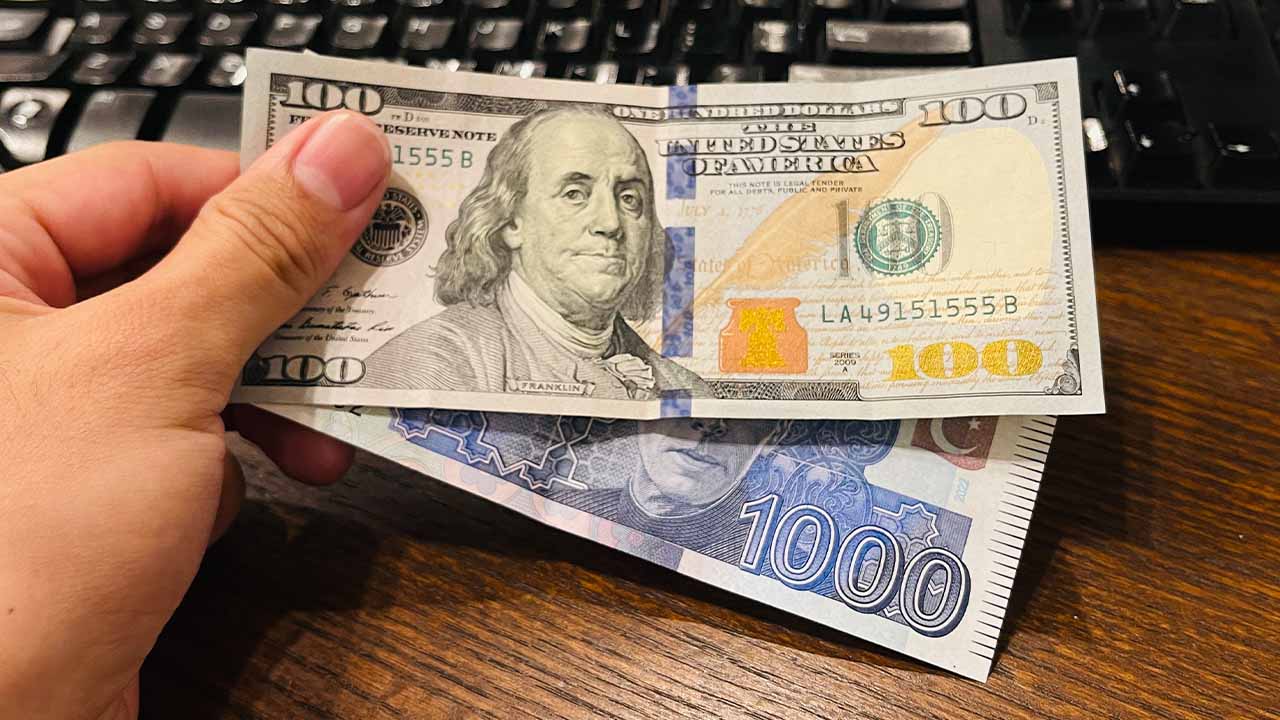
    The Pakistani rupee (PKR) has been on an upward trajectory, with the US dollar (USD) experiencing its lowest value in six months.

    This development follows a concerted effort to combat dollar smuggling, resulting in a decrease of Rs5.50 in interbank trading this week. The greenback concluded the week at Rs282.69.  

    In the open market, the US dollar saw a significant drop of 6.50 rupees, closing at Rs281.50, down from Rs288.

    This decline has been a consistent trend in recent weeks, starting from the beginning of September, when the US currency has been steadily losing ground against the Pakistani rupee.  

    Notably, other foreign currencies have also seen a decrease in their value within the currency market. Over the past week, the Euro fell by 8 rupees, going from Rs306 to Rs298. Similarly, the British Pound Sterling lost Rs5, reaching a rate of Rs248 from its previous Rs253.

    The Saudi Riyal experienced a modest decrease of one rupee, moving from Rs76.20 to Rs75.20, while the Emirates dirham shed Rs2.60 to settle at Rs77.20, down from its previous rate of Rs79.80 over the weekend.  

    This strengthening of the Pakistani rupee against the US dollar in the open market has occurred while maintaining a narrow gap with the interbank market, aligning with the limits stipulated by the International Monetary Fund (IMF).  

    This positive trend in the rupee’s value against the dollar can be attributed to a nationwide crackdown on illegal currency operations carried out by law enforcement agencies. 

  • Electricity tariff for K-Electric consumers increased by Rs4.45 per unit 

    Electricity tariff for K-Electric consumers increased by Rs4.45 per unit 

     
    Residents of Karachi are set to see an increase in their electricity bills, as the National Electric Power Regulatory Authority (Nepra) has recently decided to raise the power tariff by Rs4.45 per unit for consumers of K-Electric (KE).  

    The decision to elevate electricity rates, as outlined in a notification from the Power Division, was made during the initial quarterly adjustment of the preceding fiscal year. 

    Moreover, additional charges from KE consumers will be applied to their October and November 2023 bills, as specified in the notification. 

    Simultaneously, in response to a request from KE, Nepra has granted approval for the inclusion of actual or prudent expenses associated with the temporary operation of Unit-3 of Bin Qasim Power Station (BQPS-I) from May 1 to August 15, 2021, in the cost calculations. 

    Consequently, prior determinations made by the Authority on September 15, 2021, and May 12, 2022, concerning this matter have been adjusted to accommodate this modification. 

    “In view of the foregoing, the Authority hereby decides to accede to the request of KEL [K-Electric Limited] and allows the actual/prudent cost relating to the interim operation of Unit-3 of BQPS-I (from May 1, 2021, to August 15, 2021). Accordingly, the earlier decisions of the Authority (dated September 15, 2021, and May 12, 2022) in this regard stand modified to this extent,” stated the power regulator. 

    However, a member of the authority, Mathar Niaz Rana, expressed in an additional note that under the Multi-Year Tariff (MYT) plan, KE was obligated to have both phases of BQPS-III operational by December 2019, a deadline they failed to meet. 

    Consequently, they resorted to utilising Unit 3 of BQPS-I, resulting in additional fuel expenses. The cost stemming from this inefficiency should not be passed on to consumers. 

    Nepra conducted a public hearing on January 25, 2023, during which KE was given an opportunity to present its case. 

    According to The News, in the hearing, the utility company asserted that they chose to temporarily utilise Unit-3 of BQPS-1 to meet Karachi’s peak summer demand instead of resorting to more costly power generation methods or implementing power outages, all in the best interest of consumers, as per Nepra Act Sections 31(2) and 32(3). 

  • PTA and FIA collaborate to bust illegal internet service providers 

    PTA and FIA collaborate to bust illegal internet service providers 

    The Pakistan Telecommunication Authority (PTA), in collaboration with the Federal Investigation Agency (FIA), executed two highly effective operations in Sargodha targeting unauthorised internet service providers.

    The initial operation unfolded in the RB Block of Rose Valley Society, while the second operation was conducted at Burj-e-Umar Plaza on Mian Khan Road, as detailed in an official press release issued on Friday.

    During these operations, law enforcement apprehended one individual, and a range of equipment used by these illicit internet service providers, such as switches, routers, laptops, antennas, and more, was seized. These entities had been offering internet services without the requisite licence from PTA, both in Sargodha and its adjoining regions.

    These successful crackdowns against unauthorised ISPs became possible due to the unwavering commitment and persistent efforts of the PTA in monitoring and addressing the issue of illegal internet services. According to ARY News, this proactive approach aims to reduce financial losses to the national Treasury caused by tax evasion and revenue misreporting.

  • Petrol price may drop by Rs41 per litre: AHL

    Petrol price may drop by Rs41 per litre: AHL

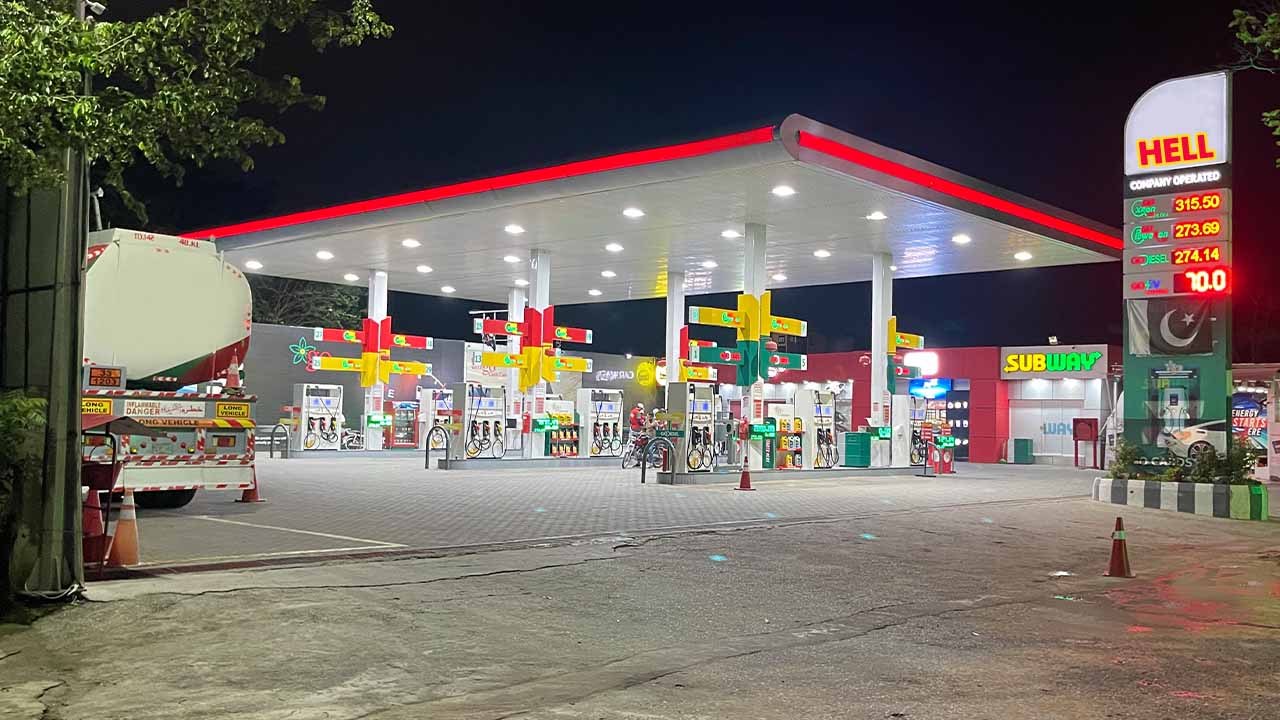
    Petroleum prices may decrease in the upcoming announcement due to a significant drop in global oil prices and the strengthening of the Pakistani rupee against the US dollar, according to Arif Habib Limited (AHL), a brokerage house.

    In the next fortnightly pricing cycle starting on October 16, 2023, AHL predicts a reduction of Rs41 per litre for petrol and Rs19 per litre for diesel in local prices.

    AHL’s projection is based on several factors. International oil prices have fallen considerably in the past week due to concerns about demand, a stronger US dollar, inflationary pressures, and increased oil supplies. 

    The prices of WTI, Brent, and Arab Light have dropped by approximately 9 per cent to 11 per cent compared to the previous fortnightly averages. International gasoline (MS) prices have plummeted by 15 per cent to $84.3 per barrel, while high-speed diesel (HSD) prices have dipped by 10 per cent to $110.6 per barrel compared to the previous fortnightly averages.

    Additionally, the Pakistani rupee has appreciated by 2.7 per cent against the US dollar, standing at 283.87 compared to the previous fortnightly average of 291.65. 

    AHL’s calculations, factoring in these price changes and the assumption of stable international prices and currency rates over the next 10 days, suggest that local petrol and diesel prices are expected to decrease by Rs41 per litre and Rs19 per litre starting on October 16, 2023.

    AHL also mentioned that in the previous fortnightly pricing, there was an exchange rate adjustment of Rs11.9 per litre for MS and a negative adjustment of Rs2.8 per litre for HSD. 

    Even assuming similar currency adjustments for MS and no adjustment for HSD in the upcoming fortnightly prices, AHL anticipates that MS and HSD prices will decrease by Rs28.6 per litre and Rs19.3 per litre, respectively.

    In terms of inflation, AHL revised its October CPI inflation estimate to 27.5 per cent. Last week, the interim government announced a reduction of Rs8 per litre for MS and Rs11 per litre for HSD, resulting in new prices of 323.38 and 318.18 per litre for petrol and diesel, respectively, effective from October 1.

  • US sees strongest job growth in eight months, raising rate hike possibility

    US sees strongest job growth in eight months, raising rate hike possibility

    In September, the United States experienced a significant increase in employment, marking the most substantial growth in eight months. 

    This surge in hiring was widespread, indicating a persistent strength in the labour market. This development potentially provides the Federal Reserve with the rationale to consider raising interest rates once again, although it’s worth noting that wage growth is currently decelerating.

    The Labour Department’s latest employment report, released on Friday, revealed a nonfarm payroll increase that surpassed expectations, along with substantial upward revisions to job counts for July and August. These findings solidify the belief that economic activity gained momentum in the third quarter.

    The continued resilience of the labour market and the broader economy, even after 18 months of the US central bank’s efforts to temper demand by raising rates, suggests that monetary policy may remain restrictive for an extended period. 

    Recent data also indicates an increase in job openings in August, coupled with consistently low first-time applications for state unemployment benefits in September.

  • KIA car prices reduced by up to Rs500,000 in Pakistan

    KIA car prices reduced by up to Rs500,000 in Pakistan

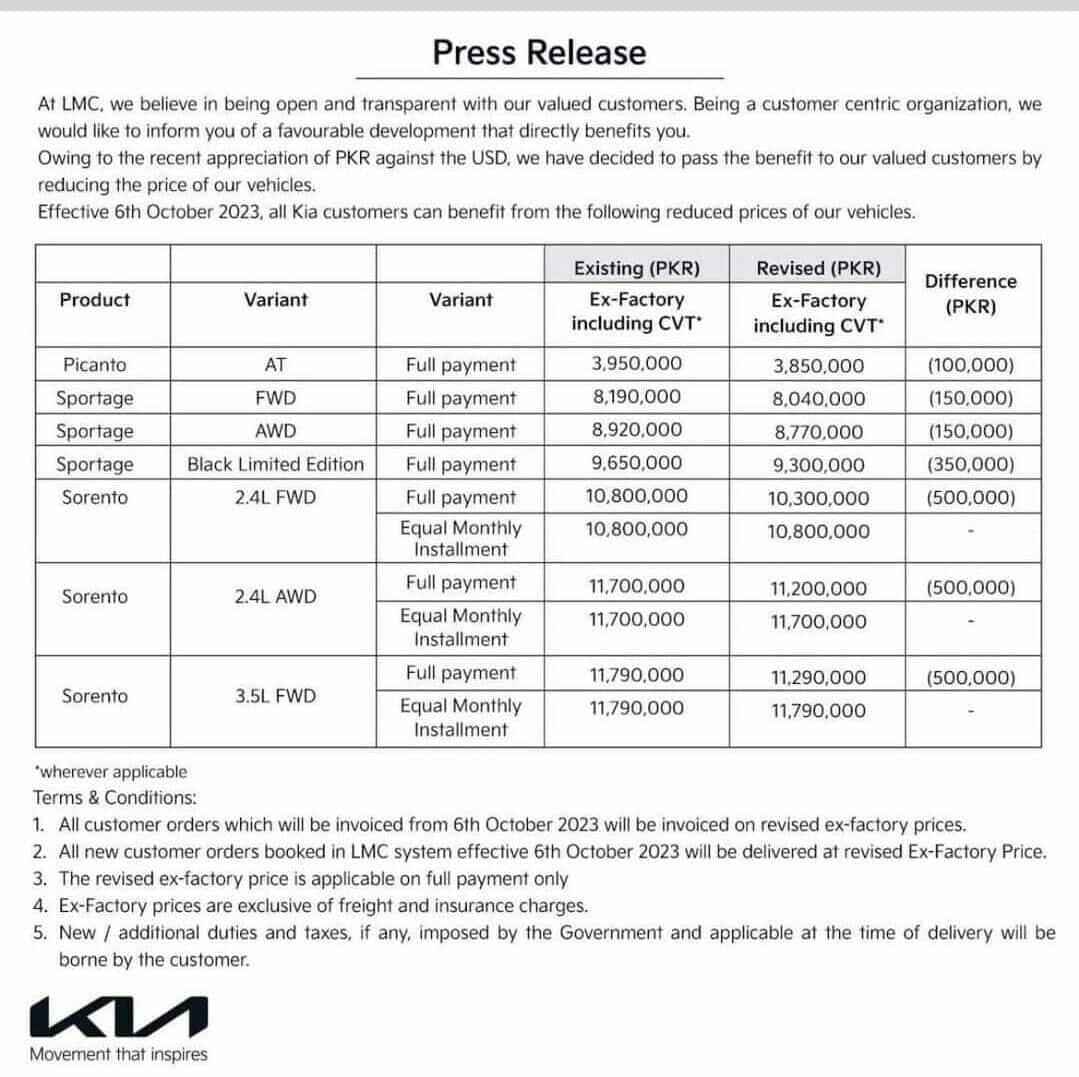
    Lucky Motor Corporation (LMC) has announced a substantial reduction in the prices of its KIA vehicles, with savings of up to Rs500,000 for customers. This decision comes as a result of the recent strengthening of the Pakistani rupee (PKR) against the US dollar. 

    The company stated, ” Owing to the recent appreciation of PKR against the USD, we have decided to pass the benefit to our valued customers by reducing the prices of our vehicles.” 

    Among the models affected, the Sorento variants, including the 3.5L FWD, 2.4L AWD, and 2.4FWD, have seen the most significant price reductions, each receiving a cut of Rs500,000. Their new prices are now Rs11.29 million, Rs11.2 million, and Rs10.3 million, respectively. 

    It’s important to note that these reduced prices apply exclusively to customers choosing the full payment option.  

    KIA cars latest prices in Pakistan (effective October 6, 2023)

    Other KIA models have also seen price reductions, with the Sportage (Black Limited Edition) receiving a discount of Rs350,000, Sportage AWD/FWD models getting a reduction of Rs150,000, and the Picanto AT receiving a Rs100,000 price cut. 

    These new prices will come into effect on October 6, 2023. The company has clarified that any new or additional government-imposed duties and taxes applicable at the time of vehicle delivery will be the responsibility of the customer. 

    This price reduction is particularly significant in light of the recent challenges faced by the auto industry in Pakistan, which has experienced rising car prices due to the rupee’s previous depreciation against the US dollar.  

    However, the rupee has been steadily strengthening, with 21 consecutive sessions of improvement in the inter-bank market. This trend aligns with the caretaker government’s efforts to combat currency smuggling. 

  • Largest money laundering scandal: FBR exposes Rs47 billion trade-based fraud 

    Largest money laundering scandal: FBR exposes Rs47 billion trade-based fraud 

    The Federal Board of Revenue (FBR) in Pakistan has uncovered a massive case of money laundering and under-invoicing in the trade industry, making it one of the country’s biggest financial scandals. 

    Following a thorough investigation by auditors, the FBR took legal action against two companies based in Peshawar. They found that these companies were involved in a staggering money laundering operation worth Rs47 billion, which they officially termed ‘trade-based money laundering.’ 

    According to the FBR’s report, these companies allegedly caused a massive financial loss of Rs25 billion to the national exchequer by under-invoicing transactions, all under the guise of dealing with solar panels. 

    In the FIR, the owners of these companies, Moon Light Traders and Bright Star, were named as suspects. The report revealed that Bright Star had been involved in under-invoicing since 2013, while auditors scrutinised records of 705 Goods Declarations (GDs) related to Moon Light Traders. 

    Furthermore, it was discovered that these companies continued their money laundering activities from 2017 to 2022. According to ARY News, the FBR promptly shared its report on trade-based money laundering and under-invoicing with the Caretaker Prime Minister, Anwaarul Haq Kakar. 

    In a separate incident in September, the FBR exposed a massive tax fraud worth Rs314 billion perpetrated by a fictitious company called K H & Sons. This fraud was uncovered by the Director-General of Internal Audit at Inland Revenue’s team. 

    Interestingly, K H & Sons was a paper company registered under the name of a Benami individual, Muhammad Kashif. Their fabricated documents falsely claimed to be in the iron and steel business, using addresses of legitimate markets like Liaquat Market, Agri Market, and M.A. Jinnah Market. 

    Sources also revealed that this bogus company was used for various illegal activities. What’s surprising is that despite the large-scale tax fraud, the FBR had not taken legal action against the culprits, leading to concerns that they might flee the country if a First Information Report (FIR) was not filed promptly.