Category: Business

  • Pakistan’s economic stability remains fragile despite increase in forex reserves

    Pakistan’s economic stability remains fragile despite increase in forex reserves

    As the country tries to find ways to secure external financing and keep itself afloat, the State Bank of Pakistan (SBP)-held foreign exchange reserves recorded a meagre rise. The SBP, in its weekly bulletin, mentioned its reserves have jumped by $30 million to $4.46 billion as of April 20, which will provide an import cover of less than a month — a position that has been the same for several months now.


    The net foreign reserves held by commercial banks stand at $5.56 billion, $1.1 billion more than the SBP, taking the total liquid foreign reserves to $10.02 billion. Although the central bank did not specify the reason behind the increase, there was a $300 million rise in the reserves last week — which was due to the loan provided by the Industrial and Commercial Bank of China.


    The $350 billion economy is in turmoil amid financial woes and the delay in an agreement with the International Monetary Fund (IMF) that would release much-needed funding crucial to avoid the risk of default.


    The government has been in talks with the Washington-based lender since end-January to resume the $1.1 billion loan tranche that has been on hold since November, part of a $6.5 billion Extended Fund Facility (EFF) agreed upon in 2019. A deal with the IMF will also unlock other bilateral and multilateral financing avenues for Pakistan to shore up its foreign exchange reserves.


    Finance Minister Ishaq Dar said earlier this week that Pakistan has “fulfilled all the conditions” of the IMF and hoped that the Fund would soon sign the staff-level agreement. Speaking to Geo News, Dar said both Saudi Arabia and the United Arab Emirates (UAE) have informed the IMF about their commitments to provide $3 billion to Pakistan.


    Riyadh will provide $2 billion while Abu Dhabi has promised $1 billion to Pakistan, Dar said, adding that the Washington-based lender has also been informed in this regard.


    The finance minister said all the conditions for the staff-level agreement between Pakistan and IMF have been fulfilled. “Pakistan is hopeful that IMF will soon sign the SLA and get it approved by its Executive Board,” Ishaq Dar added.

  • Pakistan set to receive cheap Russian oil, says PM Shehbaz

    During a National Assembly session on Thursday, Pakistan’s Prime Minister, Shehbaz Sharif, announced that the country is set to receive cheap oil from Russia.

    Minister of State for Petroleum, Musadik Malik, had previously confirmed that the government had made its first purchase of Russian crude oil, and a shipment is expected to arrive at Karachi port in May.

    Malik also revealed that the country aims to import 100,000 barrels of Russian crude oil per day, subject to the success of the first transaction.

    In the initial stages, Pakistan Refinery Limited will conduct a trial run to refine the crude oil, with other refineries, including Pak-Arab Refinery Limited, set to follow suit.

    This move marks a significant step forward for Pakistan’s oil industry, which has traditionally relied on imports from the Middle East.

  • Pakistan fails to meet Hajj quota due to rising inflation and dollar shortage

    Pakistan fails to meet Hajj quota due to rising inflation and dollar shortage

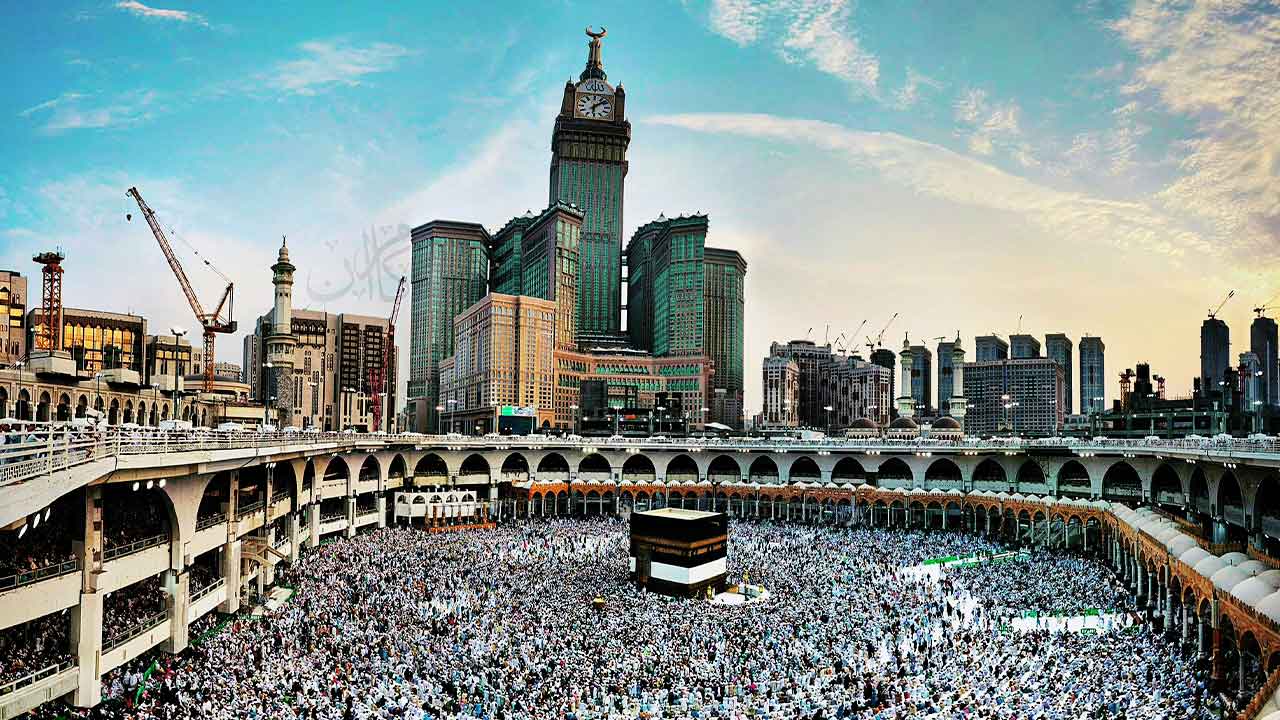
    On Wednesday, sources within the Ministry of Religious Affairs reported that the government has decided to return Pakistan’s quota of Hajj pilgrimage to Saudi Arabia due to a shortfall of applications caused by rising inflation.

    This year marked the first time a quota for Hajj pilgrimage was available in the country, but the shortage of dollars and rising inflation prevented Pakistanis from applying for Hajj.

    The final decision to return the Hajj quota will be made by the federal cabinet. The authorities considered giving the official Hajj quota to private operators after a few applications turned out for the government scheme. However, this option would lead to private operators collecting dollars from the open market, causing unnecessary demand for foreign currency.

    Pakistan had been demanding an increase in the Hajj quota, allowing 179,210 pilgrims to 202,000 or 201,000 pilgrims. This year, the country received its complete quota of 179,000 pilgrims after many years but couldn’t utilize it entirely. It’s worth noting that the cost of government-sponsored Hajj is around Rs1.2 million.

    Due to an acute shortage of the greenback amid the collapsing economy, the Ministry of Religious Affairs and Interfaith Harmony decided to allocate a 50% special quota in the Government Hajj Scheme-2023 for pilgrims who will pay in US dollars. However, a quota of 89,605 Hajj pilgrims was set under the government scheme, falling short of 9,000 applicants.

    The government received 72,869 applicants under the regular scheme and only 8,000 under the sponsorship scheme. Moreover, 28,679 additional applications were received under the official regular scheme against the quota of 44,190. Additional applicants are being sent for Hajj pilgrimage without a lucky draw.

    The sources indicated that a total of $235 million is required for the government scheme, some of which will be provided by the sponsorship scheme and the rest by the government.

  • Toyota Indus Motor Company sees 142% increase in quarterly profit despite low demand

    Toyota Indus Motor Company sees 142% increase in quarterly profit despite low demand

    Indus Motor Company (IMC) announced a 37 per cent decrease in its profit-after-tax (PAT) for the third quarter of financial year 2022-23, with earnings of Rs3.216 billion compared to Rs5.118 billion in the same period last year.

    Despite this, the automaker saw an increase in its quarterly PAT by 142 per cent, which was attributed to an improvement in gross margins, resulting in an operating profit after two consecutive quarterly operating losses. The company also declared an interim cash dividend of Rs24.4 per share, in addition to the previously paid interim cash dividend of Rs18.4 per share.

    Muhammad Abrar, an investment analyst at Arif Habib Limited, explained that IMC was able to offset the impact of currency devaluation by raising the prices of its cars significantly. The automaker’s operating expenses were also curtailed. While revenue decreased by 29 per cent due to lower units sold, IMC’s gross profit was Rs3.05 billion during 3QFY23, compared to Rs5.23 billion in the same period last year.

    Pakistan’s auto sector has been struggling due to the government’s decision to curb imports and restrict issuance of Letters of Credit (LC), higher finance cost, and massive increases in car prices. Despite this, IMC’s gross margins improved to 6.3 per cent on a QoQ basis, which was unexpected, according to Abrar.

    According to Brecorder, the company’s earnings per share (EPS) stood at Rs40.92, compared to Rs65.11. IMC’s board of directors met to review the company’s financial and operational performance in the first nine months ended March 31, 2023. While higher profits are expected in the upcoming quarter due to the increase in car prices and the reduction of operating expenses, the country’s auto industry reported a 66 per cent decrease in car sales compared to March 2022.

    Last week, Pak Suzuki Motor Company Limited also reported its highest-ever quarterly loss of Rs12.9 billion in the first three months of 2023 due to decreased sales and high finance costs.

  • Smuggled phones flood AJK and GB as device identification system remains unimplemented

    Smuggled phones flood AJK and GB as device identification system remains unimplemented

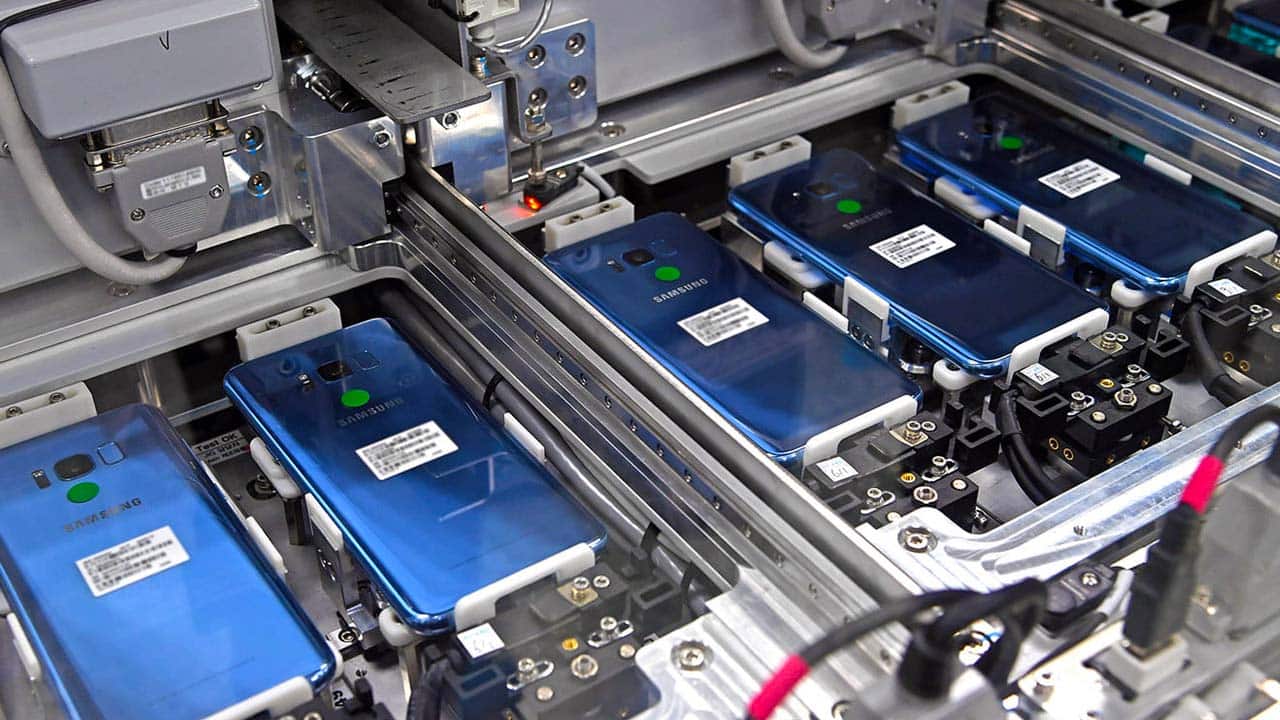
    According to a source in the Federal Board of Revenue (FBR), the non-implementation of the Device Identification, Registration and Blocking System (DIRBS) has led to an increase in the use of smuggled mobile phones in the Azad Jammu & Kashmir and Gilgit-Baltistan region. Unlike the rest of the country, the Special Communications Organisation (SCOM) is the main mobile phone operator in this region, and the DIRBS does not apply to its connections.

    The purpose of the DIRBS is to identify non-compliant devices operating on local mobile networks and eventually block them while registering compliant ones. Despite a halt in local manufacturing and import of mobile phones, around 100,000 mobile phones are being smuggled into the region every month.

    Industry experts have confirmed that non-duty paid mobile phones smuggled from Dubai have made their way to the region. Zeeshan Mianoor, Deputy Vice Chairman of Pakistan Mobile Phone Manufacturers Association, stated that the monthly sales of local mobile sets were around 2 million devices, with around 8-10% of them sold in the AJK and GB region.

    According to Dawn, Muhammad Ishaq Jalal, a Skardu-based journalist, explained that unregistered phones do not work in mainland Pakistan, but they operate on SCOM, and the same connection works in mainland Pakistan on the Ufone network due to the agreement between SCOM and Ufone. Jalal also noted that expensive, used smartphones are available at reasonable prices in the GB region because many of them are blocked in mainland Pakistan either because they were not registered with PTA or stolen, and their IMEI has been blocked.

    The spokesperson of the Pakistan Telecommunication Authority (PTA) stated that both the PTA and the Ministry of IT and Telecom have requested the Cabinet Division to ensure the implementation of DIRBS on SCOM. The spokesperson added that the system would be extended to the SCOM connections once the Cabinet Division approves the request. The DIRBS was introduced to protect local mobile device manufacturing by imposing duties on imports of mobile phones, as well as those brought by travellers coming from abroad. However, this system also helped to reduce mobile phone smuggling.

  • PSX asks companies to explain significant changes in share prices

    PSX asks companies to explain significant changes in share prices

    The compliance department of the Pakistan Stock Exchange (PSX) has contacted five listed companies seeking clarification on a “substantial” change in their share prices between March 16 and April 13. One of the companies contacted is Pakistan Services Ltd (PSEL), which owns and manages the chain of Pearl Continental hotels in Pakistan. PSEL has a free-float of 60 per cent, with the company’s sponsors controlling only 40 per cent of the shareholding while the rest is available to the public for trading.

    PSX Head of Listed Companies Compliance, Hafiz Maqsood Munshi, sent a letter to PSEL on April 20 stating that “The PSX has observed that the price in the shares of PSEL has decreased substantially during the period from March 16 and April 13”. According to the prevailing Securities Act, listed companies are required to promptly disclose any unusual movement in the price or volume of its traded securities to the general public. If the company observes any such matter or development, it must share the details with the public. Otherwise, the company should issue a statement of the fact that it’s not aware of any such matter or development.

    The share price of PSEL was Rs1,720.50 at the close of the March 15 session, dropping to Rs800.10 apiece by the end of the April 13 session, showing a decrease of 53.5 per cent in less than a month. The PSX has directed PSEL to provide, “at the earliest”, the reason or any material information that may have resulted in the substantial decrease in its price during the period under consideration.

    Capital market regulators across the world keep an eye on any sudden share price movements to protect small investors from fraud. Listed companies are required to share any new development that may have a material impact on its stock price with the public immediately. This regulatory requirement is aimed at preventing insider trading, which involves buying and selling of shares by someone with non-public but material information about the stock undergoing a sharp change in its price or trading volume.

    The PSX also contacted Tandlianwala Sugar Mills Ltd (TSML), a producer and seller of white crystalline sugar and ethanol with a free-float of only 5 per cent, to explain the substantial increase in its share price between March 16 and April 13. TSML had no trading on March 15 or 16, with a closing price of Rs67.03 apiece on March 17. Its share price rose 50.3 per cent to Rs100.79 a share by the end of April 13.

    According to Dawn, the PSX compliance department contacted Towellers Ltd, a manufacturer and exporter of textile make-ups, garments and towels, which saw its share price rise from Rs183 on March 15 to Rs291.16 on April 13, up 59.1 per cent in the period under review. The PSX asked Khairpur Sugar Mills Ltd, a seller of sugar and by-products with just 5 per cent of free-float, to explain why its share price rose from Rs46.22 on March 15 to Rs72 on April 13, reflecting an increase of 55.7 per cent in about a month.

    Lastly, the stock exchange sought an explanation for the substantial share price increase from Metropolitan Steel Corporation Ltd, which makes ribbed bars, wire rods, bailing hoops, wires, transmission towers and cold profiles. The steel maker’s share had no trading on March 15, with a closing rate of Rs22.19 on March 16. Its closing rate on April 12 was Rs35 apiece, which shows the increase in the stock rate was 57.7 per cent over the period under review. The shares of the company were not traded on April 13.

  • Supply of free flour for underprivileged cannot be questioned, says Lahore High Court

    Supply of free flour for underprivileged cannot be questioned, says Lahore High Court

    Lahore High Court has ruled that the government is responsible for providing free flour to those living below the poverty line and unable to purchase it themselves, and therefore the supply of free flour cannot be challenged in court. The court also stated that the supply of free flour under the government’s “Ramzan package” is a policy decision that cannot be interfered with by the court. This ruling came in response to a petition filed by a bar member challenging the government’s fixation of the wheat price at Rs3,900 per 40 kg.

    LHC dismissed the petition, stating that the government has the authority to fix prices and take necessary measures to cater to the needs of the people. The court also observed that the fixation of prices of commodities such as wheat by the government falls within the policy-making domain of the government and that this function must be performed keeping in mind various factors such as the availability of stocks and demand and supply.

    The court further noted that the government’s power to fix prices cannot be ordinarily interfered with by the court in its constitutional jurisdiction and that in the absence of any law or policy, the court cannot issue directions to respondents to provide flour or wheat to consumers at subsidised rates. The court also stated that the government’s purchase and sale of wheat, provision of wheat to flour mills, subsidised value, and framing of policy to provide flour at a particular rate or free of cost to deserving people of the society are all within the policy-making domain of the government.

    The court held that the government’s fixation of the wheat price was within its jurisdiction and powers, and that the government’s decision to fix the price was made after considering various factors, including regulating market forces. According to Brecorder, the court observed that the government’s power to fix prices cannot be challenged by petitioners who do not have access to the relevant data or the capability to determine various aspects of the price-fixing criteria.

    In conclusion, the court ruled that the government has the authority to fix the price of wheat and that the supply of free flour to those in need is a policy decision that cannot be challenged in court. The court also noted that the fixation of prices of commodities falls within the policy-making domain of the government and must be performed in consideration of various factors and that the court cannot interfere with the government’s power to fix prices in its constitutional jurisdiction.

  • Saudi Arabia and UAE pledge $3 billion to Pakistan as IMF agreement nears

    Saudi Arabia and UAE pledge $3 billion to Pakistan as IMF agreement nears

    On Monday, Finance Minister Ishaq Dar stated that Pakistan has fulfilled all conditions set by the International Monetary Fund (IMF). He expressed hope that the IMF would soon sign the staff-level agreement, which would allow for the release of the $1.1 billion tranche.

    Since February, the two parties have been negotiating various conditions and external financing from friendly nations before signing the agreement. Speaking to Geo News, Dar stated that Saudi Arabia and the United Arab Emirates (UAE) have informed the IMF of their commitments to provide $3 billion to Pakistan.

    Riyadh has pledged $2 billion, while Abu Dhabi has promised $1 billion. The IMF has also been notified of this, according to Dar. The finance minister emphasized that all conditions for the staff-level agreement have been met, and he expressed optimism that the IMF’s Executive Board would approve it soon.

    The country’s foreign exchange reserves have dwindled to cover barely a month of imports since the IMF funding stalled in November. Pakistan must resume the bailout package, which was agreed upon in 2019 and is worth $6.5 billion, to avoid risking default on external payment obligations.

    Pakistan had to take several steps demanded by the IMF, including reversing subsidies in its power, export, and farming sectors, raising energy and fuel prices, imposing a permanent power surcharge, among other measures.

    These moves have pushed Pakistan’s inflation to its highest level ever, rising to over 35 per cent YoY in March. The IMF programme will disburse another tranche of $1.4 billion to Pakistan before it ends in June, and it will unlock other bilateral and multilateral financing for the cash-strapped country.

    In recent weeks, neighbouring China has rolled over $2 billion and refinanced another $1.3 billion.

  • Rising petrol prices and rupee devaluation push inflation to 47.23% in Pakistan ahead of Eid

    Rising petrol prices and rupee devaluation push inflation to 47.23% in Pakistan ahead of Eid

    According to data released by the Pakistan Bureau of Statistics (PBS), a steep increase in the prices of essential food items such as chicken and petrol has pushed weekly inflation to 47.23 per cent year-on-year for the week ending on April 19. Inflation has risen 0.51 per cent week-on-week, compared to a 0.60 per cent decrease in the previous week.

    The rising inflation has been attributed to the increase in sensitive price indicators such as LPG, potatoes, petrol, tea, gur, matchbox, bread, chicken, bananas, broken basmati rice, and rice irri-6/9. However, a major decrease was observed in the prices of tomatoes, onions, garlic, sugar, wheat flour, mustard oil, cigarettes, and pulse gram.

    For the week under review, the SPI (Sensitive Price Index) was recorded at 251.83 points, against 250.56 points registered last week and 171.05 points recorded during the week ended April 21, 2022. Fahad Rauf, head of research at Ismail Iqbal Securities, said that SPI experienced an increase mainly driven by a 4 per cent and 2 per cent increase in the prices of petrol and chicken, respectively.

    During the week, the government raised petrol prices by Rs10 per litre, bringing the new price to Rs282 per litre, due to the impact of rising international oil prices and rupee devaluation. Chicken prices have also risen mainly due to increased seasonal demand in Ramadan and the arrival of Eid.

    Prices of commodities have risen significantly over the last year on account of devaluation as well as the massive floods that devastated food crops across most of the fertile plains of the country. Different weights are assigned to various commodities in the SPI basket, and prices of commodities have risen on a year-on-year basis. The PBS compiles the SPI by collecting prices of 51 essential items from 50 markets in 17 cities of the country.

    During the week under review, out of 51 items, prices of 29 (56.86 per cent) items increased, eight (15.69 per cent) items decreased, and prices of 14 (27.45 per cent) items remained unchanged. The PBS data attributed the year-on-year rise in SPI to the jump in the prices of goods such as cigarettes, wheat flour, gas charges for Q1, tea, diesel, potatoes, bananas, eggs, petrol, broken basmati rice, rice irri-6/9, pulse moong, and plain bread. However, a decrease was observed in the prices of tomatoes and chilli powder.

  • Inflation hits Pakistanis hard as they prepare for Eid-ul-Fitr festivities

    Inflation hits Pakistanis hard as they prepare for Eid-ul-Fitr festivities

    Eid-ul-Fitr is an important religious holiday celebrated by Muslims around the world, marking the end of the holy month of Ramadan.

    During Ramadan, Muslims fast from dawn until sunset and abstain from food, drink, and vices like gossip and lying. It is a period of self-reflection and a reminder to be charitable to the less fortunate.

    Observed first day of Shawwal, the tenth month of the Islamic calendar, Eid-ul-Fitr is a time for Muslims to come together with family and friends to offer prayers, exchange gifts, and share meals. It is also a way for Muslims to show their gratitude to Allah for giving them the strength to fast and to seek forgiveness for any sins committed during the year.

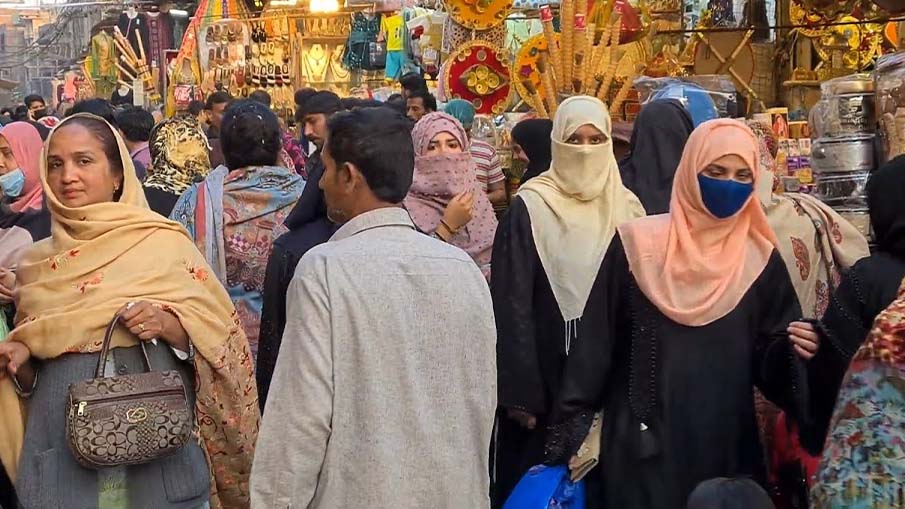
    However, in Pakistan, small shops and businesses are struggling to make ends meet during this year’s Eid-ul-Fitr celebrations. The high levels of inflation, which have hit their highest levels in decades, have left many businesses unable to make enough money to cover their monthly expenses, including rent and utility bills.

    For many small shops and businesses in Pakistan, the last days of Ramadan or before Eid-ul-Fitr used to be a guaranteed earner—a big-spending week that could match the take from the rest of the year. However, this year, many worry they will not even make enough to pay for their monthly expenses.

    A tailor in Canal Bank, Lahore, stated that each year, he was fully booked and had so many orders that he couldn’t take orders after the middle of the month of Ramzan. However, this year, he said, “For the first time, we are accepting orders in the last week of Ramzan as there is not much work.”

    Tailors in Lahore who used to charge Rs1,500 are now charging Rs2,500 or Rs2,200. Even well-known brands or shops are charging more, which is leaving consumers with no option but to go for cheap ready-made clothes or clothes that are available on sale.

    The South Asian country of more than 220 million people saw year-on-year inflation hit 35.4 per cent in March. Food prices surged more than 47 per cent in 12 months, with transport costs rising by 55 per cent.

    Pakistan is deeply in debt and needs to introduce tough reforms to unlock a tranche of a $6.5 billion bailout from the International Monetary Fund in order to avoid default. The economy has been wrecked by years of financial mismanagement and political instability—a situation exacerbated by a global energy crisis and devastating floods that left a third of the country under water last year.

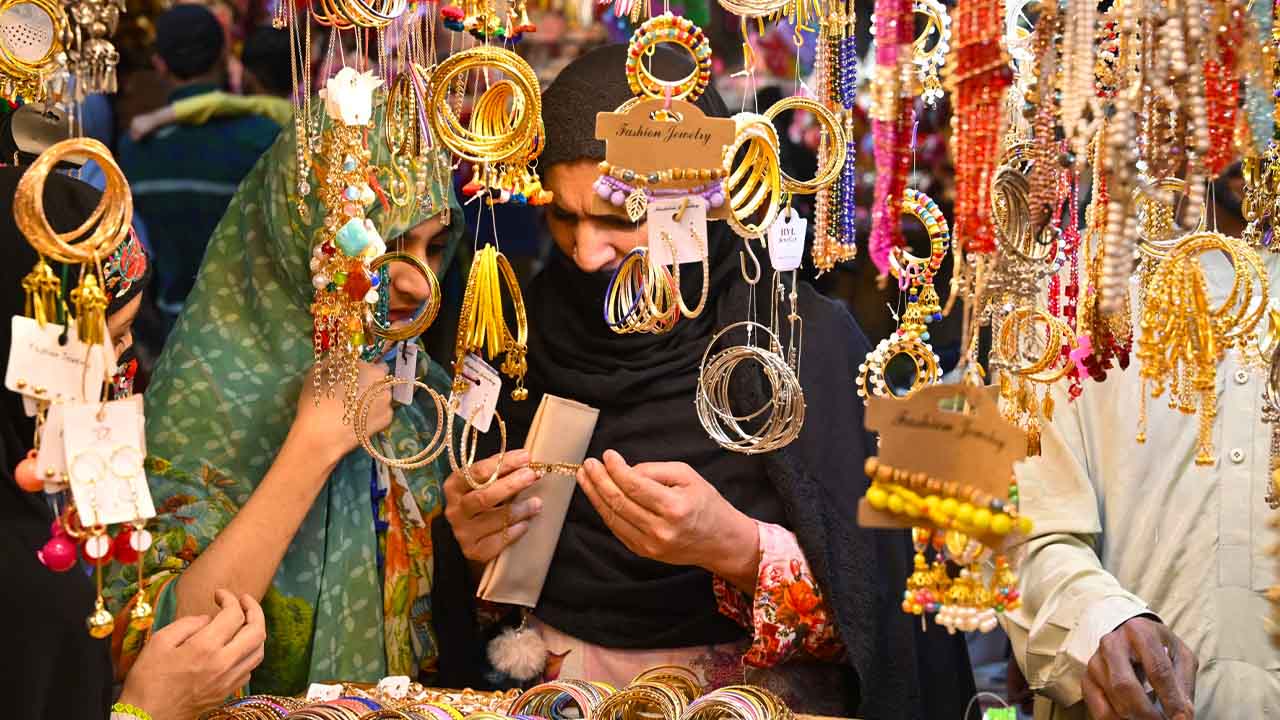
    An artificial jewelry shop owner in Anarkali, Lahore, Zaryab, said, “There is a significant difference between last year’s sales and this year’s. People come to our stall, see 3-4 necklaces or bangles, ask the price, and then leave.”

    The high inflation has significantly reduced the purchasing power of Pakistanis, and people are mostly focusing on fulfilling their essential needs. Noman Khan, an electrical engineer at ACE Pakistan, stated that this Eid, he has not been able to buy clothes for himself as he had to buy clothes for his two kids and wife. He added that “From artificial jewelry to kids’ clothes, everything is so expensive this year that I have no option but to wear old clothes. Although, I made sure that my kids and wife at least get what they want to wear this Eid.”

    In conclusion, the struggle for small businesses in Pakistan during Eid-ul-Fitr celebrations is a stark reminder of the country’s economic challenges. While many Pakistanis are still managing to celebrate the holiday, the high levels of inflation have made it difficult for many to enjoy the festivities.