Category: Business

  • IMF asks for more effort from Pakistan, loan programme in jeopardy

    IMF asks for more effort from Pakistan, loan programme in jeopardy

    Despite assurances from friendly countries regarding external funds for Pakistan, the International Monetary Fund (IMF) remains unconvinced and is asking Islamabad to make additional efforts to unlock a loan programme.

    According to sources, Pakistan has been requested to present a repayment plan for a $3.7 billion loan to the IMF in June and to demonstrate stronger support from friendly nations to fulfill this obligation.

    However, the IMF has not yet accepted a proposal to exchange reserves worth between $11 to $12 billion, equivalent to two months’ revenues. The Ministry of Finance has stated that the government has imposed Rs170 billion in taxes through a mini-budget to secure a staff-level agreement with the IMF, which was initially scheduled for February 9th.

    It is noteworthy that the IMF has not included Pakistan in any agenda until May 17th. The budget-making process may also be affected if transactions with the IMF are not concluded, as funding will not be available from international financial institutions without a staff-level agreement.

    Last month, the staff-level agreement between Pakistan and the International Monetary Fund was postponed due to the lender’s new demand.

    Finance Secretary Hamid Yakoob’s meeting with the International Monetary Fund in the United States did not yield positive results as the lender requested the arrangement of $1 billion from commercial banks to unlock the loan program.

    The staff-level agreement, originally scheduled for February 9th, was delayed due to the IMF’s demands.

  • ADB recommends targeted subsidies and tax reforms for Pakistan’s economic recovery

    ADB recommends targeted subsidies and tax reforms for Pakistan’s economic recovery

    The Asian Development Bank (ADB) has recommended that Pakistan implement targeted subsidies to alleviate inflationary pressures and improve the tax-to-GDP ratio in order to emerge from the current state of economic uncertainty.

    Yevgeniy Zhukov, Director General of the Central and West Asia Department, and Yong Ye, Country Director of the Pakistan Resident Mission, emphasised the significance of targeted subsidies to help the most vulnerable segments of society, as well as the mobilization of domestic resources to bolster the national economy. They also suggested strengthening the Benazir Income Support Programme (BISP) and improving its verification process to ensure that the assistance reaches only those who require it.

    Zhukov noted that the ADB has been providing financial assistance to the government to strengthen social security through the BISP programme since 2016. The ADB has provided $600 million in conditional cash transfers for health and education since 2021, and an additional $1.5 billion under the Countercyclical Support Facility.

    A significant portion of this funding will be directed to the BISP to provide necessary assistance to those most affected by ongoing difficulties. Zhukov further suggested that Pakistan should improve its revenue collection, as its tax-to-GDP ratio of 10 per cent is one of the lowest in the region. He cautioned that if the government is only collecting 10 per cent, it may not have adequate resources to provide support and boost income.

    Yong Ye indicated that the ADB, World Bank, European Union, and United Nations had pledged assistance to Pakistan after devastating floods last year, and a second meeting of the Geneva conference was scheduled to take place soon to discuss progress. Zhukov expressed sympathies for flood victims and stated that the ADB had approved a $1.5 billion programme for Pakistan before the floods to address the negative impact of the Russia-Ukraine war on the country’s economy, which was then repurposed to provide social protection for the flood-affected people.

    The ADB has approved additional emergency assistance, including a $175 million loan and $5 million in grants, to rehabilitate damaged infrastructure and develop a stronger infrastructure that can withstand future floods. The bank is working with Pakistan and other partners, such as the International Monetary Fund and the World Bank, to introduce important structural reforms in public finance management, domestic resource mobilization, and energy sector reforms. The ADB is committed to collaborating with its partners and the Pakistani government to ensure that the reform agenda is advanced.

  • Rawalpindi, Islamabad residents forced to buy low-quality flour at exorbitant prices

    Rawalpindi, Islamabad residents forced to buy low-quality flour at exorbitant prices

    Residents of Rawalpindi and Islamabad are paying exorbitant prices for low-quality flour due to the poor performance of the District Food Department. The officials in charge have failed to take concrete steps to prevent smuggling and hoarding of flour, despite lip service and paperwork.

    As a result, locals are forced to pay more for flour than in any other city in the country. Dealers have hoarded ‘Atta’ and are selling a 15-kilogram bag for Rs2,300 to Rs2,650, while ‘Chakki’ owners are selling 1-kilogram ‘atta’ for Rs180 to Rs200. The price of a 20-kilogram ‘atta’ bag has reached Rs3,200 to Rs3,500 in retail shops.

    The Utility Store Corporation (USC) has resumed providing subsidized flour, but the quality is poor. The District Food Department and flour mill owners are working together to supply unhygienic flour at high prices. The department is not taking action to stop smuggling or control profiteers and hoarders, playing on both sides of the wicket.

    According to The News, District Food Controller (DFC) Hasan Nazir has admitted to a flour shortage in Rawalpindi and has written to the Secretary of Food (Punjab) to issue special permits for wheat supply. He assures the public that the ‘atta’ crisis will be resolved within weeks, and they are working to stop wheat smuggling, with over 600 wheat-filled vehicles stopped en route to Afghanistan.

    However, corrupt officials within the District Food Department are involved in wheat smuggling to Afghanistan via Torkham, and only ten vehicles are being stopped to show performance in the media while the officers let 90 vehicles go. The corrupt officials have several pending cases against them in the Anti-Corruption Establishment (ACE), Rawalpindi, and the Federal Investigation Agency (FIA).

    Despite Prime Minister Shahbaz Sharif claiming a bumper wheat crop this year, residents are struggling to afford basic necessities due to the inflated price of flour. The Punjab government has set the price of 40-kilogram wheat at Rs3,900, but owners are violating this order and selling it for Rs5,400 to Rs6,000 in Rawalpindi. The situation is dire, with many struggling to afford basic necessities due to the inflated price of flour.

  • Pakistan’s weekly inflation reaches record high of 48.35%

    Pakistan’s weekly inflation reaches record high of 48.35%

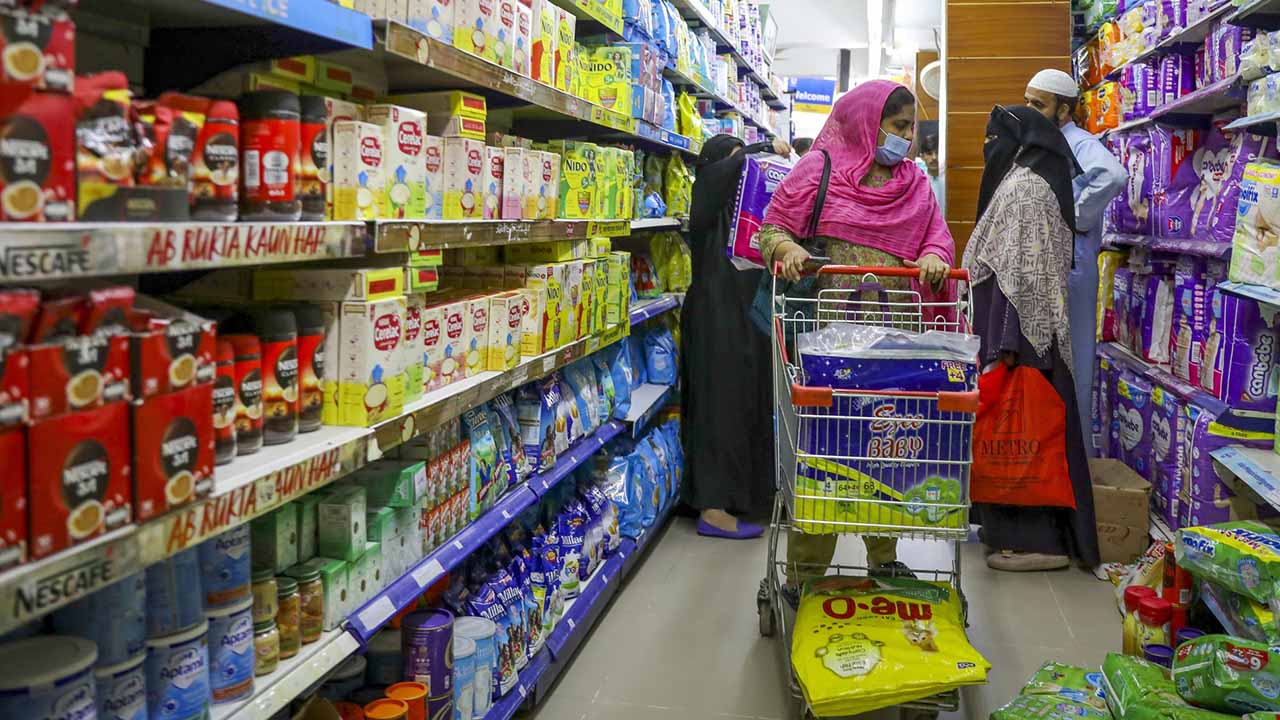
    According to data from the Pakistan Bureau of Statistics (PBS), the Sensitive Price Indicator (SPI) has risen by 1.05 per cent to reach a record high of 48.35 per cent year-on-year for the week ending May 4. The SPI for the aforementioned week was recorded at 254.84 points, compared to 252.2 points the previous week.

    Of the 51 monitored items, 30 items experienced an increase in average price, while 9 items decreased, and 12 items remained unchanged during the week.

    The items that experienced an increase in average prices on a week-on-week (WoW) basis were chicken (8.91 per cent), potatoes (3.99 per cent), powdered milk (3.81 per cent), pulse gram (1.96 per cent), pulse masoor (1.83 per cent), eggs (1.81 per cent), mutton (1.71 per cent), pulse mash (1.58 per cent), cooked daal (1.36 per cent), and bread (1.13 per cent). The non-food items that saw an increase were gents sponge chappal (58.05 per cent), gents sandal (33.36 per cent), ladies sandal (14.31 per cent), and washing soap (1.27 per cent).

    On the other hand, a decline was seen in the prices of onions (16.69 per cent), garlic (3.44 per cent), tomatoes (3.41 per cent), diesel (1.70 per cent), mustard oil (0.99 per cent), LPG (0.96 per cent), cooking oil 5 litre (0.40 per cent), and vegetable ghee 2.5kg & 1kg (0.10 per cent each).

    Monitored ItemsAverage Price Increase/Decrease
    Chicken+8.91%
    Potatoes+3.99%
    Powdered Milk+3.81%
    Pulse Gram+1.96%
    Pulse Masoor+1.83%
    Eggs+1.81%
    Mutton+1.71%
    Pulse Mash+1.58%
    Cooked Daal+1.36%
    Bread+1.13%
    Onions-16.69%
    Garlic-3.44%
    Tomatoes-3.41%
    Diesel-1.70%
    Mustard Oil-0.99%
    LPG-0.96%
    Cooking Oil 5L-0.40%
    Vegetable Ghee 2.5kg-0.10%
    Vegetable Ghee 1kg-0.10%
  • Fitch warns of further depreciation of Pakistani rupee due to $6.7 billion debt payment

    Fitch warns of further depreciation of Pakistani rupee due to $6.7 billion debt payment

    Fitch, the world’s leading credit rating agency based in Hong Kong, said on Friday that Pakistan must pay a total of $6.7 billion in debt payments for the ongoing fiscal year of 2022-23.

    Of this amount, $3.7 billion must be paid by Islamabad this month, with another $3 billion due in June. Krisjanis Krustins, Fitch’s director, warned that these payments could cause the Pakistani rupee to depreciate further, exerting greater pressure on the country’s currency.

    Krustins also revealed that Pakistan expects a rollover of $2.4 billion from China to address its economic needs. However, he emphasised the need for Pakistan to revive its International Monetary Fund (IMF) loan programme.

    Pakistan has been working to restart the stalled loan programme with the IMF. Earlier this year, Saudi Arabia and the United Arab Emirates pledged external funds, but the IMF has demanded that Pakistan “do more” to unlock the loan programme.

    Finance Secretary Hamid Yakoob recently met with the IMF in the US, but the meeting remained unfruitful. The international lender has proposed that Pakistan arrange $1 billion from commercial banks to unlock the loan programme.

  • Pakistan to pay for Russian oil in Chinese yuan, shipping expected in June

    Pakistan to pay for Russian oil in Chinese yuan, shipping expected in June

    According to a senior official from Pakistan’s Ministry of Energy, the country is expected to pay for a test cargo of 750,000 barrels of Russian oil in Chinese Yuan. The cargo is set to dock in Pakistan in June, with a possibility of arrival by the end of May.

    It has been suggested that the Bank of China will play a role in the transactions. However, the exact mode of payment and discount offered have not been made public to avoid backlash from other countries purchasing Russian oil directly from Moscow.

    The test cargo will likely contain URAL crude, which will be refined by Pakistan Refinery Limited. Commercial analysis of Russian crude has been conducted in favour of Pakistan’s economy, but will be further assessed after refining. The estimated shipping cost of the Russian oil is around $15 per barrel, which will be confirmed upon arrival at the Pakistani port.

    Pakistan has reportedly settled on a per barrel price of $50-52, lower than the cap price of G7 countries at $60 per barrel. Pakistani refineries currently import 80 per cent of crude under long-term agreements with ADNOC and Saudi Aramco. However, the remaining 20 per cent provides a cushion to purchase Russian oil under GtG on a long-term agreement to some extent. The government plans to keep some cushion for purchasing crude from the international market, as crude prices can fluctuate.

    Pakistan had initially hoped to obtain Russian crude at a discount close to $50 per barrel, $10 per barrel below the cap price imposed by G7 countries in response to the Ukraine conflict. However, a top official from the coalition government has expressed concern that importing Russian crude at a 30 per cent discount under the GtG agreement may not provide sufficient relief.

  • Japanese car companies consider establishing hybrid vehicle plants in Pakistan

    Japanese car companies consider establishing hybrid vehicle plants in Pakistan

    Japan has urged Pakistan to allow the import of manufacturing equipment for vehicles due to the shortage of dollars, which has affected the issuance of letters of credit to Japanese companies operating in the country.

    Japanese firms are considering the establishment of hybrid vehicle plants in Pakistan, with plans to export the vehicles from the country in the future.

    During a meeting between Ambassador Wada Mitsuhiro and Finance Minister Senator Ishaq Dar at the Finance Division, the Ministry of Finance issued an official statement. The Vice Chairman of Toyota, Shinji Yanagi, SAPM on Finance Tariq Bajwa, finance secretary, and senior officers were also in attendance.

    The finance minister briefed the envoy on the economic challenges and priorities of the government and emphasized that Japan is one of its major development partners. The cooperation between the two countries will strengthen in multiple fields for mutual benefit. The finance minister also welcomed the investment plans of Japanese companies in Pakistan.

    Ambassador Mitsuhiro praised the government’s pragmatic policies and actions and expressed confidence in the country’s economic policies. Meanwhile, a World Bank delegation led by Mamta Murthi, Vice President of the World Bank for Human Development, met with Dar at the Finance Division.

    Murthi emphasized the importance of investing in human capital, particularly in education, health and nutrition, social protection, population control, and women’s development. She also highlighted the importance of local ownership and community participation in implementing development projects.

    The finance minister briefed Murthi on the government’s policies and programs related to key areas of human development to uplift the masses and eliminate poverty in the country. He expressed the government’s commitment to work with the World Bank to achieve their shared goals of sustainable development in Pakistan.

  • Historic high: Gold price in Pakistan soars to record-breaking Rs225,300 per tola

    Historic high: Gold price in Pakistan soars to record-breaking Rs225,300 per tola

    Pakistan’s economic turmoil and an increase in international gold rates have led to a new high in the value of the precious metal in the country.

    According to data provided by the All Pakistan Sarafa Gems and Jewellers Association (APSGJA), the rate of gold (24 carats) surged by Rs2,600 per tola and Rs2,229 per 10 grams to reach Rs225,300 and Rs193,158, respectively.

    The price of gold in the international market also rose by $29 to settle at $2,044 per ounce. In Pakistan, the rising gold rate is a consequence of weakened economic fundamentals, rupee depreciation, and record-high inflation.

    During such times, people prefer to buy gold as a hedge against inflation and currency depreciation. Furthermore, the delay in an agreement with the International Monetary Fund (IMF) for a much-needed economic bailout has led to increased demand for gold as it negatively impacts the currency market.

    The APSGJA also revealed that the price of gold is Rs2,500 per tola “undercost” in Pakistan as compared to the Dubai market, indicating that the Pakistani gold market is currently cheaper than the global market.

    Finally, the rate of silver also increased to a new high in the country, with the rate of silver rising by Rs120 per tola and Rs102.88 per 10 grams to settle at Rs2,870 and Rs2,357.68, respectively.

  • IMF demands approval for subsidies as Pakistan struggles to secure tranche

    IMF demands approval for subsidies as Pakistan struggles to secure tranche

    Pakistan has been negotiating an agreement with the International Monetary Fund (IMF) since January 2023. The IMF has specified that Pakistan must receive prior approval before providing any additional subsidies.

    Negotiations have hit a snag over a plan announced by Prime Minister Shehbaz Sharif in March to charge wealthy fuel consumers more to subsidise prices for the poor who have been severely impacted by inflation.

    Despite meeting almost all of the Fund’s conditions, the government is struggling to convince the lender to release the tranche. On a separate issue of securing confirmation on the external financing gap of $5 billion by June 2023, the Kingdom of Saudi Arabia and the United Arab Emirates have provided over $2 billion and $1 billion respectively.

    The formal agreements with these countries are expected to be signed soon. The Pakistani authorities are complaining that the IMF has placed prior actions before signing the staff-level agreement, which was not done in the past.

    According to The News, the IMF asks for confirmation from commercial banks before signing the agreement, while banks are asking for IMF’s board approval and the revival of the Fund program to refinance loans worth $2-3 billion.

    Finance Minister Ishaq Dar has assured US diplomat Andrew Schofer that the government is committed to completing the ongoing IMF program.

  • Pakistan’s history of IMF bailouts: A look at 75 years of economic challenges

    Pakistan’s history of IMF bailouts: A look at 75 years of economic challenges

    Pakistan is currently facing yet another economic crisis, a recurring issue that has caused the country to repeatedly seek help from the International Monetary Fund (IMF) for financial assistance.

    Unfortunately, most of the previous 13 bailouts granted since the late 1980s were left unfinished, as Pakistan failed to implement any meaningful structural changes to rein in government spending or boost revenue.

    The country’s current government, led by Prime Minister Shehbaz Sharif, is currently in talks to revive its latest $6.5 billion loan programme as a result of the ongoing economic downturn, exacerbated by last year’s devastating floods and continued political instability. However, the implementation of the necessary belt-tightening measures may prove to be challenging, given the upcoming national elections planned for later this year.

    Pakistan and the IMF had agreed to a $6 billion bailout program in 2019, but disputes over monetary policies have prevented the release of over $1 billion. Furthermore, donors and lenders have demanded structural reforms before providing any further financial aid to Pakistan.

    Pakistan’s traditional partners have made it clear that their assistance is conditional upon the revival of the IMF program and the successful implementation of reforms, including the expansion of tax collection.

    Based on the prevailing Special Drawing Rights (SDR), also known as XDR, rates, the International Monetary Fund (IMF) has approved loans totaling $31.629 billion for Pakistan.

    It is worth noting, however, that not all of the approved funds have been disbursed, with only one out of 22 loans having been fully transferred to Pakistan. This highlights the complex political and economic dynamics that underlie IMF programs.

    Pakistan’s history of borrowing from the IMF

    Pakistan has a history of borrowing from the International Monetary Fund (IMF), which can be divided into four distinct periods. The early years of borrowing spanned from 1950 to 1988, followed by the Benazir and Nawaz Sharif era from 1988 to 1999. The third period was marked by the Musharraf and Zardari administrations from 2000 to 2013. The current period is led by Nawaz Sharif and Imran Khan.

    During these periods, each government worked with the IMF differently, especially in the past two decades. While the Benazir and Nawaz Sharif administrations alternated in seeking IMF programs in the 1990s, the Musharraf government, despite experiencing substantial foreign currency inflows, also had to turn to Washington for financial assistance.

    The Zardari administration, on the other hand, abandoned the largest-ever IMF program when it deemed it expedient to do so. This trend illustrates how Pakistan’s borrowing from the IMF has been characterised by inconsistency and shifting priorities.

    2013-2022

    Pakistan’s recent history of borrowing from the IMF has been marked by different governments seeking assistance in their own unique ways. While the Imran Khan government initially refused to seek assistance from the IMF, it eventually sought an Extended Fund Facility (EFF) loan worth SDR4.268 billion in July 2019. This was due to the country’s financial deterioration and instability, which had eroded the stability gains made since late 2016.

    Under Imran Khan’s government, the IMF disbursed a total of SDR3,159.5 million to Pakistan in four tranches. However, talks for the fourth tranche proved challenging and the government sought help from the US Assistant Secretary of State Donald Lu. Despite receiving SDR750 million in February 2022, then-Prime Minister Imran Khan announced a subsidy on petrol and diesel, effectively breaking the agreement with the IMF. As a result, the IMF suspended Pakistan’s $6 billion loan programme in March 2022.

    Negotiations for the revival of the fund facility did not commence until May, when Shehbaz Sharif of the PML-N took over the government. Talks on reviving the fund facility were concluded in late June, but only after the government took some harsh decisions, including withdrawing tax relief for salaried individuals. The next tranche will only be released after the IMF Executive Board takes up the combined 7th and 8th reviews.

    2000-2013

    During Pervez Musharraf’s government, Pakistan received significant foreign aid in the form of military and civil assistance, resulting in a low reliance on IMF loans for financial support. However, Pakistan did receive two IMF loans in the first two years of Musharraf’s regime, totaling SDR520 million. The first loan was a stand-by arrangement of SDR465 million, of which SDR150 million were disbursed, and the second was an extended credit facility of SDR1.033 billion, of which only SDR315 million were disbursed. Pakistan did not require IMF assistance from 2001 to 2008, as foreign aid prevented a balance of payment crisis.

    However, the aid failed to boost Pakistan’s forex reserves, which experienced a sharp decline between 2006 and 2008. In 2008, the Pakistan Peoples Party government negotiated with the IMF for the largest-ever loan of SDR7.235 billion, also the largest stand-by arrangement. Only SDR5.2 billion were disbursed between 2008 and 2010 in three tranches. Afterward, the PPP government did not complete the program as it received funds under the Kerry-Lugar program until 2013, when the United States ceased funding. The PPP government was unable to implement tough reforms demanded by the IMF due to impending elections.

    1989-1999

    During the 1990s, Benazir Bhutto and Nawaz Sharif sought eight bailouts from the IMF due to the consequences of the Soviet-Afghan war and political instability in Pakistan. In 1988, Bhutto signed up for two IMF packages, totaling SDR655 million. The IMF made two payments of SDR122.4 million and SDR189.5 million in 1991 and 1992. In 1993, Nawaz Sharif negotiated a loan of SDR265.4 million, with the IMF paying SDR88 million that year.

    Bhutto’s government signed three IMF programs of SDR379 million, SDR606 million, and SDR562 million between 1994 and 1995, with lower disbursements of SDR123 million, SDR133 million, and SDR107 million before being removed in 1996. Sharif then negotiated two loans in 1997 of SDR682.4 million and SDR454.9 million, respectively, with SDR250 million disbursed before his government was toppled in 1999. Bhutto negotiated a total of five programs of SDR2.2 billion, receiving SDR676.26 million, while Sharif signed up for three programs of SDR1.4 billion, with Pakistan receiving only SDR608 million. The instability of the government prevented the implementation of IMF reforms, which often led to increased tariffs and taxes, causing a negative perception of the IMF in the country.

    1958-1988

    The Zia-ul-Haq government received the largest amount of foreign aid from the International Monetary Fund in Pakistan’s history, surpassing the sum of all seven previous programs approved since 1958. In 1980, the IMF granted SDR1.268 billion to the government, followed by another program of SDR919 million in 1981. The Zia-ul-Haq administration received SDR1.079 billion out of the total SDR2.187 billion approved by the IMF.

    Before that, Zulfikar Ali Bhutto signed four loan programs with the IMF between 1972 and 1977 for a total of SDR330 million, of which SDR314 million was withdrawn. In 1958, Ayub Khan initiated Pakistan’s first loan from the IMF, seeking only SDR25 million, and in 1968 and 1969, two more programs of SDR37.5 million and SDR75 million were approved, respectively. The Ayub government received SDR112 million of the total SDR137.5 million approved.

    Pakistan has received a total of SDR23.656 billion in IMF-approved programs, of which SDR14.189 billion was disbursed. Pakistan was offered three long-term Extended Credit Facilities, five medium-term Extended Fund Facilities, at least 12 short-term Standby Arrangement loans, and one Structural Adjustment Facility over 63 years.

    This news story was created by compiling information from various news platforms as well as the IMF website.