Category: Business

  • Pakistani rupee extends losses, nearing Rs219 against dollar

    Pakistani rupee extends losses, nearing Rs219 against dollar

    After closing at Rs218.38 on Wednesday, the Pakistani rupee (PKR) dropped further versus the US dollar on Thursday morning during the intraday trade.

    As of 11:00am, the rupee depreciated by Rs0.61 or 0.27 per cent against the US dollar to Rs218.99 during intraday trading.

    It is worth noting that the local unit has been witnessing a downward trend since the beginning of this week. PKR fell on Wednesday for the third straight session showing a decline of 0.33 per cent.

    The fall occurs amid news that Pakistan’s cash-strapped economy may receive support from an investment of $3 billion by the Qatar Investment Authority, one of the biggest sovereign funds in the world.

    Oil prices, a crucial factor in determining currency parity, increased on Thursday as supply fears mounted in the wake of delays to Russian exports, the potential for major producers to reduce output, and the partial suspension of a US refinery.

    US West Texas Intermediate crude increased 42 cents, or 0.4 per cent, to $95.31 a barrel, while Brent crude increased 59 cents, or 0.6 per cent, to $101.81 per barrel.

    On Wednesday, the PKR declined by Rs7 for both buying and selling against the USD on the open market, finishing at Rs227 and Rs229, respectively.

  • India forced Twitter to hire agent, reveals former security chief

    India forced Twitter to hire agent, reveals former security chief

    According to a whistleblower statement to US authorities, a former Twitter security head said that the Indian government pressured the social media company to hire a government agent.

    Along with other security breach allegations at Twitter, Peiter “Mudge” Zatko brought up the matter with the US Securities and Exchange Commission.

    According to a redacted version of the lawsuit posted by the Washington Post and confirmed by Zatko’s attorney at Whistleblower Aid, he claimed that Twitter’s lax security measures would have allowed the government agent access to sensitive user data.

    Without going into further detail, a corporate source told Reuters that the claims against the Indian government have already appeared on Twitter.

    Requests for comment from the Indian IT ministry’s representatives were not immediately responded.

    “What we’ve seen so far is a false narrative about Twitter and our privacy and data security practices that are riddled with inconsistencies and inaccuracies and lack important context,” a Twitter spokesperson said in a statement.

    India is engaging in unlawful activities and content on Twitter, according to the company’s management.

    After asking a local court to reverse several government orders to remove content from the social media site and alleging official abuse of authority, Twitter filed a lawsuit against the Indian government in July.

    The case’s next hearing will take place on August 25.

    “The company did not in fact disclose to users that it was believed by the executive team that the Indian government had succeeded in placing agents on the company payroll,” Zatko’s complaint noted.

    According to Washington Post, the National Security Division of the US Justice Department and the US Senate Select Committee on Intelligence have received documentation corroborating Zatko’s assertions.

    CNN claims that these revelations of Twitter’s carelessness represent a serious threat to democracy and national security.

  • PM Shehbaz announces relief for 17 million power consumers

    PM Shehbaz announces relief for 17 million power consumers

    Prime Minister Shehbaz Sharif stated that 17 million of the nation’s electricity consumers would not be required to pay the excessive fuel cost adjustment (FCA) charges that are included in their monthly bills.

    According to Express, the prime minister outlined the rationale behind the FCA and claimed that it had resulted in a substantial increase in power rates for July and August due to high international oil prices.

    He claimed that following discussions with the IMF, PML-N leader Nawaz Sharif, and other coalition leaders, it was decided that 17.1 million energy users would not be required to pay the FCA.

    The remaining 13 million power consumers who are in a better financial situation are also being reviewed by the government, according to PM Shehbaz.

    Later, the PML-N tweeted that the relaxation will only apply to people with low electricity consumption.

    Shehbaz stated that Power Minister Khurram Dastgir will give a thorough explanation of the announcement’s process and how it would actually operate.

    The FCA exception would also apply to tube well users, who the prime minister estimated to number approximately 300,000.

    Earlier, PM Shehbaz also abolished the budget’s fixed tax on traders.

  • Pakistan’s current account deficit shrinks to $1.2 billion, reflecting decline in imports

    Pakistan’s current account deficit shrinks to $1.2 billion, reflecting decline in imports

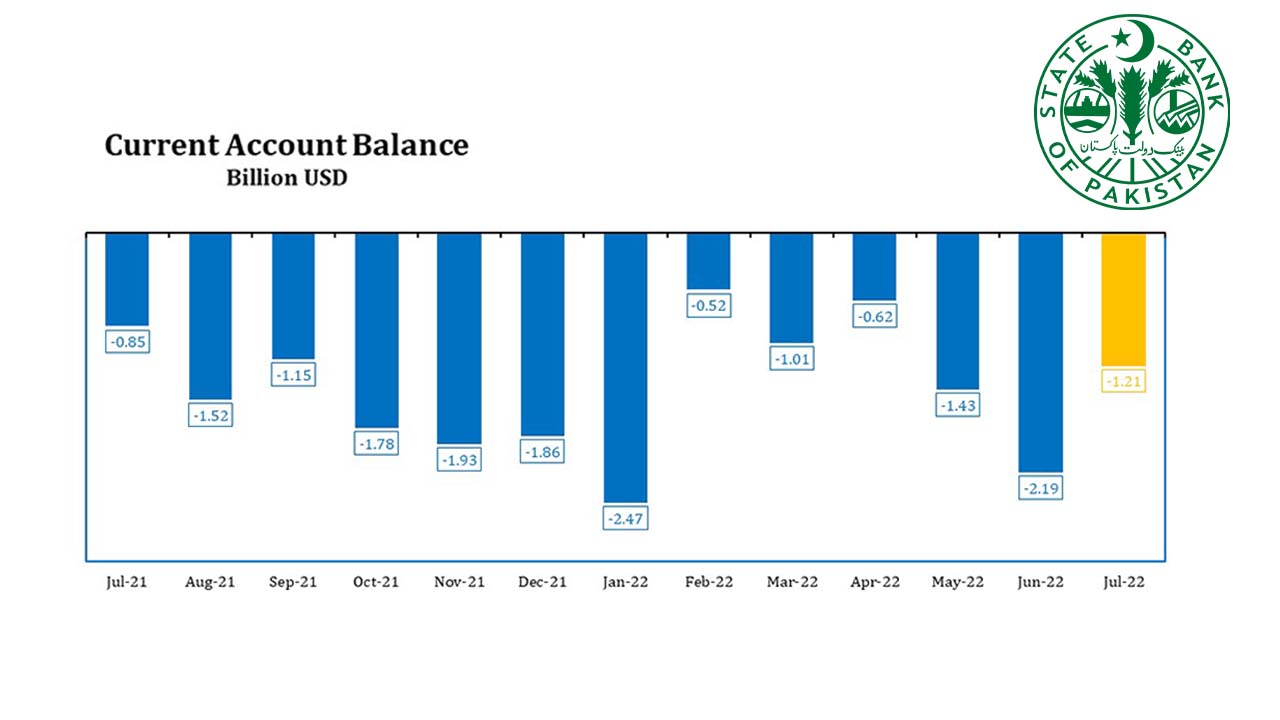
    According to figures provided by the State Bank of Pakistan (SBP) on Wednesday, Pakistan’s current account deficit (CAD) decreased to $1.2 billion in July from $2.2 billion in June, reflecting a 45.45 per cent month-over-month decrease.

    The SBP ascribed the dip to a significant reduction in energy imports and ongoing moderation in other imports.

    “The narrower deficit is the result of wide-ranging measures taken in recent months to moderate growth and contain imports, including tight monetary policy, fiscal consolidation & some temporary administrative measures,” it said in a tweet.

    But the current account deficit widened by 42 per cent year over year. In July 2021, a deficit of $851 million was reported as opposed to a deficit of $1.1 billion this year, according to the online financial statistics and analytics portal Mettis Global.

    The trade deficit in services, which is still negative, decreased by 62 per cent month over month as a result of a 40 per cent decline in imports and a 17 per cent decline in exports. According to the figures, the trade balance in services was $260 million in July as opposed to $682 million in June.

    The Mettis Global study showed a 9 per cent reduction in the trade deficit year over year.

    It also pointed out that worker remittances, which it referred to as the foundation of the economy, fell by 9 per cent from one month to the next, coming in at $2.52 billion in July as opposed to $2.76 billion in June.

  • Fuel Cost Adjustment: Consumers protest against inflated electricity bills

    Fuel Cost Adjustment: Consumers protest against inflated electricity bills

    Power consumers protested in major cities against the government and power supply companies due to excessive residential and commercial bills that were issued under the pretext of Fuel Cost Adjustment (FCA).

    A number of Lahore residents were seen protesting outside LESCO offices, complaining about the skyrocketing electricity bills, chanting anti-LESCO slogans at Dharam Pura, Begum Kot and Ghazi Road.

    A number of farmers in Jhang also participated in a protest by burning their power bills while obstructing traffic on the Jhang Road. On the other hand, the shopkeepers and locals of Faisalabad organised a sizable protest against FESCO for billing residential and commercial customers for nearly twice the actual cost of electricity.

    PM Shehbaz demands urgent report on inflated electricity bills

    In response to complaints from the public about excessive electricity bills, Prime Minister Shehbaz Sharif ordered the relevant authorities to provide an immediate report to address the issue.

    The premier ordered the concerned officials to present a thorough report with recommendations for resolving consumer complaints against energy bills on an urgent basis.

    What is FCA?

    In addition to criticising the power supply companies, consumers are questioning the FCA charges that take up a significant portion of their monthly bills.

    Understanding the actual fuel cost (the cost of fuel in a month) and the reference fuel cost is crucial for comprehending the fuel price adjustment.

    Simply put, FCA is charged/adjusted in customers’ monthly bills to reflect the actual increase or decrease in fuel prices.

    Based on the price of fuel (such as coal, LNG, or furnace oil) used in the nation’s various energy sources, the total cost of fuel used in the production of electricity in a month (basket fuel cost) is calculated.

    The entire fuel cost for that month is therefore compared to the reference fuel cost at the end of each month, and as a result, the FCA is applied to the power bills after two months.

    The electricity bill will reflect a change in the FCA amount if the total fuel cost for that month exceeds the reference cost, while it will reflect a change in the FCA amount if the total fuel cost is less than the reference cost. We refer to this as a fuel price adjustment.

    How power suppliers calculate FCA?

    Whenever a power plant uses coal, it is possible to estimate how much coal was burnt and at what cost, as well as the total cost of the energy needed to generate the power.

    For instance, if hydel electricity generation has increased, the overall fuel price will reduce; likewise, if gas is consumed more frequently in a month due to its higher price, the fuel price would climb.

    It is also impacted by the rupee’s appreciation or depreciation. This is due to the fact that coal, LNG, and furnace oil are imported, therefore a weakening or strengthening rupee directly affects the cost as a whole.
  • BYKEA hints at launching a car-hailing service

    BYKEA hints at launching a car-hailing service

    The bike taxi and logistics company BYKEA has recently hinted that it will start offering a car-hailing service. Although the company has not publicly announced its plans or informed its regular users, a recent tweet from its official account suggests what it may be up to in the next weeks or months.

    Since BYKEA offers slightly lower costs than its competitors, such as Uber and Careem, it has experienced tremendous growth and popularity among everyday commuters. However, given that petrol prices are so high and that people would rather take inexpensive transportation than spend money on a car, it does not seem like the ideal time to roll out such a service.

    https://twitter.com/bykeapk/status/1561712052577734658?ref_src=twsrc%5Etfw%7Ctwcamp%5Etweetembed%7Ctwterm%5E1561712052577734658%7Ctwgr%5Edd9180fcae0de4b4a46012b47b2b13a878212574%7Ctwcon%5Es1_&ref_url=https%3A%2F%2Fpropakistani.pk%2F2022%2F08%2F22%2Fbykea-to-launch-a-car-hailing-service-soon%2F

    Although it is too early to speculate about BYKEA’s plans, but it is apparent that the ride-hailing company is growing and wants to expand its operations in the country. Considering its latest tweet, “hum 2 se 4 honay walay hain,” makes it obvious that the company is actively formulating a significant strategy.

  • Govt imposes Rs36 billion additional tax on cigarettes, tobacco processing to revive IMF programme

    Govt imposes Rs36 billion additional tax on cigarettes, tobacco processing to revive IMF programme

    The government has issued an ordinance to impose an additional Rs36 billion tax on cigarettes, an additional Rs2 billion tax on the processing of tobacco, and lowered charges on transportation vehicles in order to raise an additional Rs38 billion in taxes.

    According to Geo, tier-1 brand cigarettes may see a price increase of Rs20 to Rs30 each packet, while tier-2 brand cigarettes would see a price increase of Rs10 per packet.

    The government increased the advance federal excise duty (FED) tax on tobacco processing from Rs10 per kg to Rs390 per kg, which will be adjustable.

    In order to secure the restart of a stalled programme and the release of a $1.17 billion tranche under an expanded $7 billion extended fund facility (EFF), Pakistan has moved to impose taxes on cigarettes and tobacco processing just prior to the International Monetary Fund’s (IMF) executive board meeting, which is scheduled to take place in Washington on August 29.

    The government did not apply regulatory duties on luxury goods because they will be imposed through SRO after receiving tariff board approval and perhaps receiving ECC approval.

    The FBR expects to raise between Rs5 and Rs14 billion in tax income through RDs, hence the overall revenue impact could reach between Rs50 and Rs52 billion.

    It appears strange that the government did not implement any taxation measures on the production of sugar-filled beverages, which also harms the health sector.

    According to the ordinance, retailers who do not fall under tier-1 will be charged the tax through their monthly electricity bills at a rate of 5 per cent where the amount of the bill does not exceed Rs20,000 and at a rate of 7.5 per cent where the amount is greater. The electricity supplier will deposit the money that is thus collected directly without deducting it from his input tax.

    Through this move, the government hopes to raise Rs2 billion.

    In contrast, the FED on locally produced cigarettes has increased from Rs5,900/1,000 sticks to Rs6,500/1,000 sticks for tier-1 and from Rs1,850/1,000 sticks to Rs2,050/1,000 sticks for tier-2 cigarettes. The FED on un processed tobacco has increased from Rs10 per kg to Rs390 per kg.

  • Pakistani rupee loses Rs2.01 against dollar to close at Rs216.66

    Pakistani rupee loses Rs2.01 against dollar to close at Rs216.66

    On Monday, the Pakistani rupee (PKR) remained under pressure to start the week, falling Rs2.01, or 0.93 per cent, versus the US dollar in the interbank market.

    The local currency dropped from Friday’s closing rate of Rs214.65 to Monday’s closing rate of Rs216.66 per dollar, according to the State Bank of Pakistan.

    The dollar fluctuated between Rs213-214 during the previous week. It ended at Rs214.65 on Friday after ending at Rs213.98 on Monday. Last week, the rupee lost 0.31 per cent of its value against the dollar.

    The KSE 100-index of the Pakistan Stock Exchange (PSX), on the other hand, experienced a bearish trend on Monday, shedding 443.99 points, or 1.03 per cent, and finishing at 42,826.66 points as opposed to 43,270.65 points on the last working day.

    When compared to the previous trading day, when 306,208,580 shares were traded, a total of 194,667,559 shares were traded on Monday (today). The price of the shares was Rs5.331 billion as opposed to Rs6.393 billion on Friday.

  • Govt imposes 100% penalty surcharge to release banned imported items

    Govt imposes 100% penalty surcharge to release banned imported items

    The federal government has approved the release of imported goods with a penalty surcharge of 100 per cent of assessed value that arrived at the ports after June 30.

    The federal government has reportedly permitted the release of all imported products and imposed fines of up to 100 per cent on goods that had arrived at ports by the end of July notwithstanding limitations.

    Finance Minister Miftah Ismail made the announcement during a news conference, noting that the restrictions were put in place in response to the International Monetary Fund’s (IMF) requirements.

    Vehicles, mobile phones, home appliances, and other property may now be released with a 100 per cent penalty surcharge.

    Other imported items were permitted with payment of a premium of up to 35 per cent, according to the announcement. Items received after June 30 and up to July 31 will be released with a penalty surcharge of 25 per cent.

    Three months after the limitation was put in place, the federal government earlier on August 18 relaxed the ban on the importation of luxury and non-essential goods.

  • Twitter accused of profiting from leaking users’ private information

    Twitter accused of profiting from leaking users’ private information

    Twitter is allegedly giving user email addresses and phone numbers to marketers without their permission, which has put the social media giant in more legal trouble.

    The business admitted in 2019 that it may have utilised the personal data customers provided in exchange for a security feature for targeted advertising.

    Two Twitter users filed a proposed class action lawsuit against the social media platform on Thursday in a federal court in Northern California. Billy Moses and Christina McClellan, both of Texas, claim in the 38-page complaint that they would not have given Twitter their phone numbers and email addresses if they had known that the firm would utilise the information for targeted advertising.

    According to CNET, the lawsuit is the most recent repercussion Twitter is facing because of purported privacy infractions. Twitter reportedly violated the Federal Trade Commission Act and a 2011 FTC order by misrepresenting how it will use nonpublic user contact information, and in May, Twitter agreed to pay a $150 million fine.

    Users of Twitter have filed lawsuits against the social media site for violating their privacy in other jurisdictions, including Washington.

    Twitter urged users to enter their phone numbers and email addresses for two-factor authentication, an additional security measure, but failed to disclose that the information would be used for targeted advertising.

    Because marketers could utilise emails and phone numbers to determine a potential customer’s identity and learn about where they reside, what items they buy, where they shop, and other useful information, the lawsuit claims that Twitter made money off of this data without user consent.

    Due to the possibility of using phone numbers and email addresses to identify a person, there are additional hazards associated with their disclosure. According to the lawsuit, hackers may attempt to access a user’s social media accounts through email or gather other data in order to commit identity theft.

    Additionally, the corporation is said to have broken both its agreement with users and California’s Unfair Competition Law. At the time, Twitter’s privacy policy stated that while it doesn’t provide its partners access to user information like email addresses and phone numbers, it may link the data it supplies to other data if a user gives their approval to that partner.